Richibi’s Weblog

Just another WordPress.com weblog

Tag: Cello Suites – Bach

a degustation

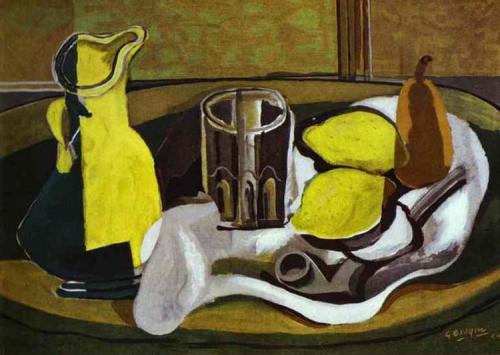
lemons-1929.jpg!Large.jpg

Lemons (1929)

Georges Braque

___________

watching one of my cooking competition
shows on television the other day, the
twelve contestants were called upon in
pairs to create, each couple, one of the
six elements in a degustation menu

a degustation menu – I raised an eyebrow
at that one – is the same as a tasting menu,
but at a finer, it is implied, restaurant

the theme was citrus fruit, each service
had to highlight one of them, a mandarin,
a lemon, an orange, a lime, a tangelo,
a grapefruit, in that order

my goodness, I thought, a set of
variations on edibles, I was delighted,
not to mention synesthetically
titillated, all my senses were alive

the first course was a mandarin-cured
prawn ceviche, with pesto, something
to tease one’s palate, leaving plenty of
room, however, for what was to follow,
the second course, an equally light
lemon-cured salmon with smoked
crème fraîche and decorative
translucent radish slices, in again but
polite allotments

the third service introduces the protein,
duck with the nearly ever requisite
orange, but with beets, in this instance,
on an underlying sheen of all their
accumulated and colourful juices,
bread, I would imagine, would’ve been
gluttonously required

beef then followed, to fill the second
of the more substantial and filling
elements of the meal, with a lime
reduction and beets

for dessert, the fifth service presented
a tangelo cup with a surprise chocolate
truffle meant to burst in one’s mouth
with iced tangelo flavour, refreshing
and unexpectedly delightful, followed
by a grapefruit sorbet with chocolate
ganache and meringue shards as a
finale

not all contestants reached the heights
wished for, but some were memorable,
much as in any set of, even noteworthy,
variations

here’s Glenn Gould playing Beethoven’s
Six Variations in F major, Opus 34, each
variation is comparable to a culinary
experience, but for piano

listen, compare

these are preceded here by a late, and
haunting, Beethoven bagatelle, his
Opus 126, however, after which the
variations themselves are conveniently
spliced in the editing process to help
distinguish each movement from the
other

Glenn Gould doesn’t hit a note wrong,
but I think Beethoven’s introductory
aria, upon which the variations are
built, and which is repeated at the end
after a coda, or final interpolated wave,
is slow, a more engaging opening
would’ve been, to my mind, more
effective

I also would’ve, however peripherally,
degusted especially the lime beef

R ! chard

psst: incidentally, all Bach’s Cello Suites
are in six segments, their common
theme is dance, each one is a
scintillating Baroque example
Chopin / Debussy – Preludes

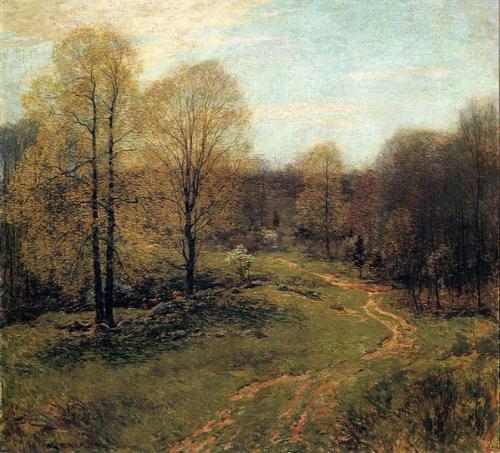
prelude.jpg!large

       “Prelude (1909) 


               Willard Metcalf


                         _________


what’s a prelude


something that, by definition, 

precedes something else


which it had been, formally, 

before Chopin made it stand 

alone as musical form, 

much, incidentally, as he 

later did the scherzo 


a prelude, earlier, had preceded

several other dance pieces in

suites, Bach’s Cello Suites, for 

example, all start with a

prelude


or fronted fugues, in, again,

notably, Bach’s celebrated 

Preludes and Fugues sets, 

more of which, for their 

complexity, later


here’s Chopin, however, with 

his array of 24, his Opus 28

one for each key, incidentally, 

much in the manner of Bach’s 

template pieces, the Preludes

and Fugues


here’s Debussy’s Book 1

picking it up for the 20th 

Century, with his tonally

indiscriminate 12 


what’s the difference


you tell me


R ! chard


psst: apples and oranges, I think,

          depends on my mood that 

          particular night, whether

          meditative or melancholy

French Suite no 3 in B minor – Bach

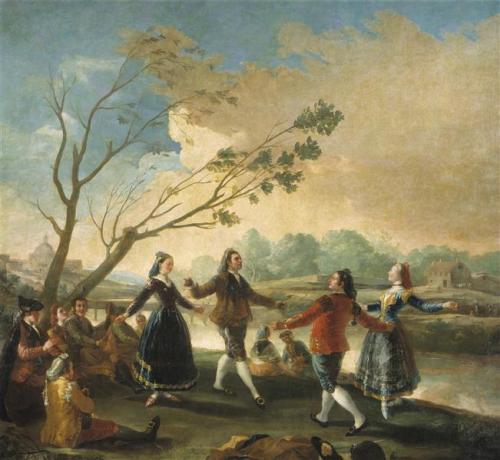
dance-of-the-majos-at-the-banks-of-manzanares-1777.jpg!Large.jpg

   “Dance of the Majos at the Banks of Manzanares (1777)

           Francisco Goya

                _________

upon reading up somewhat on the different
Bach Suites, I’ve provisionally concluded
that the earlier English Suites, 1715 to 1720,
were a modification of the established form 
of the suite, which would not have included 
a prelude, which isn’t, indeed, a dance

the Cello Suites follow, ahem, suit

but by the French Suites, 1722 to 1725, Bach 
is eschewing – Gesundheit – the prelude, but 
inserting, however, an air in his Fourth – an  
air is not either a dance – and mixing up  
their order in the later Suites, a minuet, for 
instance, in the last one of them, his Sixth,  
coming up after the gigue, which sports even
also a polonaise, where in his Fifth, Bach adds  
a loure, I ask you, a slow French gigue, to his  
bristling concoction

the terms French and English, incidentally, 
were added only after Bach’s demise, for 
diverse and uncorroborated reasons, so 
that these titles probably don’t mean much 
to a contemporary audience, who can’t tell, 
anyway, our gavottes from our bourrées

the music of Bach is like that of no other 
composer, he owns essentially the Baroque
Period, having, in fact, wrenched the Era 
from the painters, who’d established it in 
art to such a degree that it defined its
earlier historical phase

with Bach, the torch is handed over to 
music, from then on until the 
Impressionists, the period is defined 
by composers, both Classical, then 
Romantic, with some poets holding 
some sway 

the technique that dominates the music 
of Bach is that of counterpoint, where 
a tune is repeated in the harmonization
a few beats from its first iteration, 
vocally, we call that singing in canon

his music is introspective, as though 
the player were privately meditating,
it has the playfulness of Mozart, but
Mozart is expressive, not interior,
therefore nowhere near as spiritual,
Beethoven will return with a 
profundity that matches Bach’s, but 
with much more Sturm und Drang, 
tempestuous moral struggle, much  
less resignation, ouch, watch

listening to Bach for me is like getting 
on a train, and just letting the rhythm
of the wheels sustain me, as I watch,
indeed introspectively, the surrounding 
countryside, stopping at the musical 
journey’s several halts, its intervals, 
until its final destination, which 
despite, or even because of, taking 
sometimes hours, is nevertheless  
endlessly satisfying, and never  
ever less than, however improbably, 
inspiring

here’s Bach’s Third French Suite
you’ll note it includes an idiosyncratic 
“trio”, not strictly a recognized dance
either – leave it to the saucy French, I   
say, to consider interpolating a trio


R ! chard

English Suite No 3 in G Minor – Bach

suite-fibonacci-2003.jpg

   “Suite Fibonacci (2003) 

           Charles Bezie

               ________

 
before I say much more about his Cello
Suites, let me point out that Bach has
some French Suites, some English 
Suites, on top of similarly structured 
Partitas and Toccatas, the French have 
their tout de suites, and hotels have, 
nowadays, their so named luxury 
apartments 

musical suites are sets of dance pieces, 
by the early 18th Century much stylized, 
with an introductory prélude, an allemande, 
followed by a courante, which is to say, folk 
dances, the first German, the next French, 
then a sarabande, Spanish, followed by a 
couple of galanteries, court dances, 
minuets, gavottes, bourrées, then a final 
English gigue

all of the markings are in French, which
leads me to believe that all of these 
dances must’ve originated at the court 
of Louis XlVth, the Sun King, 1638 to 
1715

but the suggestion is that Europe was 
becoming an integrated community
all of these dances were eclipsed by
the Classical Period, of Haydn and 
Mozart, apart from the minuet, which 
more or less defined, nevertheless, 
that new era

the minuet will die out by the time of
Beethoven, you’ll note, to be replaced
by the waltz, which had been 
considered much too racy until 
transformed by Chopin into a work 
of ethereal art

the Strausses, father and son, gave it,
only a little later, celebratory potency,
but that’s another story


here’s Bach’s English Suite, the 3rd
for context, the French ones are a 
little too salty, as it were, they do not 
quite conform to prescribed suite 
notionshowever might their 
propositions have been, ahem, 
sweet 

meanwhile, enjoy this one


R ! chard

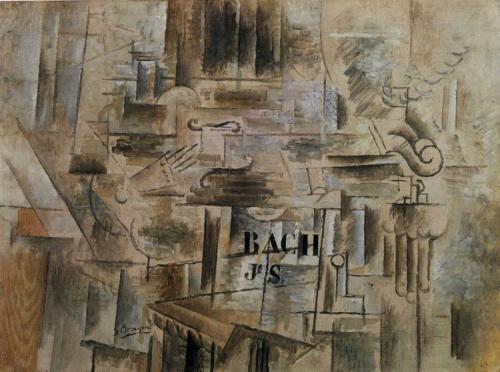
Cello Suite no 1, in G major – Bach

homage-to-j-s-bach-1912.jpg!Large

        “Homage to J.S. Bach (1912) 

              Georges Braque

                   __________

                                      for Lynne, who’s been catching up
                                                         on her Bach, recently
                                                                                   
the cello had been a peripheral instrument,
supplying accompaniment, merely, until 
Bach gave it wings, in new employ as 
Kapellmeister for Leopold, Prince of 
Anhalt-Cöthen, a Calvinist, who decried 
music in his churches, Bach turned to 
secular music mostly during this period,
instead of to the cantatas and oratorios,
the ecclesiastical stuff, he’d in earlier 
services been composing, not at all, 
however, unproductively, for he produced 
during this new period the template 
essentially for the entire modern epoch – 
the “Well-Tempered Klavier”, all of his 
piano literature, the Two- and Three-Part 
Inventions, his Toccatas, his Partitas, the 
sublime Cello Suites, his equally profoundly 
inspirational Sonatas for Unaccompanied 
Violin, are the basis upon which our 
contemporary music still stands, these 
pieces are still the Everests to climb for 
contemporary instrumentalists, you need 
only to listen to know why, by a semi-tone 
a cellist can fall apart, destroy the entire 
experience, distort an otherwise 
transcendental possibility, like a climber 
can tragically lose hir life

listen to Mischa Maisky, to my mind the 
very Zeus of 20th-Century cellists, 
perform Bach’s 1st Cello Suite, and
deliver incontrovertible proof of that,  
however Olympian, claim


R ! chard