Richibi’s Weblog

Just another WordPress.com weblog

Tag: Caspar David Friedrich

Piano Concerto no 1 in D minor, opus 15 – Brahms
the-wanderer-above-the-sea-of-fog.jpg!Large

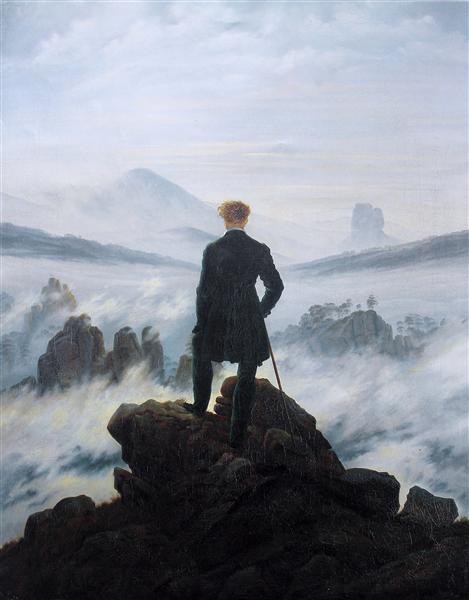
    “The Wanderer above the Sea of Fog (1818)

         Caspar David Friedrich

                  _____________

if Beethoven built the Church, along 
with Goethe maybe, of Romanticism, 
and be assured Romanticism is an 
ideology, a moral outlook, a 
motivational perspective, much like 
the economy is nowadays, 
supplanting any more humanistic 
imperatives, Brahms put up one of its 
Cathedrals, just listen, the First Piano
Concerto is a monument, as mighty 
as the Cologne Cathedral musically,
right next to Bonn, incidentally,  
Brahms‘ birthplace

with the disintegration of the 
supremacy of the Catholic deity 
at the onset of the Protestant 
Reformation, Luther, Calvin
Henry Vlll and all that, bolstered
by new discoveries in scientific
speculation, that the earth wasn’t 
flat, for instance, that it revolved 
around the sun rather than the 
other way around, contradictory, 
though convincing, voices began 
to abound, excite question  

in the 18th Century, the Age of 
Reason, the Christian Deity fell,
never effectively to be put back 
together again, see for Its final
sundering, Nietzsche

in France, after the Revolution
the Church was officially removed 
from political consideration, 
countermanding its centuries of 
morally heinous depredations, 
the United States had already at 
its own Revolution separated it 
from State  

Romanticism was an answer to 
a world wherein there might not 
be a God, a world with, however,  
a spiritual dimension, to respond 
to the clockwork universe 
envisioned by the earlier epoch,
the Enlightenmenta world where 
everything could be categorized,
analyzed, predicted

Romanticism called for the 
inclusion of inspiration in the mix,
there are more things in heaven 
and earth, Horatio, than are 
dreamt of in your philosophy, 
as Shakespeare would, for 
instance, have it – “Hamlet”,
1.5.167-8 
 
poets became prophets thereby, 
if they could manage it, very 
oracles, the world was blessed 
with, at that very moment, 
Beethoven, far outstripping the 
likes of, later, for example, Billy
Graham, or other such, however
galvanizing, proselytizers, 
whose messages would’ve been 
too, to my mind,  literal

for music cannot lie, obfuscate, 
prevaricate, music cannot be 
fake  

and then there was Schubert
and Chopin, TolstoyDickens
Elizabeth Barrett Browning
Roberther husband, 
TchaikovskyCaspar David
Friedrich, the Johann Strausses,  
ByronShelley, Keats, whose 
artworks, all, are as profoundly 
in our blood, our cultural system,
as, if not more so than, our 
present information about the 
details of our Christian myths, 
despite superfluity of them 
even, throughout the long 
indeed Middle Ages, and right 
up to, and including, the still 
fervent then Renaissancefor 
better or for worse still, for us

what Romanticism did, and 
specifically through the work 
of these seminal artists, was 
give each of us a chance, 
show us how to come 
through trial and tribulation,
what a faith does, any faith

it said, here, this is my dilemma, 
and this is how I deal with it

for me, Beethoven’s 32nd
Piano Sonata is, soundly, the 
epitome of that, but listen to 
Brahms put a stamp on it
with undaunted authority

we might be ultimately of no 
consequence in an indifferent 
universe, they say, but, hey, 
this is what we can do, and 
do gloriously, while we are 
at it

Woody Allen picks up the 
purpose in our own recent 
20th Century, following in 
the earnest footsteps of his 
Existential mentor, the much 
too dour, think, Ingmar 
Bergman  

but that’s another story
entirely 


meanwhile, listen

also watch, the conductor here
complete delight, is right out 
of Alice in Wonderland“, 
promise you’ll love it


R ! chard 

Clarinet Quintet in B minor, Op. 115 – Johannes Brahms

the-wanderer-above-the-sea-of-fog.jpg!Blog

    “The Wanderer above a Sea of Fog / 

            “Der Wanderer über dem Nebelmeer (1818)   

          Caspar David Friedrich

                     ___________

                              for Collin, who’ll appreciate
                                        especially, I’m sure, the 
                                             Chopin


while I’m on the subject of clarinet quintets,
since there are so few significant ones, let 
me pull Brahms’ out of my hat and celebrate 
it, a worthy challenge to Mozart’s own utter
masterpiece

but over a century has gone by, it’s 1891, 
Beethoven, the French Revolution, the 
Romantic Era is reaching its end, ceding 
to Impressionism, after the disruptions of 
rampant industrialization, and its 
consequent effects on the social contract

Marx has proposed a theoretical master 
plan to equitably protect the rest of us 
from the 1%, however too politically 
fraught, eventually, such a system – see
Communism

furthermore, Darwin had suggested that 
we weren’t all descended from Adam and 
Eve, but from larvae, which is to say, 
millennially morphed, modified, through
time, genetically, leading to festering still 
ideological  objections

Elizabeth Barrett Browning had written 
her unadulterated love poems to her 
husband, RobertCaspar David 
Friedrich had shown us his wanderer’s 
back while facing the mountainous 
challenges of the upcoming world, 
godless now after NietzscheAnna 
Karenina had thrown herself in front 
of a train, Madame Bovary had taken 
poison, and Ibsen‘s Nora had left her 
husband for a fraught, if not even 
dangerous, life on her own, to escape 
his safe but insufferable dominance, 
while Jane Eyre was finding ghosts
in her cobwebbed, and insufferable, 
to my mind, though admittedly  
aristocratic, attic 


you’ll note the clarinet is not sitting
centre stage, but has nevertheless 
a place at the table, by this time, 
though not not honoured, familiar,
and is more integrated to the 
conversation, the idea of democracy 
has taken hold, with everyone having
an equal, and even a vociferous, say

Brahms modelled his Clarinet Quintet,
on Mozart’s, the Classical structure is 
still the same, movements, tonality, 
musical recurrence, all to wonderful 
effect

that he would do that is not a given, 
but a tribute to the power of that form, 
take the waltz for instance, alive from 
even before Strauss, not to mention 
Chopin, to approximately the middle 
of the Twentieth Century

think about it, who waltzes anymore,
though they might’ve enchanted still, 
residually, the  50’s – see Patti Page
for instance – its lustre having 
dissipated, with the wind, as it were, 
the gust, before us, of the unending 
ages 


R ! chard

Evgeny Kissin – a bouquet of composers‏

midway in my considerations about music I
came to myself in a dark wood for the straight
way was lost, if I may paraphrase Dante for my
own purposes, I’d digressed to Elizabeth Barrett
Browning, Audrey Hepburnand others, and
forgot what I had been talking about with
respect to the development of music, but have
been wonderfully, and perhaps even karmically, 
put back on track by this correspondingly 
 
Evgeny Kissin had provided a resplendent
haven’t yet finished enjoying often, but
found among his other Internet offerings
 
 
at first I wondered about the Schubert/Liszt
connection in the written introduction to the
program, they’d been united by a forward
slash, implying that there’d been some kind
of cooperation, but I hadn’t ever heard of
those two ever meeting  
 
upon very little investigation however I found
out that Liszt had merely transcribed of course
some of the Schubert lieder, something which 
Liszt was wont to do, Liszt transcribed
everybody and everything, most famously all
of Beethoven’s symphonies, writing them
up for piano only, so that more remote areas
could also enjoy them, in often even there 
aristocratic salon settings
 
lieder are songs in German, a lied, a song,
works Schubert produced in astonishingly
great number
 
 
Liszt was paraphrasing Schubert for his own 
Lisztian purposes of course, artists do that, 
which is to say he was giving them much
more Lisztian fanfare and, not unwelcome,
I might add, extravagance, Schubert could
be pretty dry, I think, in his lieder,
uncharacteristically, even his fun ones, 
despite their being ever so eminently
 
 
und der Bach  from Die schöne Müllerin“, one
of his song cycles,Ständchen” from
Schwanengesang“, another cycle, Gretchen
 am Spinnrade“, and Erlkönigare all poems
of celebrated German poets Schubert set for
accompanied voice, and that Lizst, and Kissin,  
transform into something pretty special   
 
 
next on the program Schubert takes independent
flight with his wondrous “Wanderer” Fantasy,
opus 15, D760
 
 
a fantasy is not a sonata for having only one
movement, but note this fantasy goes through
all the motions of a sonata, fast, slow, fast, each
with its own structural contrasts, but without
any of the intervening pauses
 
so is a fantasy just a sonata without breaks, or is
a sonata just a fantasy with hiatuses, had the
sonata become a fantasy, had the fantasy
become a sonata, definitions were being
upended, then again that’s what revolutions
are about
 
before Beethoven this had been unheard of
when music hadn’t yet learned to actually talk,
mean something, Schubert, like Beethoven,
not only talks, not only narrates, as in for
 “Pastoral“,  nor either describes, as in
but actually speculates, ponders, moves 
metaphysically forward, in thrall to his
vagabond spirit much more than to his
wayward heart 
 
hence, incidentally, the more abstract, less
geographical, “Wanderer”, to compare with
for instance Liszt’s more panoramic
see also Caspar David Friedrich here for 
a close contemporary counterpart of his
in art
 
 
music has become no longer merely narration 
then but philosophy, it is finding its way like
the rest of us, and for the rest of us, to the
stars 
 
 
Bach then intervenes here with a Siciliana, a
Baroque composer in Kissin’s Romantic
clothing, but the shoe entirely fits, and
hauntingly, you’ll remember Bach was
composing for the harpsichord, which
had none of the piano’s resonance 
 
 
Brahms then returns us to a more abstruse
Romanticism, “7 Fantasies”, his opus 17,
pushes the limits of melodic continuity, you
can’t sing Brahms, you’re not even drawn to     
 
seven fantasies in one opus, incidentally,
suggests a sonata with seven movements,
with all of the permutations that have been  
suggested already for the fantasy I talked
about, it’s open season on sonatas, in
other words, and by extension their less
segmented fantasies  
 
it is the history of art 
 
 
the final piece is totally transcendent, some
incidental music from Glück, from his sublime
Orfeo ed Euridice“, one of my very favourite
operas, Orpheus approaches the Underworld
in order to retrieve his beloved bride, we are
about to enter the Elysian Fields, the actual,
original Champs Élysées, or Elysium, with
him, the moment is unforgettable
 
others have led us into the Underworld, most
notably Homer in the “Odyssey“, Virgil in the
Aeneid“, and of couse, somewhat more
recently but just, Dante in his Divine Comedy“,
even Bosch in his Garden of Earthly Delights”  
 
Glück is the one whose hereafter you won’t
not  remember  
 
 
Richard


“Man at the Window” – Gustave Caillebotte‏

             Man at the Window - Gustave Caillebotte

                                  “Man at the Window”  (1875)
 
                                            Gustave Caillebotte  

                                                                  __________ 
 
 
it’s hard not to think of Caspar David Friedrich (1818) or
Norman Rockwell (1962) upon viewing now this painting,
which came up today in a lecture I was viewing on the
Impressionist Gustave Caillebotte1848-1894, halfway
between both 
 
they are, all three of course, all about contemplation,
but all explore a different aspect of that phenomenon
 
let me suggest that Friedrich‘s concerns are patently
metaphysical, he casts his eyes, which we do not see,
incidentally, upon a horizon that looks like destiny,
ours by extension, murky yet imbued with possibility,
even the improbable
  
or maybe this is just what I see
 
 
Rockwell‘s perspective is instead aesthetic, a view
of the world as expressed by others, the capacity to
understand and relate to other voices, opinions, within 
our social construct, allegorized here by the exhibition
room
 
it is a closed speculation, circumscribed by the limited
dimensions, physical or conceptual, of any other
counterpart, contained therefore metaphorically, and
concisely, within a frame  
 
that frame represents the physical limits imposed on
a painter, but also the conceptual limitations of the
viewer him- or herself, it works both ways, for some
this will be a man merely looking out a window, for
others an opening on an epoch
  
 
Caillebotte1848-1894, looks inward to his isolation,
alienation, from his luxurious interior, black as a cave,
upon a confined avenue where nothing but an impossible
communication, with the lone woman crossing the
street, surely a furtive eye, gives way necessarily to
resignation, and a kind of existential yield to ineluctable
fate, a sensibility beginning to burgeon at the time, see
Nietzsche, 1844-1900, and nihilism  
 
then again this is only my impression, this is what I got
 
and a picture is worth, we say, a thousand words
 
 
Richard  


“The Connoiseur” – Norman Rockwell‏

The Connoiseur - Norman Rockwell

The Connoiseur (1962)

Norman Rockwell

____

serendipitously trolling Rockwells after sensing his spirit in a
poem I’d just been reading I happened upon this marvelous
piece, an homage of course to Jackson Pollock, perhaps the
most successful of the Abstract Expressionists

but lurking behind the obvious surface of this painting it was
easy to recognize also another glaring, though not as explicit
maybe, tribute, misted perhaps by the transformational
permutations of context and time, wherein a seed becomes
a tree, a caterpillar becomes a butterfly, to no less an iconic
masterpiece than Caspar David Friedrich‘s Wanderer Above
a Sea of Fog
“,
the work we just, a blog or so ago, explored

both look upon their own idea of a new horizon

and a Pop Art stab at an Abstract Expressionist through a
High Romantic is a cute trick, witty, wonderful, wise

it’s an easy step to a literary counterpart from there, Keats’
On First Looking into Chapman’s Homer nearly automatically
comes to mind, another iconic Romantic new dawn

Much have I travell’d in the realms of gold,
And many goodly states and kingdoms seen;
Round many western islands have I been
Which bards in fealty to Apollo hold.
Oft of one wide expanse had I been told
That deep-brow’d Homer ruled as his demesne;
Yet did I never breathe its pure serene
Till I heard Chapman speak out loud and bold:
Then felt I like some watcher of the skies
When a new planet swims into his ken;
Or like stout Cortez when with eagle eyes
He star’d at the Pacific—and all his men
Look’d at each other with a wild surmise—
Silent, upon a peak in Darien.

Beethoven, were I to go to music, is always, especially in his
later works, contemplating new dimensions, new worlds, he
more than any other composer is a metaphysical explorer

maybe also Pink Floyd

who’ve taken me to their own also exalted musical galaxies,
awesome commanding perspectives, transcendental heights,
to my own “wild” indeed “surmise / Silent, upon a peak in”
my version of “Darien”

Richard

psst: Chapman’s “Homer”

“Wanderer Above a Sea of Fog” – Caspar David Friedrich


                                   “Wanderer Above a Sea of Fog”  (1818)  
 
                                              Caspar David Friedrich
 
 
                                                     __________ 


upon further reflection I realized that the painting above had also “the same power, the same clarity and precision” to describe the Romantic Era as the first chord of Beethoven’s “Pathétique” Sonata, it is an equally powerful representation of the spirit of that highly introspective time
 
the Romantic Epoch championed nature, patriotism on the political heels of the French Revolution – and explorations of the soul, following the latter’s calls to liberty, equality, fraternity, the natural groundwork for what followed, our own period of reverence for human rights
 
we look with Caspar David Friedrich here upon a nebulous perspective, onto daunting horizons, reflecting, with him, through the painter’s psychological ingenuity and art, upon our own daunting choices, our own murky landscapes, our own obscure and imposing destinies, both physical and philosophical, a profoundly Romantic conception 
 
it was a time when the heart and its irreverent passions took centre stage, stood, in all its permutations, under the light
 
 
please excuse my egregious oversight
 
and of also the inspired Caspar David Friedrich I’ve begged pardon, expressed my heartfelt, humble compunction, and regret, for a not insignificant slight  
 
 
cheers
 
Richard