Richibi’s Weblog

Just another WordPress.com weblog

Tag: Calisto / nymph

“The Mariners transform’d to Dolphins” – Ovid
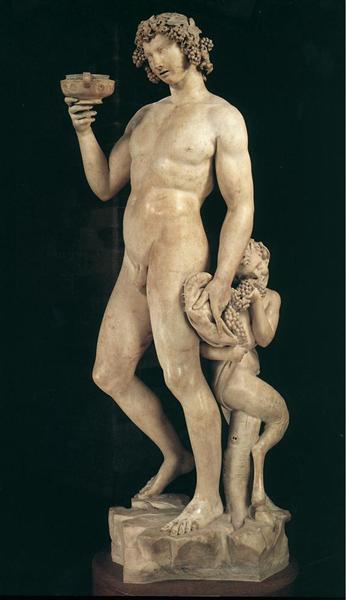
Bacchus, 1497 - Michelangelo

        Bacchus” (1497)


            Michelangelo


                   _______   


             Him Pentheus view’d with fury in his look,


Pentheus, king of Thebes, if you’ll

remember, after Cadmus, his

grandfather, founder of Thebes


viewed, scanned, surveyed


             And scarce with-held his hands, whilst thus he spoke:


with-held, withheld


             “Vile slave! whom speedy vengeance shall pursue,
             And terrify thy base seditious crew:


Vile slave, the zealous votary from

the last instalment, follower, acolyte

of Bacchus / Dionysus, who’d been

captured by Pentheus’ men instead

of the god himself


by exacting a speedy vengeance on

this [v]ile slave, Pentheus expects

to terrify the remaining elements of

the offending crew, the seditious

party of Bacchus / Dionysus


             Thy country and thy parentage reveal,
             And, why thou joinest in these mad Orgies, tell.”


where are you from, what are you

doing here, Pentheus asks


             The captive views him with undaunted eyes,
             And, arm’d with inward innocence, replies,

             “From high Meonia’s rocky shores I came,
             Of poor descent, Acoetes is my name:
             My sire was meanly born; no oxen plow’d
             His fruitful fields, nor in his pastures low’d.

meanly, poor, without adequate

means


plow’d, low’d, an interesting

rhyme, they’re called forced

or oblique rhymes


             His whole estate within the waters lay;


estate, livelihood, Acoetes‘ father,

his sire, was a fisherman


             With lines and hooks he caught the finny prey,


finny, having fins


             His art was all his livelyhood; which he
             Thus with his dying lips bequeath’d to me:


His art, the quality of his work


             In streams, my boy, and rivers take thy chance;
             There swims, said he, thy whole inheritance.


Acoetes will inherit at best his

father’s skill


             Long did I live on this poor legacy;
             ‘Till tir’d with rocks, and my old native sky,


that of Meonia, see above


             To arts of navigation I inclin’d;


arts of navigation, knowledge of

the open sea, the wider oceans


             Observ’d the turns and changes of the wind,
             Learn’d the fit havens, and began to note
             The stormy Hyades, the rainy Goat,
             The bright Taygete, and the shining Bears,
             With all the sailor’s catalogue of stars.


Hyadesa cluster of stars, with their

own mythic origin story, grieving

nymphs cast upon the heavens,

augurs of rain,hence stormy


the rainy Goat, Capricornus, the

constellation


Taygete, a satellite of the planet

Jupiter

the shining Bears, Ursa Major

and Ursa Minor, or the Great

and the Little Bear, whose

origins you might remember

from The Story of Calisto


             “Once, as by chance for Delos I design’d,


Delos, a Greek island


design’d, planned as a destination


             My vessel, driv’n by a strong gust of wind,
             Moor’d in a Chian Creek; a-shore I went,


Chian, of Chios, a Greek island


             And all the following night in Chios spent.
             When morning rose, I sent my mates to bring
             Supplies of water from a neighb’ring spring,
             Whilst I the motion of the winds explor’d;
             Then summon’d in my crew, and went aboard.
             Opheltes heard my summons,


Opheltes, a confederate apparently


                                                                and with joy
             Brought to the shore a soft and lovely boy,
             With more than female sweetness in his look,


hmmmm


             Whom straggling in the neighb’ring fields he took.


he took, he apprehended


             With fumes of wine the little captive glows,
             And nods with sleep, and staggers as he goes.

             “I view’d him nicely, and began to trace
             Each heav’nly feature, each immortal grace,
             And saw divinity in all his face,
             I know not who, said I, this God should be;
             But that he is a God I plainly see:
             And thou, who-e’er thou art, excuse the force
             These men have us’d; and oh befriend our course!

befriend, accord it your sympathy

             Pray not for us, the nimble Dictys cry’d, 
Dictys, one of Acoetes‘ shipmates


             Dictys, that could the main-top mast bestride,
             And down the ropes with active vigour slide.
             To the same purpose old Epopeus spoke,


Epopeus, another sailor


             Who over-look’d the oars, and tim’d the stroke;
             The same the pilot, and the same the rest;
             Such impious avarice their souls possest.


all countermanding Acoetes‘, however

discerning, assessment


             Nay, Heav’n forbid that I should bear away
             Within my vessel so divine a prey,
             Said I; and stood to hinder their intent:


Acoetes had no intention of confining

this so divine a prey to his ship


             When Lycabas, a wretch for murder sent
             From Tuscany, to suffer banishment,
             With his clench’d fist had struck me over-board,
             Had not my hands in falling grasp’d a cord.


Lycabas, a third shipmate


Tuscany, a region of what is now

central Italy


it appears, however, that Acoetes

lived to tell the tale


stay tuned


R ! chard

“The Transformation of Actaeon into a Stag” (ll) – Ovid

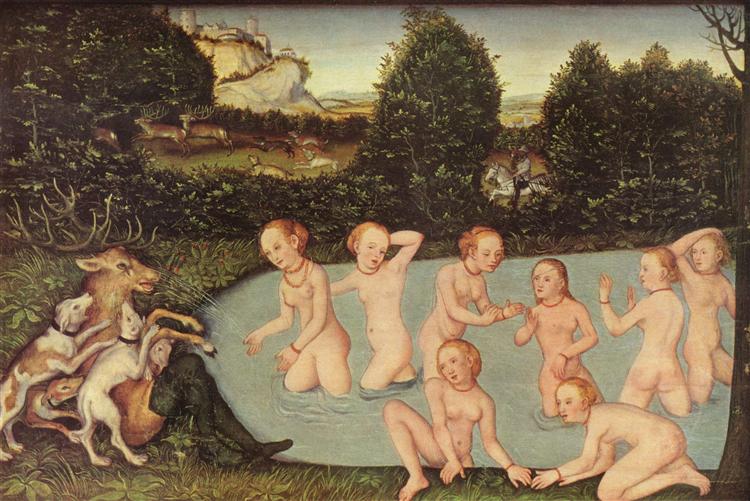
Diana and Actaeon, c.1518 - Lucas Cranach the Elder

          Diana and Actaeon

                 Lucas Cranach the Elder

                                   ____________


               Now all undrest the shining Goddess stood,
               When young Actaeon, wilder’d in the wood,


wilder’d in the wood, wandered

in the wild, in the forest


               To the cool grott by his hard fate betray’d,


grott, grotto


betray’d, treacherously confronted,

his hard fate would not be on his

side for this one


               The fountains fill’d with naked nymphs survey’d.


survey’d, observed, espied,

considered, contemplated


               The frighted virgins shriek’d at the surprize

               (The forest echo’d with their piercing cries).


listen, you can hear it


               Then in a huddle round their Goddess prest:
               She, proudly eminent above the rest,
               With blushes glow’d; such blushes as adorn
               The ruddy welkin, or the purple morn;


ruddy welkin, red sky, as at sunset


               And tho’ the crowding nymphs her body hide,
               Half backward shrunk, and view’d him from a side.
               Surpriz’d, at first she would have snatch’d her bow,
               But sees the circling waters round her flow;
               These in the hollow of her hand she took,
               And dash’d ’em in his face, while thus she spoke:


These, ’em, the circling waters


               “Tell, if thou can’st, the wond’rous sight disclos’d,
               A Goddess naked to thy view expos’d.”


not a warning here, but a curse, if thou

can’st being the operative expression,

for Actaeon, now in the process of

transformation, will no longer be able

to utter words


               This said, the man begun to disappear
               By slow degrees, and ended in a deer.


begun, began


               A rising horn on either brow he wears,
               And stretches out his neck, and pricks his ears;
               Rough is his skin, with sudden hairs o’er-grown,
               His bosom pants with fears before unknown:


the skittishness of a deer


               Transform’d at length, he flies away in haste,
               And wonders why he flies away so fast.


how did I do that, Actaeon wonders


               But as by chance, within a neighb’ring brook,
               He saw his branching horns and alter’d look.


his reflection, however by chance,

however inadvertently, in the water, 

the neighb’ring brook, reveals to him

his transformation, his metamorphosis


               Wretched Actaeon! in a doleful tone
               He try’d to speak, but only gave a groan;
               And as he wept, within the watry glass


the watry glass, the mirroring rivulet,

rill, waterway, brook


               He saw the big round drops, with silent pace,
               Run trickling down a savage hairy face.


the association with Bambi here for

me is inescapable, however grim

might be later Actaeon’s own fate


               What should he do? Or seek his old abodes,
               Or herd among the deer, and sculk in woods!
               Here shame dissuades him, there his fear prevails,
               And each by turns his aking heart assails.


something like the onset of puberty,

I think, that frightful fundamental

biological transformation, the fear,

the shame, remember


compare Calisto pregnant before the

very same goddess, Diana / Artemis

incidentally, the evidently unforgiving

deity before anything but unsullied

modesty, before uncompromised

chastity, who’s presently, consider,

condemning Actaeon


               As he thus ponders, he behind him spies
               His op’ning hounds, and now he hears their cries:


op’ning, advancing


               A gen’rous pack, or to maintain the chace,

               Or snuff the vapour from the scented grass.


or to … Or, either to … Or


maintain the chace … snuff the vapour,

dogs doing what dogs do


               He bounded off with fear, and swiftly ran
               O’er craggy mountains, and the flow’ry plain;
               Through brakes and thickets forc’d his way, and flew
               Through many a ring, where once he did pursue.


brakes, bracken, brush


a ring, a territory, a circumscribed

area


where once he did pursue, Actaeon

had earlier been not the hunted, but

the hunter


               In vain he oft endeavour’d to proclaim
               His new misfortune, and to tell his name;
               Nor voice nor words the brutal tongue supplies;


“Tell, if thou can’st, Diana / Artemis

had warned, and now [n]or voice

nor words the brutal tongue supplies,

allows, Actaeon, to speak


               From shouting men, and horns, and dogs he flies,

               Deafen’d and stunn’d with their promiscuous cries.


promiscuous, unleashed,

unconstrained


               When now the fleetest of the pack, that prest
               Close at his heels, and sprung before the rest,
               Had fasten’d on him, straight another pair,
               Hung on his wounded haunch, and held him there,
               ‘Till all the pack came up, and ev’ry hound
               Tore the sad huntsman grov’ling on the ground,
               Who now appear’d but one continu’d wound.


the attack


               With dropping tears his bitter fate he moans,
               And fills the mountain with his dying groans.
               His servants with a piteous look he spies,
               And turns about his supplicating eyes.


His servants, the jolly huntsmen, the

friends he’d advised to [t]ake the cool

morning to renew the chace


               His servants, ignorant of what had chanc’d,


what had chanc’d, the transformation,

the metamorphosis, Actaeon become

a stag


               With eager haste and joyful shouts advanc’d,
               And call’d their lord Actaeon to the game.


Actaeon seemed to them not there,

absent


               He shook his head in answer to the name;


he couldn’t speak, could only [shake]

his head


               He heard, but wish’d he had indeed been gone,


gone, away, in another place, as [h]is

servants thought him to be


               Or only to have stood a looker-on.


a looker-on, observing rather than

having been the centre, the subject

of the situation


               But to his grief he finds himself too near,


too near, indeed present, central,

in the very thick of the fray


               And feels his rav’nous dogs with fury tear
               Their wretched master panting in a deer.


Actaeon doesn’t survive this

transformation, nor is he

transmuted, like so many others

who’d displeased the gods, into 

sets of stars, or constellations


a recurring theme seems to be,

as the poem advances, how

arbitrary the fate of humans is

in the hands of the, apparently

capricious, gods


to follow


R ! chard