Richibi’s Weblog

Just another WordPress.com weblog

Tag: caduceus

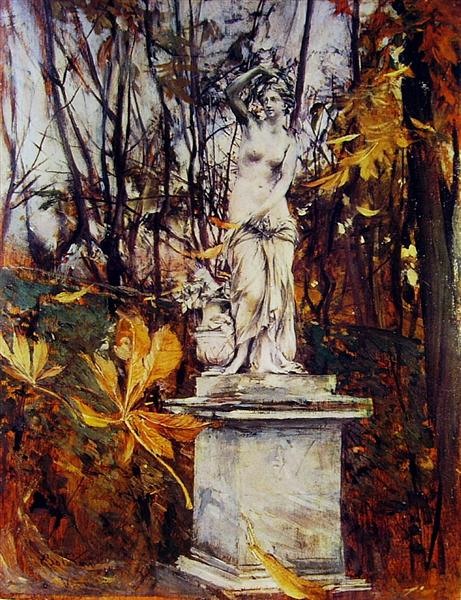
“The Story of Aglauros, transform’d into a Statue” (lV) – Ovid

statue-in-the-park-of-versailles.jpg!Large

       Statue in the Park of Versailles


                   Giovanni Boldini


                             ________


Envy, at the instigation of Minerva,

has flown towards the site of her

commissioned mischief, to hex

Aglauros, who’s miffed her


            When Athens she beheld, for arts renown’d,

            With peace made happy, and with plenty crown’d,


Athens, its glories, architectural,

literary, political, philosophical, would

have been impressive still, despite its

intervening decline, to the mind of a

Roman poet of the later First Century,

compare, say, a contemporary poet’s

evaluation of Great Britain’s grandeur

during its 19th Century supremacy, or

of the United States’ promise before

its late-20th-Century deterioration


            Scarce could the hideous fiend from tears forbear,

            To find out nothing that deserv’d a tear.


Envy, the hideous fiend, was upset

because she couldn’t find anything

to cry about, anything that deserv’d

a tear


            Th’ apartment now she enter’d, where at rest

            Aglauros lay, with gentle sleep opprest.


with gentle sleep opprest seems

to me oxymoronic, conflicting

definitions, how could a gentle

sleep oppress, but let’s continue


            To execute Minerva’s dire command,

            She stroak’d the virgin with her canker’d hand,

            Then prickly thorns into her breast convey’d,

            That stung to madness the devoted maid:

            Her subtle venom still improves the smart,


improves the smart, accentuates

the sudden pain


            Frets in the blood, and festers in the heart.


Frets in, unsettles, the blood, festers,

rots , becomes cankerous, in the heart.


            To make the work more sure, a scene she drew,

            And plac’d before the dreaming virgin’s view

            Her sister’s marriage, and her glorious fate:

            Th’ imaginary bride appears in state;

            The bride-groom with unwonted beauty glows:

            For envy magnifies what-e’er she shows.


Aglauros is not only struck with

subtle venom, but subjected to

psychological manipulation, if

you’ll excuse the reference to

modern analytical methods, is

made to see [h]er sister’s

marriage, Herse‘s, as well as 

her glorious fate


For envy magnifies what-e’er

she shows, an observation

worth remembering


            Full of the dream, Aglauros pin’d away

            In tears all night, in darkness all the day;


the dream, though Envy might’ve

envenomed Aglauros in her sleep,

the unwanted vision continues to

plague her throughout the following

days, and nights


            Consum’d like ice, that just begins to run,

            When feebly smitten by the distant sun;

            Or like unwholsome weeds, that set on fire

            Are slowly wasted, and in smoke expire.


the slow torture in the mind of

rancour there eating away at

the psyche


            Giv’n up to envy (for in ev’ry thought

            The thorns, the venom, and the vision wrought)


The thorns, the venom, and the vision,

all three, wrought, writhing, smouldering,

in ev’ry thought


            Oft did she call on death, as oft decreed,


decreed, resolved


            Rather than see her sister’s wish succeed,

            To tell her awfull father what had past:


her awfull father, Cecrops l, founder

and first king of Athens, according to

myth


awfull, as in inspiring awe, reverence


            At length before the door her self she cast;


the door, of her chamber, where the

God Hermes / Mercury had asked

Aglauros to speak in his favour to

her sister, Herse, whom he had

wanted, if you’ll remember, to woo


cast, set herself up awaiting the

God’s return


            And, sitting on the ground with sullen pride,

            A passage to the love-sick God deny’d.


Aglauros denies the God his wish,

she will not praise him to her sister


            The God caress’d, and for admission pray’d,

            And sooth’d in softest words th’ envenom’d maid.


caress’d, used endearing words


            In vain he sooth’d: “Begone!” the maid replies,

            “Or here I keep my seat, and never rise.”


I’ll stay here till you leave, Aglauros

tells Hermes / Mercury


            “Then keep thy seat for ever,” cries the God,


the impudence of vying with a god

has its consequences


            And touch’d the door, wide op’ning to his rod.


his rod, his caduceus, his winged

staff


            Fain would she rise, and stop him,


Fain,willingly


                                                             but she found

            Her trunk too heavy to forsake the ground;

            Her joynts are all benum’d, her hands are pale,

            And marble now appears in ev’ry nail.

            As when a cancer in the body feeds,

            And gradual death from limb to limb proceeds;

            So does the chilness to each vital parte

            Spread by degrees, and creeps into her heart;

            ‘Till hard’ning ev’ry where, and speechless grown,

            She sits unmov’d, and freezes to a stone.


Aglauros has become of stone,

a statue


            But still her envious hue and sullen mien

            Are in the sedentary figure seen.


still, though Aglauros might’ve been

rendered inanimate, it’s interesting

to note that she’s nevertheless

become immortal, immortalized


see, for instance, above


R ! chard

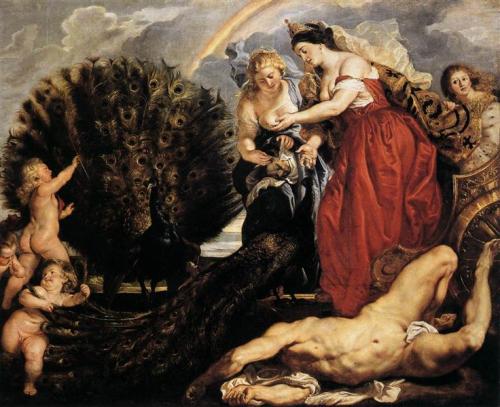
“The Eyes of Argus transform’d into a Peacock’s Train” – Ovid

juno-and-argus.jpg!Large

    Juno and Argus (c.1611) 


           Peter Paul Rubens


                         ______


                  While Hermes pip’d, and sung, and told his tale,
                  The keeper’s winking eyes began to fail, 


The keeper, Argus, of Io, nymph

become heifer


                  And drowsie slumber on the lids to creep; 
                  ‘Till all the watchman was at length asleep. 


all the watchman, all of Argus‘ eyes, 

were closed, asleep, at length, after 

a time 


                  Then soon the God his voice, and song supprest; 


the God, Hermes, messenger of the

gods, on a mission from Jove / 

Jupiter / Zeus to save Io, nymph 

become heifer


his voice, and song supprest, Hermes 

stopped talking, stopped playing his

song, his music


                  And with his pow’rful rod confirm’d his rest: 


his powerful rod, the caduceus, with

which Hermes could both waken those

asleep as well lull the wakeful to

slumber


                  Without delay his crooked faulchion drew, 


faulchion, now spelled falchion, 

is a short sword with only one 

sharp edge, a sort of sickle


since falchions go back only to the 

13th Century, Dryden‘s translation 

from the Latin has to be an 

anachronism


just saying


                  And at one fatal stroke the keeper slew.
                  Down from the rock fell the dissever’d head,
                  Opening its eyes in death; and falling, bled;
                  And mark’d the passage with a crimson trail:
                  Thus Argus lies in pieces, cold, and pale;
                  And all his hundred eyes, with all their light,
                  Are clos’d at once, in one perpetual night.
                  These Juno takes, that they no more may fail,
                  And spreads them in her peacock’s gaudy tail. 


see above


Juno, wife of Jove / Jupiter / Zeus,
queen, therefore, of the gods and 

goddesses


                  Impatient to revenge her injur’d bed, 


Juno had been offended by the fact 

that Jove / Jupiter / Zeus had

transgressed 


                  She wreaks her anger on her rival’s head; 


her rival, Io


                  With Furies frights her from her native home; 


Furies, also known as Erinyes

goddesses of vengeance, the 

oldest of all the deities, they live 

in Erebus, the Underworld, look 

frightful, snakes in their hair, bat’s 

wings, and haunt, unsettle, the 

disrespectful, the insolent, those 

who betray, are not true to, their 

word 


frights, frightens


                  And drives her gadding, round the world to roam: 


her, Io, nymph become heifer


to gad, to wander


                  Nor ceas’d her madness, and her flight, before
                  She touch’d the limits of the Pharian shore. 


Pharian, relating to Pharos, island off 

the coast of Alexandria, notable for 

its lighthouse, itself called Pharos

one of the Seven Wonders of the 

Ancient World


                  At length, arriving on the banks of Nile,
                  Wearied with length of ways, and worn with toil,
                  She laid her down; 


She laid her down, she laid herself 

down, stopped, stayed in place


                                                 and leaning on her knees,
                  Invok’d the cause of all her miseries: 


the cause of all her miseries, Jove /

Jupiter / Zeus, who’d abandoned 

her, Io, to the wrath of Juno, his 

wife, when she’d discovered him 

to be unfaithful 


                  And cast her languishing regards above,
                  For help from Heav’n, and her ungrateful Jove.
                  She sigh’d, she wept, she low’d; ’twas all she cou’d;
                  And with unkindness seem’d to tax the God. 


to tax, to accuse, to make 

responsible for


                  Last, with an humble pray’r, she beg’d repose,
                  Or death at least, to finish all her woes. 


repose, relief, Io, nymph become 

heifer, has completely had it


                  Jove heard her vows, and with a flatt’ring look,
                  In her behalf to jealous Juno spoke, 


a flatt’ring look, a seductive approach,

toward Juno, his reproachful wife


                  He cast his arms about her neck, and said,
                  Dame, rest secure; no more thy nuptial bed
                  This nymph shall violate; 


Dame, or Madam


                                                       by Styx I swear, 


Styx, one of the five rivers that 

separate Earth from the 

Underworld, also one of the 

earliest goddesses, after whom

the river itself was named, who 

had, significantly, sided with Jove /

Jupiter / Zeus during the Giants’ 

War, for which, upon having won, 

Jove / Jupiter / Zeus ordained that 

all oaths be sworn upon her, Styx

much as we, in our own day, swear 

upon Bibles


this all precedes, note, Bibles


                  And every oath that binds the Thunderer. 


the Thunderer, Jove / Jupiter, Zeus,

god, indeed, of Thunder


                  The Goddess was appeas’d;  


The Goddess, Juno


                                                       and at the word
                  Was Io to her former shape restor’d.
                  The rugged hair began to fall away;
                  The sweetness of her eyes did only stay,
                  Tho’ not so large; her crooked horns decrease;
                  The wideness of her jaws and nostrils cease:
                  Her hoofs to hands return, in little space: 


little space, the blink of an eye


                  The five long taper fingers take their place,
                  And nothing of the heyfer now is seen,
                  Beside the native whiteness of the skin.
                  Erected on her feet she walks again:
                  And two the duty of the four sustain. 


rather than walk on four feet, Io

now stands erect, [e]rected, on 

two


                  She tries her tongue; her silence softly breaks,
                  And fears her former lowings when she speaks: 


she can hardly believe she’s  

become, not just a nymph,

but indeed 


                  A Goddess now, through all th’ Aegyptian State:
                  And serv’d by priests, who in white linnen wait. 


Io has become the Egyptian 

goddess Isis


but that’s an entirely other story 


stay tuned


R ! chard


“The Transformation of Io into a Heyfer” (V) – Ovid

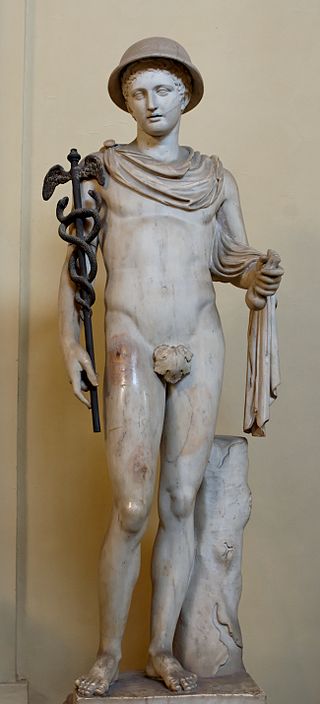
320px-Statue_Hermes_Chiaramonti

     Statue of Hermes (Vatican Museums)

                     ___________________

though Io might still have been “not

out of the woods”, when last we saw 

her, there remained nevertheless 

her original suitor, Jove, god of gods


                 Now Jove no longer cou’d her suff’rings bear;
                 But call’d in haste his airy messenger,
                 The son of Maia, with severe decree
                 To kill the keeper, and to set her free.  
 

The son of Maia, Hermes, messenger

of the gods


Maia, one of the Pleiadesplaymates

of Artemisgoddess of the Hunt,

daughters, also, of Atlasfamously 

condemned, he, to hold up the

heavens for eternity


                 With all his harness soon the God was sped, 
 

Hermes, no sooner equipped,

[w]ith all his harness, livery,

attire, was sped, got under

way


                 His flying hat was fastned on his head,
                 Wings on his heels were hung, and in his hand
                 He holds the vertue of the snaky wand. 
 

vertue, virtue, but having retained, 

still in 1717, its root, vertu, French 

for virtue, benefit 


Hermes is usually shown wearing

[h]is flying hat, [w]ings on his heels,

a snaky wand, identifying accessories


snaky wand, his caduceus


see above


                 The liquid air his moving pinions wound, 


pinions, the feathers of a bird’s wing


wound, to injure, but also to wrap 

around, according to its two 

differing pronunciations


                 And, in the moment, shoot him on the ground.


to rhyme with wound, note


Hermes has landed, but apparently

uncomfortably


                 Before he came in sight, the crafty God
                 His wings dismiss’d, but still retain’d his rod: 


dismiss’d, put aside, made invisible,

[h]is wings


                 That sleep-procuring wand wise Hermes took,
                 But made it seem to sight a sherpherd’s hook. 


though Hermes kept his rod, he made

it look, seem to sight, like a shepherd’s 

staff, hook


                 With this, he did a herd of goats controul;  


controul, control


                 Which by the way he met, and slily stole. 


by the way, as he walked along


slily stole, deities make up their

own rules


                 Clad like a country swain, he pip’d, and sung;
                 And playing, drove his jolly troop along. 


swain, young man


                 With pleasure, Argus the musician heeds; 


Argus heeds the musician, again

an inverted sentence, in order to 

rhyme with


                 But wonders much at those new vocal reeds. 


vocal reeds suggests Pan pipes

here, a wind instrument consisting 

of several tubes of increasing length 

placed side by side, where the piper 

creates the melody by moving his 

lips, her lips, from embouchure to 

embouchure, the openings through 

which to blow


               And whosoe’er thou art, my friend, said he,
               Up hither drive thy goats, and play by me: 


Argus asks Hermes to stay, drive thy 

goats away, [u]p hither, he directs, 

and play thy instrument, keep him 

company


                 This hill has browz for them, and shade for thee. 


browz, browse, matter, twigs, shoots,

upon which goats might graze


                 The God, who was with ease induc’d to climb,  


to climb, [u]p hither, in order to drive

the goats 

                Began discourse to pass away the time;
                 And still betwixt, his tuneful pipe he plies;   


betwixt, meanwhile


plies, continues


                 And watch’d his hour, to close the keeper’s eyes.


his hour, his opportune moment  


the keeper, Argus, over Io


                 With much ado, he partly kept awake; 


the calming effect of the Pan pipes

was making it hard, much ado, for

Argus to stay awake 


                 Not suff’ring all his eyes repose to take: 


never allowing, suff’ring, all his eyes 

to close, repose to take, at the same

time


                 And ask’d the stranger, who did reeds invent,
                 And whence began so rare an instrument? 


how do you do that, Argus asks,

which leads to an interpolated story,

wherein Hermes, before we learn

much more about Io, answers the 

questions 


stay tuned


R ! chard