Just another WordPress.com weblog
Tag: Cadmus – brother of Europa / son of Agenor
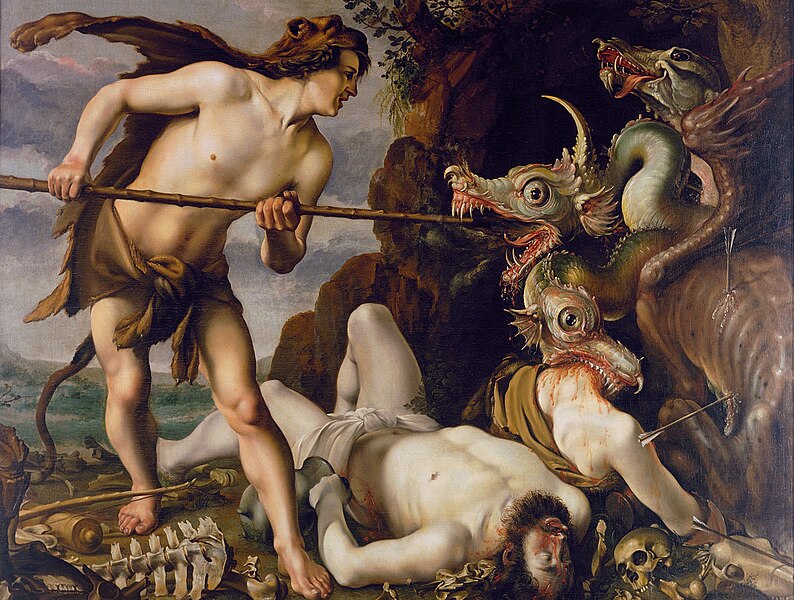
__________ And now the scorching sun was mounted high, In all its lustre, to the noon-day sky; When, anxious for his friends, and fill’d with cares, To search the woods th’ impatient chief prepares. th’ impatient chief, Cadmus , prince ofTyre , had sen[t] his servants to a neighb’ring grove / F or l iving streams, to thank that god for these new A lion’s hide around his loins he wore, The well poiz’d javelin to the field he bore, Inur’d to blood; the far-destroying dart; And, the best weapon, an undaunted heart. Cadmus here is a precursor of the mythologically later Heracles , orHerakles, or Hercules in Latin, a hero , which is to say descended from the gods, in that latter’s case, very deity who’d just abducted of all Europeans, divine or human Soon as the youth approach’d the fatal place, He saw his servants breathless on the grass; breathless, not breathing,deceased The scaly foe amid their corps he view’d, Basking at ease, and feasting in their blood. The scaly foe, the dragon corps, corpses “Such friends,” he cries, “deserv’d a longer date; a longer date, a longer life, a more extended period of existence But Cadmus will revenge or share their fate.” either [t]he scaly foe will die, the dragon, or Cadmus attempt to avenge his friends, his servants breathless on the grass, he promises Then heav’d a stone, and rising to the throw, He sent it in a whirlwind at the foe: in a whirlwind, taking advantage of a meteorological condition, as one would a kite A tow’r, assaulted by so rude a stroke, With all its lofty battlements had shook; a tower would’ve swayed at so powerful a strike, I rememberan earthquake once rocking my own high rise apartment building for an unnerving moment before settling, returning the ground, my ground, to its, otherwise imperturbable, placidity But nothing here th’ unwieldy rock avails, Rebounding harmless from the plaited scales, That, firmly join’d, preserv’d him from a wound, With native armour crusted all around. native, integral, a constituentpart of With more success, the dart unerring flew, the dart, the javelin Which at his back the raging warriour threw; the raging warriour, Cadmus Amid the plaited scales it took its course, And in the spinal marrow spent its force. The monster hiss’d aloud, and rag’d in vain, And writh’d his body to and fro with pain; He bit the dart, and wrench’d the wood away; The point still buried in the marrow lay. And now his rage, increasing with his pain, Reddens his eyes, and beats in ev’ry vein; Churn’d in his teeth the foamy venom rose, Whilst from his mouth a blast of vapours flows, Such as th’ infernal Stygian waters cast. forms the boundary between the river also, which encircled the entire world The plants around him wither in the blast. Now in a maze of rings he lies enrowl’d, enrowl’d, encircled, surrounded Now all unravel’d, and without a fold; without a fold, an intervening obstacle Now, like a torrent, with a mighty force Bears down the forest in his boist’rous course. Bears down the forest, like a torrent, against the wall oftrees Cadmus gave back, and on the lion’s spoil Sustain’d the shock, then forc’d him to recoil; gave back, drew back, backed away, forc’d … to recoil the lion’s spoil, the dragon’s venom and its gore The pointed jav’lin warded off his rage: the dragon readies for the onslaught, overcoming his, otherwise consuming rage, at the sight of [ t]he pointed jav’lin Mad with his pains, and furious to engage, The serpent champs the steel, and bites the spear, Till blood and venom all the point besmear. But still the hurt he yet receiv’d was slight; For, whilst the champion with redoubled might Strikes home the jav’lin, his retiring foe Shrinks from the wound, and disappoints the blow. the jav’lin is still no match for the, however wounded, dragon The dauntless heroe still pursues his stroke, And presses forward, ’till a knotty oak Retards his foe, and stops him in the rear; retards, stops, inhibits Full in his throat he plung’d the fatal spear, That in th’ extended neck a passage found, And pierc’d the solid timber through the wound. the fatal spear has pierc’d not only th’ extended neck, but alsothe knotty oak behind it, which had prevented the dragon from moving onward toward his escape Fix’d to the reeling trunk, with many a stroke Of his huge tail he lash’d the sturdy oak; ‘ Till spent with toil, and lab’ring hard for breath, He now lay twisting in the pangs of death. ding dong, the dragon is, if not dead, dying stay tuned R ! chard
_______ Cadmus salutes the soil, and gladly hails The new-found mountains, and the nameless vales, And thanks the Gods, and turns about his eye To see his new dominions round him lye; Europa , has , on the advice of thethe lonely cow, / Unworn with yokes, unbroken to the plow had stoop’d, and couch’d amid the rising grass,
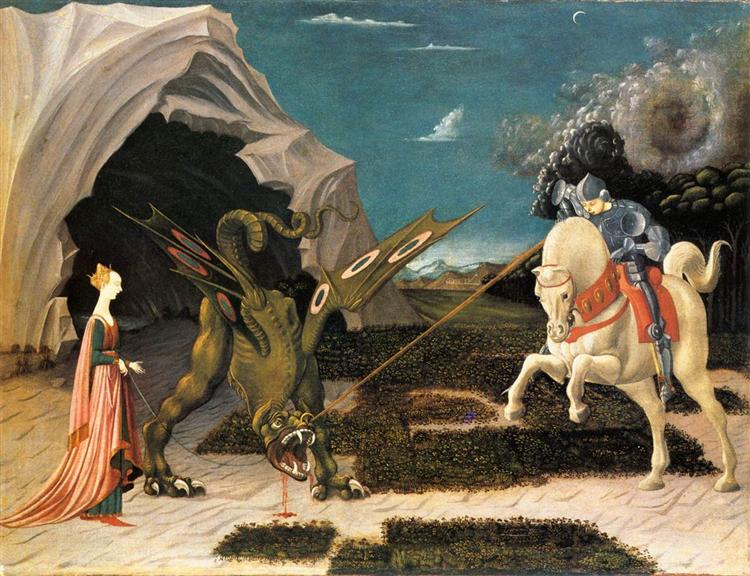
vales, valleys Then sends his servants to a neighb’ring grove For living streams, a sacrifice to Jove. Cadmus , a prince, would’ve hada retinue, followers, Hamlet for instance, his Horatio , his Jove , note, is the god who abductedto our story, isn’t yet supposed to know this, never having found his sister, nor identified, consequently, her ravisher, namely Jove , the god to whom Cadmus is now about to give sacrifice, give thanks O’er the wide plain there rose a shady wood Of aged trees; in its dark bosom stood A bushy thicket, pathless and unworn, O’er-run with brambles, and perplex’d with thorn: perplex’d, a wonderful metaphor here for entangled, enmeshed Amidst the brake a hollow den was found, With rocks and shelving arches vaulted round. brake, bracken, brush Deep in the dreary den, conceal’d from day, Sacred to Mars, a mighty dragon lay, Mars , god of War a mighty dragon, dragons, it appears,go back to very prehistory, perhaps dinosaurs, and the like, that made its way into our poetic imagination Bloated with poison to a monstrous size; Fire broke in flashes when he glanc’d his eyes: glanc’d his eyes, threw glances at His tow’ring crest was glorious to behold, crest, as in roosters, or reptiles His shoulders and his sides were scal’d with gold; scal’d, having scales, plates,overlapping surfaces Three tongues he brandish’d when he charg’d his foes; His teeth stood jaggy in three dreadful rowes. rowes, rows, three dreadful ones,one behind the other The Tyrians in the den for water sought The Tyrians, Cadmus and his men,all originally from Tyre
And with their urns explor’d the hollow vault: urns, to collect from living streams within the vault a sacrifice to Jove From side to side their empty urns rebound, rebound, knock against a hardersurface repeatedly And rowse the sleeping serpent with the sound. rowse, rouse Strait he bestirs him, and is seen to rise; he bestirs him, he bestirs himself And now with dreadful hissings fills the skies, And darts his forky tongues, and rowles his glaring eyes. rowles, rolls The Tyrians drop their vessels in the fright, vessels, urns All pale and trembling at the hideous sight. Spire above spire uprear’d in air he stood, Spire above spire, scale upon scale uprear’d, reared up he, the serpent And gazing round him over-look’d the wood: overlook’d, looked over, surveyed Then floating on the ground in circles rowl’d; rowl’d, rolled Then leap’d upon them in a mighty fold. fold , embrace, encirclement Of such a bulk, and such a monstrous size The serpent in the polar circle lyes, That stretches over half the northern skies. The serpent in the polar circle, Serpens ,a constellation in the Northern Hemisphere in close proximity to the North Pole lyes, lies In vain the Tyrians on their arms rely, their arms, their weapons In vain attempt to fight, in vain to fly: All their endeavours and their hopes are vain; Some die entangled in the winding train; the winding train, the serpent’stail Some are devour’d, or feel a loathsom death, Swoln up with blasts of pestilential breath. stay tuned R ! chard
______
When now Agenor had his daughter lost, Europa , his daughter lost He sent his son to search on ev’ry coast; his son, Agenor’s son, Cadmus , Europa’s brother And sternly bid him to his arms restore pious to a crime, intent on, devoted to, having justice restored The restless youth search’d all the world around; amours, loves, trysts, entanglements When, tir’d at length with unsuccessful toil, his angry sire, Agenor , father, sire He goes a suppliant to the Delphick dome; suppliant, supplicant, petitioner, one in search of a favour proclaimed her cryptic prognostications, her famously ambiguous prophecies Delphi , incidentally, was one of several sacred sites in Greece, sanctuaries, open to any Greek, or person who could speak Greek, regardless of geographical provenance, any city-state , for instance then, or kingdom, akin to embassies today, or places where people can expect to find similar political haven Delphi was the destination then also ofpilgrimages, comparable to our own ancient path I dearly would’ve, but never have, unfortunately, undertaken though I did walk to Mission B.C. some several years ago, from my home in Vancouver, to a monastery there, a place of recuperation when I needed one, three days there, and a half, three days and an equal half back, my feet were blistered, I noticed at one point, but hadn’t at all registered any pain, a truth I gathered about the power of intention, one’s very aim can be a salve, a balm, a solace, against any adversity There asks the God what new appointed home where do I land, asks Cadmus , where is my appointed home, my final destination The Delphick oracles, subordinates to Pythia , the high priestess at Delphi
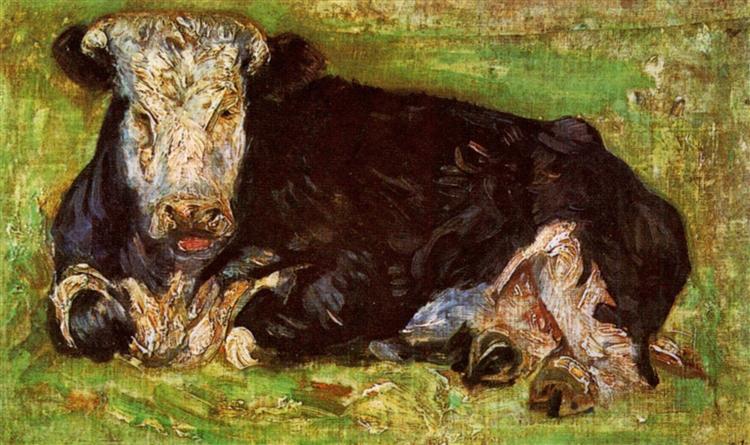
“Behold among the fields a lonely cow, Unworn with yokes, unbroken to the plow; Mark well the place where first she lays her down, There measure out thy walls, and build thy town, And from thy guide Boeotia call the land, In which the destin’d walls and town shall stand.”
Boeotia , a region still of Greece No sooner had he left the dark abode, the Delphick God, Apollo , god ofmusic, dance, truth, prophecy, healing, the sun, light, poetry, among many other things When in the fields the fatal cow he view’d, fatal, fateful gall’d, irritated, frustrated Her gently at a distance he pursu’d; the great Pow’r, Apollo , by way of hisDelphick oracles, the high priestesses, through their counsel, their divinations Her way thro’ flow’ry Panope she took, Panope , plural, were sea nymphs, not places, in Ancient Greece, therefore Cadmus must’ve been crossing water,however flow’ry, I’ll have to check my Latin text for, maybe, inaccuracies inthe translation And now, Cephisus, cross’d thy silver brook; a brook, a stream, anthropomorphized here, which is to say Cephissus , the flow, the waterway, is being addressed as a rational being, I have cross’d t hy silver brook, he says
meanwhile, to brook, to conquer, to overcome, a wonderful, a shimmering, literarily speaking, homonym , which is to say, a word with two faces When to the Heav’ns her spacious front she rais’d, she, the fatal cow, see above , has led Cadmus destination, destin’d place, destiny stay tuned R ! chard
 Richibi's Weblog