how to listen to music if you don’t know your Beethoven from your Bach, XV – what’s a rhapsody
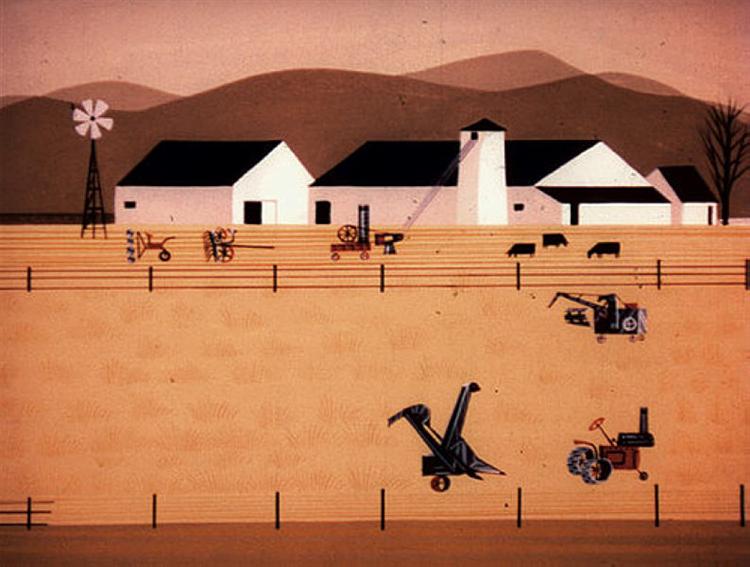
“Rhapsody of Steel“ (1959)
________
so what’s a rhapsody
“Rhapsody of Steel“ (1959)
________
so what’s a rhapsody
______________
if I’m including Tchaikovsky’s Third,
and last, Piano Concerto in my survey,
it’s not because of its excellence, it is,
indeed, severely flawed, but because
I am a completist – if I’m visiting the
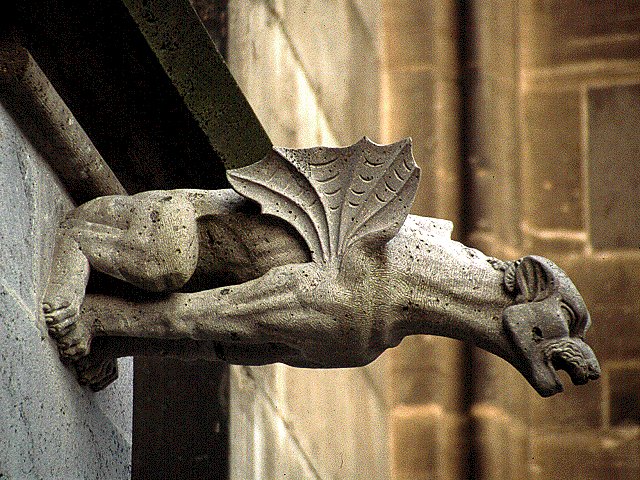
Cologne Cathedral, ergo, for instance,
I’ll make my way to the very top,
however treacherous might be the
stairs, the gargoyles being worth it,
not to mention the view
first of all, it’s incomplete, Tchaikovsky
died before finishing it, you can’t blame
him for that, though he was, curiously,
complicit in his own demise, but I don’t
believe this composition and his death
are that intimately interrelated
it has only one movement, but has
nevertheless been termed a concerto
on the, debatably unsound, strength
of its intention
briefly, and this is my opinion, the
movement has no lyrical moment,
no melting melody to float you out
of the recital hall as you exit,
nothing to hum, nor to whistle as
you wistfully wend your way back
home, nothing to remember but
flash, braggadocio, bombast,
expert fingers strutting their
dazzling, even, stuff, style over
substance, I venture, won’t be
enough to whisk you into the
following centuries
Chopin, the other towering Romantic
figure standing between the spiritual
bookends of Beethoven and Brahms,
wrote two piano concertos, of which
his Second suffers from, essentially,
not being his First, however mighty
his Second here, for instance,
proves to be in this utterly convincing
performance, watch, wow
Beethoven, in other words, wrote the
book, two works, Tchaikovsky’s First
and Chopin’s First, tower above his
in the public imagination during the
ensuing High Romantic Period, after
which Brahms closes the door on the
era with his two powerful masterpieces
for piano and orchestra
of which more later
there are other piano concertos
along the way, but Beethoven’s
five, Tchaikovsky’s and Chopin’s
one each, and Brahms two are
the basics – but let me add, upon
further consideration, and for a
a perfect ten options, Liszt, his
own, of two, First Piano Concerto –
what you need to consider yourself
comfortably aware of the essentials
of music in the 19th Century, the
culture’s predominant voice then,
until art, painting, took over as the
Zeitgeist‘s most expressive medium
with Impressionism
of which more later
R ! chard
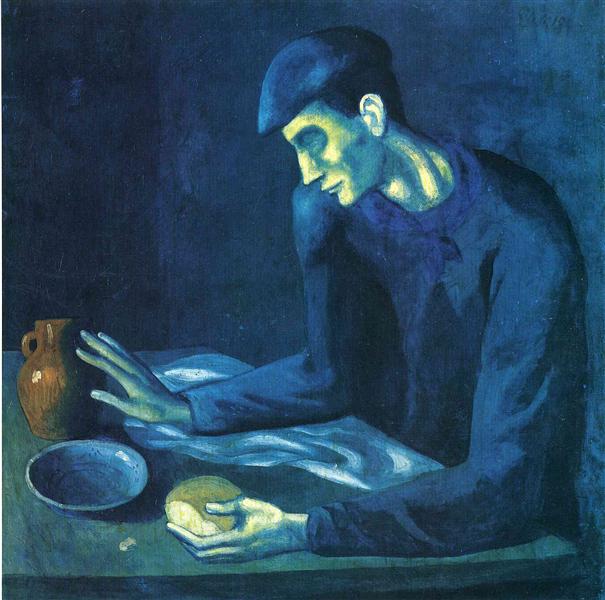
“Blind Man’s Portion“ (1903)
________
though you’ll have to actively listen
to Christopher King rather than
merely hear him here, as you might
have been doing with many of my
suggested musical pieces, should
you be at all interested in the history
of music, he is fascinating, dates his
investigations back millennia to very
Epirus, Ancient, nearly primordial,
Greece, to mirologia there, ancient
funerary chants
some have survived, and have been
recorded for posterity, one, in 1926,
by a Greek exile fled to New York City,
Alexis Zoumbas, a year later, however
improbably, by an American, a blind
man, his own story inspirational, akin
to that of Epictetus, one of the two
iconic Stoic philosophers, the other,
incidentally, an emperor, though the
blind man here, Willie Johnson, was
never himself a slave, but only, by a
historical whisker, the emancipations
of the American Civil War
Christopher King‘s comparison
of an Epirotic miralogi with an
American one brings up, for me,
the difference between Mozart
and Beethoven, notice how the
Willie Johnson version is more
rhythmic, the cadence is much
more pronounced than in the
Greek one, Johnson would’ve
got that from the musical
traditions Europeans had
brought over from their native
continent, probably also from
Africa, Africans
Beethoven would’ve been
surrounded, meanwhile, by Roma,
perhaps called gypsies then, their
music ever resonant in his culture,
not to mention later Liszt‘s, and
the Johann Strausses’ even, for
that matter, Paganini also seems
to have been imbued with it, it
having come up from Epirus
through, notably, Hungary – not
to mention, later still, that music’s
influence, and I’ll stop there, on
late 19th-Century Brahms
Christopher King, incidentally,
sounds a lot like someone you
already know, I think, from his
eschewing – Gesundheit – cell
phones, for instance, to his
enduring preoccupation with
death, not to mention his
endearing modesty, indeed
his humility, his easy
self-deprecation, despite his,
dare I say, incontestable, and
delightful, erudition
makes one wonder why that
other hasn’t become also
famous yet
what do you think
R ! chard
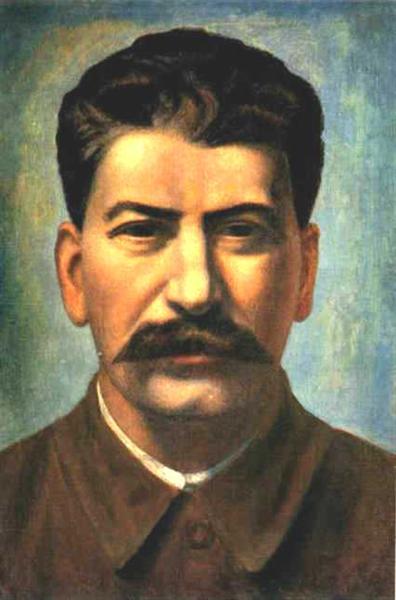
“Portrait of Joseph Stalin (Iosif Vissarionovich Dzhugashvili)“ (1936)
_________
if you’ve been waiting for a Shostakovich
to write home about among his early
symphonies, here’s the one, his
Symphony no 4 in C minor, opus 43 will
knock your socks off from its very
opening gambit, have a seat, settle in,
and get ready for an explosive hour
the Fourth was written in 1936, some
years after the death of Lenin, and the
instalment of Stalin as the supreme,
and ruthless, authority, after several
years throughout the Twenties of
maneuvering himself, cold-bloodedly,
into that position
from Stalin, “Death is the solution to
all problems. No man – no problem.“
fearing retribution after Stalin had
criticized his recent opera, “Lady
Macbeth of Mtsensk“, Shostakovich
cancelled the first performance of
this new work, due to take place in
December, ’36, others had already
suffered internal exile or execution
who had displeased the tyrant, a
prelude to the infamous Great Terror
the Symphony was eventually played
in 1961, 25 years later, conducted by
no less than Kirill Kondrashin, who’d
partnered Van Cliburn a few years
earlier in Cliburn’s conquest of Russia,
but along with this time however the
long-lived Leningrad Philharmonic
Orchestra
to a friend, I said, this is the biggest
thing since verily Beethoven, no one
has so blown me away symphonically
since then
he looked forward, he replied, to
hearing it
the Fourth Symphony has three distinct
movements, to fit thus appropriately the
definition of symphony, though the first
and third have more than one section,
something Shostakovich would have
learned from already Beethoven, it gives
the opportunity of experiencing a variety
of emotions within one uninterrupted
context, add several movements and
you have a poignant, peripatetic musical
journey, more intricate, psychologically
complex, than many other even eminent
composers, Schubert, Chopin,
Mendelssohn, even Brahms, for instance
it’s helpful to think of film scores, and
their multiple narrative incidents,
brimming with impassioned moments,
however disparate, Shostakovich had
already written several of them
let me point out that Shostakovich’s
rhythms are entirely Classical, even
folkloric in their essential aspects,
everywhere sounds like a march,
proud and bombastic, if not a
veritable dance, peasants carousing,
courtiers waltzing, and repetition is
sufficiently present to not not
recognize the essential music
according to our most elementary
preconceptions
but the dissonances clash, as though
somewhere the tune, despite its rigid
rhythms, falls apart in execution, as
though the participants had, I think,
broken limbs, despite the indomitable
Russian spirit
this is what Shostakovich is all about,
you’ll hear him as we move along
objecting, however surreptitiously,
cautiously, to the Soviet system, like
Pasternak, like Solzhenitsyn, without
ever, like them, leaving his country
despite its manifest oppression, and
despite the lure of Western accolades,
Nobel prizes, for instance, it was their
home
and there is so much more to tell, but
first of all, listen
R ! chard

__________
for Barbara, who died recently,
she would’ve loved this
Shostakovich was just nineteen when
his Symphony No.1, opus 10 was
first performed – it had been his
graduation piece the previous year
from the Petrograd Conservatory –
by, then, which is to say 1926, the
Leningrad Philharmonic, renamed the
Saint Petersburg after the fall of the
U.S.S.R., the name it had held before
the Bolshevik Revolution, the oldest
philharmonic orchestra, therefore,
incidentally, in our Russia, going
back to 1882
the work was a complete success, not
surprisingly, if you’ll consider its scope,
its power, and its novel musical
interpolations, I mean a piano as an
integral orchestral instrument rather
than as a distinct, however interrelated,
component, a pas de 40 instead of a
pas de deux, something I can’t remember
anywhere else having seen for piano
not to mention the drum roll between
the last two movements, drums making
a splash in an orchestral setting, who’d
‘a’ thunk it, though Richard Strauss had
done just that in his extraordinary
“Burleske” several decades earlier,
another youthful work, Strauss only 21
but meanwhile back in Russia, before
I too seriously digress, Shostakovich
was immediately compared to another
earlier young prodigy there, Alexander
Glazunov, who’d himself put out his
own First Symphony, the “Slavonic“,
at age 16, introducing, incidentally, his
own instrumental novelty then, an oboe
obbligato, which by very definition is
lovely
Glazunov also mentored, by the way,
Shostakovich at the Petrograd, proved
to be instrumental indeed in his
progress
it’s interesting to put these last two
together, to compare, the Glazunov, 1881,
follows the traditional Romantic
imperatives, tempo, tonality and
repetition, but with more bombast, to my
mind, than its European counterparts,
its fields are the Russian steppes with
troikas, horse-drawn carriages, flying
across vast unhampered vistas of the
Russian snow-covered, therefore
pristine, tundra, to whet the unbridled
Russian spirit, the Europeans, Brahms,
Mendelssohn, Mahler, conversely,
are confined to the hunt, however ever
glorious, but with shrubs, copses,
thickets, if not veritable forests, to blur
the sonic arena, inspire dreams,
consequently, less far-reaching than
those of Johnny Appleseed even, of
the North American Prairies poets,
their own far-flung, boundless
imaginations, inspiration, you can
hear it all, blatantly, in the resonance
of the horns
you’ll note the movements follow
essentially the same rhythmic order
in either symphony, the first two fast
enough, then a third that’s somewhat
slower, a variation from the strictly
Classical order of fast, slow, fast, then
a last, eclectic, movement
but Shostakovich is more atonal,
melodically divergent, an eccentricity
he’ll later polish to a degree of
politically subversive brilliance
for not submitting, however, to the rule
of repetition, which is manifest, though,
in Glazunov, Shostakovich, I find, leaves
us trying to find our bearings as his music
rolls along, kind of like in biographical
movies, when you start looking at your
watch to determine how many life
incidents remain in this particular,
however significant, existential drama
as spectacle – and it must be noted that
symphonic displays were at the time
indeed spectacles – there was no
phonographic, photographic
equipment to transmit such
experiences, the symphony itself was
the show, it had, right there, itself, to
wow the audience
in all of these cases, all of them did
Shostakovich, however, of all of them
remained eventually potently
pertinent, powerfully paramount,
watch
R ! chard
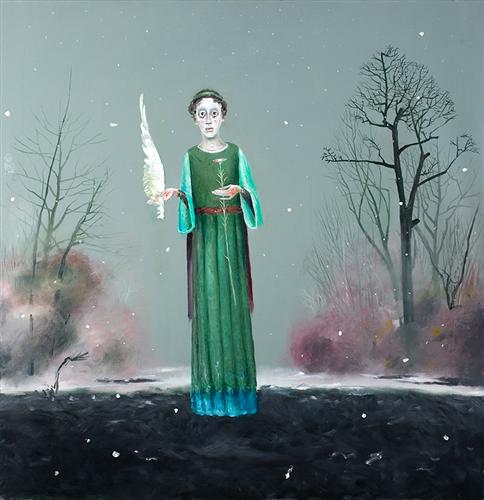
“Poet With Flower“ (2008)
_____
wherefore art, I’ve long and often wondered,
with only a wink to Juliet’s Romeo, for my
question dug deeper, why, indeed, itself art
we build our souls on the stories we’ve
heard, the impressions we’ve received
from voices that spoke directly to our
senses, painters with paint, musicians
with music, writers with words, poets
with poems
it started with fairy tales, which told of
right and wrong, good and bad, courage,
kindness, responsibility, and dire
consequences for discord
Biblical stories also took up a lot of my own
childhood, Jesus, Adam and Eve, Moses
and the Ten Commandments, this last
reinforced by Cecil B. DeMille’s epic
but soon enough it was Oliver Twist, Little
Nell, and by an inescapable authorial leap,
since these were all by an irresistible
Charles Dickens for a guy my age, Sydney
Carton, who valiantly stands in for his
friend, Charles Darnay, at the guillotine, a
quantum, even existential, leap from
Peter Pan and Mary Poppins
though I had the good fortune to learn to
read and write music as a boy, play music,
learn about Bach, Brahms and Beethoven,
it didn’t take anyone else much more than
their enthusiasm to see what the Beatles
were similarly doing, the Rolling Stones,
the Supremes, they were not only singing,
but making history, shaping it, and us, we
followed the questions they rose, their
responses, the effects upon ourselves
for nothing is considered until it’s
mentioned, spoken, made clear, and they
were those prophets
the same goes for art, we see as we see
cause Monet, Picasso, Warhol showed
us how to see, what to look at
and of course poets, Shakespeare,
Rostand, Dante, Goethe, to inform, each,
their individual language, and culture
I have been Philip Carey, Scarlett O’Hara,
Blanche Dubois, Gary Cooper in “High
Noon“, both Martha and George in
“Who’s Afraid of Virginia Woolf“, lately
I’ve been even Hank Williams
as Babette would say, a French doll who
gets abducted in “Raggedy Ann and Andy:
A Musical Misadventure“, an animated
movie from the Seventies, – oo aahrr yoo
Richard
psst: all of them have been me too,
incidentally
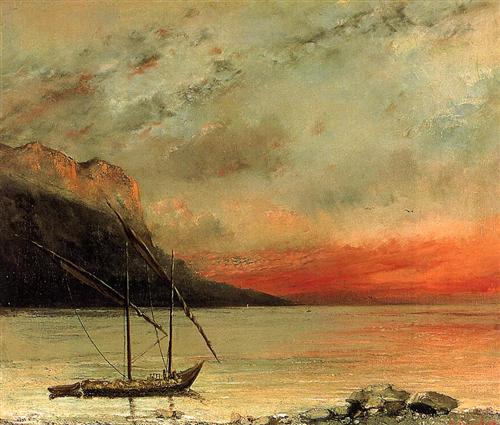
“Coucher de soleil sur le lac Léman“ (1874)
_________
paying attention to tenuti is not as
easy as all that, you’ll have found
probably that the music’s kept on
going and you’re not so sure if
what just went by indeed was a
tenuto, so brief, however stressed,
might’ve been the impression
rubati are easier, it’s hard to miss
them when they come round, for
being spread out through the
musical passage as a
consequence of being at the very
least three notes, usually
considerably more
tenuti happen on one note only,
one fleet fish in an ebullient river
rather than a more noticeable and
synchronous school
interestingly, not many of either,
rubati, tenuti, show up in music
history until the late Romantic
Era, the mid- to late 1800s, they’d
been only theoretically, and here
and there, part of the musical
vocabulary for having had no
purchase in music written for the
harpsichord, an instrument that
had allowed only minimal
resonance, though it laid the
foundations for composition,
and therefore dictated taste
into the very mid-nineteenth
century, a whole hundred years
after the invention of the piano,
by having entrenched the ideal
of strict tempo, the reflection,
note, of an ideal, and belief
then in a scientifically cogent
world
that was the Enlightenment
Romanticism came along to
express the ineffable reality of
the truths of the human heart,
in contrast to merely reason –
“Le coeur a ses raisons que la
raison ne connaît point”, says
Pascal, “The heart has its own
logic which allows it to
understand what the rational
mind cannot”, though he in a
somewhat other, much more
theological, context
but the shoe snugly fits, so I’ll
wear it, though with the same
consideration I’d render the
shoes, understand, of my
father
you can tell we’ve reached the
late 1800s when you start
hearing tenuti, ritardandi,
atonality, for that matter, and
also obscure and eccentric
repetitions
this pattern is probably more
evidenced in pictorial art,
where precision gives way to
individualized expression,
and the blurred lines of Early
Impressionism, see above
at the same time, the German
grip on the history of Western
music which it had held for a
hundred and fifty years, from
Bach to Brahms, began to loosen,
along with the idea, incidentally,
of a rationally, even irrationally,
conceived world, you can hear
it in the evolution of the tenuti,
the rubati, like canaries sense
altered conditions in a coal
mine
note however that music itself
is as indifferent to bald facts
as mathematics, it merely
describes, doesn’t comment
listen to Bedřich Smetana, a
Czech composer, his String
Quartet no 1, “From My Life”
follows in the footsteps of
the Germans, but with a
distinctively folkloric air,
there’s even a polka
tend the tenuti, relish the
rubati, if you can identify
them, they’re milestones
to the modern
but, more than anything,
enjoy
Richard
 Richibi's Weblog