Richibi’s Weblog

Just another WordPress.com weblog

Tag: Boreas

“Metamorphoses” (The Giants’ War, XI) – Ovid

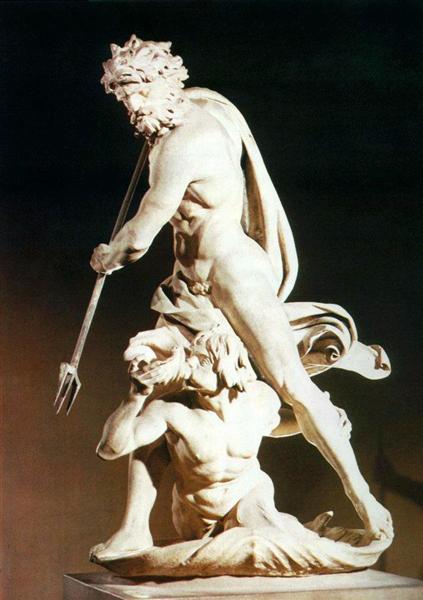
david-1624(4).jpg!Large

    “Neptune and Triton (1620 – 1622) 


          Gian Lorenzo Bernini


                ____________


              When Jupiter, surveying Earth from high,
              Beheld it in a lake of water lie,
              That where so many millions lately liv’d,
              But two, the best of either sex, surviv’d;
              He loos’d the northern wind; 


the new world begins


                                                       fierce Boreas flies
              To puff away the clouds, and purge the skies:
              Serenely, while he blows, the vapours driv’n,
              Discover Heav’n to Earth, and Earth to Heav’n. 


Boreas, ruler of the northern wind, as in 

aurora borealis, at the instigation of the

officiating Jupiter, disperses the clouds, 

drives away the vapours, allowing Heav’n 

to see Earth, and Earth  to see Heav’n, 

nothing between the earth and the 

clear blue sky


              The billows fall, while Neptune lays his mace
              On the rough sea, and smooths its furrow’d face. 


while billows fall, gusts of boreal wind, 

Neptune, god of the Sea, as well and 

simultaneously in the service of Jupiter

smooths the surface of the water by 

laying his mace, a club with spikes, 

upon it, to still the unruly waves


              Already Triton, at his call, appears
              Above the waves; 


Triton, son of Neptune, also a sea deity


                                           a Tyrian robe he wears; 


Tyrian, of Tyre, a city in what is now

Lebanon, but was then Phoenicia, it 

was famous at the time for its cloth 

of a particular colour, Tyrian purple


Tyre is one of the oldest continuously

inhabited cities in the world


              And in his hand a crooked trumpet bears. 


Triton is characteristically depicted 

with a conch shella crooked trumpet 


see above


              The soveraign bids him peaceful sounds inspire,
              And give the waves the signal to retire. 


[t]he soveraign, or sovereign, is none

other than Neptune, his father 


              His writhen shell he takes; whose narrow vent
              Grows by degrees into a large extent, 


writhen, twisted, contorted, as is typical 

of a conch shell, which grows from 

where one blows into it, by degrees,  

towards the much larger opening from 

which the sound emanates


              Then gives it breath; the blast with doubling sound,
              Runs the wide circuit of the world around: 


Triton blows into the conch, gives it 

breath, the blast [ ] doubling [the]

sound, resounding, reverberating, 

the world around, the world over


              The sun first heard it, in his early east,
              And met the rattling ecchos in the west.
              The waters, listning to the trumpet’s roar,
              Obey the summons, and forsake the shore.


the waters begin to recede


R ! chard


“Metamorphoses” – Ovid, 104

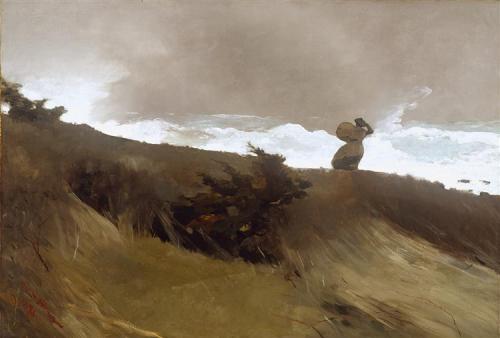
the-west-wind.jpg!Large

      The West Wind (1891)


            Winslow Homer


               __________


next, the creation of climate 


          And as five zones th’ aetherial regions bind,

          Five, correspondent, are to Earth assign’d: 


the five zones are the equatorial zone, the two 

temperate zones, and the polar zones


          The sun with rays, directly darting down,

           Fires all beneath, and fries the middle zone: 


the equator gets the brunt of it


          The two beneath the distant poles, complain

          Of endless winter, and perpetual rain. 


the poles get the other brunt of it


          Betwixt th’ extreams, two happier climates hold

          The temper that partakes of hot, and cold. 


temper”, as in “temperate”, as in zones


          The fields of liquid air, inclosing all, 

          Surround the compass of this earthly ball:


fields of liquid air, cloud covers


          The lighter parts lye next the fires above; 


fires above, the sun and the stars 


         The grosser near the watry surface move:


“grosser” air, less pure, less aetherial


          Thick clouds are spread, and storms engender there, 

          And thunder’s voice, which wretched mortals fear, 

          And winds that on their wings cold winter bear. 


they gravitate towards the denser earth, creating

conditions “there” for storms, strife, thunder


ever so ominously


          Nor were those blustring brethren left at large,

          On seas, and shores, their fury to discharge: 


blustring brethren, the winds, are not, we learn,  

not apportioned, not not allocated


          Bound as they are, and circumscrib’d in place,

          They rend the world, resistless, where they pass;

          And mighty marks of mischief leave behind;

          Such is the rage of their tempestuous kind. 


tempests, tsunamis, hurricanes


they call the winds 


          First Eurus to the rising morn is sent

          (The regions of the balmy continent);

          And Eastern realms, where early Persians run,

          To greet the blest appearance of the sun. 

          Westward, the wanton Zephyr wings his flight;

          Pleas’d with the remnants of departing light: 

          Fierce Boreas, with his off-spring, issues forth

          T’ invade the frozen waggon of the North.  


where we encounter, incidentally, aurorae borealis


          While frowning Auster seeks the Southern sphere;

          And rots, with endless rain, th’ unwholsom year.


it is to be noted that in 8 AD, when Metamorphoses 

was purportedly first published, one gathers from 

the text that the world was understood to be 

spherical, with two poles, the boreal and the 

austral, from which we later get the eponymously 

named Australia 


the world went flat, note, only later in the 

Middle Ages


R ! chard 


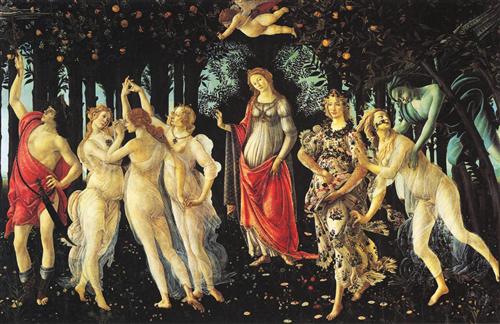
“Primavera” – Sandro Botticelli‏

Sandro Botticelli - "Primavera"

Primavera (1478)

Sandro Botticelli

_________

on the right, Zephyrus, god of the west
wind, and messenger of spring, having
prised Chloris from his brother, Boreas,
the icy north wind, ravishes her, the
naked nymph, who is being transformed
into Flora, goddess of flowers, note
Chloris‘ hand dissolving into Flora‘s
arm

but listen to Ovid tell it

“‘I, called Flora now, was Chloris: the first letter in Greek
Of my name, became corrupted in the Latin language.
I was Chloris, a nymph of those happy fields,
Where, as you’ve heard, fortunate men once lived.
It would be difficult to speak of my form, with modesty,
But it brought my mother a god as a son-in-law.
It was spring, I wandered: Zephyrus saw me: I left.
He followed me: I fled: he was the stronger,
And Boreas had given his brother authority for rape
By daring to steal a prize from Erechteus‘ house.
Yet he made amends for his violence, by granting me
The name of bride, and I’ve nothing to complain in bed.
I enjoy perpetual spring: the season’s always bright,
The trees have leaves: the ground is always green.
I’ve a fruitful garden in the fields that were my dower,
Fanned by the breeze, and watered by a flowing spring.
My husband stocked it with flowers, richly,
And said: “Goddess, be mistress of the flowers.”
I often wished to tally the colours set there,
But I couldn’t, there were too many to count.””

Fasti, Book V, May 2 – Ovid

________________

I love “It would be difficult to speak of my
form, with modesty”

go, girl, indeed goddess

on the left of the painting the three Graces,
Aglaea, Euphrosyne, and Thalia dance

on the far left, Mars, whence, incidentally,
our name for the month of March, is god
not only of war, but of also agriculture

Venus, who needs no introduction,
presides at the centre, accompanied
by her prankish son, Cupid, fluttering
above

“Love looks not with the eyes, but
with the mind”, Shakespeare says,
“And therefore is winged Cupid
painted blind” *

as he is in the painting above

no painting has yet replaced Botticelli‘s
Primavera as a universal symbol of
spring

may yours be equally timeless,
enchanted

Richard

* A Midsummer Night’s Dream
Act 1, scene 1, lines 234 – 235

– William Shakespeare