Richibi’s Weblog

Just another WordPress.com weblog

Tag: Boeotia / Greece

“The Story of of Cadmus” – Ovid

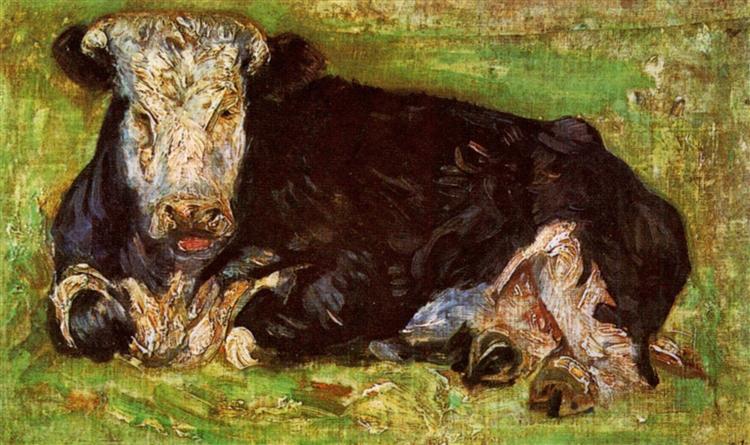
Lying Cow, 1883 - Vincent van Gogh

        Lying Cow(1883)


             Vincent van Gogh


                           ______

            When now Agenor had his daughter lost,


Agenor, king of Tyre, father of

Europahis daughter lost


            He sent his son to search on ev’ry coast;


his son, Agenor’s son, Cadmus,

Europa’s brother


            And sternly bid him to his arms restore
            The darling maid, or see his face no more,
            But live an exile in a foreign clime;
            Thus was the father pious to a crime.


pious to a crime, intent on, devoted to,

having justice restored


            The restless youth search’d all the world around;
            But how can Jove in his amours be found?


amours, loves, trysts, entanglements


            When, tir’d at length with unsuccessful toil,
            To shun his angry sire and native soil,


his angry sire, Agenor, father, sire


            He goes a suppliant to the Delphick dome;


suppliant, supplicant, petitioner,

one in search of a favour


Delphick dome, the Temple of Apollo

at Delphi, where the oracle, Pythia,

proclaimed her cryptic prognostications,

her famously ambiguous prophecies


Delphi, incidentally, was one of several

sacred sites in Greece, sanctuaries,

open to any Greek, or person who

could speak Greek, regardless of

geographical provenance, any

city-statefor instance then, or

kingdom, akin to embassies today,

or places where people can expect

to find similar political haven


Delphi was the destination then also of

pilgrimages, comparable to our own

Santiago de Compostela today, an

ancient path I dearly would’ve, but

never have, unfortunately, undertaken


though I did walk to Mission B.C. some

several years ago, from my home in

Vancouver, to a monastery there, a

place of recuperation when I needed

one, three days there, and a half, three

days and an equal half back, my feet

were blistered, I noticed at one point,

but hadn’t at all registered any pain,

a truth I gathered about the power of

intention, one’s very aim can be a

salve, a balm, a solace, against any

adversity


but back to Cadmus


            There asks the God what new appointed home
            Should end his wand’rings, and his toils relieve.


where do I land, asks Cadmus,where

is my appointed home, my final

destination


            The Delphick oracles this answer give.


The Delphick oracles, subordinates

to Pythia, the high priestess at Delphi


            “Behold among the fields a lonely cow,

            Unworn with yokes, unbroken to the plow;

            Mark well the place where first she lays her down,

            There measure out thy walls, and build thy town,

            And from thy guide Boeotia call the land,

            In which the destin’d walls and town shall stand.”


Boeotiaa region still of Greece


            No sooner had he left the dark abode,
            Big with the promise of the Delphick God,


the Delphick God, Apollo, god of

music, dance, truth, prophecy,

healing, the sun, light, poetry,

among many other things


            When in the fields the fatal cow he view’d,
            Nor gall’d with yokes, nor worn with servitude:


fatal, fateful


gall’d, irritated, frustrated


            Her gently at a distance he pursu’d;
            And as he walk’d aloof, in silence pray’d
            To the great Pow’r whose counsels he obey’d.


the great Pow’r, Apollo, by way of his

Delphick oracles,the high priestesses,

through their counsel, their divinations


            Her way thro’ flow’ry Panope she took,


Panope, plural, were sea nymphs, not

places, in Ancient Greece, therefore

Cadmus must’ve been crossing water,

however flow’ry, I’ll have to check my

Latin text for, maybe, inaccuracies in

the translation


            And now, Cephisus, cross’d thy silver brook;


Cephisus, or Cephissus, a river in Boeotia,

a brook, a stream, anthropomorphized here,

which is to say Cephissus, the flow, the

waterway, is being addressed as a rational

being, I have cross’d thy silver brook, he 

says, speaking to the torrent


meanwhile, to brook, to conquer, to

overcome, a wonderful, a shimmering,

literarily speaking, homonym, which is

to say, a word with two faces


            When to the Heav’ns her spacious front she rais’d,
            And bellow’d thrice, then backward turning gaz’d
            On those behind, ’till on the destin’d place
            She stoop’d, and couch’d amid the rising grass.


she, the fatal cow, see abovehas led

Cadmus to his famed, his mythic,

destination, destin’d place, destiny


stay tuned


R ! chard

The Story of Phaeton (VII) – Ovid

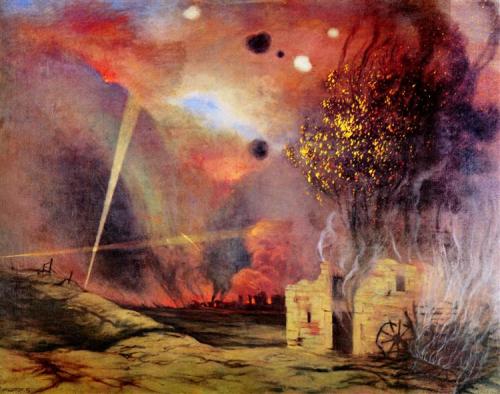
landscape-off-ruins-and-fires-1914.jpg!Large

   Landscape of Ruins and Fires (1914)


               Félix Vallotton


                   _______


                ‘Twas then, they say, the swarthy Moor begun
                To change his hue, and blacken in the sun. 


Moor, a flagrant anachronism here, 

as Moors, Muslim inhabitants of

North Africa, didn’t exist before the 

advent of Islam, which began in the 

Seventh Century CE, Ovid, in Latin,

uses Ethiopian, which would entirely 

throw off, note, Dryden‘s poetic 

metre, thus Moor


                Then Libya first, of all her moisture drain’d,
                Became a barren waste, a wild of sand. 


Libya, Ancient Libya, a much larger 

country of North Africa than the 

Libya we know of today


                The water-nymphs lament their empty urns,
                Boeotia, robb’s of silve Dirce, mourns, 


empty urns, the water has evaporated


Boeotia, a region still of Greece


Dirce, upon her gruesome death, which 

I won’t get into here, was transformed 

by Dionysus, god of revelry and fertility,  

into a fountain, which became revered


silve, sylvan, of the forest, the 

countryside


robb’s, I’ll guess robbers, because 

Boeotia is where Dirce, abducted,

became a fountain 


                Corinth Pyrene’s wasted spring bewails,
                And Argos grieves whilst Amymone fails. 


Corinth, a city still in Greece


Pyrene, a princess, who was, another 

distressing story, transformed into the 

Pyreneesby Heracles, her seducer,

as well as being a god renowned for 

his extraordinary exploits


Argos, a city still in Greece


Amymone, another unfortunate maiden,

who was granted by Poseidon, god of 

Water, for, throughout her tribulations, 

her probity, springs, sources of water, 

for her community, which, in the 

instance, all fail[ ] 


                The floods are drain’d from ev’ry distant coast,
                Ev’n Tanais, tho’ fix’d in ice, was lost. 


Tanais, the river today known as the 

Don in Russia, thus fix’d in ice


                Enrag’d Caicus and Lycormas roar, 


Caicus, a river in Asia Minor, now

given a different name in a different

script, Bakırçay, which I’ll let you 

try to pronounce 


Lycormas, a river in Ancient Greece, 

now called Evinos


                And Xanthus, fated to be burnt once more. 


Xanthus, or Xanthos, a river in Ancient

Asia Minor, which was yellowish already

due to its surrounding tainted soil, thus 

burnt once more    


                The fam’d Maeander, that unweary’d strays 


Maeander, a river in Ancient Asia

Minor


                Through mazy windings, smoaks in ev’ry maze. 


smoaks, smokes


mazy, maze, cute


                From his lov’d Babylon Euphrates flies;
                The big-swoln Ganges and the Danube rise
                In thick’ning fumes, and darken half the skies. 


the Euphrates, the Ganges, and the

Danube, rivers which still go by their

ancient names


                In flames Ismenos and the Phasis roul’d, 


Ismenos, or Ismenus, a river in 

Boeotia, Greece


Phasis, ancient name for the 

Rioni River in Georgia, Eurasia


roul’d, rolled


                And Tagus floating in his melted gold. 


Tagus, a river in the Iberian 

Peninsula


                The swans, that on Cayster often try’d
                Their tuneful songs, now sung their last and dy’d. 


Cayster, a river in Turkey


                The frighted Nile ran off, and under ground
                Conceal’d his head, nor can it yet be found:
                His sev’n divided currents all are dry,
                And where they row’ld, sev’n gaping trenches lye: 


it is being suggested that the Nile

had at one point seven tributaries,

some of which dried up, never

recovered


rowl’d, rolled


                No more the Rhine or Rhone their course maintain,
                Nor Tiber, of his promis’d empire vain. 


the Rhine, the Rhone, and the Tiber

are all European rivers


vain, deprived


                The ground, deep-cleft, admits the dazling ray,
                And startles Pluto with the flash of day. 


dazling, dazzling


Pluto, god of the Underworld, who 

would be understandably startle[d] 

by a flash of day


                The seas shrink in, and to the sight disclose
                Wide naked plains, where once their billows rose; 


billows, of [t]he seas


                Their rocks are all discover’d, and increase
                The number of the scatter’d Cyclades.

 discover’d, uncovered


Cyclades, a group of islands in the 

Aegean Sea, between present-day

Greece and Turkey


                The fish in sholes about the bottom creep, 


sholes, shoals


                Nor longer dares the crooked dolphin leap
                Gasping for breath, th’ unshapen Phocae die, 


Phocae, plural of Phoca, is the 

generic name, and therefore, 

interestingly, capitalized, for 

seals, walruses, sea lions


                And on the boiling wave extended lye. 


lye, lie


                Nereus, and Doris with her virgin train,
                Seek out the last recesses of the main; 


Nereus, and Doris, Sea god and 

goddess, parents, notably, of the 

Nereids, sea nymphs, the virgin 

train


the main, the ocean


                Beneath unfathomable depths they faint,
                And secret in their gloomy caverns pant. 


secret, unseen, alone, untended


                Stern Neptune thrice above the waves upheld
                His face, and thrice was by the flames repell’d. 


Neptune, principal god of the Sea


it is interesting to note that where 

earlier the earth had been 

submerged in water, during the 

Giants’ War, now the earth is

engulfed in flames, a primordial

global warming, as it were, the 

result, consider, of a human, 

Phaeton, trying to take on the 

duties of a god, a warning the 

Ancients were already delivering,

so many years, so many centuries, 

so many millennia, ago


I suspect, worldwide, indigenous 

people would be telling a similar 

tale were we able to access their 

own, unfortunately unwritten, 

though undoubtedly comparable, 

ancestral wisdom, going back,

perhaps, even as far 


R ! chard