Richibi’s Weblog

Just another WordPress.com weblog

Tag: Blaise Pascal

String Quartet no 1, “From My Life” – Bedřich Smetana‏

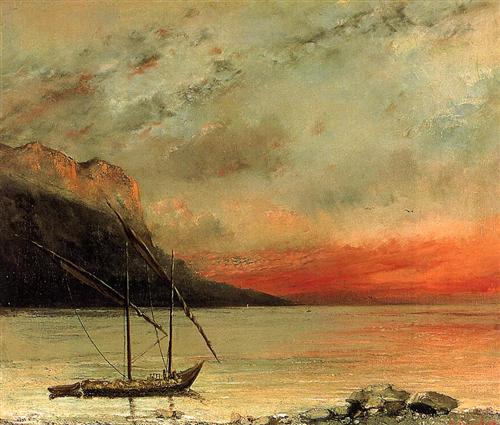
"Coucher de soleil sur le lac Léman" - Gustave Courbet

Coucher de soleil sur le lac Léman (1874)

Gustave Courbet

_________

paying attention to tenuti is not as
easy as all that, you’ll have found
probably that the music’s kept on
going and you’re not so sure if
what just went by indeed was a
tenuto, so brief, however stressed,
might’ve been the impression

rubati are easier, it’s hard to miss
them when they come round, for
being spread out through the
musical passage as a
consequence of being at the very
least three notes, usually
considerably more

tenuti happen on one note only,
one fleet fish in an ebullient river
rather than a more noticeable and
synchronous school

interestingly, not many of either,
rubati, tenuti, show up in music
history until the late Romantic
Era, the mid- to late 1800s, they’d
been only theoretically, and here
and there, part of the musical
vocabulary for having had no
purchase in music written for the
harpsichord, an instrument that
had allowed only minimal
resonance, though it laid the
foundations for composition,
and therefore dictated taste
into the very mid-nineteenth
century, a whole hundred years
after the invention of the piano,
by having entrenched the ideal
of strict tempo, the reflection,
note, of an ideal, and belief
then in a scientifically cogent
world

that was the Enlightenment

Romanticism came along to
express the ineffable reality of
the truths of the human heart,
in contrast to merely reason –
“Le coeur a ses raisons que la
raison ne connaît point”,
says
Pascal, “The heart has its own
logic which allows it to
understand what the rational
mind cannot”,
though he in a
somewhat other, much more
theological, context

but the shoe snugly fits, so I’ll
wear it, though with the same
consideration I’d render the
shoes, understand, of my
father

you can tell we’ve reached the
late 1800s when you start
hearing tenuti, ritardandi,
atonality, for that matter, and
also obscure and eccentric
repetitions

this pattern is probably more
evidenced in pictorial art,
where precision gives way to
individualized expression,
and the blurred lines of Early
Impressionism, see above

at the same time, the German
grip on the history of Western
music which it had held for a
hundred and fifty years, from
Bach to Brahms, began to loosen,
along with the idea, incidentally,
of a rationally, even irrationally,
conceived world, you can hear
it in the evolution of the tenuti,
the rubati, like canaries sense
altered conditions in a coal
mine

note however that music itself
is as indifferent to bald facts
as mathematics, it merely
describes, doesn’t comment

listen to Bedřich Smetana, a
Czech composer, his String
Quartet no 1, “From My Life”

follows in the footsteps of
the Germans, but with a
distinctively folkloric air,
there’s even a polka

tend the tenuti, relish the
rubati, if you can identify
them, they’re milestones
to the modern

but, more than anything,
enjoy

Richard


why I write

why I write, just click

the information that either music or
art deliver isn’t intellectual, in the
sense that it isn’t driven by any
discernible logic

it’s a logic of the heart, which follows
other, inscrutable, principles

“Le coeur a ses raisons que la raison
ne connaît point.”,
the heart has its
reasons which reason can never
ever fathom – Blaise Pascal

therefore art

Richard

J.S. Bach – Sonatas for Violin and Keyboard

though Bach wrote several works for solo violin – 
the astonishing feat of keeping you entertained
for again, like his work for the cello, with one
note only at a time for a couple of nevertheless
rapturous hours – this performance of the sonatas 
for violin and keyboard, which at the time would’ve
been the harpsichord, is live, complete, and too
sublime not to take precedence over his equally
mesmerizing solo stuff, unavailable anyway yet
cohesively on the Internet, before taking leave
of this mighty master, as we eventually must, 
for more contemporary pastures 
 
Bach was the end of an era, of civility, of order,
of, after Newton, the apparently clockwork
universe, where all would be ultimately
mathematically comprehensiblethough God, 
somewhere beyond the paradoxically
indecipherable still infinite, would remain
obstinately for a while the watchmaker
 
you can hear this in Bach’s music, each intricate
piece coming to an always thoroughly satisfying
end, like absolution, like sonic grace 
 
 
this would change, the dissolution of the idea
of God, the basis of the rights of kings, would
logically have to founder on the primacy of
individual rights, democracy, and the
positioning of the heart at the centre of
philosophical speculation, which is to say, 
after a Classical intervention, the Romantic
Age  
 
yes, of course, it was saying, to staunch and
irrevocable reason, indeed the mind, but the
heart has also its ratiocinations of which
reason knows naughtas Blaise Pascal,
1623-1662, iconic mathematician, physicist,
philosopher, had so incisively stated, who
even so early had understood the ineluctable
place of passion in the affairs of men   
 
 
you’ll note the more languid pace of the violin
that the keyboard at this point cannot accomplish,
but that the pianist here mimics with only spare
use of the hold petal, which would give notes
otherwise a too reverberant, too self-indulgent 
tone 
 
 
the music of Bach by the time of Mozart was
considered unfashionably dated, and was lost
for nearly a hundred years, to be revived
decisively by conductors and performers only
in the mid-nineteenth century, Mendelssohn
among the most noteworthy of these proponents 
 
today I can think of no other more consistently
profoundly satisfying composer, pace even the 
very Homer of music, the monolithic Beethoven  
 
but of course that’s just my opinion   
 
 
Richard
 
psst: Polling Abbey is a monastery in Upper
         Bavaria, a short distance from Munich