Richibi’s Weblog

Just another WordPress.com weblog

Tag: Beethoven’s Violin Concerto in D major

twice upon a violin concerto – Beethoven / Paganini
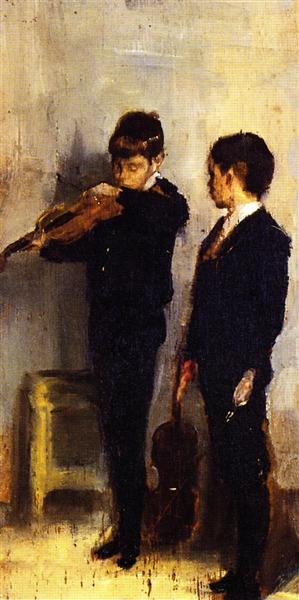
the-violin-lesson-1889.jpg!Large

  “The Violin Lesson (1889) 

         Tom Roberts

              _______

to juxtapose two things for consideration
to my mind, is the best way to sharpen 
both one’s aesthetic and, therefore, 
spiritual personality, here, thus, are 
two contemporaneous, essentially,  
violin concertos, concerti, if you like, 
Paganini’s 5th, 1830, Beethoven’s
Only, 1806

let me point out that the Classical Era
is over at this point, this isn’t music 
for the courts any longer, but music 
as spectacle, you can hear it, it’s like 
moving from Frank Sinatra‘s 
nightclubs to David Bowie’s stadiums

noteworthy about these two pieces is 
that the structure in each is identical, 
the same lengthy introduction in the 
first movement, followed by an 
articulate, and eventually mesmerizing, 
elaboration on the initial melody by 
the soloist, with divergent, however, 
intentions, Paganini starts with a 
fanfare, promises histrionics, delivers
fireworks, Beethoven begins with 
portent, goes instead for drama, 
which is to say, your heart, as well

both their second and third movements 
are essentially, then, indistinguishable 
conceptuallytheir last movement in 
either is even a rondo

the challenge in the Paganini is physical,
the glory is in the player’s technical 
prowess

with Beethoven the requirements are 
both physical and emotional, he 
punches for the heart, which the 
player musttherefore, with equally 
astounding panache, incidentally, 
also conquer 

style, in other words, over substance,
substance over style, which is to say
The Phantom of the Opera“, for
instance, or Cirque du Soleil,
Rachmaninov, maybe, versus 
Liberaceyou are the judge

history has sided, however, with 
substance, Beethoven’s Violin  
Concerto is everywhere, it isn’t at 
all easy, conversely, to come up  
with any of Paganini’s, despite 
their incontestable magnificence

maybe it’s time for a Paganini 
revival, they did that several years 
ago for the inimitable Rossini, an 
effervescent light in an otherwise 
mostly dour 19th Century, listen,
with counts and countesses here  
in attendance, at very, can you 
believe it, Versailleswow

 
R ! chard

some Joshua Bell

in my search for another violin concerto to follow up
on my suggested commitment for a while to that
instrument, to point out that concertos can go further
afield of course than the piano, and notably have, I
was able to find an Aladdin’s cave of musical wonders
but none to fit that specific bill

these other options however have been overwhelming,
once again for me irresistible, I’m a sucker, I’m afraid,
for excellence

for instance this astounding performance I’d temporarily
put aside for being a repetition, another interpretation
of Beethoven’s Violin Concerto in D major, done already
superbly here by the resplendent Anne-Sophie Mutter
with her inimitable mentor, Herbert von Karajan, no
less, among my previous recommendations

but this rendition by Joshua Bell, an American, who’d ‘a’
thunk it midst the profusion of Asian superstars, totally
transcends, he is precise, impassioned, is carried away
incandescently by his muse

we are too

Anne-Sophie Mutter who, we wonder, though only for a
moment, she is reliably transcendent, incandescent ever
too

his glissandos made me shiver, his rallentandos hold my
breath, his cadenzas, well, gasp in veritable wonder

a cadenza is what seems like an extended solo part near
the end of a movement where the soloist gets to strut
his, her stuff, it is often enough composed independently
of the composer, but I can only suppose that’s indeed the
case here for this cadenza not sounding especially
contemporary with Beethoven, for instance the strident
atonalities, long stresses on individual notes, defying
the usually strict conditions of that master’s nearly
religious adherence to tempo, rhythm

but it magisterially works, and therefore who cares

whether by Beethoven, Joshua Bell, or anyone else, I
don’t know, and am content to leave behind here such
esoterica

there is a bit of another cadenza near the end also of
the third movement

slow movements are not likely to have one for being
inappropriate, it would be bad form to show off at a
dirge

also von Karajan is not replaced, a conductor is simply
not there, and Joshua Bell seems an unlikely stand-in
for one here since he doesn’t even often look at the
orchestra, also he looks busy enough doing, wouldn’t
you think, other things

since the timpanist, the drummer, at the outset
gives the cue, a lovely of course Asian girl, she could
conceivably be setting the beat at least for her orchestra,
though often the first violin will take up the conductor’s
cause, when not the soloist, why else would one take a
bow, as they always do at concerts, but this one appears
unsubjected to so commanding a role

they open with some recalcitrance at first, as though
not quite sure of the engine, but soon things are humming,
the orchestra is in full swing, stunning, committed, soaring,
through giddy, infinitely miraculous, air

soon enough they also transcend

Joshua Bell earns himself meanwhile for his inspired part
in this splendid presentation an estimable place in my lofty
heaven, among the other poets, painters, asteroids and
stars shining there

Richard

a couple of violin concertos‏

a violin concerto is of course the same thing as a piano
concerto with a violin however where the piano would
be, performing histrionics before an orchestra for the
length of several movements, traditionally three, usually
fast, slow, fast, for reasons of presentation psychology,
a fast, arresting introduction, then a slow, languorous
beat to forcefully display an alternative musical sensibility,
then fast again for a big, splashy, electrifying finish, leaving
no question about outsized either compositional or
interpretive capabilities, or rather, about outright,
manifest, wizardries 
 
Beethoven and Tchaikowsky give us again the big ones,
Rachmaninoff, essentially a pianist, didn’t write for the
violin, composing to be able to play himself his own works, 
superbly in fact, even definitively, his performances of his
piano concertos are matchless 
 
Anne-Sophie Mutter, one of the brightest stars in
Herbert von Karajan‘s Deutsche Grammophon galaxy,
the company that he put on the international map in
the sixties to cast, magisterially, the richness of our
musical heritage upon that unsuspecting decade, and  
beyond, still commands rapt attention internationally 
though her mentor died in 1989, leaving the world
with less charisma, I might add, less glamour and
authority, less power and panache, in his musical
wake, though other concert luminaries shine
illustriously still, only without now the power of his
charged magnetism, his inspired musical sensibility
and the consummate ability to market his own and
his artistic community’s wares to an often otherwise
distracted audience
 
here he is a divinity overseeing the motion of the sun,
the moon, the stars in a universe of his own creation,
he is extraordinary, he is composed, supremely
confident, while his eyelids reveal the reaches of his
ecstasy 
 
Anne-Sophie Mutter is impeccable, evidently a star
pupil in her master’s stable 
 
 
Sarah Chang, a mere child, is no less dazzling in her
piece, an old spirit in the guise of a sprite, she polishes
off a fiendish Tchaikowsky, an electrifying work, with
the invaluable help of her own conductor, the eminent,
Charles Dutoit, you can see it in her trusting, ever
soulful intermittent gaze 
 
be assured you will be dazzled 
 
 
the Royal Concertgebouw Orchestra, which accompanies
her, is a symphony orchestra of the Netherlands, considered
one of the very best in the world  
 
 
Richard