Richibi’s Weblog

Just another WordPress.com weblog

Tag: Beethoven’s Sixth Symphony

on Beethoven’s Symphony no. 6, the “Pastorale”
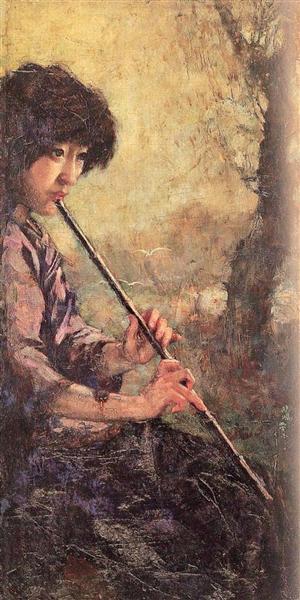
the-sound-of-the-flute.jpg!Large

      The Sound of the Flute 


               Xu Beihong


                 ________


                                    for Susan, who urges

                                               me ever to write


a friend wrote recently, extolling a

performance of Beethoven’s Sixth

Symphony he’d just seen, a 

noteworthy conductor conducting 


then again, how can you go wrong, 

I wrote back, with that already 

enchanting music, sent him, in

return, a version I’d ferreted out,

tried out for him, had been duly

enchanted, had laughed, had cried, 

taken shelter from the storm, come 

out the other side transported, again  


I wondered about the power of music, 

during my intermittent musings

throughout the variegated movements, 

as the peregrinations ambled on along 

their own magical explorations, long 

irrepressible arpeggios running up or 

down the scales, performing 

arabesques at their peaks, rumbling 

tremolos at their grumbling bottoms, 

before returning to the more stable 

middle ground of the melody


where, wondered, does it all find its 

source


sounds, individual sounds, would 

have been signals of danger, 

originally, a single note from a horn

warning of strangers on the way to

a community of otherwise peaceful

cohabitants if not only family, twig 

cracking in the forest when you 

believe you’re all alone


individual sounds would’ve picked

up meaning beyond their own pitch

and volume, resonance, reverberation,

rotundity, through Darwinian, even, 

time


a mother’s voice, for instance, 

identified immediately, upon a single

note, perenially, by any of her brood


it’s a long way from there to a symphony

but those are its roots, why we laugh, why

we cry, take shelter from the storm, and 

come out the other side transported


notes are written, emblazoned, on 

our consciousness, our lives depended,

depend still, on it 


listen


R ! chard


psst: interestingly, our Darwinian evolution

          has produced pitch as an identifying

          factor for our species, a female voice 

          is higher than a male’s, this has 

          allowed us, as a species, to sing

Evgeny Kissin – a bouquet of composers‏

midway in my considerations about music I
came to myself in a dark wood for the straight
way was lost, if I may paraphrase Dante for my
own purposes, I’d digressed to Elizabeth Barrett
Browning, Audrey Hepburnand others, and
forgot what I had been talking about with
respect to the development of music, but have
been wonderfully, and perhaps even karmically, 
put back on track by this correspondingly 
 
Evgeny Kissin had provided a resplendent
haven’t yet finished enjoying often, but
found among his other Internet offerings
 
 
at first I wondered about the Schubert/Liszt
connection in the written introduction to the
program, they’d been united by a forward
slash, implying that there’d been some kind
of cooperation, but I hadn’t ever heard of
those two ever meeting  
 
upon very little investigation however I found
out that Liszt had merely transcribed of course
some of the Schubert lieder, something which 
Liszt was wont to do, Liszt transcribed
everybody and everything, most famously all
of Beethoven’s symphonies, writing them
up for piano only, so that more remote areas
could also enjoy them, in often even there 
aristocratic salon settings
 
lieder are songs in German, a lied, a song,
works Schubert produced in astonishingly
great number
 
 
Liszt was paraphrasing Schubert for his own 
Lisztian purposes of course, artists do that, 
which is to say he was giving them much
more Lisztian fanfare and, not unwelcome,
I might add, extravagance, Schubert could
be pretty dry, I think, in his lieder,
uncharacteristically, even his fun ones, 
despite their being ever so eminently
 
 
und der Bach  from Die schöne Müllerin“, one
of his song cycles,Ständchen” from
Schwanengesang“, another cycle, Gretchen
 am Spinnrade“, and Erlkönigare all poems
of celebrated German poets Schubert set for
accompanied voice, and that Lizst, and Kissin,  
transform into something pretty special   
 
 
next on the program Schubert takes independent
flight with his wondrous “Wanderer” Fantasy,
opus 15, D760
 
 
a fantasy is not a sonata for having only one
movement, but note this fantasy goes through
all the motions of a sonata, fast, slow, fast, each
with its own structural contrasts, but without
any of the intervening pauses
 
so is a fantasy just a sonata without breaks, or is
a sonata just a fantasy with hiatuses, had the
sonata become a fantasy, had the fantasy
become a sonata, definitions were being
upended, then again that’s what revolutions
are about
 
before Beethoven this had been unheard of
when music hadn’t yet learned to actually talk,
mean something, Schubert, like Beethoven,
not only talks, not only narrates, as in for
 “Pastoral“,  nor either describes, as in
but actually speculates, ponders, moves 
metaphysically forward, in thrall to his
vagabond spirit much more than to his
wayward heart 
 
hence, incidentally, the more abstract, less
geographical, “Wanderer”, to compare with
for instance Liszt’s more panoramic
see also Caspar David Friedrich here for 
a close contemporary counterpart of his
in art
 
 
music has become no longer merely narration 
then but philosophy, it is finding its way like
the rest of us, and for the rest of us, to the
stars 
 
 
Bach then intervenes here with a Siciliana, a
Baroque composer in Kissin’s Romantic
clothing, but the shoe entirely fits, and
hauntingly, you’ll remember Bach was
composing for the harpsichord, which
had none of the piano’s resonance 
 
 
Brahms then returns us to a more abstruse
Romanticism, “7 Fantasies”, his opus 17,
pushes the limits of melodic continuity, you
can’t sing Brahms, you’re not even drawn to     
 
seven fantasies in one opus, incidentally,
suggests a sonata with seven movements,
with all of the permutations that have been  
suggested already for the fantasy I talked
about, it’s open season on sonatas, in
other words, and by extension their less
segmented fantasies  
 
it is the history of art 
 
 
the final piece is totally transcendent, some
incidental music from Glück, from his sublime
Orfeo ed Euridice“, one of my very favourite
operas, Orpheus approaches the Underworld
in order to retrieve his beloved bride, we are
about to enter the Elysian Fields, the actual,
original Champs Élysées, or Elysium, with
him, the moment is unforgettable
 
others have led us into the Underworld, most
notably Homer in the “Odyssey“, Virgil in the
Aeneid“, and of couse, somewhat more
recently but just, Dante in his Divine Comedy“,
even Bosch in his Garden of Earthly Delights”  
 
Glück is the one whose hereafter you won’t
not  remember  
 
 
Richard


Dmitri Shostakovich – String Quartet no 15, opus 144

several years ago when an angel I knew passed away
I read at his commemoration something I had written
for him, adagios, I said, always remind me of John

only a few days later, after I’d spoken, an adagio in
the distance was weaving its magic spell as I
abstractedly washed perennial dishes, a pivotal
spot, it would appear, for me, in my mystic
wanderings, my spiritual peregrinations

gradually I recognized the presence I’d apparently
inadvertently evoked with my unsuspecting but
thoughtful and caring script, opening a key, like
Ali Baba, it would transpire, to the very undiluted
infinite, something I’d wished for from my dad,
who’d died just a few months earlier, promising
me he’d speak to me if he could, though by then
I hadn’t yet heard from him

later when I was browsing for music to get into
to while away my pensive hours I happened upon
some Shostakovich in a nearby record store, I’d
recently been exploring his stuff, having reached
forward from the Romantics and even the
Impressionists, and looked to a relatively more
recent touch, the early Twentieth Century

which is to say the atonalists, Schoenberg, Berg,
Stravinsky and so forth, of which Shostakovich,
I would argue, has proven to be the most
significant voice, his music being that of a
desperate, nearly broken people enduring
the atrocities under Stalin

he is the most important composer of the
Twentieth Century, I think, along with Olivier
Messiaen, who survived a German prisoner of
war camp, two tough, even heroic, spirits

and here were not one, not two, not even three,
but six adagios in his 15th String Quartet, when
anything faster was too much for me to bear,
otherwise it would have to have been silence,
I was elated

I was not let down, Shostakovich’s 15th String
Quartet, opus 144, is a masterpiece, and helped
me through my rigorous Calvary with compassion,
grace, and ultimately golden hope, to health and
resignation

it is not an easy piece, you might find it
overwhelming, but it is the last word in adagios,
and for me it means the world, I couldn’t leave
it out

I found the distribution awkward however, I
haven’t found the quartet complete anywhere
on the Internet, you’ll have to access the movements
separately, pee breaks are therefore allowed, there
are six movements, not usual but we’ve seen
Beethoven do five already for his Sixth Symphony,
so not entirely unexpected

the first movement, Elegy (Adagio), is played by the
Rubio Quartet, but with only an image of war torn
Leningrad to inspire visually

the second, Serenade (Adagio), by the Borodin String
Quartet, perhaps Shostakovich’s best interpreters, are
also presented visuals inert

the third, fourth, and fifth – Intermezzo (Adagio),
Nocturne (Adagio), and Funeral March (Adagio molto)

in that order, are played live by the Shostakovich
Quartet, named of course in the composer’s honour

and the sixth, Epilogue (Adagio), again by the Borodin

may you be granted the poise and profound grace
of the adagio

Richard