Richibi’s Weblog

Just another WordPress.com weblog

Tag: Beethoven

Beethoven piano sonata no 28 in A major, opus 101
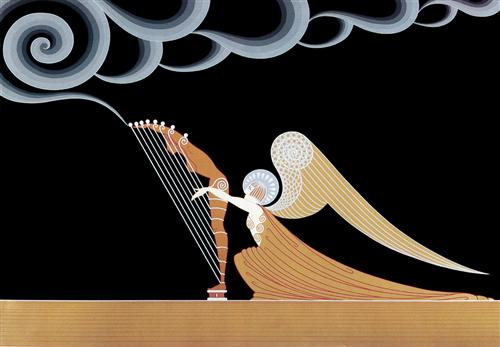
Erte - "The Angel"

The Angel

Erte

___

Beethoven’s piano sonata no 28, opus 101,
in A major
, is the first of what is considered
to be his late piano sonatas, as opposed to
early and middle, three entirely distinct
periods that are easily recognizable upon
closer listening, the early ones are bold,
even headstrong, with Beethoven’s ever
characteristic vigor and Promethean authority,
the length themselves of his early works are
a testament to his sense of his own great
personal validity, the first four, to my mind,
go on much longer than often enough they
should, a typically youthful presumption on
his part, and are musically at best trite, I find,
after their first expositions, the repeats come
as redundant, and tolerable merely, surprises,
even the famous 8th, the Pathétique“, opus 13,
is, I think, too brash and impudent, however in
this manner, nevertheless admittedly, entirely
effective, listen

the Pastorale“, of the middle period, opus 28,
no 15
, is where I deem the music to become
henceforward sublime, it has a settled
confidence that brims with not only technical
wizardry but with also positively enchanting
and entrancing musical ideas, bursting like
very flowers in springtime, with colour and
inspired, effervescent, imagination

the late period is where Beethoven becomes,
however, a sage, a prophet, and indeed a
hierarch in the new secular order of a
reconstituted Heaven, after all, someone
had to take the place of the now discredited
angels, Nietzsche called them Übermenschen,
Supermen

the 28th sonata starts out slowly, or rather,
more slowly than the earlier forthright ones,
already a sign of less physical, more
measured and considered reponses, my
impression here is of a grandfather visiting
his granchildren, jovial but not too disportive,
merely jaunty, always cheery but for a moment
of haunting melancholy, at the adagio, before
becoming congenial and avuncular again,
with then a big, boastful ending, snapping
staunchly his patriarchal suspenders,
getting the last, and traditional, word, with
a firm, which is to say, a foursquare-major-
chord, finish, the aural equivalent of turning
out the lights

musically, however, the progressions are
exploratory, incremental, more and more
layered with possible, and often apparently
rejected outcomes, in order to try out
something more fitting, maybe, more
accurate, a deconstruction, in other words,
of musical ideas, an investigation, in search
of a viable musically cohesive path

in the 28th sonata Beethoven, I think, is
doodling, however, coming up with the
methods of his great addresses, the
language here is not yet philosophically
precise, a smattering merely of pianistically
plausible ideas, musical sketches, the first
stirrings here, you’ll gather, of formal jazz

in the next sonata, the 29th, the still
unsurpassed “Hammerklavier”, he writes
the definitive book, speaking for music in
the forthcoming history of the world, and
determining its future path, we are still
moving along on his transcendent carpet,
no one ‘s come along still to give us a
more assured ride, kind of like Homer,
some would say Shakespeare, others
Albert Einstein, other, incidentally,
post-Christian, post Revolutionary
Supermen

who do you presently pray to, who are
your angels, who your Superwomen,
-men,
towards what do you aspire,
towards whom

Superwomen, -men, incidentally,
cultivate their own efflorescence,
manifest their own, I think, destinies,
or, if you like, their own Heaven

much as I believe angels also do

Mozart’s Fantasy in C minor on the
same program
shows him in a nearly
Beethovenian mode atavistically, much
more somber than he usually is, but he’s
nevertheless easily distinguished by
his much less intricate musical
accompaniment and his much more
rigorous melodic line, you’re more
likely to hum it

Mozart also composes from the nursery,
I find, the exhilaration of playful discovery,
you can see the toy soldiers, the golden
tresses on little milkmaids in dirndls with
red circles for cheeks

Mozart’s pieces are like nursery rhymes

Beethoven progresses to literature

before you judge me too harsh on Mozart,
by the way, consider that my favourite
piece of the two in this program is the
Mozart, it’s like comparing apples and
oranges, though, it depends on your
mood that day which you’ll favour

cheers

Richard

psst: just in case you missed it, this version
of the Pathétique is the best I’ve ever
heard, indeed, of all the pieces here
the most extraordinary, don’t miss it

Katharine Hepburn, among the prophets‏

 
to the icons of my art-infused philosophy,
Proust, primarily, and Beethoven, I am
adding this day, on the strength of this
very video, the indomitable Katharine
Hepburn, a veritable cultural treasure
and, here, a fierce and guiding light   
 
 
Richard


Nemo – “Ennead I” by Plotinus (17 )‏


Date: Thu, 28 Mar 2013 00:08:23 +0000
To: richibi@hotmail.com
From: comment-reply@wordpress.com
Subject: [New comment] “Ennead I” by Plotinus
 

Richard,

You wrote, ” should there, in the instance, however, be a One, an Absolute, we would not, nor can anyway ever, from our intrinsically divergent perspectives, be able to, in any meaningful way, know It”

Our opinions are not “intrinsically”, but “accidentally” divergent. If they are intrinsic, they would not be affected by changes in our circumstances. But often times our opinions are affected by external circumstances. Therefore, they are not “intrinsic”. For instance, your story about the color of the wall reminds me of a similar story of how the English chemist John Dalton discovered color blindness. He himself was color blind but never realized it until his mother (or aunt) disagreed with him on the color. Without such a defect, there would be no disagreement.

Truth cannot be a sum of opinions or even an unanimous decision of all people. Why? Because the sum of contrary opinions amount to nothing, and the sum of contradictory opinions only lead to confusion, since people are never unanimous about anything.

To use a classic Platonic analogy: If you have a serious disease and want to be healed. Will you call everyone in from the street, hold a public assembly and have them vote for a treatment of your disease? Of course not. You’ll seek out the specialist in the field and have him examine you and give you the proper diagnosis and treatment. Because he possesses the knowledge, whereas the others don’t. Even a grain of truth is worth more than a boatload of false opinions.

Having said the above, however, I agree that the truth may be multifaceted, like the color of light shining through a prism. Because our senses have their limitations, we can only see part of the spectrum, similarly, our rational faculty may also be limited, and we only see the Truth in part. This is why dialogues such as we’re having are meaningful. That we may see the rainbow, while not losing sight of our own color.

“So please your majesty
That we may wake the king: he hath slept long.”
King Lear Act IV Scene VII


oof, Nemo, again where do I start, I’ll try to
tackle merely Truth here, deconstruct It, so
that we can know what we’re even talking
about
 
what do you mean by Truth
 
 
something corresponds to what it is that
we see, hear, feel, I would think, to be
locked in my head, my spirit, a fundamental
unity, without the support of an underlying
Reality, would be horrible, a profound, and
unbearable, solitude, I don’t want any more
to even try to imagine it, though, in my
youthful invincibilty, I once did, it would
nearly drive me, sometimes, I remember, 
crazy 
 
I would try to guess what people would
say in their next breath and found that
mostly I could do it, that mostly I could
get it right, which didn’t do much for an
outside Reality
 
but, again, babies must learn to separate,
not easily, their suddenly unfamiliar world
from their initially undifferentiated senses,
their identity from what we understand to
be Reality, I’d been merely atavistically
revisiting that fundamental experience 
 
I first fell in love, incidentally, when I met
someone I wasn’t able to preempt, to my
utter fascination, at which point I was
forced to acknowledge not only Reality
but also probably a Heaven, it has
become a condition, I fall in love with
only people from other planets, or, if
you like, dimensions
  
 
so, Nemo, I am also subservient to an
ideal, or even an Ideal
 
but it, or It, is my utter fabrication, though,
manifestly, not an uninformed one
 
my Truth is that ethereal, a bedrock, 
however, of my nevertheless basically 
nebulous view of life, made out of,
indeed, thin air
 
my opinions are therefore entirely
speculative, except for my
understanding of myself
 
I think, according to Descartes, therefore
I am, and of that, of myself, I am not at
all speculative, for I think, listen   
 
 
Truth, incidentally, is a function of our
species, assuming that it is a formal
Reality is akin to placing ourselves,
as we once did, at the centre of the
Universe, we were apparently
egregiously wrong about that, it
seems to be generally now agreed,
I suspect an Absolute, or Idealized,
potential Reality, is asking for hubris,
and too often, incidentally, we get it,
see wars, torture, man’s inhumanity
to not only man
   
 
about the world which has mathematical
dimensions we are mostly in agreement,
two plus two will always equal four in our
rational construct, and Science seems to
flow pretty smoothly from that
 
therefore Truth with respect to matter I
will not question, it is the grid we are all
at least comfortable with, like speaking
the same language, despite its even
basic insufficiencies, these fairly easy
mostly to patch up with persistence
and ingenuity   
 
but Plato’s Truth, Ideal, or Absolute, is
of a more noumenal, spiritual, which is
to say, abstract, order, and as such, like
Beauty, is in the eye of the beholder,
Truth is what we think it is
 
is John Dalton wrong to have seen a
divergent colour, and who could tell
him that his blue was green, his red,
orange, when these were categorically
his impressions, dissent is a matter
merely of concensus  
 
Truth, I believe, is our accommodation,
and is no more than the sum of its
collective parts, the truths that
scientists unearth are Science, not
Truth, Reality, not Wisdom     
 
other worlds would have entirely
different conceptions of the Universe
for being other than we, us
 
we are assuming we have the answer,
Nemo, to imponderables 
 
therefore, not Philosophy, I insist,
but Art, and metaphorical rather
than categorical imperatives
 
see Beethoven for that, and / or Proust   
 
 
Richard
 
psst: according to these two excellent
          programs,
 
                  Bernard Williams on Descartes      
 
                  Bernard Williams on Descartes (cont.)
 
           two parts of an interview with an
           authority on Descartes, I could’ve
           easily been a figment of his
           imagination for sounding nearly 
           word for word, to my surprise
           and delight, very much like him
 
           though he probably wouldn’t,    
           by my calculations, therefore,
           have loved me      


Beethoven piano sonata no 32, opus 111‏


when I was a young boy my sister returned
from school with a catechism the nuns had
given her, if there’s anything you’d like to
know, she said, the answer will be in here,
touting it triumphantly

we all laughed at her of course, being a
family of sceptics

but in the following sonata, Beethoven’s
transcendent no 32, opus 111, I believe
that’s exactly what you get, that catechism,
something with all the answers

there are only two movements in the 32nd,
an oddity to say the least, it will end not on
a joyous note, as was the traditional manner,
but on a much more contemplative one

midway I never manage not to break down

the first movement is fast, chaotic, succinct,
the following one tentative, orderly, expansive,
exploratory as opposed to rash, humble as
opposed to demanding

dichotomies, in other words, abound the
more profoundly you let the pattern sink
into you, the more you spend time with
the music

for me it is man, woman, it is chaos, grace,
right, wrong, evil, good, sin, retribution,
war, peace, intolerance, mercy, love

it is also the very steps of our passage
through those life choices

when life has been for me too much of a
struggle this sonata has come along, in
those most private and most vulnerable
moments, invariably to hold my hand,
thanks be duly to Beethoven, philosopher,
poet, mystic, guardian angel, sage

if there’s anything you’d like to know, I
affectionately quote, and presently
ardently remind you, the answer will
be in this cathechism

if you can keep your eye off the pianist,
who is evidently, and indeed enviably,
in its throes

we’ll want to see more of Yeol Eum Son

Richard

XXXl. Thou comest! all is said without a word – Elizabeth Barrett Browning‏

from Sonnets from the Portuguese

XXXl. Thou comest! all is said without a word

Thou comest! all is said without a word.
I sit beneath thy looks, as children do
In the noon-sun, with souls that tremble through
Their happy eyelids from an unaverred
Yet prodigal inward joy. Behold, I erred
In that last doubt! and yet I cannot rue
The sin most, but the occasion – that we two
Should for a moment stand unministered
By a mutual presence. Ah, keep near and close,
Thou dovelike help! and, when my fears would rise,
With thy broad heart serenely interpose:
Brood down with thy divine sufficiencies
These thoughts which tremble when bereft of those,
Like callow birds left desert to the skies.

Elizabeth Barrett Browning

______________________

it is a natural instinct nearly to read such
a poem in iambic pentameter, until you get
to the end of the verse, pause, and then do
the same thing with the next line, applying
a rhythm to each phrase, much like toneless
singing, after all, one surmises, it’s a poem,
words without the tune, it has a beat

but the beat in Elizabeth Barrett Browning‘s
poems, though staunch, is steeped in the
less evidently accented constructions of
prose, looser and less regimented, for
realism

like Beethoven, Elizabeth Barrett Browning
is breaking out of the Classical mode and
introducing the overflowing elements of
the Romantic personality, personal
expression dominating form the better
to reflect a new cultural reality

it’s interesting to note that Beethoven as
well found the key to representing that
new revolutionary spirit through the
manipulation of beat, both achieving
thereby the very pinnacle of consummate
artistry, icons of their, however great their
own personally chronologically distant,
age

but read the poem as though it were an
everyday sentence, the poetry will be clear,
beautiful, even wondrous, the rhythms not
immediately apparent though always
present and profoundly sure

both music and poetry would attempt
to sound like real life, to speak more
intimately and therefore truthfully,
while others will attempt to make
poetry out of mere prose, watch me,
we live in different times

about the poem, compare you are
the wind beneath my wings
“,
for a
not dissimilar sentiment, watch
Patti Labelle make powerhouse
poetry out of mere prose

Richard

psst: more about wings

Nemo – “Ennead I” by Plotinus (13)

 
Date: Sun, 17 Mar 2013 19:04:56 +0000
To: Richibi’s Weblog
From: comment-reply@wordpress.com
Subject: [New comment]“Ennead I” by Plotinus.
 
Richard,     
 
You wrote, “my experience is that I cannot know even dimensions before I formally deduce them,”

That is a unique experience. Einstein came to the same conclusion when he developed the Theory of Special Relativity, though perhaps he didn’t have quite the same experience. You both beheld the same underlying reality, although you expressed it in different ways.

Plato’s Absolute, i.e., which is Beauty, Goodness and Truth in One, is immanent. It is distinct but not distant from us, and every soul can ascend to it by reason and intellect. There are different types and levels of beauty, in the human body, in nature, in the universe, in science and art, literature and music. One doesn’t have to be a “Superman” to see beauty or create beauty. Every life is an artistic activity. Every individual is an artist.

The concept of Absolute by no means deny or diminish the freedom of individual existence. On the contrary, the more diverse and free the individual existence, the better and fuller it manifest Absolute Beauty. For instance, Beethoven’s Ninth, unless each member of the choir and orchestra plays his/her best part, the beauty of the symphony cannot be manifested nor experienced by the audience.

Unlike Kant who believes that the noumenal is unknowable, Platonists reason that the noumenal and the phenomenal correspond with one another (sort of like the way an image in the mirror corresponds to the original), since they are both derived from one and the same intelligible reality. Because of this “correspondence”, it is possible to do science. We have been able to predict with accuracy the movement of the stars and other events occurring in nature; Because of this “correspondence” between our consciousness and the outside world, it is possible for us to interact with other people and the world


you say, Nemo, “Plato’s Absolute, i.e., which is
Beauty, Goodness and Truth in One“, which
seems to me anachronistic, a premature
conflation with Christian, however implicit,
thought, I don’t think Plato would’ve had a
Trinity, whatever for in a society replete with
a variety of quite serviceable, not to mention
glorious, deities
 
when you speak of “[e]very life“, “[e]very
individual” being “an artistic activity“, “an
artist“, what about animals, insects, trees,
do roses perceive their own beauty, these
are lives, even creative, even inspiring ones,
though I draw the line at inspired, I suspect
they don’t consciously know it 
 
therefore “Beauty, Goodness and Truth” are in
the eye of the beholder, no, as we ask in
French, and the beholder is our own human
only, it appears, incarnation, blessed as we
are, for better or for worse, with
self-consciousness, ““Superm[e]n”” need
not even, but only superfluously, apply  
 
the Tree of Knowledge bore the fruit of
which all of us have partaken, for better or
for worse, by our very nature, and we’ve
created a poem around it in order to
understand
 
it has been mighty, if flawed
 
 
about mirrors, when I yearned for word
from above, or from wherever, I understood
I’d have to forego my entrenched scepticism
 
under the influence of Sartre and Camus,
the Existentialists, whose ideas dominated
the Western World, and my university years,
however nowadays incredible, a time when
Van Cliburn, a Classical music pianist, 
would return from a sealed Communist
Russia, no less, to a New York ticker tape
parade, a more idealistic time than our
present more rapacious, morally bankrupt,
apparently, epoch, I’d believed in Being
and Nothingness, and the corollary Absurd,
I was alone in an indifferent Universe
 
to assume spirits, an extraterrestrial entity
who might be responsive, would require
an act of absolute faith, a profound
disorder in my otherwise determinedly
rational perspective
 
but I had no choice but to succumb to
even irrationality, I knew, for any chance
of grace, you need to believe in miracles
to experience them  
 
need I say that I found that transcendence,
I called it crossing the Bridge of Faith
 
where everything was the same but
different, Nemo, like crossing through a
mirror, like Alice, and discovering another,
infinitely more enchanted, however
numinous and otherworldly, world   
      
 
Richard


Beethoven piano sonata no 23, opus 57, “Appassionata”‏

despite its apparently appropriate appearance
Beethoven’s “Appassionata” once again was
not so titled by Beethoven, but posthumously
even only, by an otherwise inconsequential
publisher with respect to our story, it is filled
with brilliance and verve, as had been
Beethoven’s wont, but a new spirit has
invaded this work, to my mind, which
hadn’t been evident in his earlier, even
more recent sonatas  
 
Beethoven has ceded to contemplation,
no longer merely the bravura that bristled
thrillingly when his fingers flew across a
dazzled, surely, keyboard, dashing off
feats of musical dexterity, indeed of
outright improbable prestidigitation, the
inspired and omnipotent fury of a youth
in all his promise and pulsating
exhilaration
 
here, in the second movement mostly,
the very heart of the piece, his quest is
philosophical, this is no longer merely
a musical air, but a striving for meaning
 
from here on Beethoven, where earlier
he’d been an adventurer, a Johnny
Appleseed, if you’ll remember my calling
him that, in his idyllic Pastorale“, full of
determination and fire, still impervious 
to any danger, now has suffered doubt,
and begins here, at the height of his
compositional powers to display it 
 
this is no longer entertainment, this is
conversation, it’s like going from the
Beatles’ I Want to Hold Your Hand to
John Lennon’s Imagine having been
through the intermediate Sergeant
Pepper“, the later works meant to
actually change the world, not only
just to regale it 
 
this is also only the start, Beethoven
will become extraordinary, a sage, 
music’s highest priest, and prophet  
 
watch, listen, wonder
 
 
Richard


Nemo – “Ennead I” by Plotinus (11)‏


Date: Tue, 12 Mar 2013 15:56:00 +0000
To: Richibi’s Weblog
From: comment-reply@wordpress.com
Subject: [New comment] “Ennead I” by Plotinus
 

Richard,

Forgive me for saying so, but it seems to me that your philosophy is quite incongruent with your personality, which is passionate, sensitive and kind. As far as I can tell, you’re much more gregarious than the demented Nietzsche.

If, as you wrote at the beginning, you can’t even be sure that I exist, why are you taking the trouble to have this conversation? If everything is in a flux, what is there to “grasp” and “tackle”? If all is a figment of the imaginations of beings in their separate cages, what’s the point of conversation? You’re still trapped in your own cage anyway.

Kant may be wrong about some things, but I do agree with him about the difference between noumenon and phenomenon. Our thoughts revolve around the phenomenal, and consequently, they are in flux, “peripheral” as you put it, or evolving, as some believe. But, this doesn’t negate the noumenon, the eternal and unchanging. To use an analogy in biology, when you observe the growth of a seed or an embryo, it seems to be changing constantly, and if you didn’t know what it was, you would think that everything was in flux, but all the while it remains the same substance: a human being


what’s to forgive, Nemo, I don’t mind at all being
called “passionate, sensitive and kind
 
thank you
 
 
and you are right, after a study of philosophy I
went my own way, which was what philosophy
had taught me to do, it is a conversation, I
learned, rather than an ideology, that secular
cousin of theology, either system oftentimes
flagrantly autocratic, for instance Plato, or
take your pick of religions 
 
along the way I discovered miracles, I wanted to
talk to my beloved, but somehow I’d only asked
my dad, who’d died earlier the same year, to
speak to me from beyond the grave, I’m your
son, I said, I’ll hear you, and, Nemo, I did, and
all, eventually, the others, I’ve been talking to
all of them ever since  
 
this might seem very strange, of course, but
you can tell from what I’ve written to date,
surely, that I’m not entirely demented,
conversely, maybe I’m inspired, maybe just
eccentric, who knows, take your pick, so
long as I’m not, I think, hurting anybody    
 
 
Kant, incidentally, didn’t affirm the noumenon,
he merely did not deny it, so he’s made room
for my unorthodox constructions, and miracles,
as a corollary, in general
 
this was also Descartes’ dilemma essentially,
or Shakespeare’s, There are more things in
 
also my own 
 
we cannot beyond our consciousness affirm,
we can only interpret, I am the only thing I can
affirm, the rest is what you make it, for better
or for worse, this from “the demented“, Nemo, 
Nietzsche
 
therefore Beethoven or Proust, or maybe
even me    
 
 
I believe in miracles, and so I experience them
 
I’d asked a friend on a cold winter day with
only icicles everywhere in the city, what
should we do, let’s go out and look for
beautiful things, he replied, we did, and all
the icicles consequently shimmered and
glistened, I’d found a key to finding beauty,
another valuable parable 
 
later, needing more than just beautiful things
to cheer me I asked for miracles, which, Nemo,
like the earlier beautiful things, profusely in
their turn abounded, you just have to be
ready to receive them
 
 
I believe there is a noumenon, but I’ll never
be able to prove it, though I feel it profoundly,
and judiciously sort out with the help of
wisdom and poetry, truth and beauty, all
I can muster, the information I receive 
 
I hope it might be of some service
 
 
to me there is poetry behind everything,
shimmering, glistening magic, but I’m not
sure that’s what everyone sees, nor wants
to see, I won’t try to impose my perspective,
I can only tell what I see
 
and I’ve long seen more than mere facts,
what I see, have long seen, is an inherently 
transcendental reality 
 
which suggests the probability of other
noumenal worlds
 
so, to answer your question, I do think
you indeed exist, though I can’t be
absolutely sure of it, though you might
not be a figment of my imagination you
are nevertheless to me merely my
impression of you, but who really are
you, that’s a tricky question, cause you
don’t even know
 
meanwhile there’s no harm in sharing
even a virtual, irony of ironies, 
conversation
 
   
cheers
 
Richard


Nemo – “Ennead I” by Plotinus (10)‏


Date: Fri, 8 Mar 2013 21:28:13 +0000
To: Richibi’s Weblog
From: comment-reply@wordpress.com
Subject: [New comment] “Ennead I” by Plotinus
 
Hi Richard,

Have you thought of writing or already written memoirs? I think I’d enjoy reading them.
Your second story reminded me of the Confessions by St. Augustine,
in which he grieved over the death of his beloved friend.

Descartes might say this about your “This is the census” moment: “I lisp, therefore I exist”.
But how would you interpret the “parable”?

What caused you to stop ministering at the palliative care unit after ten years?


a parable is in the eye of the beholder, Nemo,  
nearly by definition, and therefore wide in the
possible breadth of its interpretation, that wide
net, should it catch the imagination of many,
can describe a potent, though indefinable,
moral precept that even whole communities
can then propagate and follow, mysticized
fairy tales, for these last serve a similar
purpose, maybe the age of the listener,
reader, here, is the distinguishing factor,
adults have a hard time with fairy tales 
 
dimension to my lisp, if you’re asking what
moral precept I derived from that tale, it is
that something was profoundly watching,
unobtrusive, but gently ready to nudge just
enough to inspire hope, like a second wind
 
I felt, however solipsistically, that something,
someone, was listening, and that was enough,
that indeed would be, wouldn’t you think,
though the information was entirely
metaphorical and abstract 
 
but I’ve experienced too many moments of
transcendence not to subsribe to a more
than merely rational agenda, Shakespeare
again, There are more things in heaven and
earth, Horatio, / Than are dreamt of in your
philosophy.” – Hamlet, act 1, scene 5,
lines 186–187 – which I heartily second
 
no philosopher has ever admitted that but
Proust and Beethoven, which is why I’ve
somewhat put aside classic philosophy,
though I love the Moralists, after Rome
and before Christianity, Saint Augustine,
I’m afraid, however, distorted the facts,
as well as his great acuity, in order to
entrench a mythology, the dominion of
numinous, entirely male, incidentally,
Trinity, forcing Truth into a submissive,
not to say penitent, and furthermore
impotent, corner until the very Renaissance, 
specifically until Descartes, and, by the way,
until his near contemporary, Shakespeare,
1564 -1616, nearly the equal of Beethoven
and Proust in his philosophical perspicacity, 
To be, or not to beis of course the first
existential soliloquy of our era
 
Descartes, 1596 – 1650
 
 
after ten years at palliative care I had changed,
and the unit had changed, it had become more
regimented and constrictive than it had been in
its early, more companionable, and not yet so
regimented, years, I now had to go through
security to get to my station, which was not at
all the spirit in which I’d entered the service
 
I am now, I’m imagining, a poet, and live and
write accordingly, these very missives, Nemo, 
are my memoirs, at present you are my muse
 
thanks  
 
I hope you’re “enjoy[ing] reading them


Richard


“Thirty Two Short Films About Glenn Gould”‏

to my mind, one of the best films Canada has
had to offer, a study of the musical giant which
is probing, perceptive, and profoundly revealing,
and the impersonator, Colm Feore, is impeccable,
superlative, rendering the mystery of flights of
inspiration vivid and comprehensible, he is,
seamlessly and completely convincingly,
Glenn Gould     
 
Glenn Gould is of course identified with his
book-end interpretations, his first release and
the interval of not quite thirty years for him to
further appraise these epic pieces, both issues
are considered monumental, defining cultural
moments, both eclipse, have eclipsed, any
other, even celebrated, performance
 
the reference in the film’s title is to these  
Goldberg Variations, of course, composed
of thirty variations on an opening “aria”,
which is repeated as a “coda”, an ending,
a musical last word, for a total of 32
segments
 
but I submit that the place of Beethoven’s own
could not possibly have been overlooked in
the movie’s title, considering especially the
inclusion of that specific number, despite,
incidentally, the missing hyphen, an infelicitous,
I think, literary licence 
 
the Thirty Two Short Films are themselves,
not incidentally, a set of 32 filmic, note, 
variations, on the subject, in this instance, 
of the player himself, Glenn Gould
 
may his star shine bright forever    
 
 
Richard