Richibi’s Weblog

Just another WordPress.com weblog

Tag: Beethoven

Beethoven – piano sonata no 7, in D major, opus 10, no 3‏

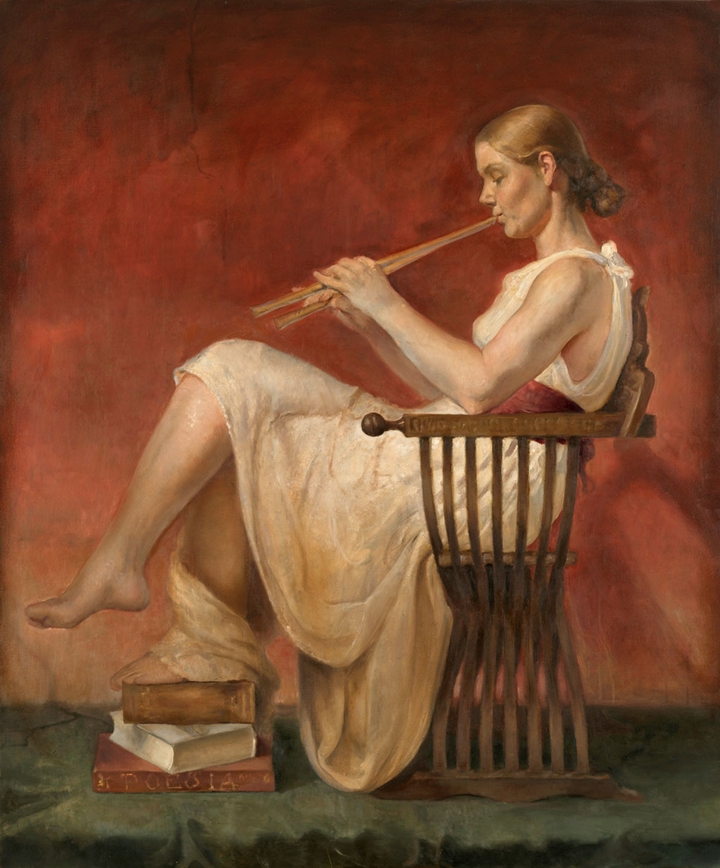
Euterpe - Apollo and the Muses - Helene Knoop 1979 - Norwegian Figurative painter - Tutt'Art@

EuterpeApollo and the Muses (2008 – 9)

Helene Knoop

________

if the piano sonata no 4 of Beethoven,
in E flat, opus 7, was academic, an
exercise, a display of technical
dexterity and some, admittedly,
even mighty, compositional verve,
it lacked, in my estimation, a centre,
a convincing motivating factor, a muse,
though ever ardent, ever entertaining,
it is ultimately arid, I think, trite, I’m
not, one is not, keen on returning to it

but in the piano sonata no 7, in D major,
opus 10, no 3
, Beethoven hits, I submit,
his stride, this sonata is enchanting

note the similarities of structure
between the two, the order of the
movements with identical, essentially,
tempo patterns, notably the middle
slow movement, in the first a largo,
con gran expressione,
slow with
great expression, in the latter, a
largo e mesta, slow with sadness,
where Beethoven plumbs, evidently,
the limits of pacing, the time lapse
between two notes, the capacity for
silence of this new instrument, the
pianoforte, of which he’ll look into
also, and even vigorously, its
capacity for volume, the crashing
introduction to his celebrated 8th,
for instance, to establish the
instrument’s new perimeters

you’ll note you can listen to the later
largo, the opus 10, no 3, forever, you
can get lost in its aural world, I can’t
think of anywhere else right now a
more profound largo

the other movements are dazzling
in their thrilling prestidigitation, all
organically sound, and, crucially,
motivationally centred, I think, this
is indeed music, magisterial music,
Beethoven’s not just kidding
anymore, he’s hitched onto his
proper inspirational deity, his own
private Euterpe, music’s muse, and
we’re in for something, from here
on, of a ride

note the cool riff closing off the last
movement, Beethoven in the guise
of Gene Kelly stepping in for a
breezy good-bye, prefiguring, of
course, XXth-Century music, and
the serendipitous extrapolations
of jazz

Richard

psst: incidentally, the headings, largo,
con gran expressione, largo e
mesta,
are entirely Romantic
musical notions, notations,
Classical composers would’ve
been too sedate, formal, courtly,
for such flagrant sentiment

Beethoven – piano sonata no 4, in E flat major, opus 7

though Beethoven’s piano sonata no 4,
in E flat major
, opus 7 has never been
one of my favourites, I’m finding this
particular renderin
g completely
enchanting

the opus 7 is, of course, early, when
you consider Beethoven reached into
the late 130s for his opuses, his opera,
not counting his, as bountiful, WoOs,
works without opus numbers

the sonata is steeped in Classical
conditions that are becoming ossified
at this point, about a decade after the
French Revolution, 1796 – 7, and that
have yet to be culturally overturned,
put to rest, you can hear it, you hear
the Classical form – formality, repetition,
congenial tonalities still – in the sonata,
brilliantly displayed by a composer
of ripe and rich imagination, but at
the service of structure rather than
the music itself, style over substance,
a student’s musical submission for a
composition exam

you’ll hear the repeat of the opening air
in the first movement more times than
you think is necessary, though the tune
be ever jaunty, never unpleasant, just
essentially trite, the second movement,
is a largo, a largo indeed, you’ll think,
about to fall asleep, even, at the wheel,
the later movements keep you
entertained in most interpretations,
not much, however, inspired, music to
pass the time, to check your watch by,
it needs what Beethoven will later
deliver in spades, miracles and
majesty, conviction

the opus 7 is long as well, nearly
interminable, I think, second only in
length to the sublime however
Hammerklavier, the 106, impudent
therefore, to my mind, if not outright
arrogant, in the mode of lesser artists,
Salieri, Clementi, for instance, who
never manage to transcend their,
however impressive, technical
expertise

but in this commanding account
maybe I’ve grown into the piece, or
maybe the performance itself is more
inspired – Joel Schoenhals finds
something that’s had me listen for
hours and hours, rapt, mesmerized

listen

Richard

psst: I needed this sonata for a course
I’m taking at Coursera, an Internet
learning site, on the Beethoven
piano sonatas
, the opus 7 is the
first one we’re looking at, this
performance
was the best one I
could find

join me

“Meditations”, Book 3 – Marcus Aurelius‏

“If thou workest at that which is before thee, following right reason seriously, vigorously, calmly, without allowing anything else to distract thee, but keeping thy divine part pure, as if thou shouldst be bound to give it back immediately; if thou holdest to this, expecting nothing, fearing nothing, but satisfied with thy present activity according to nature, and with heroic truth in every word and sound which thou utterest, thou wilt live happy. And there is no man who is able to prevent this.”

Meditations“, Book 3, 12

Marcus Aurelius

_________

the idea of the virtuous man, or the
interpretation of Marcus Aurelius of
such a person, goes back of course to
Socrates by way of Plato, 427 – 347
B.C., who’s ideal was primarily
political, what to achieve within a
political order, rather than a private
meditation, an advice rather than
a contemplation as in Marcus
Aurelius, 121 – 180 A.D., 550,
not inconsequential, years later

other moral perspectives meanwhile
applied, Epicureanism, for instance,
notably, after which the stranglehold
of Christianity produced not philosophy
but dogma, for a subservient and,
biblically labeled, fallen people,
nearly fifteen hundred years spent
trying to figure out how many angels
fit through the eye of a needle,
essentially, how many irrationalities
could prove the existence, and
authority, of a mandated God

René Descartes inadvertently in this
very quest, but not before 1637, put
an end to that, introduced a new, and
revolutionary, perspective, I think,
therefore I am
“,
which put the individual
instead of the Church in the driver’s seat,
this, if it didn’t bring on the Renaissance,
at least gave it a significant push

but because of his famous scientific
method
, studies afterwards in what
we now know as the humanities
became more empirical than
specifically moral, how do we
perceive rather than how do we live
according to what is right or wrong,
Nietzsche‘s Beyond Good and Evil“,
1886, reoriented that investigation,
as it happened, ominously, in an age
where any kind of god had become
irrelevant, Beethoven would be
transformed into a Hitler, an
uncomfortably fateful Übermensch,
Superman

now philosophy is concerned with
language, what do we mean when
we say what do we mean, and can
anybody understand that

our closest moralist, our modern day
Marcus Aurelius, is at present Miss
Manners
, whom I wholeheartedly
recommend

as well as, of course, Marcus Aurelius

Richard

psst: Miss Manners‘ question and answer
format, incidentally, is not at all unlike
what Plato does in his Socratic dialogues
,
she just has a larger, more flip audience

Pink Floyd‏

after Beethoven there was Pink Floyd,
just click

Richard

Mozart piano sonata no 11, in A major, K 331

again my especially musically erudite friend,
Norm, has returned with a catchy morsel, a
popularized version this time of the third
movement, the Alla Turca“, of Mozart’s
piano sonata no 11, in A major, K 331
,
possessed by the glitzy spirit, in this
outing
, of Las Vegas

these whet my appetite always for the entire
meal, the source from which these playful
tidbits originate, like an ebullient tributary
returning to its more elementary, and
profound, as it were, spring, a lost child
needing to return to its place of origin
for direction and validation

Mozart, you’ll note, is not Beethoven, though
he might be a not inconsequential Mozart, I
think of his stuff as music for the nursery,
toy soldiers and rocking horses, dairy maids
and cuckoo clocks, not at all to inform but to
delight, the musical structure is foursquare,
lilting ever, and entirely comprehensible,
Mozart just wants to have fun, with here
and there a nod to melancholy, perfect, I
would think, for a powdered and pampered,
though pilloried eventually, indeed
guillotined then, court

the first movement, you’ll remark, is a set
of variations, a bit of a novelty still during
this period, 1778 to 1783 approximately,
the date of composition is not precisely
known, which allowed for, of course, a
variety of styles, voices, to be flaunted
in one only section of a work, instead
of the usual call and response of,
ordinarily, the traditional movement,
extending already, incidentally, the
possibilities of the sonata form, which
later composers would make much
use of

neither of the next movements are
slow, Mozart, as I said, just wanted
to essentially enjoy himself, or his
sponsors did, music did, that’s
what they payed him for

but the times they were a’ changing

as indeed they still are

Richard

psst: thanks Norm

Liszt – piano concerto no 2 in A major‏

since discovering Tamás Érdi, feral hands,
uncommonly hirsute, but uncovering the
soul of a poet, an angel in wolf’s clothing,
a satyr, without a flute but, at the piano,
I’ve been hooked, combined with Liszt he
is again irresistible, not to mention totally
transcendental

you’ll find Liszt quite a bit like Beethoven,
but more bombastic than philosophical,
style trumps substance, Liszt was a
show-off, a pianistic Paganini

stylistic flourishes abound in the hands
of a deft, however uninformed might he
or she be, technical wizard, it doesn’t
take an Einstein, in other words, to be
a Puccini

and Liszt is a Puccini, who delivers
likewise, and for the very ages

note the same intensity as Beethoven
in Liszt, much of the same musical
idiosyncrasies, but with more dramatic,
late Romantic, alterations of tempo, he’ll
milk a phrase before returning to a more
Classical, which is to say, less elastic
beat

his extemporisations are also less
ruminative, more serendipitously
motivated, like jazz, Liszt wants
primarily to dazzle, kick around,
not instruct

and he does, masterfully, just that

here’s Alfred Brendel doing an alternate,
wholly incandescent version
I couldn’t
at all leave out

here’s Julie Andrews giving her take on
the history of jazz

Richard

Beethoven Strinq Quartet no 14, opus 131‏

if Beethoven had written merely one transcendental
work we would still have been beholden, but that he
wrote neither two, nor three, but several immutable
pieces is extraordinary, super-, apparently, human,
though, of course, manifestly not, unless you want
to bring Jesus into the picture as such a dual being,
then we’ll talk, but Beethoven is a staunchly secular
voice, devoid of the spiritual considerations of a
Bach, for instance, Beethoven speaks for humanity,
its longings, consternations, aspirations, its essence,
no longer the discredited primacy of the Cross and
Its imperial derivatives, Human Rights have trumped
God

what Beethoven maintains however is the reverence,
his later pieces – you’ve heard the Hammerklavier“,
already, the 32nd piano sonata – are manifestly
spiritual experiences, as opposed to religious

the 14th String Quartet will do the same

if the Hammerklavier is akin to Moses delivering
his peremptory tablets, the 14th String Quartet is
the Sermon on the Mount, in the history of music
they have so great an impact

briefly, as briefly as I can, I’ll say a few introductory
words, then let your soul and the music do the rest,
see what happens to your karma

there are seven movements in the 14th, uninterrupted,
no pauses between the movements, though each is
easily identifiable, tempo therefore becomes incidental
instead of Classically ordered, the first movement, for
instance, is an adagio, a Classically improbable spot

the sections therefore play much as chapters in a
novel, advancing according to the logic and emotions
of the moment, always, as in all of Beethoven, moving
inexorably forward despite the intricacies of the, not at
all predictable, plot, as had been the case in the more
regimented Classical model, Beethoven takes you,
instead of around the corner, into the clouds, into a
spiritualized heaven, a place of profound existential
introspection

try listening to the 14th String Quartet attentively
without thinking about your soul, its existence,
its mission, in the very face of its ineradicable,
and fateful, actuality, the human conundrum,
Beethoven lets us know we’re not alone

some mountaintop Sermon indeed, watch what
happens to your sensibility, your very sacred
self, or maybe I should say, listen

may your path be decked meanwhile with laurels,
and your days be blessed with grace, be it ever
so merely, maybe, human

who knows

sincerely

Richard

psst: if you’ll allow me to pursue my series of
similarities you’ll imagine piano sonata
no 32
as Beethoven’s “Last Supper”,
this one in particular five luminous stars

Schubert – Piano Sonata D959‏

to my utter surprise when I checked I’d never
but only once in the many months I haven’t
been able to shut up since I started spouting
my bristling endorsements, like a very rushing
river gushing with the overflowing bounty of
an inveterate spring, mentioned Schubert, an
incandescent voice from surely heaven

it was about his String Quartet in C major, the
D956, not surprisingly, it is utterly enchanting,
D for Otto Erich Deutsch still, incidentally

here’s an alternate version of it, an utterly
inspired one

but if I’ve reintroduced Schubert it’s specifically
this time to compare him with Beethoven, they’re
easily confounded, I even did it once myself, to
my crushing embarrassment, in erudite and
unflinching company, oof, I cringe to even
remember it

the D959, moments only after the 956 of course,
has all the idioms of a Beethoven, and exercises
them as expertly, the beat, however, is always
on, unlike Beethoven, whose beat is always off,
contrary, rebellious, against the prevailing
order

though this variance might seem slight, one
senses already in the younger and later
Schubert a return to form, elegance, and civility,
the First Empire had indeed taken hold during
the transformation of Napoleon from hero of
the Revolution to a different incarnation of
Emperor, Chopin as well would be beholden
to later similarly reinstated French courts

so seemingly trivial an alteration speaks
volumes when one attentively listens, one
must do this with one’s heart

such a return to aristocratic principles is not
uncommon, incidentally, we seem, indeed, to
thirst for dynasties, if you’ll note the return of
late, of the Bushes, the Clintons, and most
recently the Canadian Trudeaux

Putin is another, though arguably somewhat
less democratic, version of that principle

Beethoven is off the beat then, Schubert on, you
won’t find much else that’s different upon first
listening, you’ll note only that their music is very
much the same, rigorous beat, tonal, essentially,
harmonics, and the return eventually of the
melodies, Classical imperatives, but with the
distinction of the new Romantic,
transformational however, sensibilities

Schubert might’ve even outpaced Beethoven
had he survived, I think, but he didn’t, he died
much too young, at the most tender age of
only 31, younger even than the more
celebrated Mozart, famous for succumbing
prematurely at the still early age of 36

may they rest, may they all rest, Schubert,
Mozart, and the somewhat longer-lived
Beethoven, still early deceased at 56, in
eternal peace, for they have brought us
but wonders

Richard

psst: here’s a movie to go with the earlier
Schubert
, The Company of Strangers“,
the very best film Canada has ever had
to offer, bar none, a gaggle of old women
are stranded in the Laurentians after their
tour bus breaks down, Schubert would’ve
loved it

and been honoured

Beethoven’s piano sonata no 29, “Hammerklavier”, revisited, as promised

upon listening to Beethoven’s 29th sonata
one doesn’t imagine its originality, having
been showered for centuries now with its
miracles and majesties, nothing would’ve
been heard like it before, so great a project,
a work of not only temporal magnitude, an
astonishing fifty minutes, but evidently of
more than just mere entertainment, a work
of philosophical, even, amplitude

Beethoven is not just trying to delight, he’s
trying to engage here, bring together, stir,
more profound human responses, evoke
thought, responsibility, compassion, a
spiritual complicity in the new
post-Revolutionary secular order, he is
establishing new metaphysical ground

the subject is existential, the audience
no longer merely aristocratic, masses
now were talking, an affluent bourgeoisie,
artists were responding to a new Romantic
Age, about rights, and what it means to be
human, both men and women, incidentally
– and I stress that newly pertinent at the time
conjunction – above and beyond those of
God, for each couldn’t both hold the
supreme, the earlier Classical, pinnacle,
the rights of Gods and, by extension,
Kings, Queens if you lived in England,
Russia

secularism was needing new oracles

see Elizabeth Barrett Browning, for
instance, for the emergence of
women

see also, of course, otherwise,
Beethoven

the difference with Beethoven is that
he achieved, ultimately, profound
wisdom, I can think of no other
comparable poet, save, of course,
Marcel Proust, both of whom proved
to be, in the same breath, philosophers,
able to stake that exalted claim, certainly
no painter, a difficult medium through
which to philosophize admittedly, to
bring logical and existential constructions
together to enunciate a transcendental
vision

then again, before Proust and Beethoven,
who’d ‘a’ thunk one could’ve transformed
words or music into very grace, mystically
transubstantiated gold, notwithstanding
the misguided alchemists

Pink Floyd did some of that in the Seventies
but retreated into historic and more personal,
less oracular, reminiscences, philosophizing
isn’t easy, see the punishment of Prometheus,
or, for that matter, John Lennon

Beethoven was completely deaf by the time
he composed the Hammerklavier“, lost in
his own isolation, like Homer, blind to,
though obviously not unaware of, his art

not lost, not unaware either, more like
having been given extrasensory, outright
extraordinary, manifestly, perception

to our utter and everlasting, both of them,
benefit

Richard

Beethoven piano sonata no 29, the “Hammerklavier”

take a few minutes, well, nearly an hour,
to watch, imbibe, incorporate, integrate,
this video, to smell this miraculous
flower, Beethoven’s piano sonata no 29,
the monumental Hammerklavier“, the
equivalent, to my mind, of the Eiffel
Tower, the Coliseum, the Parthenon,
Homer’s Iliad“, I promise it will
transform you

I’ll talk about it later, I also promise

Richard

psst: you might need some Kleenex