Richibi’s Weblog

Just another WordPress.com weblog

Tag: Beethoven

at the XVth International Tchaikovsky Competition – the program‏‏

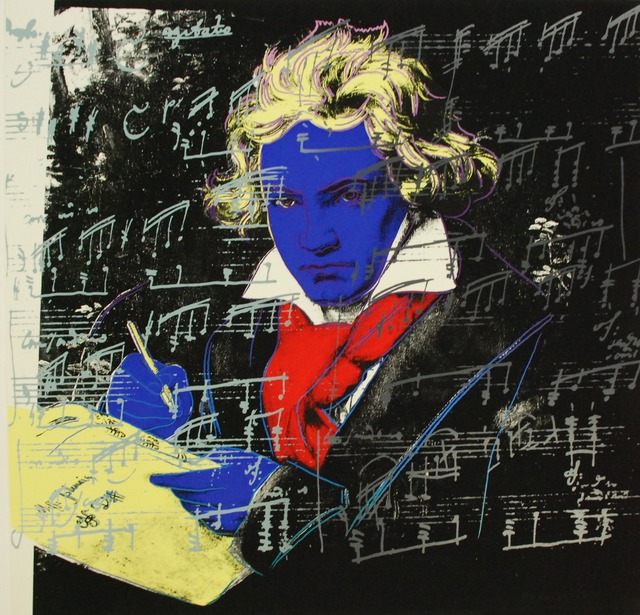
"Beethoven, 1987" -  Andy Warhol

Beethoven, 1987 (1987)

Andy Warhol

______

you’ll probably have noted, if you’ve
been following the Tchaikovsky
Competition
, that, unlike the
Rubinstein, the selection of works
is much more constrained, though
the mighties nevertheless
predominate

after the third day and into the
fourth, only one contestant has
started with anything other than
Bach, a Tchaikovsky

but unfortunately none of them but
one had given us a Bach worthy of
his name, then followed through
with, not surprisingly, a quite
competent Mozart, the cultural
conditions being not yet all that
different, aristocrats were looking
for their own music instead of the
church’s, secular instead of
ecclesiastical, therefore a tune
rather than an oratorio, Beethoven
and the Revolution would change
all that

afterwards a sonata of Mozart,
Haydn or Beethoven, the Classical
triumvirate, after which Tchaikovsky,
appropriately at this competition,
then études, either “-tableaux”,
“transcendentales”, or plain and
simple, by Rachmaninov, Liszt, or
Chopin, that’s it, you get to hear
the “Appassionata” or the “Grandes
études de Paganini”
several times
that way, sharpening discernibly
your musical ear

one was riveting, Andrey Dubov‘s

another, Lukas Geniušas transfixed
me with his opus 2, no 3, of
Beethoven, a work I usually only
ever tolerate, sending it soaring
into the bard’s later mature, and
revelatory, period

others have been competent, even
admirable, several, however, not
ready for this trial, they’ve come
without adequate preparation for
the ball

though I’ve been watching it in
my pajamas, I should talk

Richard

at the XVth International Tchaikovsky Competition‏ – June 16, 2015

Emmanuel Rimoldi

Emmanuel Rimoldi

__________

perhaps was I precipitous in my prompt
appraisal of a promising participant on
the first day of the XVth International
Tchaikovsky Competition, for every
other pianist, but two, was not
unequal to the plaudits I’d earlier
pronounced for this powerful
preliminary performer

it appears there are, indeed,
several

after an egregious error in her
Beethoven, a rhythmic miscalculation
that erupts like breaking wind at a
formal function, and needs to be
recovered by something, someone,
who will, which will, overwhelm the
unwelcome air, Maria Mazo quickly
rallies and delivers a Beethoven
you’re not likely to forget, followed
by a bouquet of other marvellous
concoctions

but Emanuel Rimoldi eventually
wins the day, June 16th, to my mind,
with a resplendent, and revelatory
Mozart, followed by other equally
dazzling interpretations

check them out

Richard

Paganini’s First Violin Concerto – Akiko Suwanai‏

Jean Auguste Dominique Ingres - "Niccolo Paganini" (c.1819)

Niccolo Paganini (c.1819)

Jean Auguste Dominique Ingres

_____________

for Apollo, who alerted me to my error

having egregiously misspelled “Akiko”
in my recent commentaries about Ms
Suwanai, since, however, corrected, I
can only heap upon her greater praise
now for again an immaculate
performance of, this time, Paganini’s
First Violin Concerto
, itself an event,
as atonement

not only does she play this thrilling
masterpiece
with precision and
consummate artistry, this is the
performance with which she wins
the Tchaikovsky Competition, the
one Van Cliburn had secured so
illustriously back in the late Fifties,
at the height of Soviet Communism,
she in 1990, moments only after its
fall, a full, now, 25 years ago

it astounds me that such a talent
would’ve taken so long to reach my
ears, which have been attuned to
Classical music and its
peregrinations for as long as I can
remember

then again there was no ticker tape
parade for Ms Suwanai when she
triumphed
, the world has changed,
it seems such excellence is no longer
so universally paraded, not even
much advertised

the Paganini Violin Concerto was
composed around 1818, late
Beethoven, early Chopin, Paganini
defines for the violin the Romantic
Period, what Chopin did for the piano,
Beethoven had given them the push

if you can get past your astonishment
you’ll note that the foundation of the
piece
is Classical, tight tempi, tonality,
no discordant notes, and repetition
always of the themes, still the triple
pillars of our understanding of music,
its Trinity, despite some strong forays
into their deconstructions, see, for
instance, the haunting George Crumb

what Paganini adds to Classicism is
personality, Romanticism, same as
Beethoven did, and at about the
same time

aristocratic formality was giving way
to the voices of the crowd, some highly
articulate, representative, formidable,
as the shackles of servitude fell with
the French Revolution and human
rights became central, and
indomitable

Richard

“Six Pictures for Piano” – Arno Babajanian‏


Paul Gauguin "Poèmes barbares" (1896)

Poèmes barbares (1896)

Paul Gauguin

_______

if you thought that Arno Babajanian was
done with synesthetic investigations,
seeing sounds, hearing colours, here’s
his Six Pictures for Piano“, which he
plays, all of them, himself

can a piano paint, take pictures

you tell me

something else interesting is happening
here, the six are individual pieces despite
being part of a common whole, as the title
suggests

this is the opposite of trying to integrate
movements to a continuous and unfolding
conception, something Beethoven, for
instance, pursued, indeed ardently, in his
own sublime music

dissociation seems a context, a XXth-,
a XXlst-Century, context, in our presently
more polarized world, according to, of
course, Babajanian

what might hold us together then

maybe music

incidentally, the movements to the
Six Pictures here are

1 – Improvisation
2 – Folk Song
3 – Toccatine (a little toccata)
4 – Intermezzo
5 – Choral
6 – Sasoun Dance (don’t ask),

should you not be able to read Russian

note, none of these themes are
photographic

don’t either miss Babajanian‘s
Sonata for Violin and Piano
as played by, here again,
himself, it’s rapturous

Richard

psst: see Gauguin above paint poems

my reply to BookInhabiter, a.k.a. Brain

a reader writes

“Hello Richard,
Recently I’ve been watching up on many dance competitions. I knew of the existence of piano competitions but never thought that they would be filmed. I must listen to the top contenders. How did you hear about this competition?”

here is my, admittedly extended, answer, with pertinent links

Richard

_____________


I haven’t missed So You Think You
Can Dance
“,
Brain, for 11 years, so
we’ve probably been watching the
same “many dance competitions”

“piano competitions” aren’t much
different, just another art, judged
here by professionals throughout,
rather than entire publics

the competitions are fierce, to a
person the competitors are world
class

the music is often sublime, utterly
transcendent, though more rigorously
intellectual than popcorn – pace
Mozart – this puts some people off

much as you probably find covers of
songs you like, I go out looking for
sonatas, string quartets, concerti I
already know of and admire, I check
out the big names, Chopin, Beethoven,
Rachmaninov, see what might be up

the Internet abounds with nearly
anything you might want to find, the
only obstacle is the quality

the Van Cliburn competition, from
Houston, was dreadful, enough to
put me off it, but looking for musical
counterparts to pieces of interest, I
found the Rubinstein one in Tel
Aviv
offering sterling performances

I quickly flew across the globe,
virtually, of course, speaking

the experience has been well worth
it, I heard miracles of music, haven’t
had so much fun since reading Proust,
in French of course, but you must
understand I’m an inveterate egghead,
totally chronic

this week I started Edward Gibbon’s
The Decline and Fall of the Roman
Empire”
, text and, to my delight,
audiotape, its reader is extraordinary

check out the Chopin Competition
for, up to this point anyway in my
investigation, only Chopin, but he’ll
do for a significant while, his music
is consistently breathtaking

I’ll also check out the Russian
Tchaikovsky Competition, which Van
Cliburn made famous for us in the late
50’s
, by winning it, despite the rancours
of the Cold War, with a still paramount
rendition of Tchaikovsky’s own
monumental First Concerto

wow, I’ve been hooked ever since

thanks for stopping by my blog, Brain,
you’ll find, incidentally, a lot of excellent
performances highlighted there, several
of the best, in fact, from the most recent
Rubinstein Competition
, none of which,
to my utter consternation, managed to
win

other recommendations follow, check
it out

I think your blog is wonderful, keep
it up

Richard

Ran Dank

Mount  Everest

Mount Everest

_________

though I’d only just listened to a full
recital at the Rubinstein Piano
Competition
, a peek at the next
performer’s program, left me unable
to not watch another, Ran Dank would
be playing, along with four pieces of
Chopin, three mazurkas and his A flat
major Polonaise, itself a towering
musical monument, Beethoven’s
“Hammerklavier”, the very pinnacle
of piano music, nothing surpasses in
majesty and stature the
“Hammerklavier”, the Mt. Everest of
music, a competent reading will
change your life, it is that good

Ran Dank doesn’t disappoint, I left
the planet

Richard

the 14th Arthur Rubinstein International Piano Master Competition

Thomas Gainsborough - "The Blue Boy (Portrait of Jonathan Buttall" (1770)

The Blue Boy (Portrait of Jonathan Buttall) (1770)

Thomas Gainsborough

____________


if you’ve missed me lately, it’s because I’ve been
in Tel Aviv for the past week, virtually of course,
taking in the 14th Arthur Rubinstein International
Piano Master Competition
, and they’re not kidding,
every challenger to date has been at the very least
astonishingly dextrous, sparkling even, though
some have been hampered by their own dire
program, with the unfortunate added condition
that, for all, they must integrate one of two
commissioned works that, to my mind, are
completely uninspired

other performers have been astounding, lots
of Beethoven of course, Chopin, Liszt, the
technically utterly daunting

among the moderns Ravel takes centre stage
as an option, with too many, to my mind, of his
tedious pieces,“Gaspard de la nuit”, yawn,
“La [, yawn again] valse”

but Bartok pops up, and Prokofiev, a great set
of variations by Szymanowski, unexpectedly,
and, at one point, a completely irresistible
Ligeti, more of which later

Nikolay Khozyainov starts with the only Ravel
I’ve been able to sit through without getting
impatient, “Gaspard de la nuit” to my mind
should stay there, “La valse” should
immediately stop, but Khozyainov‘s “Pavane
pour une infante défunte”
, or “Procession for
a Deceased Princess” was everything you
would want in a dirge, solemn, transcendental,
transfixing

he follows up with a Liszt to knock your socks
off, “Feux follets”, “Fireflies”, fleet as the night
air, as mesmerizing

the final Rachmaninov sonata reminds us of
how wonderful Rachmaninov really was

watch, listen

Richard

from Beethoven to Pink Floyd


in juxtaposing inadvertently recently
Pink Floyd’s “Dark Side of the Moon”
with Beethoven’s String Quartet no 14
in C# minor, opus 131
, I was once again
struck by how one resembled implicitly
the other, both had achieved structurally
an operatic concert, an original musical
form for each their epoch, a piece of
instrumental music – with, even with
Beethoven eventually, voice – see his
9th Symphony for that – in the form of
opera

stay with me

songs started off as ditties, see, for
instance, in our time, She Loves You“,
the Beatles, in Classical music that’s
the equivalent of a Mozart sonata,
quick, easy to hum along with, and
spirited

then MacArthur Park came along, in
1968, with a song twice the length,
seven minutes and some, of anything
heard before, check out Jimmy Webb,
Richard Harris, and the process

that sounds a lot like Beethoven, I
thought, throw in extrapolations of
symphonic proportions and that
sounds a lot like Beethoven too,
saying, this is not just pretty, people,
it’s potentially momentous, listen

Sgt. Pepper’s Lonely Hearts Club
Band
then put several compositions
together, without breaks, to give us
the first concept album, an
uninterrupted flow of various musical
ideas held together by an, however
inexplicit, theme

or MacArthur Park“, in other words,
amplified

in 1826, it had been Beethoven’s 14th,
where all this started out, no one had
ever done this sort of thing before,
confounded so intimately contrasting
musical forms, but he’d got it from
the Christian Mass

thus Beethoven, a secular prophet

and thus, in his eminent footsteps,
Pink Floyd, solely, among
contemporary artists, addressing
God

it all seems nearly inevitable today,
but it was 1968 then, a time of, if
you’ll recall, revolution

and all of these had been, for better
or worse, once again, our rallying
cries, anthems, towards a better
world

Richard

“I’ve Got a New Attitude”‏


as the Beatles once sang, Roll Over Beethoven

I’d been touching up my blog, specifically my
Elizabeth Barrett Brownings
, which WordPress
had to my dismay defaced, when one of my
submissions, the XXXlst, gave me the choice
of his Appassionata or Patti LaBelle, to
accompany me on the dishes, my ritual
homage to Sisyphean labour before the
limitless

both are electrifying

but I opted for a change, the effect of, maybe,
springtime, chose Patti, who’d awakened by
her very name a world of magical memories
for me, even inspiring me to find finally a
long lost friend, an ardent fan, then, of Patti

I looked for an appropriate, concert, length,
enough to finish my dishes, this is what I
found

I’ve been hooked on divas ever since

I hope you’re also enjoying them

Richard

psst: more Patti

Beethoven, piano sonata no 15, opus 28‏


Beethoven’s piano sonata no 15, opus 28,
the Pastorale, is all about nature,
efflervescence and spring, one of my very
favourites, I call it his Johnny Appleseed
Sonata

in this instance, something I’ve never
experienced before, Tomoki Sakata made
me feel as though I were his instrument,
responding to his fingers, something
entirely transcendental, but with
rushes running up my spine

Classical music indeed

watch

if you dare

Richard