Richibi’s Weblog

Just another WordPress.com weblog

Tag: Beethoven

November / Month of the Sonata – 12

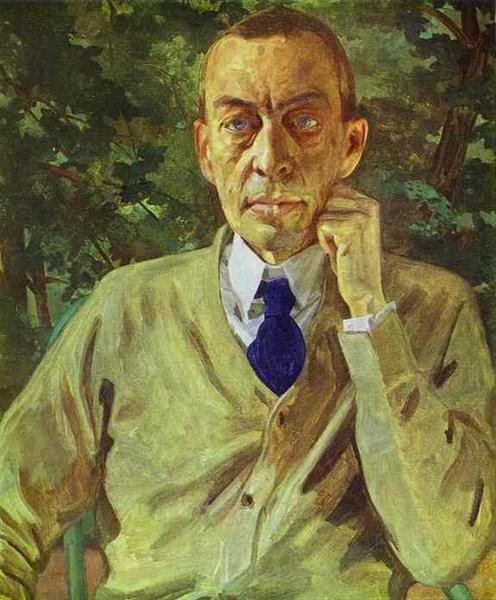
Portrait of the composer Sergei Rachmaninov, 1925 - Konstantin Somov

      Portrait of the Composer Sergei Rachmaninov (1925) 


              Konstantin Somov


                     __________


Rachmaninov, late Romantic, early

Impressionist, yanked, despite his 

modern bent, Romanticism, solidly,

into the Twentieth Century, we 

heard him in movies, and 

consequently on TV, back then, on 

long-play albums, 78s at the time, 

that were flooding the market, first 

movement on the one side, the next 

two on the other, that’s how we used 

to listen


later, we’d hear Sergeant Pepper’s 

Lonely Heart’s Club Band doing the 

same, in the late ’60s, before discs


Rachmaninov doesn’t sound like 

Chopin, Beethoven, Schubert, but

you can hear their roots, their blood 

running through his compositions


but here, in his Piano Sonata no. 2,

Opus 36, he elaborates, a sure sign

of Impressionism, intellectual rather

than emotional appeal, something 

had become tiresome after half a

century of Romantic dramatization,

how many Anna Karenina‘s can you 

take


the culture was returning to objective,

rather than emotional, Charles Dickens,

Victor Hugo, and the like, bleeding-heart,

considerations, and seeking out more 

rational answers to our psychological

stresses, consequently Freud, music

had to keep up


later, I’ll tell you a story about how 

music changes the world


meanwhile, here’s Rachmaninov’s

Piano Sonata no 2


enjoy


R ! chard

November / Month of the Sonata – 9

      Jules Delsart


           ______


at the end of the Romantic Period, 1886, and

encroaching on the upcoming Impressionistic

Era, César Frank wrote his Violin Sonata in

A major, a musical glimpse into a new age,

this is not Chopin, not Beethoven, not 

Schubert, despite obvious, if you’re 

listening, homages, references


you’ll note the atonality, musical progressions 

that seem askew, eccentric, not as harmonious 

as those earlier composers, like a neurosis 

taking over


tempo, a second essential element of music 

in the West, however changeable might it be, 

even within the individual movements, is 

recognizable


repetition, the third pillar of Western music 

is keeping us on track, bringing us back to

the original statement, to the air each 

movement presents at their several 

introductions 


Frank’s sonata was so appreciated by an

accomplished cellist friend, Jules Delsart,

that he asked if he would transcribe it for 

cello, their joint Sonata in A major for 

Cello and Piano remains to this day a 

stalwart on the cello circuit


compare, an exercise in sharpening your

aesthetic pencil, try it, enjoy


R ! chard

November / Month of the Sonata – 8

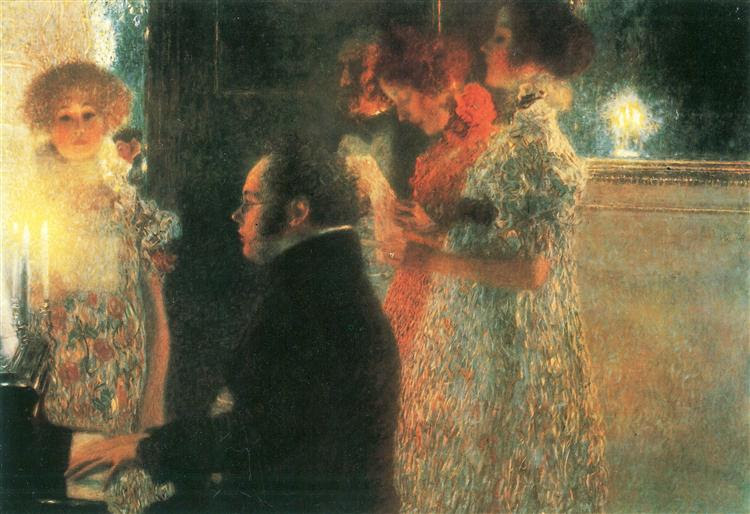
Schubert at the Piano II, 1899 - Gustav Klimt

    Schubert at the Piano II  (1899)


           Gustav Klimt


                 ______


before going any further, it’s about time

I brought up Schubert, had he survived, 

he might, I think, however conservatively,

have rivalled Beethoven


he died at the age of 31, of a sexually

transmitted disease, I believe the reason

for his relative obscurity


but he is titanic


listen to one only here of his sublime piano 

sonatas, his Piano Sonata No 21 in B-flat 

major


though one mustn’t discount his other 

transcendental masterpieces, his D956

for instance, for string quintet, is, well, 

characteristically, transcendental, 

you’ll leave the planet, I promise 


listen 


enjoy


R ! chard

November / Month of the Sonata – 2

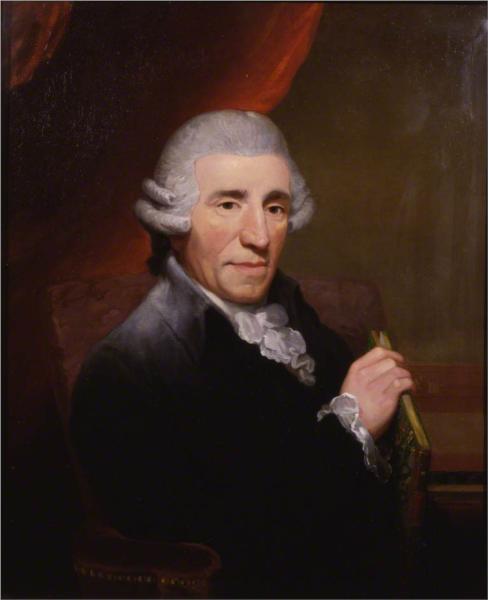
Joseph Haydn, 1791 - Thomas Hardy

     “Joseph Haydn (1791) 


           Thomas Hardy


               ________


Haydn, profoundly underrated, was the

other pillar of Classical music during that 

period, Beethoven, with half a foot only 

in that era, uses its elements to yank us, 

yelling and screaming, into the next, the 

Romantic Era, 1800 to 1870 more or less, 

more about which later


if Haydn sounds a lot like Mozart, it’s that

this piece was also written in 1789, both 

were catering to the aristocracy, courts, 

salons, music was therefore frivolous, 

meant to be entertaining, not inspirational,

trills, a lot of decoration, technical agility,

prestidigitation over profundity


Beethoven will change all that, stay tuned 


meanwhile, listen to, enjoy, Haydn’s Piano  

Sonata in A-flat major, no 31, Hob XVI-46,  

today’s prescribed apple


R ! chard

November / Month of the Sonata – 1

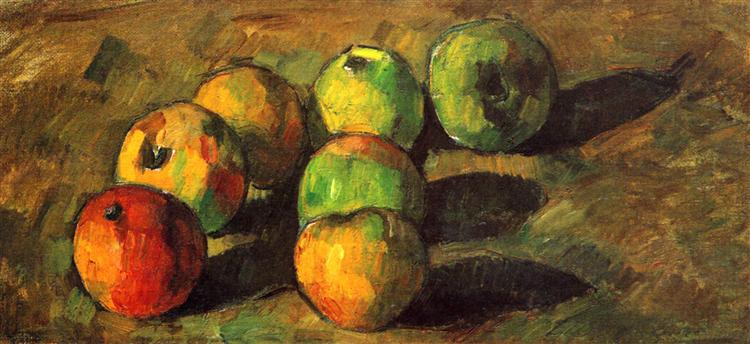
Still life with seven apples, 1878 - Paul Cezanne

      Still Life with Seven Apples (1878) 


               Paul Cézanne


                      _____


a sonata is to the concerto what an apple

is to an apple pie, its essential component, 

after which the rest is decoration, however 

inspired


sonatas existed before Mozart, but he’s 

the one, along with Haydn, as well as

early Beethoven, who put them on the 

musical map, 1750 to 1800, more or 

less


it seems to me appropriate, therefore, 

to start my Sonata Month then


here’s something by Mozart, 1789, his 

last piano sonata, No. 18, in D major,

K. 576


three movements, fast, slow, fast – allegro, 

adagio, allegretto – a perfect example of 

the sonata as it was establishing itself

then, a piece of music consisting of 

several distinct sections, movements, 

meant to highlight contrasts, musical 

agility in the artist, compositional 

imagination


listen, enjoy


R ! chard

how to listen to music if you don’t know your Beethoven from your Bach, XII – on rhapsodies 

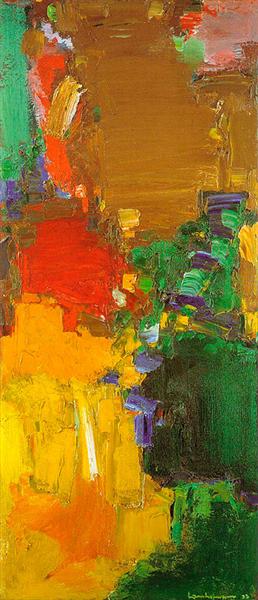
Rhapsody, 1958 - Hans Hofmann

   Rhapsody (1958) 

           Hans Hofman 

                       _____


if, in my last instalment, I compared iconic

funeral marches, let me do the same for

a couple of iconic rhapsodies, another 

musical form that came and went, that’s

come and gone, but not forgotten

what’s a rhapsody

as far as I can make out, it’s much the 

same as a fantasia, if you can remember 

what a fantasia is, a free form composition, 

but with a Romantic, which is to say a 

heartfelt, twist, more pathos, less 

technical wizardry


Gershwin wrote his Rhapsody in Blue 

in 1924, you can hear New York, Times 

Square, Broadway, from the first wail 

of the languid horn


Rachmaninov’s Rhapsody on a Theme

of Paganini, written in 1934, ten years 

later, gives you, however, Vienna, its 

Romantic Period, the traditions of, 

a century earlier, Beethoven, Schubert 


Rachmaninov is personal, introspective,

tragic, Gershwin is extroverted, social, 

fun


Rachmaninov looked back to his 

European, Old World, traditions, 

Gershwin augurs an entirely new 

voice 


listen, you can hear it 

enjoy


R ! chard   

how to listen to music if you don’t know your Beethoven from your Bach, Vl

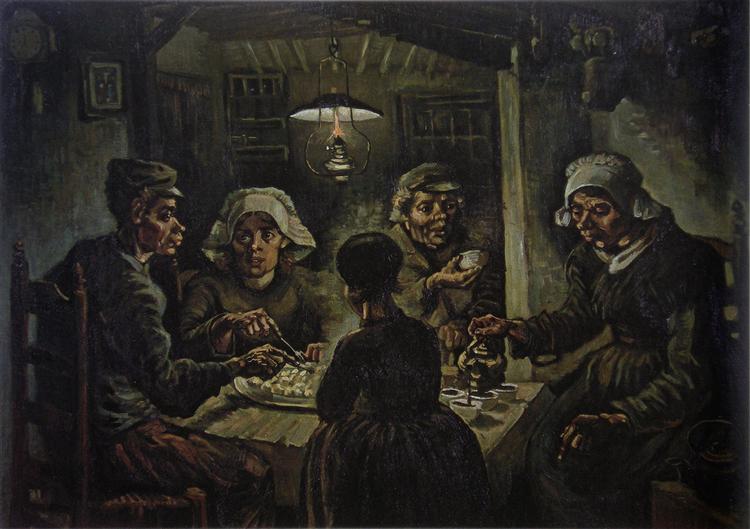
The Potato Eaters, 1885 - Vincent van Gogh

            The Potato Eaters” (1885)


                   Vincent van Gogh


                        ___________


where do you start with Chopin, he is

in our Western cultural bloodstream,

as identifiable in music as, say, van

Gogh is in painting, you don’t need 

to be interested in any kind of art to

have not been given even only a

whiff of these iconic artists


nearly anything I might present here

of Chopin you’ve probably already

heard somewhere before, if only in

bits


of van Gogh, well, he goes back in

the public imagination to at least

Vincent1971, the song, no one

doesn’t know about him, when I

heard it playing in Amsterdam at

the museum, with the first piece I

saw, The Potato Eatersdominating

the first wall, insisting on van Gogh’s

vision, his prophecy, his profound

compassion, I cried, I understood

what art is, see above


Chopin exerts a different kind of,

however equally potent, magic


Mozart might sound like Haydn,

Beethoven might sound like

Schubert, all of the Impressionists

sound like all of the Impressionists,

be they Ravel, Debussy, Satie, or

Saint-Saëns, to the untrained ear


but no one sounds like Chopin,

he’s, culturally, a North Star


here’s one of his nocturnes, the

moonlit one, in E flat major  


here’s a polonaisehere’s an étude,  

in English, a study, a finger exercise,

an iconic, here, prestidigitation


here’s an impromptu, his very,

indeed, Fantaisie-Impromptu, just

to get your categories going


consider its construction, having

some information already about

fantasias, a work of the imagination,

open to any experimentation within

the confines of one movement, with

an impromptu, something purported

to have been created on the spot,

also in one movement


the answer requires you to sharpen

your aesthetic pencil, always a

delight – an impromptu, a

spontaneous invention, a fantaisie,

a work of the imagination, how do

they differ, which part is a fantaisie,

which an impromptu, how do they

nevertheless coalesce


this exercise is the first step in

listening


enjoy


R ! chard

art in a time of crisis

prelude-to-alice-1955.jpg!Large

     “Prelude to Alice (1955) 


         Charles Blackman


               __________


in all the fallout from the very early 

reactions still to the present global 

crisis, self-isolation, a retreat from 

the, not only usual but consolidating, 

aspects of our communal interactions, 

there remain effective manners of 

dealing with this sea, this profoundly 

existential, change we are viscerally

experiencing


a social animal is being asked to 

eschew – Gesundheit – social contact, 

this is not an inconsequential ask


religions might’ve earlier been common

recourses for many believers, but the 

restrictions on assembly are already

impeding such solutions, we are left,

therefore, to find personal answers to 

our prescribed isolation – what do I do 

with my time, how do I subsist when 

my supports are disintegrating 


let me suggest immersion in the lessons

art has bequeathed us through the ages


it isn’t a bad time to review, for instance,,

the majesty of Homer’s Iliad, Ovid’s 

Metamorphoses, his interpretation of 

the origin of the world, its genesis, 

Shakespeare’s tragedies, Beethoven’s

transcendental music, since many of us 

are confined to our homes


rather than rue, bristle, use our time, I

suggest, to contemplate, learn, discover 


in looking for flowers recently, for a 

friend who’s undergone her own 

private agony, unrelated to the 

recent international medical crisis,

I fell upon, again, the magical 

inventions of this utterly inspired 

painter


like many other, even celebrated, even 

revered, artists, this, however insulated,

however apparently isolated, visionary,

with the strength of his inspiration, 

gives weight to the power of mere 

poetic passion, a thrust towards what

is thought of as beautiful, however

individual, suggesting that each our 

own aesthetic is of value, when

fervently followed, pursued,

check him out


meanwhile, I’m learning to sing, creating 

a repertoire, what have I got to lose


R ! chard


“Années de pèlerinage”, 2nd Year – Liszt

petrarch.jpg!Large

     “Petrarch (c.1450) 


           Andrea del Castagno


                     ___________


                                    for John, who would’ve 

                                                       been 60 today


though the suite might’ve started with

Bach’s string of dance pieces in the 

early 18th Centuryit becomes evident 

during the 19th Century, after a lapse 

of nearly 100 years, while it fell into 

disfavour, that its resurrection as a 

valid musical form might’ve kept the 

original structure, which is to say its 

several separate parts to make up a 

whole, its movements, but that it 

now was serving different purpose 


where music had, through to the early

Romantic Period, followed dance 

rhythms, or variations of tempo,

adagio, andante, allegro, and the like,

it now presented itself as a background

for settings, be it ballets, as in

Tchaikovsky’s, plays, as in Edvard

Grieg’s celebrated , Peer Gynt Suite“,

after Ibsen‘s eponymous play,

specific locations, as in Debussy’s

Children’s Corner“, or more  

expansively, both geographically

and in its compositional length,

these very “Années de pèlerinage” 

of Liszt


this is in keeping with the exploration

of consciousness of that era, which 

would lead to not only Impressionism, 

but to Freud, and the others, and the 

development of psychoanalysis


you’ll note that music seems much 

more improvisational in Liszt than in

Chopin, or Beethoven, prefiguring

already even jazz, more evocative,

less emotional, more personal, not

generalized, idiosyncratic, a direct

development of the newly acquired

concept of democracy, one man, at

the time, one vote, one, indeed, 

voice, however individual, however 

even controversial 


listen, for instance, to Liszt’s “Années

de pèlerinage”, 2nd Year, Italy 


   1. Sposalizio

   2. Il penseroso

   3. Canzonetta del Salvator Rosa 

   4. Sonetto 47 del Petrarca 

   5. Sonetto 104 del Petrarca 

   6. Sonetto 123 del Petrarca 

   7. Après une lecture de Dante: Fantasia Quasi Sonata 


today you can listen to suites 

from famous films, for instance 

Blade Runner“, the beat, in 

other words, goes on


but note the renovations, find them, 

dare you, you’ll be surprised at 

your unsuspected perspicacity


listen


R ! chard  

on the third day of C***mas

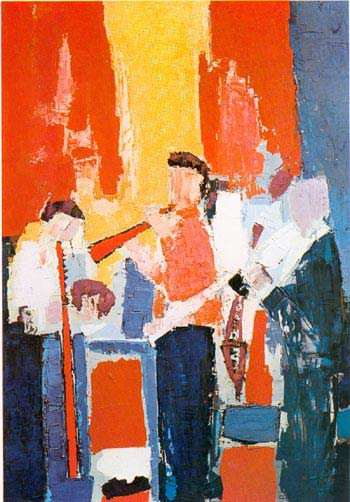
les-musiciens-1952

   “Les musiciens (1952) 


        Nicolas de Staël


           ___________


on the third day of C***mas, I needed to 

ready myself for the onslaught, I was 

hosting, yikes, for someone from out

of town


I thought I’d had it all figured out, but 

obstacles occurred, of course, to my, 

nearly cowed, consternation


needed help


I’d anticipated more violin concertos 

to get me going, but, among my 

several bookmarks, King Crimson

came up, a group I’d admired 

tremendously in my formative years,

the 70s, when freedom of expression

prevailed, in all of its innocent

expectations


they are tremendous, if you like that 

sort of thing, entirely progressive 

rock


you’ll think me eccentric if I relate 

them to Classical considerations, not 

only are they rigorous about tempo, 

tonality, and repetition, essential 

Classical components, but reach 

further into even tribal configurations,

their minimalism – later formalized by,

incidentally, Beethoven – of infinitely

repeated rhythms, like thumping, 

intoxicating, essentially, thrusts,

heartbeats meeting heartbeats, very, 

in other words, primitiveprimeval


add to that, later, their superimposed 

atonal riffs – Jimi Hendrix meets the 

jungle – a direct reference to 

Schoenberg‘s breakdown of the 

orthodoxy of the musical scale, and

cadence, and reiteration, you’re left 

with a history of our culture’s sonic

aspirations in a single incandescent

concert, despite a couple of egregious 

commercial interruptions in the

download, a 21st-Century, it seems, 

corporate roadblock


watch, enjoy 


R ! chard