November / Month of the Sonata – 24
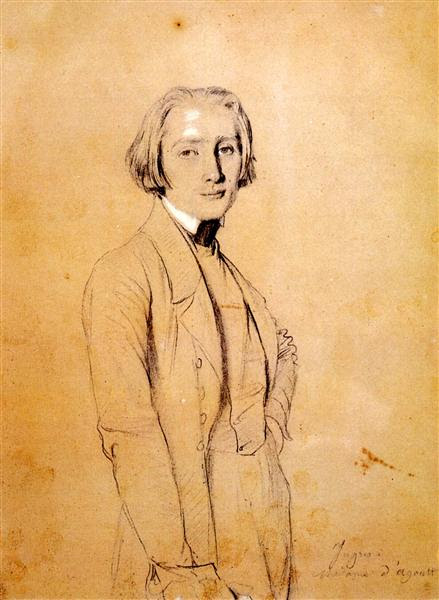
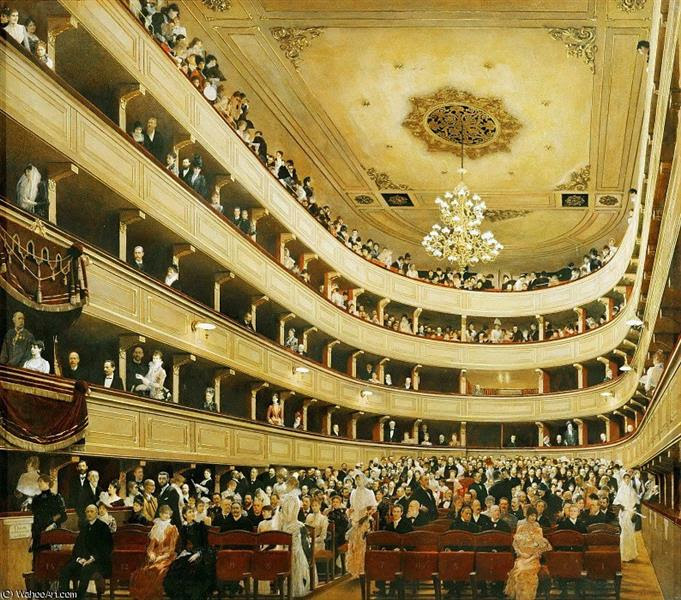
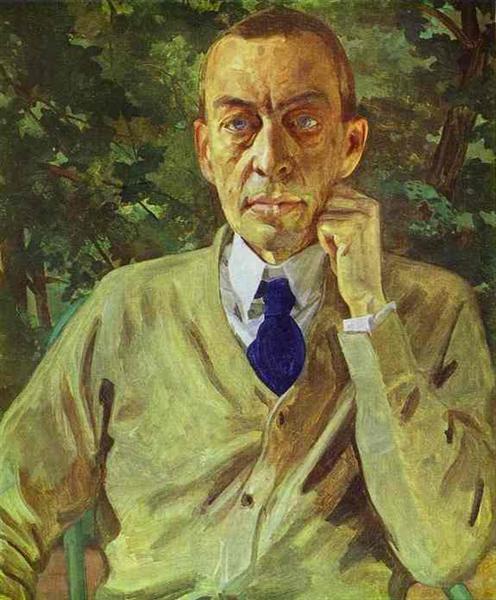
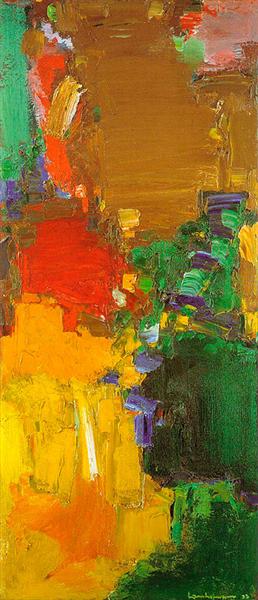
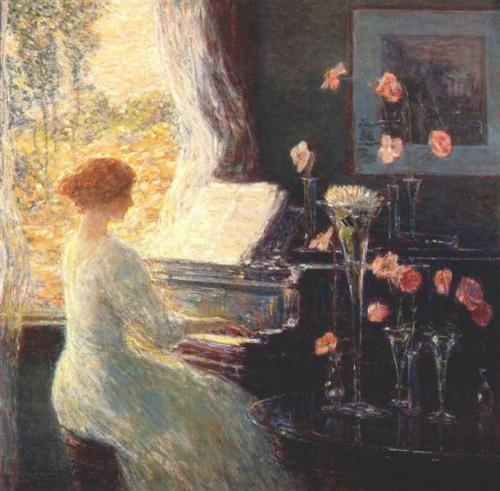
“Rhapsody“ (1958)
come and gone, but not forgotten
what’s a rhapsody
___________
for Sarah and Rachel, the daughters
of the son of a dear cousin, after a
belated lunch recently, two young
girls, 14, 16, in bloom, as Proust
would say, who speak not only
music, but French and English,
fluently, I checked – perhaps
even German, their Oma
lives with them – they also
play the flute, the piano,
and sing, what could be
I ask you, more beautiful,
two young girls in bloom,
indeed in very blossom
or am I being too French
the form of the sonata had been established
decisively during the Classical Period, out
of the rudiments of Bach’s own such pieces,
Mozart and Haydn had given the concept its
final shape, its structure, three or four
contrasting movements, by definition all
entertainments
Beethoven kicked the entertainment part
right out of the ball park, made his show
into a veritable transcendental meditation,
rather than to merely applaud, audiences
gasped, were meant to be awed, as I still
ever am by his musical speculations
but by definition as well, a sonata is a
piece for a single instrument, therefore
inherently introspective, whether the
player has an audience or not, soloists,
note, play easily on their own
even an accompanied sonata, as violin
sonatas often are, for instance, or this
one for two pianos, would lose the
intimacy of a solo piece, for having
someone playing, however compatibly,
over one’s shoulder
in other words, a piano sonata is, by
definition, a monologue, a soliloquy,
where notes tell the story that words
would intimately, even confessionally,
in poetry, convey
the emotions that are elicited from
a piece are as real as they would
be from any literary alternative,
except that they’re quickened, like
aromas, through the senses, rather
than through divisive, by definition
confrontational, logic
rosemary reminds me always, for
instance, of one of my departed
aunts, like the taste of a madeleine
dipped in tea opened the door for
Proust to an entire earlier epoch,
the seed, the subject, of his
disquisition on Time, “À la
recherche du temps perdu“, “An
Exploration into Elapsed Time“,
my own translation, none of the
published proffered titles
having rendered the subtlety
of the shimmering original
rosemary, in other words, speaks,
if even only to me
listen to Tchaikovsky’s First Piano
Sonata, in C# minor, opus 80, one
of only two of his, what do you
hear, think, feel
R ! chard
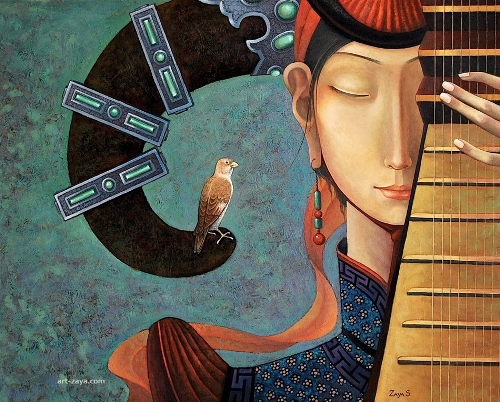
“Musician“
__
for Ian, who surely
benefitted from my
intransigeance
after watching performed the first movement
of Beethoven’s 14th String Quartet at home
with a friend, I interrupted the piece and
instead put on the one I’d found with
computer graphics
not from the beginning, he said
yes, from the beginning, I retorted, a mere
six or seven minutes which’ll be worth it, I
insisted, and they were
four lines of music, the top one yellow for
the first violin, red for the second, mauve
for the viola, and blue for the cello, which
individually advance according to the
length of each instrument’s notes, the
height, meanwhile, of the lines indicate
pitch, top ones high notes, bottom lines
low, it’s like watching a blueprint of
what’s happening, and mesmerizing, a
musical score in very motion, though
without, admittedly, the bar lines, nor
key and time signatures, clefs neither,
for that matter
the music meanwhile is transcendent
Beethoven here resolves all the issues
I brought up about his two early Late
Sonatas, grab bags of fine tunes but
without a centre, cuts on an album,
rather than the visionary
pronouncements of the prophet I’ve
come to expect from Beethoven
Beethoven pulls out all the stops
for his 14th, goes from a fugue in
the first movement, a form
reminiscent of Bach, who’d been
completely obliterated during the
Classical Period, masterful dance
rhythms then, peppered
throughout, referencing, indeed
honouring late 18th Century court
music, a set of variations in the
fourth movement, and other
classifications I won’t touch for
their being too technical, but
which all illustrate Beethoven’s
mastery of every musical
convention until his time, then
pushes all of it further still into
the future with this string quartet,
supreme among all string quartets,
his 14th
much later, Pink Floyd would pull
off a similar stunt, take its own
generation’s music to comparable
heights with an equally cultural,
which is to say historical, impact,
the comparison is, I think,
noteworthy and instructive
Pink Floyd, incidentally, was also
a quartet, for even more context
note that throughout, tonality, tempo,
and repetition have been strictly,
though, admittedly, often
eccentrically observed, the piece has
been arresting, even riveting, however,
for some, disconcertingly so, but
never not understood, never foreign,
the music isn’t at all alienating, as
could be, say, Chinese opera for most
of us, we’re still here in our corner of
the planet following faithfully in the
Western musical tradition as it thus
then evolved
I could say all of the above as well,
again, by the way, about Pink Floyd
in their own, ahem, Time
all of that said, this other version,
by the Alban Berg Quartet, is the
performance that you’ll remember,
it is still incomparable, the gold
standard
R ! chard
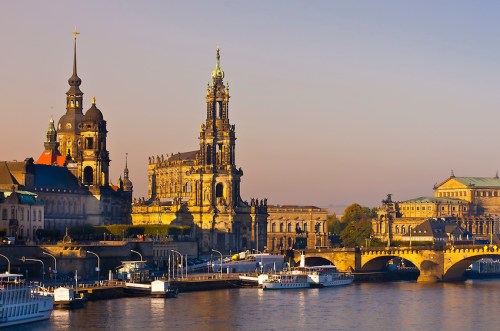
from the centre, the Hofkirche, the Dresden Cathedral, across from the
Augustusbrücke, or Augustus Bridge, extends into the Zwinger, one
of three only palaces in Europe, along with Versailles and Vienna’s
Schönbrunn, distinctly horizontally to the right, not to be confused
with a crook in the Cathedral, an intolerable, were it so, ecclesiastical
gaffe, it ‘s now become one of the most significant art galleries in
Europe, the green rooves, to the right still, are the Semperoper‘s, the
black roof, nestling before it, an unforgettable Italian
restaurant
before it all, majestically, the Elbe
_______
from the very Semperoper in Dresden,
where I’ll ever remember seeing the
worst “Barber of Seville” I’ve ever seen,
first balcony, left of centre, Figaro came
out on a motorcycle, I ask you, it was
downhill after that, my mom, beside
me, was falling even asleep, we left at
intermission, soldiered on to a
restaurant overlooking the Elbe, Italian,
if I remember, but utterly more enjoyable
than the disappointing operatic option,
there might even ‘ve been a moon at our
tableside window, picturesquely
shimmering on the river
but, hey, we both would‘ve stayed,
incontrovertibly, for this performance,
Beethoven’s “Missa Solemnis“, a late,
and towering, entry, 1823, in his opus
– second definition of that word, which
is to say, his entire output, all 135
opuses, first definition there, discrete
compositions – plus all his works
without opus – first definition again –
numbers, WoO
the plural of opus, incidentally, can
also be, both meanings, opera, just
to confuse things, I use either
interchangeably, according to my
narrative rhythm
missae solemnes, plural of missa
solemnis, are a particularly Catholic
form of music, going back to the
very Middle Ages, at which point
religious art was all that really
mattered, anything else was entirely
peripheral, of no consequence
but Catholicism, and its Protestant
offshoots, which is to say, their
common Christianity, remained
culturally entrenched during the
process of their slow disintegration
Nietzsche would, later, take care
of that, but that’s another story
Beethoven, Mozart, Catholics, if,
either, only by name, delivered
missae solemnes, while Bach,
Handel, both Protestant,
delivered oratorios, with some
intermingling
about which, later
Catholic, Protestant expression still
find, even strong, exponents at
present, though the form is,
essentially, outdated, our anthems
are national, now, mostly, if even
somewhat, that, halfheartedly, when
not, paradoxically, searchingly,
hopefully, and maybe even
revolutionarily, again, ideological
imagine “Imagine“ for instance, as
such, just click
R ! chard
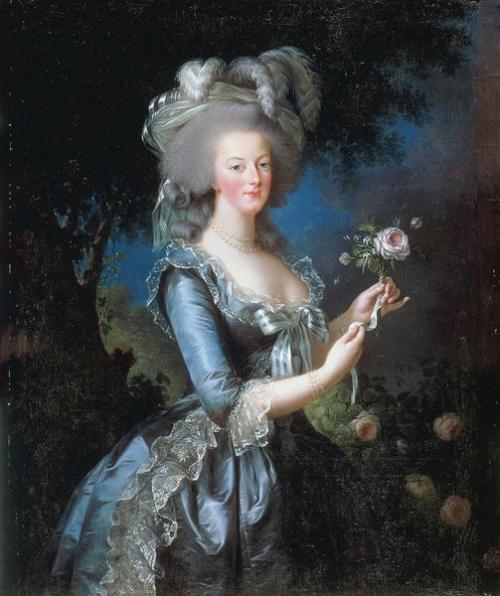
“Queen Marie Antoinette of France“ (1783)
Louise Élisabeth Vigée Le Brun
___________________
first of all, let me grievously repent an
egregious confusion I probably left
in my last diatribe, I said that the second
movement of the Opus 54, no 2 sounded
to me like a minuet, I had, through
embarrassing inattention, confused its,
however unmemorable, adagio with that
of this Opus 55, no 3, which I’d listened
to in too quick succession, driven as I
am by my thirst for epiphanies
the Opus 54, no 2 will do, but I’m not
going back for seconds, nor to the
Opus 55, no 3, though here’s where
I flaunt nevertheless Haydn, not to
mention Bach, Mozart, Beethoven,
all the way to eventually Bruckner,
Brahms, the extraordinary Richard
Wagner, passing through Schubert,
Mendelssohn, the Strausses, father
and son, and the unrelated Strauss,
Richard, another incontrovertible
giant, and I nearly left out the
unforgettable Liszt, all of them
forefathers of our present music
you might have noticed that these
are all Germanic names, obedient
to the Hapsburg empire, with
Vienna as its supreme cultural
capital, and it was that
Austro-Hungarian dynasty that
indeed nearly single-handedly
secured our Western musical
traditions
a few Italians are remembered,
from the 18th Century, Scarlatti
maybe, Boccherini, Albinoni,
but not many more
no one from France, but they were
about to have a revolution, not a
good time for creative types,
though, incidentally, Haydn was
getting Tost, to whom he was
dedicating his string quartets for
services rendered, to sell his stuff
in very Paris
then again, Marie Antoinette, I thought,
was Austrian, an even archduchess,
and would’ve loved some down-home
music at nearby Versailles
so there you are, there would’ve been
a market
the English had Handel, of course,
who was, albeit, German, getting
work where he could when you
consider his competition, he was
too solemn and plodding by half,
to my mind, for the more
effervescent, admittedly Italianate,
continentals, Italy having led the
way earlier with especially its
filigreed and unfettered operas
but here’s Haydn’s Opus 55, no 3
nevertheless, the best Europe had
to offer, socking it to them
Haydn’s having a hard time, I think,
moving from music for at court to
recital hall music, music for a much
less genteel clientele, however
socially aspiring, we still hear
minuets, and obeisances all over
the place, despite a desire to
nevertheless dazzle, impress
then again, I’m not the final word, as
my mea culpa above might express,
you’ll find what eventually turns
your own crank, floats your own
boat, as you listen
which, finally, is my greatest wish
R ! chard
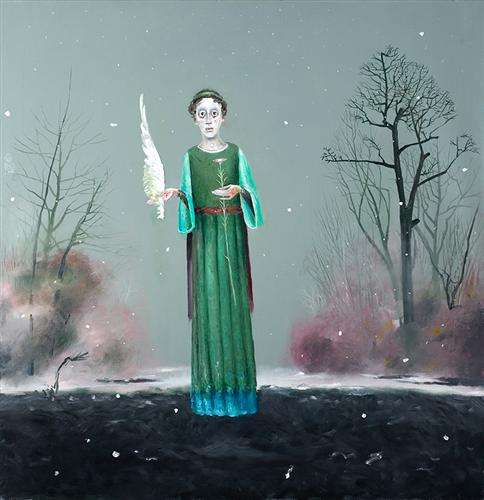
“Poet With Flower“ (2008)
_____
wherefore art, I’ve long and often wondered,
with only a wink to Juliet’s Romeo, for my
question dug deeper, why, indeed, itself art
we build our souls on the stories we’ve
heard, the impressions we’ve received
from voices that spoke directly to our
senses, painters with paint, musicians
with music, writers with words, poets
with poems
it started with fairy tales, which told of
right and wrong, good and bad, courage,
kindness, responsibility, and dire
consequences for discord
Biblical stories also took up a lot of my own
childhood, Jesus, Adam and Eve, Moses
and the Ten Commandments, this last
reinforced by Cecil B. DeMille’s epic
but soon enough it was Oliver Twist, Little
Nell, and by an inescapable authorial leap,
since these were all by an irresistible
Charles Dickens for a guy my age, Sydney
Carton, who valiantly stands in for his
friend, Charles Darnay, at the guillotine, a
quantum, even existential, leap from
Peter Pan and Mary Poppins
though I had the good fortune to learn to
read and write music as a boy, play music,
learn about Bach, Brahms and Beethoven,
it didn’t take anyone else much more than
their enthusiasm to see what the Beatles
were similarly doing, the Rolling Stones,
the Supremes, they were not only singing,
but making history, shaping it, and us, we
followed the questions they rose, their
responses, the effects upon ourselves
for nothing is considered until it’s
mentioned, spoken, made clear, and they
were those prophets
the same goes for art, we see as we see
cause Monet, Picasso, Warhol showed
us how to see, what to look at
and of course poets, Shakespeare,
Rostand, Dante, Goethe, to inform, each,
their individual language, and culture
I have been Philip Carey, Scarlett O’Hara,
Blanche Dubois, Gary Cooper in “High
Noon“, both Martha and George in
“Who’s Afraid of Virginia Woolf“, lately
I’ve been even Hank Williams
as Babette would say, a French doll who
gets abducted in “Raggedy Ann and Andy:
A Musical Misadventure“, an animated
movie from the Seventies, – oo aahrr yoo
Richard
psst: all of them have been me too,
incidentally
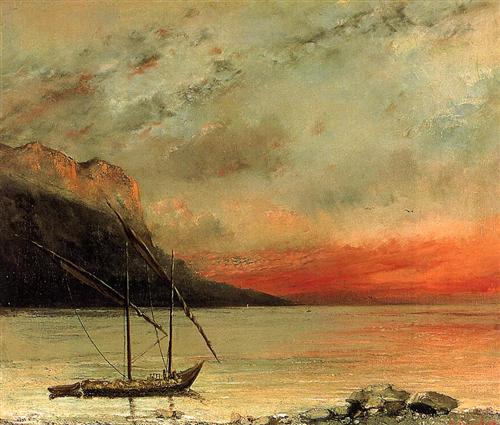
“Coucher de soleil sur le lac Léman“ (1874)
_________
paying attention to tenuti is not as
easy as all that, you’ll have found
probably that the music’s kept on
going and you’re not so sure if
what just went by indeed was a
tenuto, so brief, however stressed,
might’ve been the impression
rubati are easier, it’s hard to miss
them when they come round, for
being spread out through the
musical passage as a
consequence of being at the very
least three notes, usually
considerably more
tenuti happen on one note only,
one fleet fish in an ebullient river
rather than a more noticeable and
synchronous school
interestingly, not many of either,
rubati, tenuti, show up in music
history until the late Romantic
Era, the mid- to late 1800s, they’d
been only theoretically, and here
and there, part of the musical
vocabulary for having had no
purchase in music written for the
harpsichord, an instrument that
had allowed only minimal
resonance, though it laid the
foundations for composition,
and therefore dictated taste
into the very mid-nineteenth
century, a whole hundred years
after the invention of the piano,
by having entrenched the ideal
of strict tempo, the reflection,
note, of an ideal, and belief
then in a scientifically cogent
world
that was the Enlightenment
Romanticism came along to
express the ineffable reality of
the truths of the human heart,
in contrast to merely reason –
“Le coeur a ses raisons que la
raison ne connaît point”, says
Pascal, “The heart has its own
logic which allows it to
understand what the rational
mind cannot”, though he in a
somewhat other, much more
theological, context
but the shoe snugly fits, so I’ll
wear it, though with the same
consideration I’d render the
shoes, understand, of my
father
you can tell we’ve reached the
late 1800s when you start
hearing tenuti, ritardandi,
atonality, for that matter, and
also obscure and eccentric
repetitions
this pattern is probably more
evidenced in pictorial art,
where precision gives way to
individualized expression,
and the blurred lines of Early
Impressionism, see above
at the same time, the German
grip on the history of Western
music which it had held for a
hundred and fifty years, from
Bach to Brahms, began to loosen,
along with the idea, incidentally,
of a rationally, even irrationally,
conceived world, you can hear
it in the evolution of the tenuti,
the rubati, like canaries sense
altered conditions in a coal
mine
note however that music itself
is as indifferent to bald facts
as mathematics, it merely
describes, doesn’t comment
listen to Bedřich Smetana, a
Czech composer, his String
Quartet no 1, “From My Life”
follows in the footsteps of
the Germans, but with a
distinctively folkloric air,
there’s even a polka
tend the tenuti, relish the
rubati, if you can identify
them, they’re milestones
to the modern
but, more than anything,
enjoy
Richard
 Richibi's Weblog