Richibi’s Weblog

Just another WordPress.com weblog

Tag: Bacchus / Dionysus – god of revelry

“The Mariners transform’d to Dolphins” – Ovid
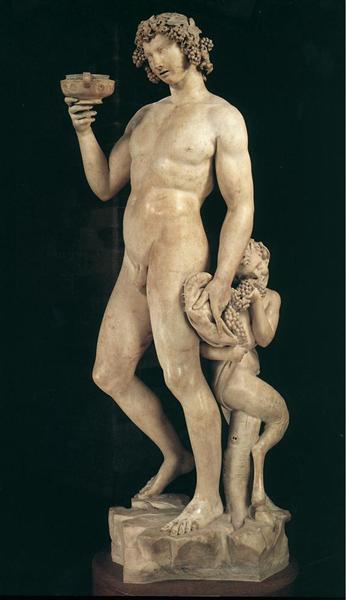
Bacchus, 1497 - Michelangelo

        Bacchus” (1497)


            Michelangelo


                   _______   


             Him Pentheus view’d with fury in his look,


Pentheus, king of Thebes, if you’ll

remember, after Cadmus, his

grandfather, founder of Thebes


viewed, scanned, surveyed


             And scarce with-held his hands, whilst thus he spoke:


with-held, withheld


             “Vile slave! whom speedy vengeance shall pursue,
             And terrify thy base seditious crew:


Vile slave, the zealous votary from

the last instalment, follower, acolyte

of Bacchus / Dionysus, who’d been

captured by Pentheus’ men instead

of the god himself


by exacting a speedy vengeance on

this [v]ile slave, Pentheus expects

to terrify the remaining elements of

the offending crew, the seditious

party of Bacchus / Dionysus


             Thy country and thy parentage reveal,
             And, why thou joinest in these mad Orgies, tell.”


where are you from, what are you

doing here, Pentheus asks


             The captive views him with undaunted eyes,
             And, arm’d with inward innocence, replies,

             “From high Meonia’s rocky shores I came,
             Of poor descent, Acoetes is my name:
             My sire was meanly born; no oxen plow’d
             His fruitful fields, nor in his pastures low’d.

meanly, poor, without adequate

means


plow’d, low’d, an interesting

rhyme, they’re called forced

or oblique rhymes


             His whole estate within the waters lay;


estate, livelihood, Acoetes‘ father,

his sire, was a fisherman


             With lines and hooks he caught the finny prey,


finny, having fins


             His art was all his livelyhood; which he
             Thus with his dying lips bequeath’d to me:


His art, the quality of his work


             In streams, my boy, and rivers take thy chance;
             There swims, said he, thy whole inheritance.


Acoetes will inherit at best his

father’s skill


             Long did I live on this poor legacy;
             ‘Till tir’d with rocks, and my old native sky,


that of Meonia, see above


             To arts of navigation I inclin’d;


arts of navigation, knowledge of

the open sea, the wider oceans


             Observ’d the turns and changes of the wind,
             Learn’d the fit havens, and began to note
             The stormy Hyades, the rainy Goat,
             The bright Taygete, and the shining Bears,
             With all the sailor’s catalogue of stars.


Hyadesa cluster of stars, with their

own mythic origin story, grieving

nymphs cast upon the heavens,

augurs of rain,hence stormy


the rainy Goat, Capricornus, the

constellation


Taygete, a satellite of the planet

Jupiter

the shining Bears, Ursa Major

and Ursa Minor, or the Great

and the Little Bear, whose

origins you might remember

from The Story of Calisto


             “Once, as by chance for Delos I design’d,


Delos, a Greek island


design’d, planned as a destination


             My vessel, driv’n by a strong gust of wind,
             Moor’d in a Chian Creek; a-shore I went,


Chian, of Chios, a Greek island


             And all the following night in Chios spent.
             When morning rose, I sent my mates to bring
             Supplies of water from a neighb’ring spring,
             Whilst I the motion of the winds explor’d;
             Then summon’d in my crew, and went aboard.
             Opheltes heard my summons,


Opheltes, a confederate apparently


                                                                and with joy
             Brought to the shore a soft and lovely boy,
             With more than female sweetness in his look,


hmmmm


             Whom straggling in the neighb’ring fields he took.


he took, he apprehended


             With fumes of wine the little captive glows,
             And nods with sleep, and staggers as he goes.

             “I view’d him nicely, and began to trace
             Each heav’nly feature, each immortal grace,
             And saw divinity in all his face,
             I know not who, said I, this God should be;
             But that he is a God I plainly see:
             And thou, who-e’er thou art, excuse the force
             These men have us’d; and oh befriend our course!

befriend, accord it your sympathy

             Pray not for us, the nimble Dictys cry’d, 
Dictys, one of Acoetes‘ shipmates


             Dictys, that could the main-top mast bestride,
             And down the ropes with active vigour slide.
             To the same purpose old Epopeus spoke,


Epopeus, another sailor


             Who over-look’d the oars, and tim’d the stroke;
             The same the pilot, and the same the rest;
             Such impious avarice their souls possest.


all countermanding Acoetes‘, however

discerning, assessment


             Nay, Heav’n forbid that I should bear away
             Within my vessel so divine a prey,
             Said I; and stood to hinder their intent:


Acoetes had no intention of confining

this so divine a prey to his ship


             When Lycabas, a wretch for murder sent
             From Tuscany, to suffer banishment,
             With his clench’d fist had struck me over-board,
             Had not my hands in falling grasp’d a cord.


Lycabas, a third shipmate


Tuscany, a region of what is now

central Italy


it appears, however, that Acoetes

lived to tell the tale


stay tuned


R ! chard

“The Story of Pentheus” – Ovid

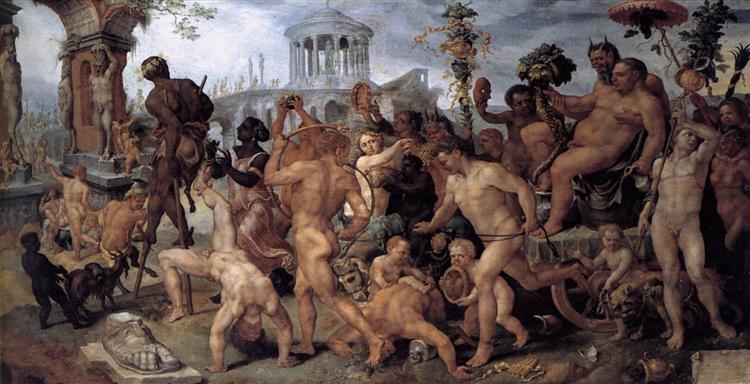
The Triumphal Procession of Bacchus, c.1536 - Maerten van Heemskerck

         The Triumphal Procession of Bacchus” (c.1536)


                   Maerten van Heemskerck


                             _______________


till now the separate stories in Ovid’s

Metamorphoses have been linked,

one being either a consequence of

the other,or its cause, but the story

of Pentheus, grandson of Cadmus,

king and founder of Thebes, who

earlier in this series had his own

tale told, starts, as my German

teacher used to say, from the

scratch


This sad event, therefore, in the

first line of the poem, refers to

what will follow, not what came

before


            This sad event gave blind Tiresias fame,

            Through Greece establish’d in a prophet’s name.


Tiresias, if you’ll remember, had been

blinded by Juno / Hera, goddess of the

gods, for having sided with Jove / Jupiter

/ Zeus, her husband, in a wager between

them he’d been called upon to decide,

Jove / Jupiter / Zeus, however, gave 

Tiresias, as consolation, having been

barred by a pact among the gods not

to undo each other’s spells, the gift

of insight, prophecy


the example that follows, of his divination,

establish[‘d] at that time his reputation

[t]hrough[out] Greece as a prophet


            Th’ unhallow’d Pentheus only durst deride

            The cheated people, and their eyeless guide.


unhallow’d, unholy, wicked, sinful


Pentheus, king of Thebes following

his grandfather, Cadmus, but that’s

an entirely other story


only, of all the people, none but

Pentheus durst, dared, deride,

mock, their eyeless guide, Tiresias

            To whom the prophet in his fury said,

            Shaking the hoary honours of his head:


hoary, grizzled, gray, aged


            “‘Twere well, presumptuous man, ’twere well forthee

            If thou wert eyeless too, and blind, like me:

            For the time comes, nay, ’tis already here,

            When the young God’s solemnities appear:


the young God[], Bacchus / Dionysus,

son of Semele and Jove / Jupiter / Zeus,

if you’ll remember, god of revelry,

intoxication, wild abandon


            Which, if thou dost not with just rites adorn,

            Thy impious carcass, into pieces torn,

            Shall strew the woods, and hang on ev’ry thorn.


impious carcass, dishonoured corpse, 

of any thou who wouldn’t’ve honoured

the celebrations


            Then, then, remember what I now foretel,

            And own the blind Tiresias saw too well.”


own, agree to, admit

            Still Pentheus scorns him, and derides his skill;

            But time did all the prophet’s threats fulfil.

            For now through prostrate Greece young Bacchus rode,


prostrate, beholden, reverent, observant

of the solemnities


            Whilst howling matrons celebrate the God:

            All ranks and sexes to his Orgies ran,

            To mingle in the pomps, and fill the train.


the rites of Bacchus were bacchanals,

orgies, celebrations of abandon, Mardi

Gras, for instance, in New Orleans,

annual Gay Parades, now everywhere,

or Hallowe’en since time immemorial


see above


            When Pentheus thus his wicked rage express’d:

            “What madness, Thebans, has your souls possess’d?

            Can hollow timbrels, can a drunken shout,


timbrels, tambourines


            And the lewd clamours of a beastly rout,

            Thus quell your courage;


quell your courage, overcome your

sense of discipline


                                            can the weak alarm

            Of women’s yells those stubborn souls disarm,


those stubborn souls, the Theban

spirit of pride and honour


            Whom nor the sword nor trumpet e’er could fright,

            Nor the loud din and horror of a fight?

            And you, our sires, who left your old abodes,


our sires, the older generation of

Thebans, of his grandfather

Cadmus‘ ilk


            And fix’d in foreign earth your country Gods;


foreign earth, very Thebes, from Tyre,

where Cadmus and his followers had

come from, in search of Europa, if

you’ll remember


            Will you without a stroak your city yield,


stroak, stroke


            And poorly quit an undisputed field?


undisputed field, there are no

military obstructions


            But you, whose youth and vigour should inspire

            Heroick warmth, and kindle martial fire,

            Whom burnish’d arms and crested helmets grace,

            Not flow’ry garlands and a painted face;


Remember him to whom you stand ally’d:


him, Pentheus himself, their king


            The serpent for his well of waters dy’d.


The serpenta reference here to the

dragon that Cadmus slew, which had

guarded the cavern where his crew

had been scouting for water, if you’ll

remember


            He fought the strong; do you his courage show,

            And gain a conquest o’er a feeble foe.


a feeble foe, licentiousness, abandon,

undisciplined revelry


            If Thebes must fall, oh might the fates afford

            A nobler doom from famine, fire, or sword.


Pentheus appeals to a loftier reason

for defeat, famine, fire, or sword, than

mere, and ignoble, debauchery


            Then might the Thebans perish with renown:

            But now a beardless victor sacks the town;


beardless victor, the young Bacchus /

Dionysus


            Whom nor the prancing steed, nor pond’rous shield,

            Nor the hack’d helmet, nor the dusty field,

            But the soft joys of luxury and ease,

            The purple vests, and flow’ry garlands please.


Bacchus / Dionysus is not impressed

by armour, military accomplishments,

prowess, but by grace, elegance, and

poetry


            Stand then aside, I’ll make the counterfeit

            Renounce his god-head, and confess the cheat.


the counterfeit, Bacchus / Dionysus


            Acrisius from the Grecian walls repell’d

            This boasted pow’r; why then should Pentheus yield?


Acrisius, a king of Argos, who must’ve

also repell’d from his city Bacchus /

Dionysus, according to the poem


            Go quickly drag th’ impostor boy to me;


th’ impostor boy, the counterfeit,

Bachus / Dionysus


            I’ll try the force of his divinity.”


try, test


            Thus did th’ audacious wretch those rites profane;


th’ audacious wretch, Pentheus


            His friends dissuade th’ audacious wretch in vain:

            In vain his grandsire urg’d him to give o’er

            His impious threats; the wretch but raves the more.


his grandsire, Cadmus

            So have I seen a river gently glide,

            In a smooth course, and inoffensive tide;

            But if with dams its current we restrain,

            It bears down all, and foams along the plain.


nature will have its way, so will the

gods, watch out, the narrator says,

who it is that you challenge

            But now his servants came besmear’d with blood,

            Sent by their haughty prince to seize the God;


his servants, Pentheus‘ men


the God, Bacchus / Dionysus


            The God they found not in the frantick throng,

            But dragg’d a zealous votary along.


votary, follower, adherent,

acolyte


the servants, Pentheus‘ men,

who did not, apparently, deliver


stay tuned


R ! chard

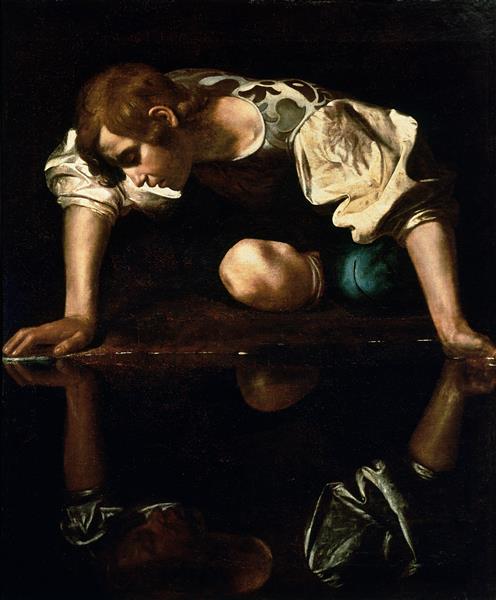
“The Story of Narcissus” – Ovid


Narcissus, c.1599 - Caravaggio

          Narcissus” (c.1599)


                 Caravaggio


                       ______


               Thus did the nymphs in vain caress the boy,


the boy, Narcissus


in vain , Narcissus‘ pride, you’ll remember,

was such that love-sick maid[s] uselessly

[their] flame confess’d, Narcissus was

oblivious to their advances


He still was lovely, but he still was coy;
               When one fair virgin of the slighted train


slighted train, row of followers, love-sick

maid[s] who’d been spurned by Narcissus


               Thus pray’d the Gods, provok’d by his disdain,


provok’d by his disdain, angered by his

rejection


               “Oh may he love like me, and love like me in vain!”


beseeches the one fair virgin


               Rhamnusia pity’d the neglected fair,


Rhamnusia, goddess of Retribution,

also known as Nemesis


               And with just vengeance answer’d to her pray’r.


just vengeance, justified retribution


               There stands a fountain in a darksom wood,
               Nor stain’d with falling leaves nor rising mud;
               Untroubled by the breath of winds it rests,
               Unsully’d by the touch of men or beasts;
               High bow’rs of shady trees above it grow,
               And rising grass and chearful greens below.


bow’rs, enclosures among trees


greens, lawns, grasslands


               Pleas’d with the form and coolness of the place,
               And over-heated by the morning chace,
               Narcissus on the grassie verdure lyes:


verdure, greenness


               But whilst within the chrystal fount he tries
               To quench his heat, he feels new heats arise.


chrystal fount, glistening fountain,

or spring


               For as his own bright image he survey’d,
               He fell in love with the fantastick shade;


shade, apparition, illusion


               And o’er the fair resemblance hung unmov’d,


see above


               Nor knew, fond youth! it was himself he lov’d.
               The well-turn’d neck and shoulders he descries,


descries, espies, catches sight of


               The spacious forehead, and the sparkling eyes;
               The hands that Bacchus might not scorn to show,


Bacchus, god of Wine and Revelry, also

known as Dionysus


And hair that round Apollo’s head might flow;


Apollo, god of the Sun


               With all the purple youthfulness of face,
               That gently blushes in the wat’ry glass.


wat’ry glass, the chrystal fount


               By his own flames consum’d the lover lyes,
               And gives himself the wound by which he dies.


the wound, the sight of himself


dies, succumbs, is undone


               To the cold water oft he joins his lips,
               Oft catching at the beauteous shade he dips

               His arms,


shade, see above


                     as often from himself he slips.


slips, becomes abstracted, bewildered

 
               Nor knows he who it is his arms pursue
               With eager clasps, but loves he knows not who.


he cannot give substance to this illusion


What could, fond youth, this helpless passion move?

               What kindled in thee this unpity’d love?

 move, excite, indeed kindle[]


               Thy own warm blush within the water glows,


the poet, here, note, interjects, speaks

directly to Narcissus


               With thee the colour’d shadow comes and goes,


colour’d, because of the water, an exact

replication, even chromatically, but

shimmering, com[ing] and go[ing]


shadow, shade, see above, reflection


               Its empty being on thy self relies;


empty being, fabrication, imagined

construct


on thy self relies, you are yourself

the source of your illusion


               Step thou aside, and the frail charmer dies.


frail charmer, shimmering, insubstantial

illusion


stay tuned


R ! chard

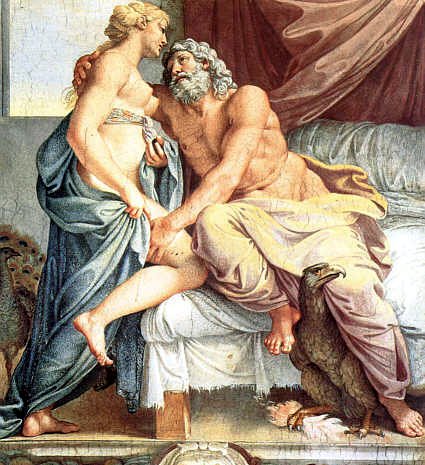
“The Transformation of Tiresias” – Ovid

Jupiter and Juno, 1597 - Annibale Carracci

          Jupiter and Juno” (1597)


                   Annibale Carracci


                             ________


                ‘Twas now, while these transactions past on Earth,

                And Bacchus thus procur’d a second birth,


second birth, Bacchus / Dionysus

had been granted a second birth

after he’d been plucked from

Semele‘s womb in a first, abortive,

birth, and carried in Jove / Jupiter

/ Zeus‘s thigh to term for the

second, if you’ll remember


                When Jove, dispos’d to lay aside the weight

                Of publick empire and the cares of state,

                As to his queen in nectar bowls he quaff’d,

                “In troth,” says he, and as he spoke he laugh’d,

                “The sense of pleasure in the male is far

                More dull and dead, than what you females share.”


you might note here that these last

eight verses have been one long

sentence, incorporating here and

there other full sentences, but

within commas, like railroad cars

pulled along by a locomotive, none

independent of the others, it seems

to me I’ve seen that kind of thing

before


quaff’d, drank, took a draught


to his queen, in her honour


in troth, in truth, truly


Jove / Jupiter / Zeus has a question

to settle with Juno / Hera, he claims

that men are less attuned to

pleasure than women are


               Juno the truth of what was said deny’d;


Juno / Hera doesn’t at all agree


                Tiresias therefore must the cause decide,


Tiresias will be the arbiter, he will

the cause decide


Tiresias, mythical prophet


                For he the pleasure of each sex had try’d.


hmmm, you don’t hear stuff like

that in the Bible, the monotheistic

counterpart to Ovid’s pantheistic

Metamorphoses


a pantheistic religion would have

no categorical set of values, no

Ten Commandments, the gods

themselves would not agree on 

a code of behaviour, morality

would be in the eye of the

beholder, not divinely mandated,

Nietzsche will have a lot to say

about that in the 19th Century

eminently pertinent to ensuing 

generations


                It happen’d once, within a shady wood,

                Two twisted snakes he in conjunction view’d,


in conjunction, mating


                When with his staff their slimy folds he broke,

                And lost his manhood at the fatal stroke.


you shouldn’t mess around with

snakes, it appears


                But, after seven revolving years, he view’d

                The self-same serpents in the self-same wood:


self-same serpents, surely he means

the same species, not the same

snakes


                “And if,” says he, “such virtue in you lye,

                That he who dares your slimy folds untie

                Must change his kind, a second stroke I’ll try.”


if it worked once, it might work a

second time, Tiresias supposes


                Again he struck the snakes, and stood again

                New-sex’d, and strait recover’d into man.


it worked, Tiresias is reconfigured,

reconstituted, as a man


                Him therefore both the deities create

                The sov’raign umpire, in their grand debate;


create, appoint, assign duties to


the grand debate, the question,

the calculus, of pleasure


sov’raign umpire, chief, ruling,

irreversible by consent, judge


               And he declar’d for Jove:


women are more susceptible to

pleasure than men are, Tiresias

definitively decides


                                                     when Juno fir’d,

               More than so trivial an affair requir’d,


fir’d, not happy, furious, motivated


More than so trivial an affair, this

incident shouldn’t’ve been the

cause of, requir’d, the extreme

response to which Juno / Hera

condemns Tiresias


                Depriv’d him, in her fury, of his sight,

                And left him groping round in sudden night.


Tiresias, the blind prophet, the

apocryphal blind prophet, so

grimly subjected, finds powerful

resonance, incidentally, in Homer,

another, even more famous, and

actual, which is to say historically

authenticated, blind prophet, both,

nevertheless, of immeasurable

cultural consequence


                But Jove (for so it is in Heav’n decreed,

                That no one God repeal another’s deed)


an honour code among the gods,

to balance competing, however

august, visions, morality, in other

words, by consensus


                Irradiates all his soul with inward light,

                And with the prophet’s art relieves the want of sight.


thus Tiresias becomes the famed

prophet, for better, it’ll turn out,

or for worse, cursed, and blessed,

simultaneously


stay tuned


R ! chard

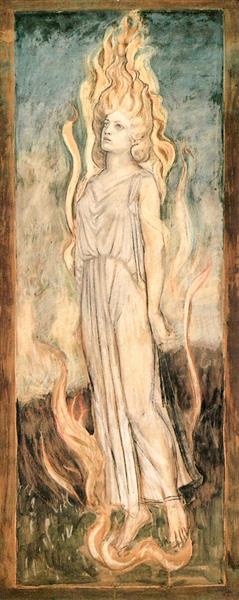
“The Birth of Bacchus” (lll) – Ovid

Semele, 1921 - John Duncan

        Semele” (1921)


             John Duncan


                    ____


         To keep his promise he ascends,


his promise, Jove / Jupiter / Zeus

had sworn by very Styx, if you’ll

remember, to Semele, his current

inamorata, that when next he[‘d]

court[ ] the rites of love, he’d

descend in those celestial charms

with which he enters Juno / Hera‘s

chambers, his goddess / wife, on

similar intimate occasions


                                                    and shrowds

         His awful brow in whirl-winds and in clouds;


shrowds, shrouds, covers in

darkness, shields


awful, inspiring awe, inspiring

consternation


         Whilst all around, in terrible array,

         His thunders rattle, and his light’nings play.


not only does Jove / Jupiter / Zeus

shrowd[ ] /His awful brow, which is

to say he actively effects changes,

consciously and manifestly producing

identifiable outcomes, a shrouded brow,

in this instance, but he also inspires the

very elements, thunders rattle 

light’nings play, to rally round his

enterprise


         And yet, the dazling lustre to abate,

         He set not out in all his pomp and state,


And yet, except that, Jove / Jupiter

/ Zeus chooses, set[s] … out, to rein

in, abate, elements of his pomp and

state, of his magnificence


         Clad in the mildest light’ning of the skies,

         And arm’d with thunder of the smallest size:

         Not those huge bolts, by which the giants slain

         Lay overthrown on the Phlegrean plain.

         ‘Twas of a lesser mould, and lighter weight;


Phlegrean plain, Phlegraean, site of the

war that won for the Olympians, Jove /

Jupiter / Zeus, Juno / Hera, and the

pantheon of other gods with whom

we’ve here become acquainted, control 

of the cosmos, against the Titans, who’d

earlier ruled, the children of Uranus,

Sky, and Gaia, Earth, though that’s

an entirely other, earlier story, equally

entrancing


         They call it thunder of a second-rate,

         For the rough Cyclops, who by Jove’s command

         Temper’d the bolt, and turn’d it to his hand,


Cyclops, any of the three Cyclopes,

Arges, Brontes, and Steropes, or in

English translation, Bright, Thunder,

and Lightning, sons of Uranus and

Gaia, one-eyed giants, who

manufactured Jove / Jupiter /

Zeus‘s thunderbolts


Cyclops here is probably Cyclopes,

this translation‘s early 18th-Century

spelling of the now singular “Cyclops”,

all of whom [t]emper’d the bolt, and

turn’d … to his hand Jove / Jupiter /
Zeus‘s commissioned arsenal


         Work’d up less flame and fury in its make,

         And quench’d it sooner in the standing lake.


this particular thunderbolt therefore

would have been less menacing, in

keeping with Jove / Jupiter / Zeus‘s

wish his dazling lustre to abate


         Thus dreadfully adorn’d, with horror bright,

         Th’ illustrious God, descending from his height,

         Came rushing on her in a storm of light.


I knew someone who came to me

like that once


         The mortal dame, too feeble to engage         

         The lightning’s flashes, and the thunder’s rage,

         Consum’d amidst the glories she desir’d,

         And in the terrible embrace expir’d.


I broke only into a thousand million

pieces, did not expire, but ruefully,

rather, survived, but that’s another

story, perhaps too intimate


         But, to preserve his offspring from the tomb,


his offspring, you’ll remember that

Semele was pregnant with Jove /

Jupiter / Zeus‘s child


         Jove took him smoaking from the blasted womb:


blasted, destroyed, [c]onsum’d[,]

amidst the glories she desir’d


see above


         And, if on ancient tales we may rely,

         Inclos’d th’ abortive infant in his thigh.


in order to allow it to complete

gestation, Jove / Jupiter / Zeus

incubated th’ abortive infant in

his [own] thigh


         Here when the babe had all his time fulfill’d,


Here, in his thigh


         Ino first took him for her foster-child;


Ino, sister of Semele, with too long

a story here, however fascinating


         Then the Niseans, in their dark abode,


Niseans, Nysians, of Nysa, a

mountainous mythical land

beyond Greece, with dark

abode[s], caves, among its

mountains, presumably


         Nurs’d secretly with milk the thriving God.


the thriving God, Bacchusthe Roman

Dionysus, god of wine, merriment, and

all kinds of mischievousness, which is

to say bacchanals, Dionysian revelries,

orgies


stay tuned


R ! chard