Richibi’s Weblog

Just another WordPress.com weblog

Tag: Augustus

“Metamorphoses” (The Giants’ War, II) – Ovid, 110

the-marriage-at-cana-1563.jpg!Large

      “The Marriage at Cana (1563) 


              Paolo Veronese


                  _________


Jove “sigh’d;” if you’ll remember, “nor 

longer with his pity strove; / But kindled 

to a wrath” which was worthy of him


           Then call’d a general council of the Gods;

           Who summon’d, issue from their blest abodes,

           And fill th’ assembly with a shining train. 


Jove calls the gods together to discuss 

the abhorrent conditions on Earth, who, 

upon being summon’d, leave their blest, 

or blessed, homes, and fill Jove’s 

assembly hall with their glittering train, 

their advancing pageantry


           A way there is, in Heav’n’s expanded plain,

           Which, when the skies are clear, is seen below,

           And mortals, by the name of Milky, know. 


when the skies are clear in Heaven’s

expanded plain, its wide expanse, 

mortals can see the Milky Way


           The ground-work is of stars; through which the road

           Lyes open to the Thunderer’s abode: 


this Milky Way is paved with stars, which

lead to Jove’s, the Thunderer’s, domain


           The Gods of greater nations dwell around, 

           And, on the right and left, the palace bound;


the dwellings of the gods who represent 

the greater nations of the era, of Rome, 

for instance, or Greece, surround,

encircle, the Thunderer’s abode, his 

palace 


           The commons where they can: the nobler sort

           With winding-doors wide open, front the court. 


the more common gods, those of 

lesser nations, live where they can, 

while the winding-doors of the nobler 

gods, doors which can be activated

mechanically, on hinges, though 

perhaps here divinely, stand wide 

open for this colloquy, this exalted 

conference, before the celestial 

court 


           This place, as far as Earth with Heav’n may vie,

           I dare to call the Louvre of the skie. 


if one were to compare [t]his place

this court, to anything on Earth, have 

it vie with, one would liken it, Ovid 

says, to the Louvre


there’s evidently an anachronism 

here since the Louvre didn’t exist at

the time of Ovid, so that the translators 

have replaced the “Palatia” of Ovid’s 

original Latin, which refers to the 

Palatine, the most central of Rome’s

Seven Hillswhere imperial palaces

were built at the time of Augustus

63 B.C. to 14 A.D., which is to say 

during Ovid’s time, 43 B.C. to 

17 /18 A.D., by this relatively more 

recent palatial residence, the Louvre,

in order to make the text more

contemporary, like settings and 

attire are used in Renaissance

art to kindle the viewer’s sense 

of connection


see, for instance, above, where 

Veronese depicts the scene of Jesus 

attending a marriage at Cana, a village 

in Galilee, and transforms water there 

into wine to accommodate a shortage,

midst Roman, note, rather than Galilean, 

trappings, splendour


           When all were plac’d, in seats distinctly known, 

           And he, their father, had assum’d the throne,


seats distinctly known means the

traditionally assigned places, with 

Jove, “their father”, at the head of

the convocation 


           Upon his iv’ry sceptre first he leant,
           Then shook his head, that shook the firmament: 


leant, or leaned, [t]hen shook his head

in revulsion


           Air, Earth, and seas, obey’d th’ almighty nod;
           And, with a gen’ral fear, confess’d the God. 


the elements, Air, Earth, and seas“, 

acknowledge, or confess’d, the God, 

with quivering anxiety


           At length, with indignation, thus he broke
           His awful silence, and the Pow’rs bespoke. 


Jove, after a silence, bespeaks, or 

addresses, the assembled Pow’rs, 

the other divinities


R ! chard


“Metamorphoses” – Ovid, 101

primavera-1478(1).jpg!Blog

   “Primavera (1478) 


       Sandro Botticelli


             _________


a friend expressed some interest in Ovid’s

Metamorphoses recently after I’d sung for 

a few moments its praises, had told her I 

was revisiting it after some time with the 

intention of duly, this time, completing it, 

given that, hey, we’ve got lots of time, at 

present, all of us, on our hands, by very 

mandate  


it sounds wonderful, she briefed me after 

I’d sent her the appropriate link, but there 

are some parts I don’t understand


I’ll help, I said, only too eager to share 

the delights of this inprobable treasure,

a gift nearly two thousand years old, 

with the magic still of very revelation


Metamorphoses is a creation story, the 

equivalent of the Bible for those who 

revered the Roman deities, the same 

deities that the Greeks revered, but 

transplanted, renamed, to Roman 

stock, like the Puritans did their  

Christian seed at Plymouth Rock  


Ovid, 43 BC to 17/18 AD, was a Roman

poet, paying fealty to Augustus, Emperor

of Rome, 63 BC to 14 AD, therefore his 

Roman goddesses, gods, and his, 

contemporary, Latin


which was translated into English early 

in the Renaissance, but found its best

expression, to my mind still, in the 

eminent hands of Sir Samuel Garth,

John DrydenAlexander PopeJoseph

AddisonWilliam Congreve, among 

others in, already, 1717


listen 


The Creation of the World


       Of bodies chang’d to various forms, I sing:
 

Ovid is saying my topic is transformation, very

metamorphoses, plural of metamorphosis


       Ye Gods, from whom these miracles did spring,
       Inspire my numbers with coelestial heat;
       ‘Till I my long laborious work compleat:
       And add perpetual tenour to my rhimes,
       Deduc’d from Nature’s birth, to Caesar’s times. 


poets have traditionally called upon their related

muses to inspire them to accomplish their task,

Ovid invokes his Gods, compare Shakespeare’s 

O for a Muse of fire, that would ascend / The

brightest heaven of invention, his prologue to 

Henry V   


“Ye Gods”, Ovid says, from whom these 

miracles did spring”, those everyday wonders 

that surround us, inspire me, he asks, that I 

might “compleat”, which is to say complete, 

his poem, this long laborious work”


his “numbers” are his years, “coelestial”, or

celestial, “heat”, is inspiration


“tenour to my rimes” means rhythm, weight, 

to his poetry


“Nature’s birth”, or the beginning of time, to

“Caesar’s time”, Ovid‘s own period under

Augustus


Ovid asks the Gods to fuel him with the

fire to tell the story of the world from its 

very beginning to his own epoch,

Caesar’s 


how’s that for a project


enough for now


but stay tuned for, to follow, the Creation,

capital C, I tell you 


R ! chard


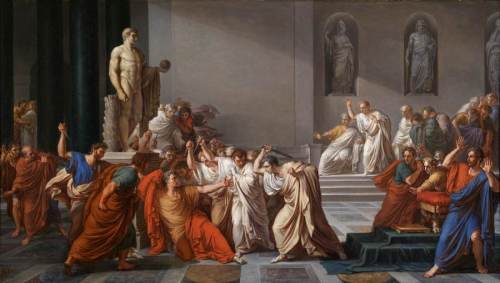
up my eccentricities / the Ides of March

ides1

        “The Death of Caesar (1798) 

               Vincenzo Camuccini

                      ___________

in looking up a requiem to commemorate 
the Ides of March, today, a date imprinted  
on our collective consciousness since 
Shakespeare’s “Julius Caesar”, act l, 
scene ll –

    Soothsayer:   Beware the Ides of March.

    Julius Caesar:   What man is that?

    Marcus Brutus:   A soothsayer bids you beware the Ides of March.

    Julius Caesar    Set him before me, let me see his face.

    Cassius:   Fellow, come from the throng, look upon Caesar.

    Julius Caesar:   What say’st thou to me now? Speak once again.

     Soothsayer:   Beware the Ides of March.

    Julius Caesar:   He is a dreamer, let us leave him. Pass.

– I found an entirely appropriate work,
though with more contemporary, and 
consequently more immediate, 
associations 

but first, let me say more about both 
Julius Caesar and Shakespeare

Caesar died on the Ides of March, 
notoriously, and ignominiously – 
though ruthless in his own way, 
not to mention also flamboyant,  
Caesar had been a ruler conscious 
of his constituency, and therefore 
socially responsive, giving, for 
instance, citizenship to residents 
from far away, a contentious issue 
still nowadays, and support for 
veterans, another hot political 
topic

he was also the lover of Cleopatra, 
among apparently many other trysts, 
not to mention, it has been suggested, 
of King Nicomedes lV of Bithynia

regardless, he is the template for 
modern rulers, eclipsing Alexander
the Great by a long shot, who else 
has a very month, July, named after 
him, apart from Augustus, Caesar‘s
heir and successor

his complete literary works have only 
recently come out in English, an
apparently, and most undoubtedly,
significant enterprise, Caesar would 
be, of course, subjective, therefore
probably indifferent to, or more 
unforthcoming about, his less savoury
excesses – he’d apparently cut off the 
hands of soldiers he had conquered,
something he never mentioned  

should we consider the impunity of our 
own 21st-Century autocrats – who will
blithely destroy communities with 
lethal chemical agents, and even, in
like manner, specifically target 
individuals – with less condemnation
and horror

nobody cared, by the way, about the 
Ides of March, until Shakespeare 
suggested, for all time, that we 
should beware of it

and we’ve been doing so ever since 


March 11th, 2011, was the date of the
Japanese tsunami, the earth shook, 
thousands died, the devastation was 
unimaginable, including nuclear 
radioactive explosions

Tōru Takemitsu‘s Requiem, written
in 1957, though not specifically 
related to that national tragedy, is
not at all unrelated to their agony

and through the power of music to
bring souls together, manifestly, 
here and now, his thoughtful
evocation, however dissonant, 
however arhythmic, however 
unhinged from Western Classical 
musical precepts, which might 
very well, I remark, be the point, 
brings souls, if you’ll listen
demonstrably together


R ! chard

psst: did I mention that the words 
          “Tsar” and “Kaiser” are 
          derivations of the name 
          Caesar