Richibi’s Weblog

Just another WordPress.com weblog

Tag: Arnold Schoenberg

November / Month of the Sonata – 23
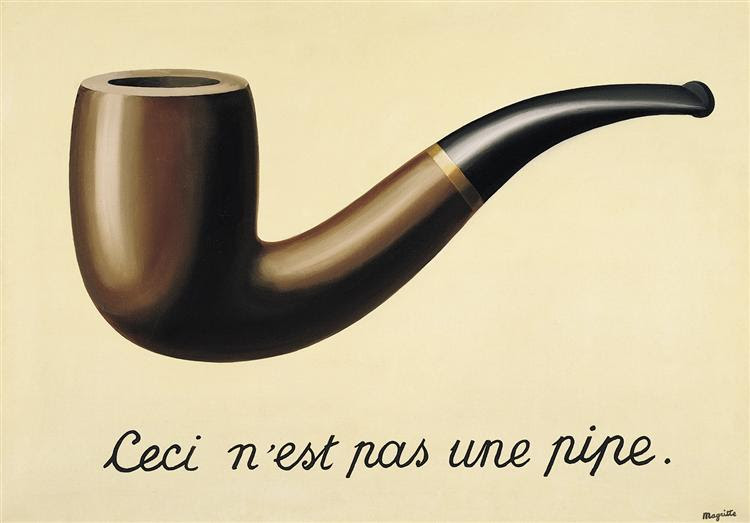
The treachery of images (This is not a pipe), 1928 - 1929 - Rene Magritte

    The treachery of images (This is not a pipe) (1928 – 1929) 


            René Magritte


                 _______


when is a sonata not a sonata, when, 

to my mind, it has less than two 

movements, but here’s Alban Berg 

doing just that in his Sonata, Opus 1


Alban Berg was a student of Arnold 

Schoenberg, the composer who did 

the most to break down the pillars

of Classical music, tempo, tonality,

and repetition, you’ll here it all here


Berg was working on a piece he 

expected would be a sonata, but 

after the first segment, he couldn’t 

find the inspiration to continue, 

Schoenberg replied that that must 

mean his work was complete, 

and Berg went along with that, 

calling it, nevertheless, a sonata, 

playing fast and loose with the

definition, poets do that, also 

painters, see above 


here’s Glenn Gould playing it, the

pianist I believe the greatest who 

ever lived, Gould admired the 

Berg, how could I argue with that


R ! chard

on the third day of C***mas

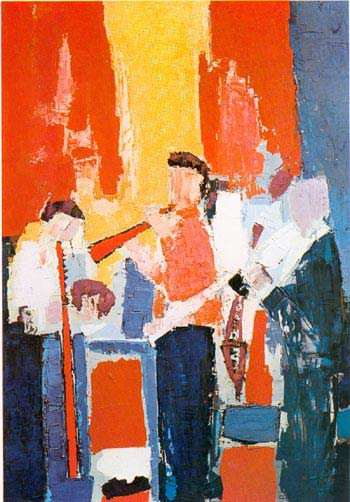
les-musiciens-1952

   “Les musiciens (1952) 


        Nicolas de Staël


           ___________


on the third day of C***mas, I needed to 

ready myself for the onslaught, I was 

hosting, yikes, for someone from out

of town


I thought I’d had it all figured out, but 

obstacles occurred, of course, to my, 

nearly cowed, consternation


needed help


I’d anticipated more violin concertos 

to get me going, but, among my 

several bookmarks, King Crimson

came up, a group I’d admired 

tremendously in my formative years,

the 70s, when freedom of expression

prevailed, in all of its innocent

expectations


they are tremendous, if you like that 

sort of thing, entirely progressive 

rock


you’ll think me eccentric if I relate 

them to Classical considerations, not 

only are they rigorous about tempo, 

tonality, and repetition, essential 

Classical components, but reach 

further into even tribal configurations,

their minimalism – later formalized by,

incidentally, Beethoven – of infinitely

repeated rhythms, like thumping, 

intoxicating, essentially, thrusts,

heartbeats meeting heartbeats, very, 

in other words, primitiveprimeval


add to that, later, their superimposed 

atonal riffs – Jimi Hendrix meets the 

jungle – a direct reference to 

Schoenberg‘s breakdown of the 

orthodoxy of the musical scale, and

cadence, and reiteration, you’re left 

with a history of our culture’s sonic

aspirations in a single incandescent

concert, despite a couple of egregious 

commercial interruptions in the

download, a 21st-Century, it seems, 

corporate roadblock


watch, enjoy 


R ! chard

up my idiosyncrasies – a bio

marcel-proust.jpg!Large

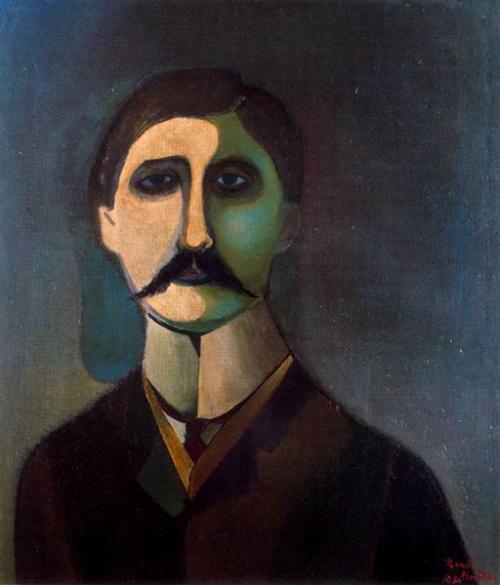
      “Marcel Proust” 
 
       Richard Lindner
 
          ___________
 
 
for a bio with which I’ve been asked 
to provide an online poetry magazine 
I’ve been encouraged to apply to, I’m 
submitting the following text
 
I thought you might enjoy it
 
 
Richard
 
           ______________
 
 
my name is Richard Bisson, from
which you’ll intuit my French 
Canadian background, though I 
write mostly in English, with no 
trouble however in French, my 
mother tongue is le français  
 
I am thus imbued, undoubtedly,
with that sensibility, my peers 
have been HugoFlaubert, and
most of all Marcel Proust, whom 
I imbibed for 33 years, in French,
page by page, reading each out 
loud as though it were my own, I 
cannot but be replicating now his 
rhythms, his aesthetic, his view 
of the world
 
it didn’t take me as long to read 
Homer, in the thunderous Robert  
Fitzgerald translation, – a mighty
roar resounding still from the 
ninth century before the Christian 
Era – from him I learned to speak 
from the heart, it’s not one’s style  
one has to master, but one’s 
humanity
 
Robert Browning gave me the 
dramatic monologue as a poetic
device, a gift he’d received from
 
Shakespeare himself, of course,
the unbridled freedom of his own 
literary imagination
 
Carl Sandburg‘s Chicago taught 
me to talk about every wo/man, 
about things even my own folks 
were doing
 
Collapsed showed me that even 
apparently inconsequential acts
can be poetry, poetry in the 
apparently humdrum 
 
Mary Oliver is a strong present 
influence
 
the cadence is entirely Beethoven,
with some help, I must admit, from 
the atonalists, SchoenbergBerg,
and Weberncommas are my bar 
lines
 
 
I call what I do prosetry, a word so 
new my computer won’t even let 
me write it, I’m a prosetrist, this 
word either
 
I want to link everyday experience 
with poetry, make poetry in the eye 
of the beholder, where truth and 
beauty lie
 
if people can see what I see, they 
can see that way themselves, it’s 
something one learns, and it’s all 
in the way one entrenches words 
and ideas
 
I eliminated the word “if” from my 
vocabulary once, for being then
too speculative, it changed my life, 
I’ve replaced it since with the word 
“miracle”, that has also changed 
my life
 
I am 67 years old
 
I live in Vancouver, Canada
 
I consider myself to be, at this 
point in my life, bibliosexual, I
sleep with my books, and we’re
all still getting along just fine 
 
may you be so blessed
 
 
Richard
 
psst: also Anaïs Nin, for the 
          intimacy of her diaries
 
          o, and Woody Allen, for
          giving up before his  
          nihilism and just 
          laughing

Alban Berg Violin Concerto‏

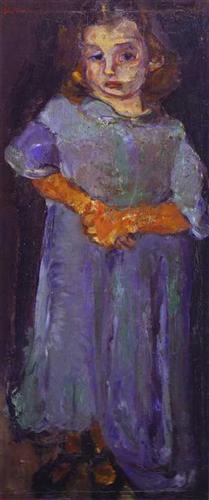
"Little Girl in Blue," - Chaim Soutine

Little Girl in Blue (c.1934-c.1935)

Chaim Soutine

________

though Apollo had offered the two
complimentary symphony tickets
he’d scored to my sister and my
mom, my mom bowed out and
suggested I, an adept, should
instead go along, though I needed
to know more about the content,
who and what would be on, no
one knew

meanwhile my sister, preferring not
to leave her husband alone, opted
to cede her ticket to Apollo so he
could accompany me

after some research, when I gushed
that Akiko Suwanai would be playing
Beethoven’s Violin Concerto in D
minor – his only one, I cried – Apollo
reconsidered, would, he said, come
along, my enthusiasm having struck
apparently a reverberant chord, a key,
maybe his D minor

once at the concert, to our surprise
and delight, my sister and her
husband, under the spell also of that
maybe bewitching key, had got rush
tickets for essentially, as it were,
a song, so that serendipitously we
all attended the superb performance
together

Dad does concert tickets too, my
sister exulted

Suwanai was transcendent, lifted me
from my seat at the very first touch of
her exquisite bow, I floated, though it
might’ve been also the magic chocolate
I’d bought at the corner, this is Vancouver
after all, known also, not inappropriately,
as Vansterdam

you’ve heard rapturous versions of
Beethoven’s Violin Concerto on at
least one of my earlier blogs,
Anne-Sophie Mutter’s there, Joshua
Bell’s
, but I couldn’t get any of Akiko
Suwanai’s renditions on the Internet

found instead for you this wonderful
Berg
, also his only violin concerto

Berg is of the Second Viennese
School, along with Schoenberg and
Webern, this is no longer Beethoven,
the advent of the First World War in
the Western world had fundamentally
altered everything, the arts were
reflecting this transformation, idioms
were abandoned in every creative field,
as well as in borders and forms of
government, rudiments were being
questioned, tested, see what Soutine
does, for instance, to traditional
representation above, to perspective,
colour, proportions

you’ll note that Berg’s Concerto
doesn’t stipulate a key, part of the
disintegration musical theory was
undergoing, twelve-tone music,
rather than the traditional eight,
was eliminating the subordination
of sharps and flats within scales,
atonality became dominant,
sounding a lot like the cacophony,
I think, of Twentieth-Century traffic

you won’t mistake however the
utterly Romantic sensibility beating
through Berg’s composition, midst
all the discord and the dissonance
you can’t miss his pulsing and
ardent heart, his wistful, dare I say,
heartstrings

there are two movements to the
concerto, the first representing life,
the second death and transfiguration,
Berg had written this, his last work,
for Alma Mahler’s daughter, Manon,
after she died of polio at the age of
18, Alma Mahler had been Gustav
Mahler’s wife, a musical giant, Berg
dedicated the piece, he wrote,
“to the memory of an angel”

Berg died later that same year,
Christmas Eve, 1935, he was 50

Richard

psst: the first part of the programme
had been a bust except for a
lovely piece for violin and koto

what’s a koto, I asked Apollo

it’s what you wear when you’re
coldo, he replied

a koto is a bit like a xylophone,
but with strings instead of
wooden bars, the performer
had dressed in traditional
Japanese garb for the special
Japanese occasion
“Snow White And The Seven Dwarfs”‏

enchanted movie for children of all ages, that
means especially you, Manolito, that means
especially you, Aidan
 
you might however notice, in a more analytical
vein, the introduction of German Expressionism
already in more popular culture, Nolde, Kirchner,
even some Edvard Munch, the Norwegian, in the
bold, garish colours that expressed horror and
perversion for them following the First World War,
and did the same for Walt Disney later if you’ll
consider the evil queen’s mirror and mask, or
van Gogh branches in the threatening forest, flat
surfaces, notably on faces for instance, touched
with only daubs of colour for only perfunctory
shading and character, prefiguring incidentally,
Andy Warhol‘s Pop Art
 
artists talk to each other
 
  
musical atonalities, also, show up, to attest to
modernity, in the music tooted out by the pipe
organ, delivering ornery pipes and a climactic
cuckoo who can only emit a shrill, discordant 
screech, we can thank especially Prokofiev,
the popinjay among the atonalists, for that,
with necessary nods to, for their more
theoretical groundwork, the more exacting
Stravinsky and the too dour, not to mention
for many too dire, Schoenberg  
 
Walt Disney was introducing modern art not so
surreptitiously at all to the larger popular culture,
acclimatizing children especially to the new
upended and revolutionizing art, crayons at
the behest of individuality 
 
 
you’ll also find interesting that Snow White 
succumbs to an apple, much like Mother Eve, 
both of whom are absolved, it’s worth pointing 
out, by nothing other than transcendental,
transformational, regenerative and ever
inspirational, Love
 
think about it  
 
 
Richard