Richibi’s Weblog

Just another WordPress.com weblog

Tag: Aristotle

on courage

aristotle-jpglarge

     “Socrates” 

            Luca Giordano

                    __________


following in the footsteps of Socrates,
who, I agree with the Oracle, has been 
ever the wisest man, one whose example 
I’ve followed since first hearing of him, let 
me query, what is courage 

a tentative definition would have one 
stating that courage is a determination
to overcome danger

but to use my own example, being called
courageous for surviving an aneurysm,
would this instance have qualified

where was my determination, apart from
waiting, submissively, for the axe to fall,
or to not fall, I felt no fear, merely time 
passing, not an ounce of determination

but what of those others who endure 
the pain often associated with dying,
agony, is that not a kind of enforced 
courage

so did I qualify

an aneurysm swells the blood vessels 
to the brain as the brain heals, but 
meanwhile the heart pumps a rhythmic
tattoo on those passages rendered 
more tenderso that a throbbing 
anguish is ever drumming its drill 
upon the cerebrum of the sufferer 

perhaps I did qualify

but Socrates brings up an interesting 
objection, can animals be brave, it 
would seem not, therefore courage 
requires self-consciousness, whether 
or not it is defiant or compliant 

and what about defiance before a lost 
cause, is that courage or doomed 
bombast

Aristotle adds to the mix the notion 
of a noble cause, not merely an 
instinctive, however, in the event, 
morally prompted, position

so what is courage, you tell me

I say that you know it when you see
it, the courageous act defines the 
word, not the other way around,

much like flowers are the result of 
their own efflorescence, not the 
manifestation of a preset Ideal

you are the measure of your own 
words

for better or for worse

Richard

psst: it is interesting to note that 
          according to the Bible, in the 
          beginning was the Word
          John 1:1, a convenient  tool  
          to impose order
Aristotle, an objection

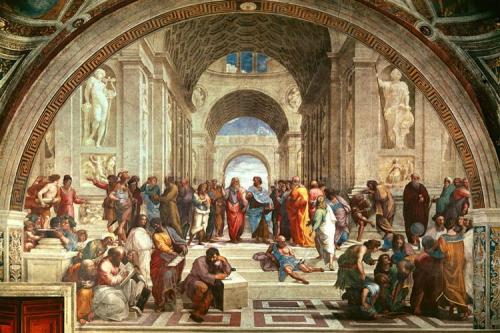
school-of-athens-detail-from-right-hand-side-showing-diogenes-on-the-steps-and-euclid-1511.jpg!Large

      “The School Of Athens (1510 – 1511) 

               Raphael

_______

upon reviewing my Socrates, Plato, and
Aristotle from a series of university  
lectures I’ve been following, I came upon 
a discovery so egregious, I couldn’t
believe I hadn’t seen it before, the old
story of the forest and the trees, I guess

upon hearing that the Oracle at Delphi
had replied that it was Socrates to those 
who’d wondered who the wisest man
was, Socrates, abashed, began to seek 
out wise men to disprove the Oracle, 
but whenever Socrates asked of them
what is virtue, what is justice, what is 
knowledge, for instance, the answers 
were always inconclusive, they always 
seemed to depend on perspective –
virtue, justice, knowledge were in the 
eye of the beholder – though Plato 
later putting in his own definitions
called them Ideals, a chair partook,
for instance, of an overarching 
chairness somewhere, as did indeed 
virtue, knowledge and justice, which 
inferred another ideal universe 
contiguously, of which our own 
universe supplied only imperfect 
renditions

you can hear the seeds of Heaven and 
God already in all of that, way before 
Christianity, not to mention Original 
Sin

it also suggests an implacable order

Socrates wouldn’t’ve liked that

but Aristotle, with a much more critical 
mind than Plato’s, less speculative, more 
akin to Socrates’, less autocratic, more 
inquisitive, begins to try to define,
nevertheless, abstractions, virtue, 
knowledge, justice, as though they
indeed existed as ideals

this is putting the cart before the horse,
I thought, in the form of a revelation

an instance exists in the act of creation,
a physical transformation produces a 
flower, the flower doesn’t happen 
because of the word

a human example

for surviving an aneurysm once, someone, 
to my astonishment, had called me 
courageous, I’d been, I thought, only
surviving, not an inch of courage, not 
even a millimetre

courage, I surmised, is in the eye of the 
beholder, it is not at all a template, an 
absolute, in my experience 

Aristotle goes on to define a host of
Virtues, indeed 11, which come out as 
essentially his Eleven Commandments,
on, in fact, courage, among others, all 
essentially, and appropriately, moral, 
thereby creating the moral realm of 
our Western world

Jesus followed

and of course God and Heaven

which, of course, still prevail despite 
sound, sober objections

as though we could know

why is this important

because, I think, we must remember 
that our assumptions are only that,
and often they’re based on only what 
we’ve been told, which is already a 
step away from incorrect 
interpretation 

in the world of false news, check 
your references, check your very 
words, our lives, it isn’t too much 
to say, I believe, depend on it

not to mention our own personal 
moral code, our soul, our purpose 
for being, which every wo/man 
must oversee for hirself

if one has the courage 

Richard

what is poetry

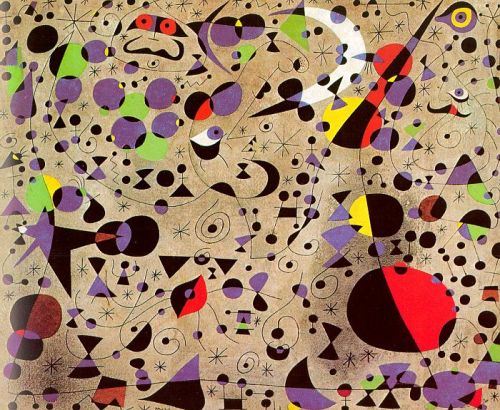
the-poetess

     “The Poetess (1940)

           Joan Miró

                 _____

when Aristotle proceeds to declare the 
parameters of “Poetry” for the ages“, his
definitions of the various poetic 
manner[s] or mode[s] of imitation” 
have already been established, his 
categorizations are not unlike Darwin’s 
categorizations of the species during
a much later age, Aristotle was a natural 
scientist much more than he was our 
notion of an abstract philosopher, he 
traded in facts rather than in the 
esoteric musings that Platofor 
instance, pursued, Virtue, Justice, 
the Good, his conclusions were more 
verifiable

Kant, incidentally, is also famous for 
following a similar form of investigation
as he attempted, nearly, for most, 
inscrutably, to categorize the elements 
of our faculty of understanding

a side story

Kant had stated that at birth we already 
have within our perceptual framework 
implicit understanding of space and 
time, these are not learned through 
experience but are already 
incorporated within us, he said

many years ago, coming out of a 
week-long coma, not knowing where
I was but alone, at that point even
just my consciousness, cause my 
body, were it there, would’ve been 
under the immaculate white sheets 
I could see that would’ve been 
shielding my legs

I looked around, could gather motes 
upon rays of light that were entering 
from what appeared to be a window 
on the right, behind sheer white 
curtains stirred by a soft breeze,  
whirling the shimmering particles 
alive in the light before me like 
miniature spinning galaxies moving 
at the pace of their own infinity

there was no sound

white walls around me stood utterly
still in the purview of my perception,
a door, also white, stood opposite 
me on the opposite wall

where am I, I wondered, could this 
be heaven, an afterlife, I might’ve 
died, I thought, marvelling, no fear, 
regret, nothing other than curiosity, 
absorption, fascination

I tried to answer my question, where 
am I, two dimensions, I figured
after having watched Terence Stamp 
exiled by Marlon Brando to a flat 
intergalactic window pane in 
Superman“, I hadn’t excluded this 
eventualityhowever ingloriously 
transcendental, as a possible 
outcome, I might be in a world with 
only two dimensions, height and 
width, no depth yet without more 
investigation, experience 

ergo, Kant, I concluded, was wrong, 
our knowledge of space is not inborn 
but a product of time and thought like 
everything else 

later, the white door on the far wall
opened, and a nurse walked in, also, 
incidentally, in incandescent white,  
and understood I was alive

Aristotle suggested that our original 
double instincts towards poetry were 
our propensity to imitate, children 
imitating their parents’ even 
idiosyncratic mannerisms, for
instance

and rhythm, repetition, preludes to 
order, coherence

those two

poetry, I read, is expression
reflecting the heartbeat, essentially,
in all its myriad representations

Richard  

“To One Who Loved Not Poetry” – Sappho

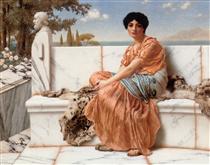
in-the-days-of-sappho-1904-jpgpinterestsmall

  “In The Days Of Sappho (1904) 

        John William Godward

                    _________

if I digressed towards “Tragedy” in my
most recent chat about poetry, I perhaps
blurred the fact that there were several 
kinds of poetry Aristotle was speaking   
about, but that all had the essential 
elements of both rhythm and 
representation, the idea that a poem 
was a reproduction of something 
that was not itself, a retelling

some of these rhythmic utterances 
were tragedies“, others were mere,  
indeed, verses without much of an 
agenda other than being the replication 
of something with rhythm the poet
wanted to promote

o, what a beautiful morning, two dactyls
and a trochee, for instance, the poetic 
meters that describe – ta da da, ta da da, 
dah dah – the natural music of that 
exclamation

and that can be a poem

here’s one of Sappho‘s, who lived 
sometime between 630 and 612 BCE
to around 570 of the same, of course,
era, famous for being from the island  
of Lesbos, yes, Lesbos 

it is To One Who Loved Not Poetry

    Thou liest dead, and there will be no memory left behind
     Of thee or thine in all the earth, for never didst thou bind
     The roses of Pierian streams upon thy brow; thy doom
     Is now to flit with unknown ghosts in cold and nameless gloom.”

so there, she says, I think, and all in iambic 
octameter, eight times ta dah

I preferred not to use one of her more
flirtatious, therefore controversial,
utterances, for fear of skewing to  
another, however compelling,
discussion

maybe next time

Richard

psst: the Pierian Spring was a spring in 
          Macedonia sacred to the Muses,
          the source of inspiration for 
          science, then, as well as the arts

up my idiosyncrasies – Plato‏

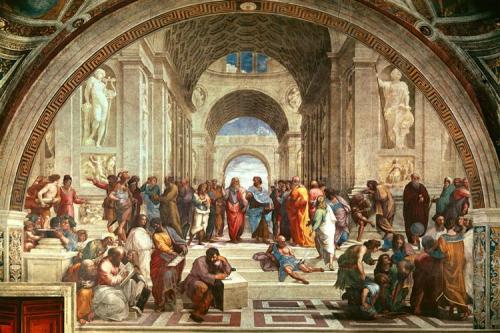
school-of-athens-detail-from-right-hand-side-showing-diogenes-on-the-steps-and-euclid-1511.jpg!Large

      “The School Of Athens (1510-1511)
 
                   Raphael
 
                       _____
 
 
he sounds just like you, my friend said,
who’d bought me the works of Plato
for C***mas maybe, or my birthday, or 
maybe just because he knew I’d very
much appreciate them
 
we were reading him together, as is 
always my inclination, his Meno 
according to my calculations, 
Socrates was doing most of the 
talking, with Meno, a Sophist 
acolyte, a school of philosophy then, 
the Sophists, which claimed it could 
prove anything by using the right 
arguments 
 
lawyers, of course, ensued, politicians
 
and rhetoric, the art of proving anything 
by using the right arguments 
 
philosophy had reached a structural,
indeed an existential, impasse, why, 
they therefore wondered, philosophy
 
wherein it entered a phase of moral 
speculation, StoicismEpicureanism,
ScepticismCynicism, and can you 
blame them, theories about the 
stars, the moon, the world, even 
matter itself, had become so 
questionable, was it fire, air, water, 
atoms, at its source, who knew
 
 
I thought so too, I said, and told 
him that Plato’s were the first   
texts studied in philosophy when 
entered university, that’s where I 
learned to talk like that, philosophy 
from the scratch, as my German 
teacher would’ve said, which is to 
say, from its very beginnings, 
whence I could view, I figured, the 
evolution of received wisdom in 
Western culture
 
I was young then, the young have 
such dreams 
 
 
my father had been agnostic, ever
asking questions, though we were 
being raised Catholic, my sister 
and I, on account of our mother 
tongue, our entire community, 
having been historically linked 
with that religion, and cause my 
parents wanted us to be educated 
in French
 
an existentialist crisis would
eventually follow, I intuited, as
indeed it did, so I majored in 
philosophy
 
 
Socrates taught me to ask 
questions, that no one had  
all the answers
 
Plato, usurping his master’s voice, 
created the paradigm for our present 
version of a Divinity, and Its Paradise
 
there is an ideal version of any 
item we might consider, he spouted,
an ideal table, for instance, exists
of which every material table is an
imperfect example
 
to virtue, love, beauty, truth, he 
applied the same principle, which
early erudite Catholics, Augustine
Thomas Aquinas, for instance, and
others, despite rejecting all of the 
other Greek cultural achievements
appropriated in order to bolster their 
impression of God, the ideal of the 
Ideal
 
this lasted uncontested for just
over a thousand years
 
for a thousand years our salvation
had been extraterrestrial, 
supranatural, this, our very, 
perhaps only, existence, an 
imperfect reflection of somewhere
else an ideal, a mere simulacrum,  
we were, a metaphor
 
Socrates had only asked questions,
what is virtue, what is justice, what
is beauty, truth
 
Plato presumed to have known the 
answers
 
 
Aristotle is making a comeback,
whose method, in opposition to 
his contemporaneous forebear,  
was much more like Charles 
Darwin‘s, working from the facts, 
which proved then, and are 
proving still now, to be multifarious, 
diverse, astonishing, and nearly 
enough to make you believe in 
God/dess again, this time, however, 
through the back door 
 
or in a multiplicity, a panoply, a 
very pavilion, even, of natural 
deities, otherwise known as 
angels, for better or for worse
 
God/dess bless, or angels
 
 
Richard

true happiness

 
in the movie Never on Sunday” Homer Thrace, an American moralist and armchair philosopher, objects to the libertine ways of the modern Greeks, Ilya especially, a whore, disconcerts him, she likes her job, so do the dockworkers, and the other women who ply her trade at the port of Piraeus, near Athens 
  
Homer Thrace accuses them all righteously of pursuing the Stoic and Epicurean philosophies that came out of the fall of Greece, instead of the true and noble ideals of the more upstanding Socrates, Plato, and Aristotle, who believed that the greatest happiness comes from the joy of understanding  
  
when he tells Taki, who plays the bouzouki, that he can never be a true musician because he can’t read music, Taki, who is too old now to learn, hides in the bathroom forlornly, and says he will never play again 
  
Ilya, Melina Mercouri, in a star turn, tells him composers need his music to be able to write his notes down, what would composers do without him, if birds can’t read music, she asks, should they stop singing  
  
Taki comes out of the bathroom
  
so had I   

  
Richard


                       ______________________________