Richibi’s Weblog

Just another WordPress.com weblog

Tag: Apollo / god of the Sun

“The Story of Narcissus” – Ovid
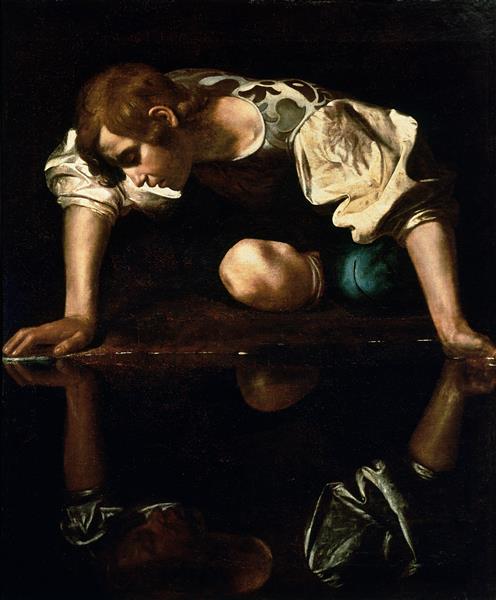


Narcissus, c.1599 - Caravaggio

          Narcissus” (c.1599)


                 Caravaggio


                       ______


               Thus did the nymphs in vain caress the boy,


the boy, Narcissus


in vain , Narcissus‘ pride, you’ll remember,

was such that love-sick maid[s] uselessly

[their] flame confess’d, Narcissus was

oblivious to their advances


He still was lovely, but he still was coy;
               When one fair virgin of the slighted train


slighted train, row of followers, love-sick

maid[s] who’d been spurned by Narcissus


               Thus pray’d the Gods, provok’d by his disdain,


provok’d by his disdain, angered by his

rejection


               “Oh may he love like me, and love like me in vain!”


beseeches the one fair virgin


               Rhamnusia pity’d the neglected fair,


Rhamnusia, goddess of Retribution,

also known as Nemesis


               And with just vengeance answer’d to her pray’r.


just vengeance, justified retribution


               There stands a fountain in a darksom wood,
               Nor stain’d with falling leaves nor rising mud;
               Untroubled by the breath of winds it rests,
               Unsully’d by the touch of men or beasts;
               High bow’rs of shady trees above it grow,
               And rising grass and chearful greens below.


bow’rs, enclosures among trees


greens, lawns, grasslands


               Pleas’d with the form and coolness of the place,
               And over-heated by the morning chace,
               Narcissus on the grassie verdure lyes:


verdure, greenness


               But whilst within the chrystal fount he tries
               To quench his heat, he feels new heats arise.


chrystal fount, glistening fountain,

or spring


               For as his own bright image he survey’d,
               He fell in love with the fantastick shade;


shade, apparition, illusion


               And o’er the fair resemblance hung unmov’d,


see above


               Nor knew, fond youth! it was himself he lov’d.
               The well-turn’d neck and shoulders he descries,


descries, espies, catches sight of


               The spacious forehead, and the sparkling eyes;
               The hands that Bacchus might not scorn to show,


Bacchus, god of Wine and Revelry, also

known as Dionysus


And hair that round Apollo’s head might flow;


Apollo, god of the Sun


               With all the purple youthfulness of face,
               That gently blushes in the wat’ry glass.


wat’ry glass, the chrystal fount


               By his own flames consum’d the lover lyes,
               And gives himself the wound by which he dies.


the wound, the sight of himself


dies, succumbs, is undone


               To the cold water oft he joins his lips,
               Oft catching at the beauteous shade he dips

               His arms,


shade, see above


                     as often from himself he slips.


slips, becomes abstracted, bewildered

 
               Nor knows he who it is his arms pursue
               With eager clasps, but loves he knows not who.


he cannot give substance to this illusion


What could, fond youth, this helpless passion move?

               What kindled in thee this unpity’d love?
 move, excite, indeed kindle[]


               Thy own warm blush within the water glows,


the poet, here, note, interjects, speaks

directly to Narcissus


               With thee the colour’d shadow comes and goes,


colour’d, because of the water, an exact

replication, even chromatically, but

shimmering, com[ing] and go[ing]


shadow, shade, see above, reflection


               Its empty being on thy self relies;


empty being, fabrication, imagined

construct


on thy self relies, you are yourself

the source of your illusion


               Step thou aside, and the frail charmer dies.


frail charmer, shimmering, insubstantial

illusion


stay tuned


R ! chard

“The Story of of Cadmus” – Ovid

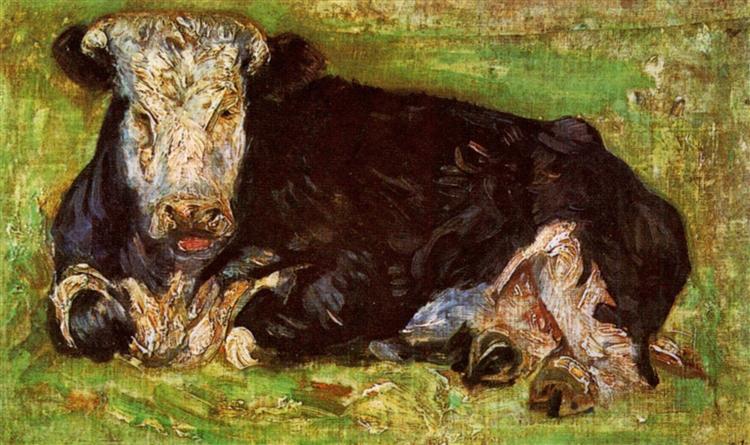
Lying Cow, 1883 - Vincent van Gogh

        Lying Cow(1883)


             Vincent van Gogh


                           ______

            When now Agenor had his daughter lost,


Agenor, king of Tyre, father of

Europahis daughter lost


            He sent his son to search on ev’ry coast;


his son, Agenor’s son, Cadmus,

Europa’s brother


            And sternly bid him to his arms restore
            The darling maid, or see his face no more,
            But live an exile in a foreign clime;
            Thus was the father pious to a crime.


pious to a crime, intent on, devoted to,

having justice restored


            The restless youth search’d all the world around;
            But how can Jove in his amours be found?


amours, loves, trysts, entanglements


            When, tir’d at length with unsuccessful toil,
            To shun his angry sire and native soil,


his angry sire, Agenor, father, sire


            He goes a suppliant to the Delphick dome;


suppliant, supplicant, petitioner,

one in search of a favour


Delphick dome, the Temple of Apollo

at Delphi, where the oracle, Pythia,

proclaimed her cryptic prognostications,

her famously ambiguous prophecies


Delphi, incidentally, was one of several

sacred sites in Greece, sanctuaries,

open to any Greek, or person who

could speak Greek, regardless of

geographical provenance, any

city-statefor instance then, or

kingdom, akin to embassies today,

or places where people can expect

to find similar political haven


Delphi was the destination then also of

pilgrimages, comparable to our own

Santiago de Compostela today, an

ancient path I dearly would’ve, but

never have, unfortunately, undertaken


though I did walk to Mission B.C. some

several years ago, from my home in

Vancouver, to a monastery there, a

place of recuperation when I needed

one, three days there, and a half, three

days and an equal half back, my feet

were blistered, I noticed at one point,

but hadn’t at all registered any pain,

a truth I gathered about the power of

intention, one’s very aim can be a

salve, a balm, a solace, against any

adversity


but back to Cadmus


            There asks the God what new appointed home
            Should end his wand’rings, and his toils relieve.


where do I land, asks Cadmus,where

is my appointed home, my final

destination


            The Delphick oracles this answer give.


The Delphick oracles, subordinates

to Pythia, the high priestess at Delphi


            “Behold among the fields a lonely cow,

            Unworn with yokes, unbroken to the plow;

            Mark well the place where first she lays her down,

            There measure out thy walls, and build thy town,

            And from thy guide Boeotia call the land,

            In which the destin’d walls and town shall stand.”


Boeotiaa region still of Greece


            No sooner had he left the dark abode,
            Big with the promise of the Delphick God,


the Delphick God, Apollo, god of

music, dance, truth, prophecy,

healing, the sun, light, poetry,

among many other things


            When in the fields the fatal cow he view’d,
            Nor gall’d with yokes, nor worn with servitude:


fatal, fateful


gall’d, irritated, frustrated


            Her gently at a distance he pursu’d;
            And as he walk’d aloof, in silence pray’d
            To the great Pow’r whose counsels he obey’d.


the great Pow’r, Apollo, by way of his

Delphick oracles,the high priestesses,

through their counsel, their divinations


            Her way thro’ flow’ry Panope she took,


Panope, plural, were sea nymphs, not

places, in Ancient Greece, therefore

Cadmus must’ve been crossing water,

however flow’ry, I’ll have to check my

Latin text for, maybe, inaccuracies in

the translation


            And now, Cephisus, cross’d thy silver brook;


Cephisus, or Cephissus, a river in Boeotia,

a brook, a stream, anthropomorphized here,

which is to say Cephissus, the flow, the

waterway, is being addressed as a rational

being, I have cross’d thy silver brook, he 

says, speaking to the torrent


meanwhile, to brook, to conquer, to

overcome, a wonderful, a shimmering,

literarily speaking, homonym, which is

to say, a word with two faces


            When to the Heav’ns her spacious front she rais’d,
            And bellow’d thrice, then backward turning gaz’d
            On those behind, ’till on the destin’d place
            She stoop’d, and couch’d amid the rising grass.


she, the fatal cow, see abovehas led

Cadmus to his famed, his mythic,

destination, destin’d place, destiny


stay tuned


R ! chard

“Ocyrrhoe transform’d into a Mare” – Ovid

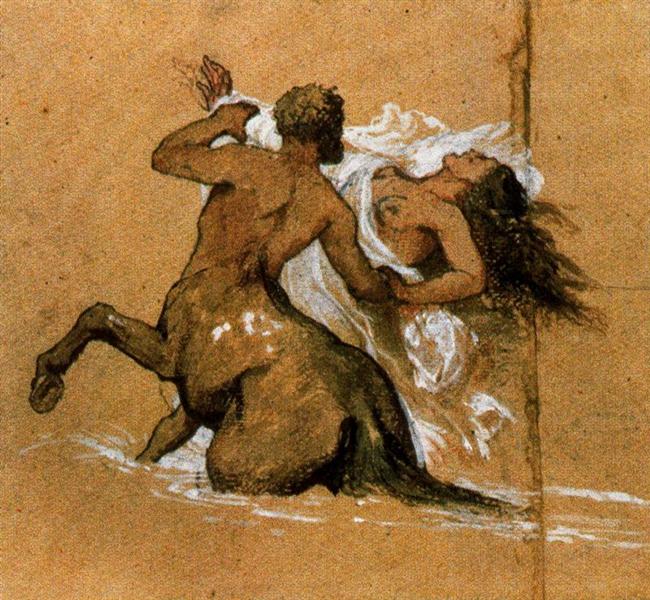
centaur-and-nymph.jpg!Large


       Centaur and Nymph


              Arnold Böcklin


                           ________


                  Old Chiron took the babe with secret joy,                 

                  Proud of the charge of the celestial boy.

                  His daughter too, whom on the sandy shore

                  The nymph Charicle to the centaur bore,

                  With hair dishevel’d on her shoulders, came

                  To see the child, Ocyrrhoe was her name;


Ocyrrhoe, daughter of Chiron and [t]he

nymph Chariclec[o]me …[t]see

the child


With hair dishevel’d on her shoulders,

there’s a suggestion here, regarding

Charicle, of madness, or possession


the child, the babethe celestial boy,

the infant, ript, by its very father,

Apollo, from his unfaithful lover,

Coronis’, womb, and [given] … to

the centaur Chiron”s charge, into

its, or his, care


                  She knew her father’s arts, and could rehearse

                  The depths of prophecy in sounding verse.


it appears that Ocyrrhoe, daughter of

Chiron and the nymph Charicle, was

a poetess, was possessed, on her

father’s side, of poetry, could reveal,  

decipher, or rehearse / The depths

of prophecy, in sounding verse, was

able, as wordmongers sometimes do,

to tell truth, deliver, in rhyme, incisive

evaluations


              Once, as the sacred infant she survey’d,


the sacred infant, the child born of

Apollo and Coronis 


              The God was kindled in the raving maid,


The God, the child, the sacred infant,

by virtue of being half, if only half,

divine, having been fathered by the

god, Apollo


kindled, inspired


the raving maid, Ocyrrhoe, beset by

neurotic, irrational, though prophetic,

it is proposed, powers


                   And thus she utter’d her prophetick tale:

                  “Hail, great physician of the world, all-hail;


great physician of the world, the fated

child of Apollo and Coronis would

become a healer of legend


                  Hail, mighty infant, who in years to come

                  Shalt heal the nations, and defraud the tomb;


defraud the tomb, recall from the

hereafter, resuscitate, revive,

return to life


                  Swift be thy growth! thy triumphs unconfin’d!

                  Make kingdoms thicker, and increase mankind.


thicker, more populated


                  Thy daring art shall animate the dead,


Thy daring art, medicine, the mighty

infant will eventually be recognized

as a celebrated man of healing 


                  And draw the thunder on thy guilty head:


guilty head, when Hades, king of the

Underworld, complained to Zeus, his

brother, that the mighty infant was

stealing his subjects, the departed,

Zeus shot the great physician down,

acknowledging the healer’s guilt, of

his defraud[ing] the tomb, condemning

the culprit with a punishing, an

annihilating, thunderbolt


                  Then shalt thou dye, but from the dark abode

                  Rise up victorious, and be twice a God.


Apollo, aggrieved, had had his son,

the child, the sacred infant, reinstated,

after tortuous ministrations, as an

immortal god, an entirely, however,

other story


                  And thou, my sire, not destin’d by thy birth

                  To turn to dust, and mix with common earth,

                  How wilt thou toss, and rave, and long to dye,

                  And quit thy claim to immortality;

                  When thou shalt feel, enrag’d with inward pains,

                  The Hydra’s venom rankling in thy veins?


the child, the sire, not destin’d by [its] birth

/ To turn to dust, which is to say, to be no

longer mortal but immortal, how will it, not

wanting particularly to survive, quit [its]

claim to immortality, deal with the

impossibility of dying, [w]hen [it] shal[l]

feel, enrag’d with inward pains, agonies,

that compel it to seek personal annihilation


Hydra, a snakelike monster with many

heads, whose venom and very breath

were poisonous, stationed at one of

the entrances to the Underworld


                  The Gods, in pity, shall contract thy date,

                  And give thee over to the pow’r of Fate.”


contract thy date, make mortal,

subject once again to Fate


R ! chard

“The Story of Coronis, and Birth of Aesculapius” (IV) – Ovid

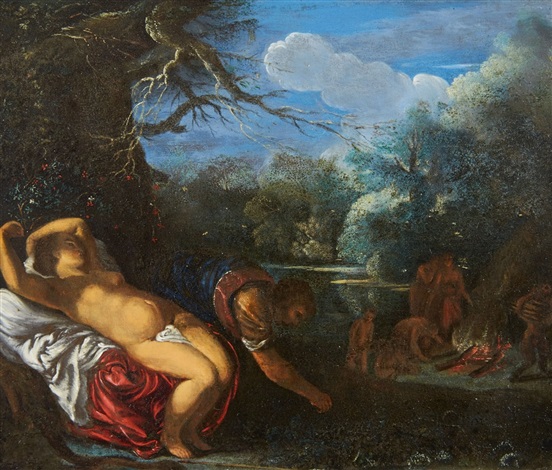
adam-elsheimer-apollo-and-coronis-2

   “Apollo and Coronis (1606 – 1608)


                Adam Elsheimer


                   __________


               On her incestuous life I need not dwell 
               (In Lesbos still the horrid tale they tell), 
               And of her dire amours you must have heard, 
               For which she now does penance in a bird, 
               That conscious of her shame, avoids the light, 
               And loves the gloomy cov’ring of the night; 
               The birds, where-e’er she flutters, scare away 
               The hooting wretch, and drive her from the day.” 


Nyctimene, daughter of Epopeus

king of Lesbos, a Greek Island in

the Aegean Sea, had been defiled 

by her father, Minerva, out of pity,

transformed her into an owl, the

above verses tell the story of

that owl, Nyctimene


               The raven, urg’d by such impertinence, 
               Grew passionate, it seems, and took offence, 
               And curst the harmless daw; the daw withdrew: 
               The raven to her injur’d patron flew, 
               And found him out, and told the fatal truth 
               Of false Coronis and the favour’d youth. 


the raven, Apollo’s own bird, having 

discovered Coronis to be unfaithful 

to their master, its and hers, remained

intentdespite the daw’s warnings,

earlier here reported, on informing

the god of the Sun 


               The God was wroth, the colour left his look, 


wroth, angry


               The wreath his head, the harp his hand forsook: 


[t]he wreath, … the harp, Apollo’s

usual attributes, symbols of his

harmony, concord


               His silver bow and feather’d shafts he took, 
               And lodg’d an arrow in the tender breast, 
               That had so often to his own been prest. 


though Apollo is not usually 

associated with bows and arrows,

his twin sister Diana, goddess of

the Hunt, always is, it would not 

be unusual to conflate the two 

deities for poetic, or indeed

mythological, purposes


               Down fell the wounded nymph, and sadly groan’d, 
               And pull’d his arrow reeking from the wound; 
               And weltring in her blood, thus faintly cry’d, 
               “Ah cruel God! tho’ I have justly dy’d, 
               What has, alas! my unborn infant done, 
               That he should fall, and two expire in one?” 
               This said, in agonies she fetch’d her breath. 


it is supposed here that the unborn

infant is indeed Apollo’s


               The God dissolves in pity at her death;

               He hates the bird that made her falshood known, 
               And hates himself for what himself had done; 
               The feather’d shaft, that sent her to the Fates, 
               And his own hand, that sent the shaft, he hates.


Apollo is suffused with regret, anger,

self-recrimination


               Fain would he heal the wound, and ease her pain, 


Fain, with pleasure, gladly


               And tries the compass of his art in vain. 


the compass of his art, the range 

of his ability, in this case vain, 

faulty, ineffective


               Soon as he saw the lovely nymph expire, 
               The pile made ready, and the kindling fire. 


pile, pyre


the sentence lacks a verb here, it 

should read The pile was made 

ready, just saying


               With sighs and groans her obsequies he kept, 


obsequies, funeral rites


               And, if a God could weep, the God had wept. 


I’ll have to watch out for gods

weeping, I suspect some have, 

some can


               Her corps he kiss’d, and heav’nly incense brought, 
               And solemniz’d the death himself had wrought. 


corps, body, corpse


wrought, brought about, made

happen


               But lest his offspring should her fate partake, 
               Spight of th’ immortal mixture in his make, 


Spight, in spite 


               He ript her womb, and set the child at large, 
               And gave him to the centaur Chiron’s charge: 


Chiron, first among the centaurs,  

half man, half horse, was highly 

revered as a teacher, having 

been raised by the twins, Apollo 

and Diana / Artemis, supremely

accomplished deities


               Then in his fury black’d the raven o’er, 
               And bid him prate in his white plumes no more. 


black’d, Apollo turned the snowy 

plume[d], [w]hite as the whitest 

dove’s unsully’d breast raven 

black


prate, babble, talk incoherently


R ! chard