Richibi’s Weblog

Just another WordPress.com weblog

Tag: Apollo

“Metamorphoses” (The Giants’ War, X) – Ovid
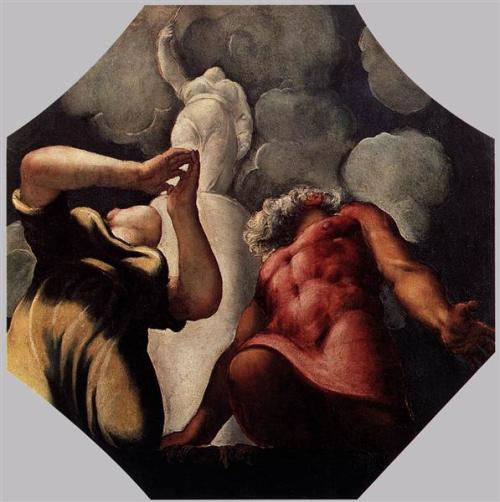
deucalion-and-pyrrha-praying-before-the-statue-of-the-goddess-themis.jpg!Large

  “Deucalion and Pyrrha Praying before the Statue of the Goddess Themis (c.1542) 


          Tintoretto


             _____


              A mountain of stupendous height there stands
              Betwixt th’ Athenian and Boeotian lands, 


Boetia was, and still is, a region of 

Central Greece, its largest city is,

and was, Thebes, a major rival in

ancient times of Athens


              The bound of fruitful fields, while fields they were, 


bound, boundary, the fruitful fields

within a certain limited area, between 

Athens, here, and Boetia


              But then a field of waters did appear: 


              Parnassus is its name; whose forky rise
              Mounts thro’ the clouds, and mates the lofty skies. 


Parnassus is a mountain in Central 

Greece, however forky, however 

forked, craggy, uneven, sacred 

especially to Apollo, god of too 

many things to list here, and the 

site, at Delphi, on its south-western 

slope, of his Oracle, famous for 

being consulted on a variety of 

matters, from personal to affairs 

of state, its high priestess was 

believed to incarnate the very 

voice of Apollo


Parnassus was also the home, 

incidentally, of the Muses, goddesses 

in their own right, of the several arts, 

who ministered to Apollo


              High on the summit of this dubious cliff,
              Deucalion wafting, moor’d his little skiff. 


Deucalion is the Abrahamic Noah‘s

counterpart, sole survivor, with his 

wife Pyrrha, of the flood 


the cliff is dubious because the

mountain is still deep in water,

its summit precarious yet 


              He with his wife were only left behind
              Of perish’d Man; they two were human kind. 


they two alone were left of humankind,

of perish’d Man


              The mountain nymphs, and Themis they adore, 


Themis, goddess of Divine Justice


              And from her oracles relief implore. 


Deucalion and Pyrrha pray to Themis

at Delphi, its first high priestess, hungry

for, and heedful of, her oracles, counsel


see above


              The most upright of mortal men was he;
              The most sincere, and holy woman, she. 


a chance at a new world


R ! chard

Hesiod on poets, and, for that matter, kings

1280px-1807_Thorvaldsen_Tanz_der_Musen_auf_dem_Helikon_anagoria.JPG

The Dance of the Muses at Mount Helicon (1807)  

Bertel Thorvaldsen

________

though Zeus may preside over kings,
none other than Apollo and the Muses
preside over poets, according to
Hesiod

Kalliope, foremost of the nine Muses
who tends specifically to kings, and 
to those being born of kings, in the
company of her sisters, Kleo and 
Euterpe, Thaleia and Melpomene, 
Terpsichore and Erato and Polymnia 
and Ourania, will pour a dew sweeter 
than honey upon such a one’s tongue, 
and his words become soothing, 
palliative, placating

“far shooting Apollo, however, 
presides at the inspiration of poets,
lending the lyrical notes from his 
representative lyre, not to mention 
his lyrics, derivative both terms of 
that etymological “lyre”, incidentally,  
so far has Apollo “shot”, dare I say,  
his spirit into our collective 
unconscious
 
“From the Muses and far-shooting Apollo
are singers and guitar-players across the earth, 
but kings are from Zeus. Blessed is he whom the Muses
love. From his mouth the streams flow sweeter than honey.
If anyone holds sorrow in his spirit from fresh grief and
is dried out in his heart from grieving, the singer,
servant of the Muses, hymns the deeds of men of the past  

and the blessed gods who hold Olympus, and
right away he forgets his troubles and does not remember
a single care. Quickly do the gifts of the goddess divert him.” 
 
                                                    Theogony (lines 94 – 103)
                                                                     Hesiod

therefore poets 

Richard 

psst: a friend has just passed on,
 it is a time for poets
a merely theoretical dilemma, a poem


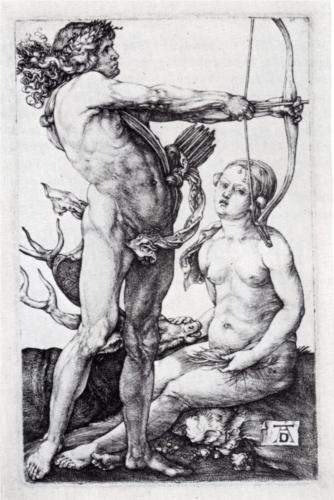
Albrecht Dûrer - "Apollo and Diana(" (1502)

Apollo and Diana (1502)

Albrecht Dürer

________

in the tradition of Elizabeth Barrett Browning,
a forthright, personal poem

a merely theoretical dilemma

yesterday, I had lunch with Vickie,
she said she admired our relationship,
despite the fact, which I’d interjected,
that there was no sex

she didn’t find that unacceptable

I found her concern more personal,
revealing, than strictly theoretical

then gave up the improbable
thought

I dream, however, ever, Apollo, and
irrepressibly, of your genitals,
knowing that your spawn would
transform me, ineradicably, into
a constellation, its crystallization
our progeny, into immortal stars

but that would mean leaving you,
Apollo, behind

could I, would I, do that

love

me

Apollo Appleseed

a friend of mine, Apollo, having
appropriated that name already
to launch a, not unpromising,
career as an artist, had never
to date considered a surname
for what I called his nom de
pinceau
, his brush name

but in a farfelu moment, French
for having lost one’s head – my
head, not his, having surrendered
immediately to his fantasy – he’d
happened upon “Appleseed” as
maybe a fitting, and to be
considered, apposition, addition,
to his presently truncated name,
I jumped on it

he later called the phenomenon,
at a loss for provenance, an
inspiration, to which I forthwith
concurred, Apollo Appleseed,
can you dig it, I told him he now
had to live up to it

inspiration is always the source
of poetry, I said, poetry is what
we all live for, to make our lives
beautiful

it involves following our inspirations,
however fanciful, however out there,
people have built lives around art,
literature, dreams, madeleines, for
goodness’ sake, fording oceans,
climbing mountains, and have
become not to be forgotten, it’s the
magic that counts, ever the aim of
inspiration

when inspiration strikes it is ever
charged with possibility, perspicacity,
delight, it is not a negative function

when inspiration strikes it is time
to stand and deliver, it knows the
ineluctable way, the one that’s in
your heart

you too can plant apple trees across
the land, of your own potentialities, if
only you dare follow even one of your
dreams

Richard

psst: you’ll have to forgive my ardour,
it’s been my Johnny Appleseed
speaking

and don’t forget to click

something creative

                                   (click on the picture should it fail)

                         “Vase of Flowers, after van Gogh” (2009)
 
                                     Apollo
 
                                       ____


with my suggestion neatly tucked under
his arm, of asking for it $1200.00, 
Apollo 
set off to sell his painting, “Vase of Flowers,
after van Gogh”, the one which has been
gracing my
 living room wall for several
years now
, a convenient place where he
could store it, maybe even indefinitely, 
while he made room for other paintings
 

the deep rust table, upon which rests the

white marbled vase which holds the

signature sunflowers, matches a somewhat 

lighter shade of it on my wall,
Burning Bush
it’s called, a colour I chose recently for its
associations with the miraculous, to freshen
up that particular corner  
 
to also see a burning bush every morning,

however metaphorically, as I start my day 


not having any idea what it might fairly cost

when
Apollo asked for my opinion, something
he couldn’t do by himself for being too intimately

connected, at
an opera evening the following
night at my place I asked my three opera guests,

who were sitting, of course, before the very item,

what they thought


the next day in an e-mail I wrote 
 
        “since we’re all, you, me, my mom, Claude

          and Yolande, whom I’ve included in these 

          deliberations, in the same position,

          stumped with regard to a price, I thought 

          I’d simply put all our uninformed opinions

          together and divide by 5 


          Claude,     2000

          Yolande,   1200 

          my mom,    700

          me,           1000,  recently upped from 800 

          you,               ?,  which is to say abstention,

                                     so that 5, to be fair, 
                                     becomes 4
 
                            ____ 
                           4900 / 4 = 1225


          but I’ll accept 1200, should you honour

          my call 


          after all, it’s my wall 


          love


          me” 


perhaps“, he’d asked, “you can make a suggestion 
 
towards a solution …
 
I’ll hear from you with something creative
 
as is your usual style“, he’d written from his own
computer in his own idiosyncratic manner, after
the prospective buyer had been up to my place,
viewed dispassionately, I thought, the painting,
though he’d warmly admired my apartment, then
left with Apollo to, ultimately inconclusively at
that point as it turned out, talk cost
     
 
I thought I’d been accordingly creative, not
without some commensurate glee
 
and quivered at what might be the result of my
creation, though the work might, sadly, leave
its now impressive standing on my wall  
 
which I knew, however, Apollo, would never
leave deficient
 
nor, for that matter, would I    
 
 
I’m not ready to set a price on it if you can’t 
come up with one, the collector had told
 
which left Apollo in a fix, until the
serendipitous $1200.00 
 
this is what Richard said, he told the buyer,
who’d indeed fretted, with noteworthy
consideration, about my having
to lose the painting, unaware that
everything turns to dust, to my mind, little
by little dries up, even in one’s imagination,
if it is to be transformed into other magic
 
  
I’d countered that at the right price the
exchange would be a spur to the
burgeoning painter, ready to pursue his
muse with just a little even inspiration,
inspiration an admirer could express in,
notably, dollars  
 
but I’ll discount down to 900, Apollo said, 
ceding to his insecurities, since I know you 
 
I’ll buy it for 1000, the man said, I would’ve
payed 2000, and showed him a work they 
both deemed inferior for which he’d payed
that much 
 
do not, he said, underestimate yourself,
you are a talented artist
 
 
later, looking over the entire transaction,
I asked Apollo, when will you acquire more
than tremulous confidence
 
I’m working on it, he replied
 
what about now, I said, you’ll only be an 
artist when you call yourself one, own it,
do it, now
 
okay, he said, today I am an artist, and
raised his arms wide to the open sky,
appropriately, I thought, surrendering
himself, with giddy determination, to
inscrutable heaven       
 
 
Richard


XLll. “My future will not copy fair my past” – Elizabeth Barrett Browning

from Sonnets from the Portuguese

XLll. My future will not copy fair my past

“My future will not copy fair my past”
I wrote that once; and thinking at my side
My ministering life-angel justified
The word by his appealing look upcast
To the white throne of God, I turned at last,
And there, instead, saw thee, not unallied
To angels in thy soul! Then I, long tried
By natural ills, received the comfort fast,
While budding, at thy sight, my pilgrim’s staff
Gave out green leaves with morning dews impearled.
I seek no copy now of life’s first half:
Leave here the pages with long musing curled,
And write me new my future’s epigraph,
New angel mine, unhoped for in the world!

Elizabeth Barrett Browning

_________________________

“You really make it seem so easy with your presentation but I find this
matter to be actually something which I think I would never understand.
It seems too complicated and extremely broad for me.
I am looking forward for your next post, I will try
to get the hang of it!“

because there was no return address
on this comment, and because its
uncorroborated website, a gaming site,
seemed to me suspect, I’ve chosen to
reply within the safer body of my
discussion, rather than within the
thickets and brambles of the more
treacherous Internet

but I profoundly respect the, not at all
uncommon, opinion

therefore this

Elizabeth Barrett Browning is not
immediately accesible to us in the
early 21st Century, this comment is
such an example, unsolicited but
honest, and it is the cry of the
uninitiated through no fault of their
own before time’s obfuscating,
even linguistic, even literary, but
ever ineffable, shroud, I had the
same sense of its, often, preciosity
when I first started reading poetry,
not only even but especially the
greats who’d been recommended,
it took a poet who spoke my
language before I could take
verse seriously

but since then it has become for
me a garden of existential, of
transcendental, delights,
revelations I can’t help but want
to share, not only substantial
stuff, but, I think, sacred

no one has said it better to date
than Pamela Spiro Wagner in
How to Read a Poem: Beginner’s
Manual

“Read just one poem a day.
Someday a book of poems may open in your hands
like a daffodil offering its cup
to the sun“

even a daffodil like Elizabeth
Barrett Browning

Elizabeth is a siren here, I asked of heaven,
she says, “My future will not copy fair my
past”,
and along comes, goodness, a
miracle in the form of, more or less, an
angel – “not unallied / To angels in thy
soul”,
she describes him in her particular
Victorian dialect, not always immediately
penetrable

she was so happy then, she grew ”green
leaves”,
she asserts, evidently exaggerating,
“with”, even, “morning dews impearled”,
she further enthusiastically confides, but
of which we won’t out of discretion, of
course, inquire

let’s just say she will hitch her wagon
therefore to his, [n]ew angel mine”, star,
for the foreseeable, however “unhoped
for”
, future

which man could resist being called “not
unallied / To angels“,
Elizabeth, seductress,
enchantress, I call my man Apollo, my
golden god of light

Richard

Brahms Piano Concerto no 2 in B flat major, opus 83‏

though I’d no intention of presenting a piano concerto
quite yet I’d been trolling Celibidaches on the Internet,
after marvelling at his wondrous Boléro”, and couldn’t
hold back this gem I found of his, Brahms’ Piano 
 
same venue, same Münchner Philharmoniker, same
starched ceremonial ruffles, I thought, same even age
of the conductor, to the very minute, it appeared, in 
his unchanged eye and perspective, wise, serene,
omnipotent, perhaps the very same concert as in the
illustrious Ravel, I said to myself, though later couldn’t
especially recognize individual instrumentalists
 
Daniel Barenboim, who conducted earlier the speedy
“Boléro”, wears another hat here, he’s the pianist, but
in this incarnation he is transcendental, carried aloft,
I think, notably, by the Olympian Celibidache, who
cedes his fire and glory to the younger Barenboim
throughout, who supremely is up for the challenge,
a ready and rearing Apollo, taking on the treacherous
musical task, defying obstreperous planets, perilous
astrological constellations in nefarious conjunctions, 
stray or fleeting stars, to foster safely home to its
final hearth his solar chariot, in a towering sunset,
finale of apocalyptic proportions, each purveyor
casting unutterable light, god and mere immortal, 
from his own particular perch, upon our beholden
world
  
Celibidache, as would Zeus, cedes serenely to his 
younger avatar his bow, his deserved adulation,
safe in his own unquestionable omnipotence
 
 
this concerto has four movements incidentally, greater
length always suggests more gravitas, more substance 
 
is it warranted
 
you be the judge 
 
 
Richard
 
psst: in another mythological context, note the hand of
         Celibidache resting on air, intermittently fluttering,
         at the beginning of the slowest movement, the
         andante, the third, the hand of God ministering, 
         according to Michelangelo, in the “Creation of 
         Adam”, should you not yet be convinced of the 
         maestro’s august and unequivocal stature


Beethoven: piano concerto no 5, in E flat major, opus 73‏

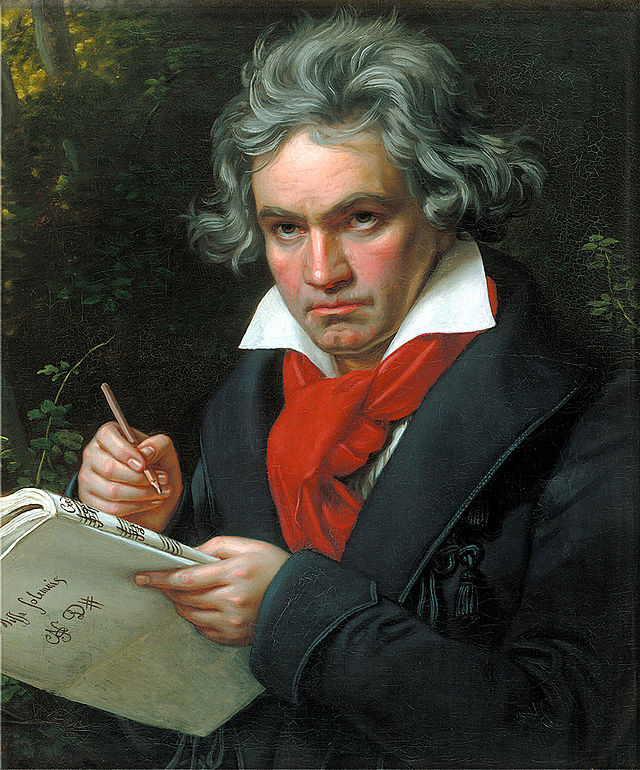
"Beethoven" - Joseph Karl Stieler

A portrait of Ludwig van Beethoven (1820)

Joseph Karl Stieler

_____________

you might say a triumvirate of piano concertos dominate
our Western musical culture, a veritable trinity of pianistic
masterworks that tower over, and have ruled, our musical
consciousness throughout the modern epoch, the
Rachmaninoff 3 has been one of them, but the 5th of
Beethove
n is surely the granddaddy, the “Guppa” as a
favourite grandchild I know would say, the Olympian
Zeus, the Christian God the Father, of them all, in majesty
and authority, others quake in its overwhelming aura, it is
the sun to all the other stars

Glenn Gould is the standard still by which it should be
played, none yet, to my mind, has surpassed him

Karel Ancerl conducts the Toronto Symphony Orchestra,
a competent orchestration, overshadowed inevitably by
this prodigy, who nevertheless doesn’t ever flaunt his
finger play but remains faithful throughout to the
dictates, the tonal balances, of the music, it is 1972

I had mentioned “variations in volume, tempo, tonality,
the play of harmonization and discords” in Rachmaninoff
,
note the strict adherence to tempo here, even the fastest
runs of notes are grounded in beat, more solid, less elusive
than the iridescent Rachmaninoffian allusions to Debussy,
you could set a metronome to the appropriate tempo of
each individual movement in Beethoven, it would remain
constant, apart from a few restrained ritardandos near
the end of some musical elaborations, until its very final
apotheosis, beat was ever an anchor for the fulgurating
Beethoven, an article of faith from which he strayed only
with great circumspection

note the language is not emotional, passionate and ardent,
but philosophical, metaphysical, Beethoven is confronting
cosmological considerations, existential realities, not the
more emotional concerns that confound us every day, it’s
God he’s talking to, eternity, not the incarnate tendrils
of the moment, not the poignant stuff even of soon
through Schubert a Chopin, Beethoven was at the start
of that Romantic Movement, indeed its very first
proponent, but not quite ready to wear his heart itself
on his sleeve, but a more spiritual, probing reason, whose
ardent metaphysical ratiocinations would set all the others
on fire, setting the stage for all the other stars

later, if you haven’t guessed what it’ll be already, I’ll
supply you with the third concerto, the Holy Ghost, of
the trinity, the Apollo, god of music and the sun, among
our concert greats

Richard