Richibi’s Weblog

Just another WordPress.com weblog

Tag: Anthony van Hoboken

Divertimento in G major, Hob.II:1 – Joseph Haydn
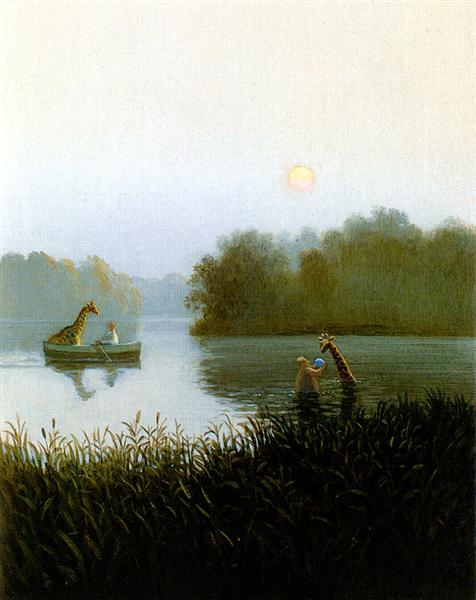
giraffe.jpg!Large

        “Giraffe” 

               Michael Sowa

                        ________

after looking everywhere on the Internet 
for how many divertimenti Haydn had 
written – since I’d given up counting them 
individually from the only list I could find
there, confounding one – I asked Siri
the 21st Century’s Delphic Oracle, whom 
I’d never yet consulted, apart from once 
during a friendly demonstration of her 
prowess

her reply about “divinity minty”, however, 
didn’t lead me anywhere, though 
“divertimento” eventually got me, 
however unsatisfactory, somewhat more 
pertinent answers

regardless, here is Haydn’s very first  
divertimento

a divertimento is quite simply an 
entertainment, an after dinner mint for
the aristocratic set, a place to digest 
one’s fine culinary offerings in the 
same, usually stratified, company
 

nowadays we have supper clubs

when Haydn called his early string 
quartets “divertimenti a quatro”, he
wasn’t kidding, a divertimento could 
be comprised of indeed even a small 
orchestra, or, quite simply, one only
performer, the string quartet as a 
form hadn’t yet been established as 
such, Haydn pulled it, as it were, out 
from under his hat, and gave it status

here’s the short, terse, Divertimento 
in G major, for instance, for, originally, 
harpsichord only, which is to say, just 
one person, but this homemade piano
version will point out already Haydn’s 
musical brilliance – you’ll love the 
giraffe, I loved the coffee cup at the 
bottom of the keyboard

incidentally, Haydn could’ve called 
his Divertimento a piano sonata, 
like Hoboken did, his bibliographer, 
eventually, for the list he compiled 
of the works of Haydn, we know it 
now, therefore, as well, as Haydn’s
First Piano Sonata in G major, 
Hob. XVl:8, same number as for  
the corresponding Divertimento

new terms were popping up, and 
being tested, then just as now, 
like our app, interface, Siriand 
who says compact disc anymore, 
or record

tempus, as we say in Latin, fugit,
time ever is on the wing


R ! chard

from Haydn to Beethoven‏

in my pantheon of pianists Sviatoslav Richter, 1915-1997, 
is a paragon, if you’ll pardon that parade of p’s, here he
plays two not especially eminent Classical masterworks, 
though neither not uninteresting nor unimportant
 
 
Haydn, along with other composers of his time, wrote
sonatas mostly for their students, young ladies frequently
looking for marriageable advantage, he saved the cream
therefore of his art for his more public pieces, symphonies,
oratorios, string quartets, these last, to my mind, his most 
impressive vehicle
 
you’ll nevertheless be delighted by this effervescent musical
 
Richter plays it in the dark, in his later years a personal 
idiosyncracy
 
it’s 1984
  
 
you’ll note in a Classical musical composition even the
adagio, the slow movement, will be wistful, never even
melancholy, never ever forlorn, considered impudent, 
impertinent, by a genteel aristocracy, their code of
noblesse oblige would’ve frowned on emotional excess, 
considering it undignified, common 
 
Beethoven’s fire bursts through these Classical strictures
already in his very first piano sonata, opus 2, no 1
adhering to the Classical sonata form, even its intention,
but he’s revealed unequivocally by his passion and fury 
 
his adagio here might be lilting but it’s unmistakably
at the very least emotionally compromised, beyond
wistful, though Beethoven at this point, is giving it an
honest try, the movements are in traditional order
despite an extra fourth instalment, and of course any
extra length, as I’ve earlier pointed out, always means
more substance, gravitas, already something of an 
impertinence to the traditional, more unbending
contemporary social cast
 
by the prestissimo, the last and appropriately most
explosive of the movements, he is anything but courtly,
his music already, three years before the Revolution in
Francewill no longer submit to imperious aristocracies
flexing no longer tolerable muscle, he cannot, in his very
bones, be confined to merely niceties, and you can hear it
 
Beethoven can no longer be Mozart, Haydn, though he
has studied profoundly at their schools, his are 
tempestuous seeds in that fertile, their Classical, soil, of,
just round the corner, its flower, the more unruly but
profoundly introspective Romantic Movement, the
exploration, the prioritization, of the human soul,
the burgeoning era of human rights 
 
Beethoven will define it, set it firmly on its path, give it
an anthem, a credo, a forthright example, a solid ground
to build a new world on
 
   
the piano sonata, opus 2, no 1, of three in his second
opus, is Beethoven’s very first piano sonata, it’s 1795   
 
stick around, this is just the start
 
 
Richard   


* Anthony van Hoboken, 1887-1983, rather than
   chronologically like Köchel Mozart, organized Haydn’s
   work according to its musical form, l for symphonies for
   instance, lll for string quartets, XVl for piano sonatas,
   of which this is the 24th, therefore Hob. XVI 24van
   first published in 1957
 
   an alternate method, published in 1963, from Christa    
   Landon, is arranged chronologically, where this is
   Haydn’s piano sonata no 39, incidentally, of 1773
 
   confusing maybe, but kind of like the EEU being
   referred to just as often as Europe, same place, 
   different organizational catalogue, not so tough