Just another WordPress.com weblog
Tag: “Années de pèlerinage” – Liszt
______
for my friend, Elizabeth, who just
recently passed away, may her
own pilgrimage be blessed
1. Angélus! Prière aux anges gardiens
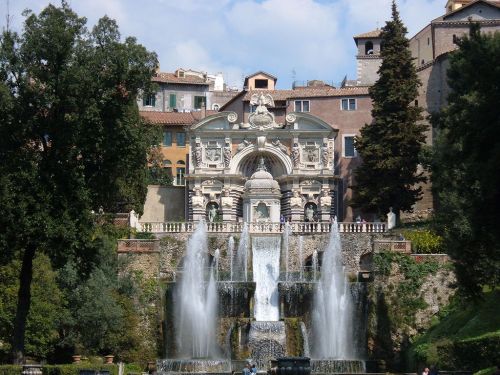
2. Aux cyprès de la Villa D’Este, Threnody (l)
3. Aux cyprès de la Villa D’Este, Threnody (ll) ((ll)
4. Les jeux de la Villa D’Este
5. Sunt Lacrymae rerum (en mode Hongrois)
These are tears for things (in Hungarian mode)
Maximilien. Empereur de Mexique, 19 juin, 1867)
7. Sursum corda (Erhebet eure Herzen)
here or above, with Beethoven’s own
from his 12th Sonata, you’ll hear the
stirrings of Impressionism peeping out
from the roots of Romanticism,
Beethoven, in 1801, is firm, solid, direct,
poignant, while Liszt, 1877, is more
diffuse, improvisational, evocative, his
is an idiosyncratic marche funèbre
compare either two with Chopin’s
Beethoven’s still, and as implanted
in our collective consciousness,
where Liszt’s more esoteric
interpretation of such a march has
essentially been forgotten
should it be, what do you think, you
tell me
R ! chard
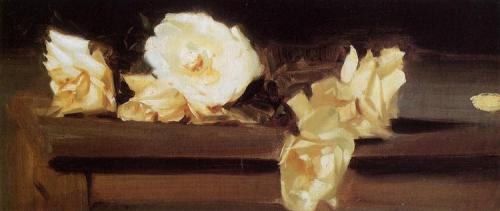
“Roses“ (c.1886)
____________
on a personal note, since I prefer longer
pieces, something I can sink my teeth
into – I like them when they’re long, I
always say – which led me into spending
33 years with Proust, for instance, page
by page, so that I could breathe it in, him,
I tend to veer towards music with several
movements, be they serial, as in sonatas,
symphonies, concertos, Classically
speaking, of course, or haphazard, as
in the more loosely associated suites
rather than smelling merely the rose,
as in a simple waltz, nocturne, étude,
I want to revel in the aroma of an
entire garden
therefore the three hours of Liszt‘s
even Wagner‘s daunting five hour
operas, individual portions of his
towering, indeed epic, four-part
these are high masses, and if you
subscribe to the faith, the experience
they allow can be transformational,
however such may still be,
nevertheless, a mere rose, a mere,
but epiphanic, rose, as is, for
inveterately, for me
a rose, a creation as unique as we
are, in our shared, however unevenly
apportioned, mortality, proud, sturdy,
protected by thorns, even, meanwhile,
as we are, in our own manner, against
our own existential vicissitudes
but vibrant, also, ever, drenched in
any of its several arresting colours,
fragrant, poised, full of perfect grace,
as we should be ourselves, I’ve told
myself, not only with regard to their
beauty, but to their inspiration,
whether a deity exists that we
might be beholden to, incidentally,
or not
Shostakovich has something poignant
to say about that, also Beethoven, but
that’s another story, for later, maybe,
however, either, powerfully
consequential
until then, l’important, as we sing in
or heed, it says, in other, but
nevertheless ever instructive words,
the wisdom of very nature
I live by it
R ! chard

___________
for John, who would’ve
been 60 today
though the suite might’ve started with
Bach’s string of dance pieces in the
early 18th Century, it becomes evident
during the 19th Century, after a lapse
of nearly 100 years, while it fell into
disfavour, that its resurrection as a
valid musical form might’ve kept the
original structure, which is to say its
several separate parts to make up a
whole, its movements, but that it
now was serving a different purpose
where music had, through to the early
Romantic Period, followed dance
rhythms, or variations of tempo,
adagio, andante, allegro, and the like,
it now presented itself as a background
for settings, be it ballets, as in
Tchaikovsky’s, plays, as in Edvard
after Ibsen‘s eponymous play,
specific locations, as in Debussy’s
expansively, both geographically
and in its compositional length,
these very “Années de pèlerinage”
of Liszt
this is in keeping with the exploration
of consciousness of that era, which
would lead to not only Impressionism,
but to Freud, and the others, and the
development of psychoanalysis
you’ll note that music seems much
more improvisational in Liszt than in
already even jazz, more evocative,
less emotional, more personal, not
generalized, idiosyncratic, a direct
development of the newly acquired
concept of democracy, one man, at
the time, one vote, one, indeed,
voice, however individual, however
even controversial
listen, for instance, to Liszt’s “Années
1. Sposalizio
2. Il penseroso
7. Après une lecture de Dante: Fantasia Quasi Sonata
today you can listen to suites
from famous films, for instance
other words, goes on
but note the renovations, find them,
I dare you, you’ll be surprised at
your unsuspected perspicacity
R ! chard

 Richibi's Weblog