Richibi’s Weblog

Just another WordPress.com weblog

Tag: Anne-Sophie Mutter

Alban Berg Violin Concerto‏

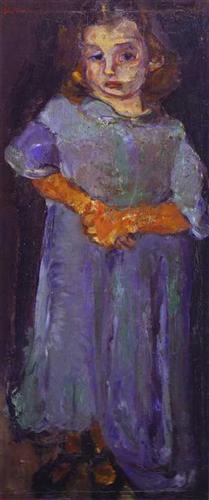
"Little Girl in Blue," - Chaim Soutine

Little Girl in Blue (c.1934-c.1935)

Chaim Soutine

________

though Apollo had offered the two
complimentary symphony tickets
he’d scored to my sister and my
mom, my mom bowed out and
suggested I, an adept, should
instead go along, though I needed
to know more about the content,
who and what would be on, no
one knew

meanwhile my sister, preferring not
to leave her husband alone, opted
to cede her ticket to Apollo so he
could accompany me

after some research, when I gushed
that Akiko Suwanai would be playing
Beethoven’s Violin Concerto in D
minor – his only one, I cried – Apollo
reconsidered, would, he said, come
along, my enthusiasm having struck
apparently a reverberant chord, a key,
maybe his D minor

once at the concert, to our surprise
and delight, my sister and her
husband, under the spell also of that
maybe bewitching key, had got rush
tickets for essentially, as it were,
a song, so that serendipitously we
all attended the superb performance
together

Dad does concert tickets too, my
sister exulted

Suwanai was transcendent, lifted me
from my seat at the very first touch of
her exquisite bow, I floated, though it
might’ve been also the magic chocolate
I’d bought at the corner, this is Vancouver
after all, known also, not inappropriately,
as Vansterdam

you’ve heard rapturous versions of
Beethoven’s Violin Concerto on at
least one of my earlier blogs,
Anne-Sophie Mutter’s there, Joshua
Bell’s
, but I couldn’t get any of Akiko
Suwanai’s renditions on the Internet

found instead for you this wonderful
Berg
, also his only violin concerto

Berg is of the Second Viennese
School, along with Schoenberg and
Webern, this is no longer Beethoven,
the advent of the First World War in
the Western world had fundamentally
altered everything, the arts were
reflecting this transformation, idioms
were abandoned in every creative field,
as well as in borders and forms of
government, rudiments were being
questioned, tested, see what Soutine
does, for instance, to traditional
representation above, to perspective,
colour, proportions

you’ll note that Berg’s Concerto
doesn’t stipulate a key, part of the
disintegration musical theory was
undergoing, twelve-tone music,
rather than the traditional eight,
was eliminating the subordination
of sharps and flats within scales,
atonality became dominant,
sounding a lot like the cacophony,
I think, of Twentieth-Century traffic

you won’t mistake however the
utterly Romantic sensibility beating
through Berg’s composition, midst
all the discord and the dissonance
you can’t miss his pulsing and
ardent heart, his wistful, dare I say,
heartstrings

there are two movements to the
concerto, the first representing life,
the second death and transfiguration,
Berg had written this, his last work,
for Alma Mahler’s daughter, Manon,
after she died of polio at the age of
18, Alma Mahler had been Gustav
Mahler’s wife, a musical giant, Berg
dedicated the piece, he wrote,
“to the memory of an angel”

Berg died later that same year,
Christmas Eve, 1935, he was 50

Richard

psst: the first part of the programme
had been a bust except for a
lovely piece for violin and koto

what’s a koto, I asked Apollo

it’s what you wear when you’re
coldo, he replied

a koto is a bit like a xylophone,
but with strings instead of
wooden bars, the performer
had dressed in traditional
Japanese garb for the special
Japanese occasion

some Joshua Bell

in my search for another violin concerto to follow up
on my suggested commitment for a while to that
instrument, to point out that concertos can go further
afield of course than the piano, and notably have, I
was able to find an Aladdin’s cave of musical wonders
but none to fit that specific bill

these other options however have been overwhelming,
once again for me irresistible, I’m a sucker, I’m afraid,
for excellence

for instance this astounding performance I’d temporarily
put aside for being a repetition, another interpretation
of Beethoven’s Violin Concerto in D major, done already
superbly here by the resplendent Anne-Sophie Mutter
with her inimitable mentor, Herbert von Karajan, no
less, among my previous recommendations

but this rendition by Joshua Bell, an American, who’d ‘a’
thunk it midst the profusion of Asian superstars, totally
transcends, he is precise, impassioned, is carried away
incandescently by his muse

we are too

Anne-Sophie Mutter who, we wonder, though only for a
moment, she is reliably transcendent, incandescent ever
too

his glissandos made me shiver, his rallentandos hold my
breath, his cadenzas, well, gasp in veritable wonder

a cadenza is what seems like an extended solo part near
the end of a movement where the soloist gets to strut
his, her stuff, it is often enough composed independently
of the composer, but I can only suppose that’s indeed the
case here for this cadenza not sounding especially
contemporary with Beethoven, for instance the strident
atonalities, long stresses on individual notes, defying
the usually strict conditions of that master’s nearly
religious adherence to tempo, rhythm

but it magisterially works, and therefore who cares

whether by Beethoven, Joshua Bell, or anyone else, I
don’t know, and am content to leave behind here such
esoterica

there is a bit of another cadenza near the end also of
the third movement

slow movements are not likely to have one for being
inappropriate, it would be bad form to show off at a
dirge

also von Karajan is not replaced, a conductor is simply
not there, and Joshua Bell seems an unlikely stand-in
for one here since he doesn’t even often look at the
orchestra, also he looks busy enough doing, wouldn’t
you think, other things

since the timpanist, the drummer, at the outset
gives the cue, a lovely of course Asian girl, she could
conceivably be setting the beat at least for her orchestra,
though often the first violin will take up the conductor’s
cause, when not the soloist, why else would one take a
bow, as they always do at concerts, but this one appears
unsubjected to so commanding a role

they open with some recalcitrance at first, as though
not quite sure of the engine, but soon things are humming,
the orchestra is in full swing, stunning, committed, soaring,
through giddy, infinitely miraculous, air

soon enough they also transcend

Joshua Bell earns himself meanwhile for his inspired part
in this splendid presentation an estimable place in my lofty
heaven, among the other poets, painters, asteroids and
stars shining there

Richard

Mendelssohn Violin Concerto in E minor, Op. 64

despite not having the stature of the other composers
already considered, Felix Mendelssohn, 1809 – 1847,
nevertheless squeezes right up the middle with his
the greatest violin concertos of all time, perhaps the
most tender of all in contrast to the mightier, more
imperious declamations of the other also more varied
and prolific masters, an archangel among the august
divinities, having earned a place of the very highest
order in their midst with even this one masterful
work, perhaps even of all the most beloved
 
he squeezed right up the middle chronologically as
well in fact, Beethoven wrote his violin concerto in
1806, while Tchaikowsky and Brahms theirs to my
astonishment each from his own little corner of the
world independently in the very same year, 1878,
a fabulous year, it would appear, for violin concertos 
 
Mendelssohn finished his violin concerto in E minor,  
opus 64 in 1844
  
 
when I began a few decades ago to explore violin
concertos, my essential resource was the set I had
on disc of all the great ones played, indeed definitively
executed, by Kyung-Wha Chung, who bested then to
my mind all, without exception, even the most
celebrated virtuosos, whom I need not therefore 
here recall   
 
until now I had never seen her perform 
 
in this outing she recovers in spades my early adulation, 
utterly, she lives and breathes her enchanted instrument,
she is the Mitsuko Uchida of the violin, I can think of no
higher honour, she is meteoric 
 
André Previn and the London Symphony Orchestra, who
accompany her, though accomplished, pale beside her
fire, which is throughout riveting   
 
André Previn was married famously to Mia Farrow way
back when, later married our very own Anne-Sophie
Mutter, though they divorced in 2006, he was a pop,
to my mind, conductor, made of serviceable and
always dependable stuff, but never shining, you’ll
have to leave that to his featured brilliant light here,
who will not, I assure you, fail to deliver searing
heat along with the stated incandescence 
 
 
Richard


a couple of violin concertos‏

a violin concerto is of course the same thing as a piano
concerto with a violin however where the piano would
be, performing histrionics before an orchestra for the
length of several movements, traditionally three, usually
fast, slow, fast, for reasons of presentation psychology,
a fast, arresting introduction, then a slow, languorous
beat to forcefully display an alternative musical sensibility,
then fast again for a big, splashy, electrifying finish, leaving
no question about outsized either compositional or
interpretive capabilities, or rather, about outright,
manifest, wizardries 
 
Beethoven and Tchaikowsky give us again the big ones,
Rachmaninoff, essentially a pianist, didn’t write for the
violin, composing to be able to play himself his own works, 
superbly in fact, even definitively, his performances of his
piano concertos are matchless 
 
Anne-Sophie Mutter, one of the brightest stars in
Herbert von Karajan‘s Deutsche Grammophon galaxy,
the company that he put on the international map in
the sixties to cast, magisterially, the richness of our
musical heritage upon that unsuspecting decade, and  
beyond, still commands rapt attention internationally 
though her mentor died in 1989, leaving the world
with less charisma, I might add, less glamour and
authority, less power and panache, in his musical
wake, though other concert luminaries shine
illustriously still, only without now the power of his
charged magnetism, his inspired musical sensibility
and the consummate ability to market his own and
his artistic community’s wares to an often otherwise
distracted audience
 
here he is a divinity overseeing the motion of the sun,
the moon, the stars in a universe of his own creation,
he is extraordinary, he is composed, supremely
confident, while his eyelids reveal the reaches of his
ecstasy 
 
Anne-Sophie Mutter is impeccable, evidently a star
pupil in her master’s stable 
 
 
Sarah Chang, a mere child, is no less dazzling in her
piece, an old spirit in the guise of a sprite, she polishes
off a fiendish Tchaikowsky, an electrifying work, with
the invaluable help of her own conductor, the eminent,
Charles Dutoit, you can see it in her trusting, ever
soulful intermittent gaze 
 
be assured you will be dazzled 
 
 
the Royal Concertgebouw Orchestra, which accompanies
her, is a symphony orchestra of the Netherlands, considered
one of the very best in the world  
 
 
Richard