November / Month of the Sonata – 10
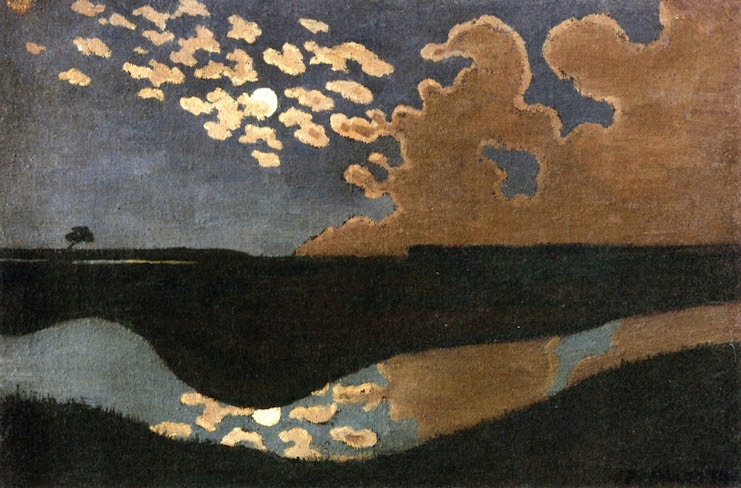

“Beech Grove I“ (1902)
________
if a sonata, or any composition for one
instrument, is a meditation, a rumination,
an introspection, a concerto is its entire
opposite, it’s a declamation, a very
harangue, the performer is not only
before an audience, but before an
orchestra, before the conductor of that
orchestra, that soloist had better be,
therefore, something
Tchaikovsky’s 2nd Piano Concerto
hasn’t cut the cultural mustard, you’ve
probably never heard of it, never mind
heard it, not even in the miasma of our
collective unconscious
why
who knows, it’s magnificent
I suspect that Moscow’s distance,
St Petersburg’s, might’ve had something
to do with it, Russia would still have been
a backwater to Europe, regardless of what
Catherine the Great might’ve done for its
intellectual edification, indeed a veritable
Elizabeth the First, Queen of England,
she, in her sponsorship of the arts
something like that happened, but in
reverse, to Gustav Klimt, Egon Schiele
in art, Schoenberg, Berg, Webern, the
Second Viennese School in music, in
literature, Robert Musil, his “The Man
Without Qualities“ a very rival to
Proust‘s epic trip down memory lane,
“Remembrance …“, when the centre
of gravity for the arts moved from
Vienna to Paris in the late 19th
Century with the advent of
Impressionism
France had entered its Fourth
Republic by then, was to finally
entrench its democracy, and we got
Monet, Debussy, and indeed Proust
instead, not to mention all of that
city’s celebrated others
leaving creative Vienna, meanwhile,
the undisputed engine of the Zeitgeist,
the spirit of the times, for over three
quarters of an earlier century, thereby,
in the dust
New York would take over in the
1950s, similarly, for a time, Andy
Warhol and The Factory, eclipsing
any other town
in other words, location, location,
location, in tandem with historical
events
R ! chard
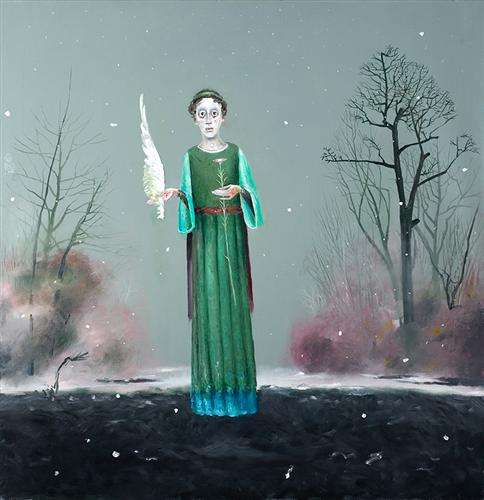
“Poet With Flower“ (2008)
_____
wherefore art, I’ve long and often wondered,
with only a wink to Juliet’s Romeo, for my
question dug deeper, why, indeed, itself art
we build our souls on the stories we’ve
heard, the impressions we’ve received
from voices that spoke directly to our
senses, painters with paint, musicians
with music, writers with words, poets
with poems
it started with fairy tales, which told of
right and wrong, good and bad, courage,
kindness, responsibility, and dire
consequences for discord
Biblical stories also took up a lot of my own
childhood, Jesus, Adam and Eve, Moses
and the Ten Commandments, this last
reinforced by Cecil B. DeMille’s epic
but soon enough it was Oliver Twist, Little
Nell, and by an inescapable authorial leap,
since these were all by an irresistible
Charles Dickens for a guy my age, Sydney
Carton, who valiantly stands in for his
friend, Charles Darnay, at the guillotine, a
quantum, even existential, leap from
Peter Pan and Mary Poppins
though I had the good fortune to learn to
read and write music as a boy, play music,
learn about Bach, Brahms and Beethoven,
it didn’t take anyone else much more than
their enthusiasm to see what the Beatles
were similarly doing, the Rolling Stones,
the Supremes, they were not only singing,
but making history, shaping it, and us, we
followed the questions they rose, their
responses, the effects upon ourselves
for nothing is considered until it’s
mentioned, spoken, made clear, and they
were those prophets
the same goes for art, we see as we see
cause Monet, Picasso, Warhol showed
us how to see, what to look at
and of course poets, Shakespeare,
Rostand, Dante, Goethe, to inform, each,
their individual language, and culture
I have been Philip Carey, Scarlett O’Hara,
Blanche Dubois, Gary Cooper in “High
Noon“, both Martha and George in
“Who’s Afraid of Virginia Woolf“, lately
I’ve been even Hank Williams
as Babette would say, a French doll who
gets abducted in “Raggedy Ann and Andy:
A Musical Misadventure“, an animated
movie from the Seventies, – oo aahrr yoo
Richard
psst: all of them have been me too,
incidentally
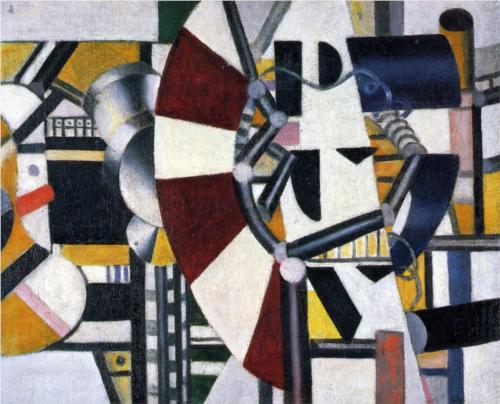
“Les éléments mécaniques“ (1920)
_________
more John Cage, if you dare
just click
with, if you can believe it, Garry Moore,
“I’ve Got a Secret“, a trip down memory
lane
also ads for Winston, and Bufferin, very
Andy Warhol, thrown in, entirely the
1950s
Richard
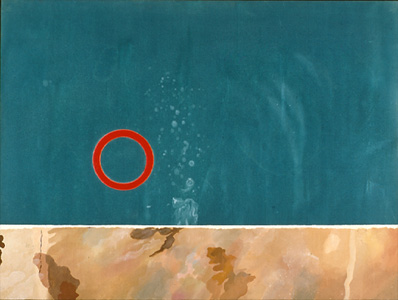
“Rubber Ring Floating in a Swimming Pool“ (1971)
_________
in responding to the powerful dictates
of Abstract Expressionism, dominant
in mid-Twentieth-Century art, its return
to essentials, the technical elements
of the medium – as indeed was taking
place in music and literature as well
during that period, see John Cage,
or Samuel Beckett, for instance, if
you dare – David Hockney, as well
as other related artists at the time,
were, it would seem, looking to
reconnect with a more general public,
their, after all, burgeoning market in
the post-war rise of the Middle Class,
not only with objects it would find
familiar, even iconic, Campbell Soup
cans, Marilyn, but with outright fun,
a not inconsequential attribute
out with ontological musings, they
were saying, dry taxonomy, and in
with, as it were, the bomp sh’ bomp
sh’ bomp
or Pop Art
noteworthy for its sense of
outrageousness, levity
and fashion, incidentally
not either inappropriately, fashion
was what the popes had been doing,
after all, adorning the Sistine Chapel
David Hockney here takes colour field
– flat, undifferentiated areas of a single
colour, a founding element of Abstract
Expressionism – and applies it to a
recognizable surface, which,
incidentally, he insists in his very title,
is not “Abstract”
we delight in the ingenuity of this
conjunction, form has become
function, or the reverse
and note furthermore the aptness
of other painterly preoccupations,
texture, a consideration that goes
back to Vermeer, and further
dimensionality, there is no horizon
to force representation of a third
dimension, which nevertheless
ingeniously doesn’t obliterate
clear three-dimensional
perspective
geometry, a hats-off to Mondrian
perhaps, and Cubism, though
we’ve come a long way from the
more diaphanous and shimmering
Cubism, just click
in fine, I’m impressed by the manner
in which this painting, despite its
naked and overt representation of
its subject, devoid of any context,
urges a more theoretical
consideration than substantial,
indeed “Abstract” rather than
grounded, rock, materially
speaking, solid
does “Rubber Ring Floating in a
Swimming Pool“ inform the form,
in other words
or does the form inform the
“Rubber Ring Floating in a
Swimming Pool“
is this grammar or a poem
you tell me
Richard
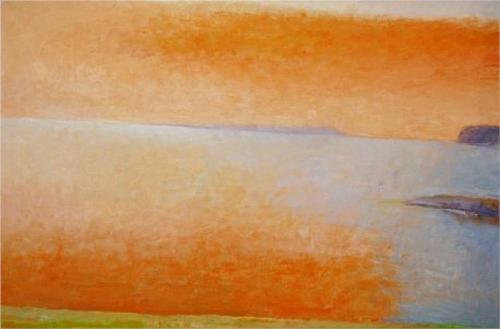
“Orange Cloud Over rhe Adriatic Sea” (1996)
_______
a reader writes, about “Poème d’amour“,
Hans Hofman
“This is a bizarre painting. It bewilders me. I can’t make sense of it. But maybe that’s the point.”
below is my answer
Richard
______
with the invention of the camera, Brain,
representational art became irrelevant,
unable to present the accuracy a
photograph would it had to discover
for itself an alternate purpose, which
is to say, reinvent itself
the medium became the message,
as Marshall McLuhan would’ve
put it, art began to study itself, it
reached for its sinews, arteries,
its colours, textures, its planar,
dimensional, limitations, limits
its form, in other words, was
becoming its substance
Abstract Expressionism was the
nadir of this movement, after the
less ethereal, more visceral,
German Expressionism, and up
to Andy Warhol, who brought us
back down to earth again with
pictures of Campbell Soup cans,
Marilyn
more matter, less theory
note the residual attachment to flat
colour fields nevertheless
that said, what part of Hofman‘s
“Love Poem“ is indeed a love poem,
search me, I think it’s just pretentious,
failed Miro
but do read the sidebar on the upper
left at the site for less partisan perhaps
insights, just click “Show details” there
I don’t either much like Schönberg,
who did the same kind of thing to
music, eviscerated it, I want to see
the body, not the entrails, these
should be studied at art school,
the conservatory, creative writing
classes
but that is of course just what I think
Schönberg and Abstract Expressionists,
however, have left their indelible marks
on art history, commendable marks for
their theoretical underpinnings, rigours
see for instance the marvellous Wolf
Kahn above for the evolution of these
ideas, you get it in less than a minute,
and delight in it
that is what real art does
thanks for asking
Richard
psst: Wolf Kahn was a student of
Hans Hofman, incidentally, he
just put everyday references
back into the picture, I call it
heart, something organic
_____________________
 Richibi's Weblog