“The Transformation of Io into a Heyfer” (IV) – Ovid
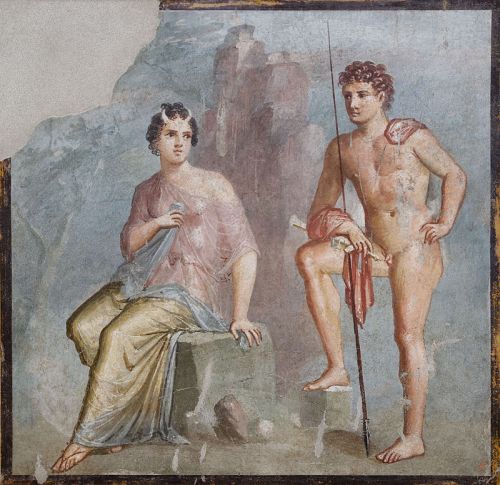
“Io Wearing Bovine Horns Watched over by Argos on Hera’s Orders“
(1st century AD)
______________
before moving forward with the trials
of Io in Ovid’s poem, let me interject
a few extracurricular opinions
a great work of art, be it poetry, prose,
a painting, a piece of music, is indicated
by what you can read between the lines
this very Ovid is such an example,
interrupted, as it is, by my
commentaries
but a better example, a more personal
one, I would think, would be that of
listening to music, and finding oneself
wandering, often often, in all kinds of
apparently unrelated areas of
introspection, before being drawn
back into the piece, the present, often
unexpectedly, when it recaptures, with
artful ingenuity, an arresting mixture of
substance and style according to the
poet’s artistry, one’s errant attention,
helping one find one’s way back home
to rekindle again and again your
attention, therein lies the art
the journey, the reverie, has been the
point of the music, where it is that the
enchantment, and I use that word
advisedly here, has taken you, that
jaunt has been your part of the
communication, which has turned it
into, indeed, a conversation
all art tries to do that
here are a few of my own reveries
around Ovid’s poem, that it must be
read as a cooperation in this instance
between Ovid and John Dryden, who
translated it, along with the help, here
and there throughout the work, of a
few other noteworthies, who must be
acknowledged
it would be impossible to translate
alliteration, onomatopeia, other
literary devices from one language
to another, these exist only, and
specifically, in the individual
vernacular, like fingerprints, the
personal and particular impression
of teeth, in people, for example
of a more technical nature is the
fact that though Dryden‘s verse
is in iambic pentameter,
Shakespeare‘s shtick, a notably
conversational metre, Ovid‘s
dactylic hexameter is of a heroic
cadence, orotund and imperious,
like ceremonial music is
unmistakably different from more
lilting popular ditties
the point is that this translation of
Metamorphoses must be read, in
my opinion, as a collaboration
between Ovid for his substance,
which is to say, the essential
story, and John Dryden for his
style
for better or for worse
otherwise we must learn Latin
an interesting element of the style,
meanwhile, I’ve uncovered, upon
reading this text, is that the
apostrophe that is often removed
from verbs we see today with the
e typically installed before the d,
in the first line below, cry’d, for
instance, reply’d in the next,
would’ve been that the poet was
indicating, in his 1717, by the
insistent elision, that the letter
not be pronounced, where
custom had earlier had it that it
often was
for a more vivid impression, compare
bless’d with blessed, both pronunciations
still in use today, where the second
spelling, the one with the e, is a
throwback to a time when most of these
participles would’ve been voiced in that
manner
1717, we learn, however incidentally,
was a year when the English language
was evolving, their is not was turning
into their isn’t
but back now to Ovid
Ah wretched me! her mournful father cry’d;
She, with a sigh, to wretched me reply’d:
how, between two profoundly
different oratories, Inachus, Io‘s
father, wonders, to translate
see my exegesis above
About her milk-white neck, his arms he threw;
And wept, and then these tender words ensue.
Inachus speaks
And art thou she, whom I have sought around
The world, and have at length so sadly found?
So found, is worse than lost: with mutual words
Thou answer’st not, no voice thy tongue affords:
mutual words,a shared language
But sighs are deeply drawn from out thy breast;
And speech deny’d, by lowing is express’d.
lowing, the sound a cow makes
Unknowing, I prepar’d thy bridal bed;
With empty hopes of happy issue fed.
happy issue, children
But now the husband of a herd must be
Thy mate, and bell’wing sons thy progeny.
bell’wing, bellowing
Inachus fears Io will be mothering
calves
Oh, were I mortal, death might bring relief:
But now my God-head but extends my grief:
Prolongs my woes, of which no end I see,
And makes me curse my immortality!
note that even the gods in this
mythology suffer
More had he said, but fearful of her stay,
The starry guardian drove his charge away,
The starry guardian, Argus
see above
To some fresh pasture; on a hilly height
He sate himself, and kept her still in sight.
to sate, to refresh, satisfy
Io is still not out of the woods
R ! chard
 Richibi's Weblog