Just another WordPress.com weblog
Tag: Agenor / king of Tyre
______ an interesting thing has happened with the story of Cadmus , he is not only a mythical figure, but also a legendary one, which is to say that Cadmus has roots in actual history, he’s not just an imaginary construct like those that until now have peopled Ovid’s text Cadmus appears to have actually founded Thebes , whose origins, however, are lost in antiquity, going back to, it appears, the late Bronze Age , around 2000 BC, goodness stories evidently grew around Cadmus , that transformed him intoour first documented hero, indeed superhero counterparts exist in other traditions, consider David , for instance, whoslew his own dragon, Goliath , before becoming king of the Israelites, 10th Century BCE, at Jerusalem, where he consorted, incidentally, later, with Bathsheba , however illicitly, butthat’s another story King Arthur , late 5th to early 6th Centuries CE , stems from British lore, though his historical actuality has been contested, is also a hero with preternatural capabilities based on some historical accountability in our day, there’s James Bond , based on real, living and breathing, personalities or, dare I say, even Jesus the point here is that actual people are being included in the, however culturally specific, mythologies, which, in each, had earlier consisted of metaphorical constructs merely, the concept of History , in other words, was being born, memorable events were to be remembered, recorded, documented, if only, originally, orally, around, say, campfires, however aggrandized might have been their recollected heroes Cadmus , meanwhile, in our story, is about to establish his own historical, and archeologically confirmed, note, credentials The dire example ran through all the field, The dire example, the dragon’s teeth, grown into men, had begun, if you’ll remember , to slaughter one another
e xample, display The furrows swam in blood: and only five Echion, one of the five survivingbrothers Wisdom, also of War
And with the rest a peaceful treaty makes, the rest, the four other survivors So founds a city on the promis’d earth, promis’d earth, the premonition of the oracles whose counsel Cadmus Here Cadmus reign’d; and now one would have guess’d his exile, from Tyre , Cadmus’ original home, from which his father, Agenor , had sent him, not to return, he’d Long did he live within his new abodes, Ally’d by marriage , at the end of a period of penance for having killed the dragon, which had been sacred to Ares , god of War, the gods gave Concord, to be his wife Ares would eventually exact mightyvengeance, but that’s another story And, in a fruitful wife’s embraces old, even Cadmus , though he might enjoy a long life, and many, a long increase of, children, is not immune to any of the vicissitudes of life either until his own time has come, the poet advises, however ominously and here Ovid also introduces the subject of his next metamorphosis, Actaeon , however early, luring us thereby, deftly, literarily, towards his next instalment, Actaeon’s story, eponymously, there, given its title Actaeon was the first of all his race, Who griev’d his grandsire in his borrow’d face; Condemn’d by stern Diana to bemoan his grandsire, his grandfather, who was the mother of Actaeon
borrow’d face, Actaeon was transformed into a stag by the Hunt, of the Moon, of Chastity, for having seen her naked as she was bathing he now has the face, the visage, of someone, something, he hadn’t been before, borrow’d To shun his once lov’d dogs, to bound away, having been transformed into a stag, or metamorphized, Actaeon would end up hunted, and worse, by his own, once lov’d, dogs And yet consider why the change was wrought, to have been at the wrong place at the wrong time, yet to suffer, however unfairly, the consequences, that, Ovid asks, is the question, the conundrum stay tuned R ! chard
_______ Cadmus salutes the soil, and gladly hails The new-found mountains, and the nameless vales, And thanks the Gods, and turns about his eye To see his new dominions round him lye; Europa , has , on the advice of thethe lonely cow, / Unworn with yokes, unbroken to the plow had stoop’d, and couch’d amid the rising grass,
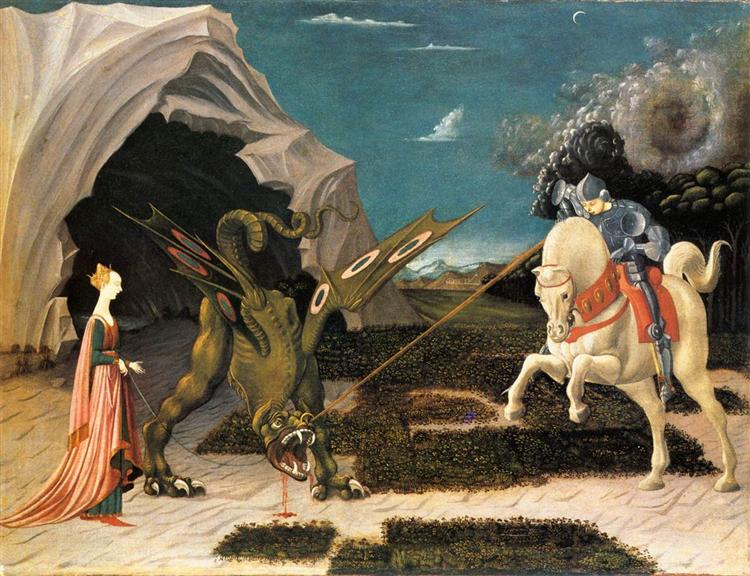
vales, valleys Then sends his servants to a neighb’ring grove For living streams, a sacrifice to Jove. Cadmus , a prince, would’ve hada retinue, followers, Hamlet for instance, his Horatio , his Jove , note, is the god who abductedto our story, isn’t yet supposed to know this, never having found his sister, nor identified, consequently, her ravisher, namely Jove , the god to whom Cadmus is now about to give sacrifice, give thanks O’er the wide plain there rose a shady wood Of aged trees; in its dark bosom stood A bushy thicket, pathless and unworn, O’er-run with brambles, and perplex’d with thorn: perplex’d, a wonderful metaphor here for entangled, enmeshed Amidst the brake a hollow den was found, With rocks and shelving arches vaulted round. brake, bracken, brush Deep in the dreary den, conceal’d from day, Sacred to Mars, a mighty dragon lay, Mars , god of War a mighty dragon, dragons, it appears,go back to very prehistory, perhaps dinosaurs, and the like, that made its way into our poetic imagination Bloated with poison to a monstrous size; Fire broke in flashes when he glanc’d his eyes: glanc’d his eyes, threw glances at His tow’ring crest was glorious to behold, crest, as in roosters, or reptiles His shoulders and his sides were scal’d with gold; scal’d, having scales, plates,overlapping surfaces Three tongues he brandish’d when he charg’d his foes; His teeth stood jaggy in three dreadful rowes. rowes, rows, three dreadful ones,one behind the other The Tyrians in the den for water sought The Tyrians, Cadmus and his men,all originally from Tyre
And with their urns explor’d the hollow vault: urns, to collect from living streams within the vault a sacrifice to Jove From side to side their empty urns rebound, rebound, knock against a hardersurface repeatedly And rowse the sleeping serpent with the sound. rowse, rouse Strait he bestirs him, and is seen to rise; he bestirs him, he bestirs himself And now with dreadful hissings fills the skies, And darts his forky tongues, and rowles his glaring eyes. rowles, rolls The Tyrians drop their vessels in the fright, vessels, urns All pale and trembling at the hideous sight. Spire above spire uprear’d in air he stood, Spire above spire, scale upon scale uprear’d, reared up he, the serpent And gazing round him over-look’d the wood: overlook’d, looked over, surveyed Then floating on the ground in circles rowl’d; rowl’d, rolled Then leap’d upon them in a mighty fold. fold , embrace, encirclement Of such a bulk, and such a monstrous size The serpent in the polar circle lyes, That stretches over half the northern skies. The serpent in the polar circle, Serpens ,a constellation in the Northern Hemisphere in close proximity to the North Pole lyes, lies In vain the Tyrians on their arms rely, their arms, their weapons In vain attempt to fight, in vain to fly: All their endeavours and their hopes are vain; Some die entangled in the winding train; the winding train, the serpent’stail Some are devour’d, or feel a loathsom death, Swoln up with blasts of pestilential breath. stay tuned R ! chard
______
When now Agenor had his daughter lost, Europa , his daughter lost He sent his son to search on ev’ry coast; his son, Agenor’s son, Cadmus , Europa’s brother And sternly bid him to his arms restore pious to a crime, intent on, devoted to, having justice restored The restless youth search’d all the world around; amours, loves, trysts, entanglements When, tir’d at length with unsuccessful toil, his angry sire, Agenor , father, sire He goes a suppliant to the Delphick dome; suppliant, supplicant, petitioner, one in search of a favour proclaimed her cryptic prognostications, her famously ambiguous prophecies Delphi , incidentally, was one of several sacred sites in Greece, sanctuaries, open to any Greek, or person who could speak Greek, regardless of geographical provenance, any city-state , for instance then, or kingdom, akin to embassies today, or places where people can expect to find similar political haven Delphi was the destination then also ofpilgrimages, comparable to our own ancient path I dearly would’ve, but never have, unfortunately, undertaken though I did walk to Mission B.C. some several years ago, from my home in Vancouver, to a monastery there, a place of recuperation when I needed one, three days there, and a half, three days and an equal half back, my feet were blistered, I noticed at one point, but hadn’t at all registered any pain, a truth I gathered about the power of intention, one’s very aim can be a salve, a balm, a solace, against any adversity There asks the God what new appointed home where do I land, asks Cadmus , where is my appointed home, my final destination The Delphick oracles, subordinates to Pythia , the high priestess at Delphi
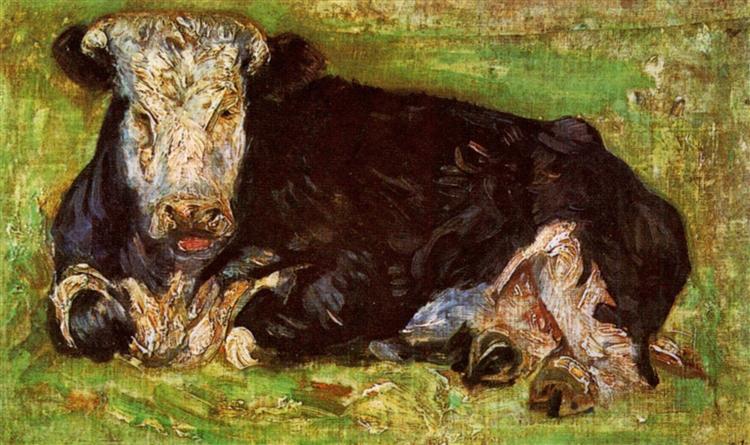
“Behold among the fields a lonely cow, Unworn with yokes, unbroken to the plow; Mark well the place where first she lays her down, There measure out thy walls, and build thy town, And from thy guide Boeotia call the land, In which the destin’d walls and town shall stand.”
Boeotia , a region still of Greece No sooner had he left the dark abode, the Delphick God, Apollo , god ofmusic, dance, truth, prophecy, healing, the sun, light, poetry, among many other things When in the fields the fatal cow he view’d, fatal, fateful gall’d, irritated, frustrated Her gently at a distance he pursu’d; the great Pow’r, Apollo , by way of hisDelphick oracles, the high priestesses, through their counsel, their divinations Her way thro’ flow’ry Panope she took, Panope , plural, were sea nymphs, not places, in Ancient Greece, therefore Cadmus must’ve been crossing water,however flow’ry, I’ll have to check my Latin text for, maybe, inaccuracies inthe translation And now, Cephisus, cross’d thy silver brook; a brook, a stream, anthropomorphized here, which is to say Cephissus , the flow, the waterway, is being addressed as a rational being, I have cross’d t hy silver brook, he says
meanwhile, to brook, to conquer, to overcome, a wonderful, a shimmering, literarily speaking, homonym , which is to say, a word with two faces When to the Heav’ns her spacious front she rais’d, she, the fatal cow, see above , has led Cadmus destination, destin’d place, destiny stay tuned R ! chard
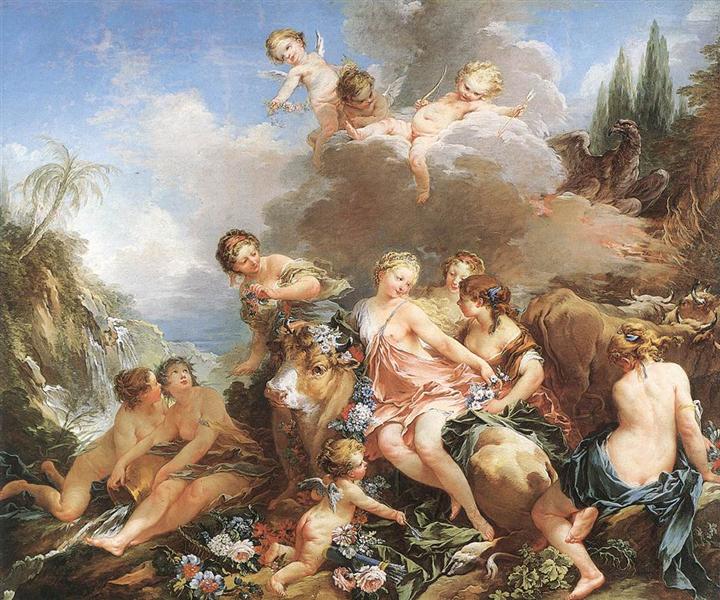
___________ Agenor’s royal daughter, as she plaid Among the fields, the milk-white bull survey’d, an area comprised then of ancient Lebanon , as well as a good part of the Eastern, and later, the Southern, which is to say the African, Mediterranean coasts, father of, notably, Europa , his royal, hisindeed mythic, daughter And view’d his spotless body with delight, And at a distance kept him in her sight. Europa is intrigued, delight[ed], by this milk-white … spotless … bull, but froma distance, discreetly, furtively At length she pluck’d the rising flow’rs, and fed The gentle beast, and fondly stroak’d his head. pluck’d, dared, mischievously, to confront He stood well-pleas’d to touch the charming fair, But hardly could confine his pleasure there. And now he wantons o’er the neighb’ring strand, Now rowls his body on the yellow sand; to wanton, to play, to frolic, often immodestly, like puppies, goats strand, shore rowls, rolls And, now perceiving all her fears decay’d, decay’d, dispelled, dissipated, evaporated Comes tossing forward to the royal maid; Gives her his breast to stroke, and downward turns His grizly brow, and gently stoops his horns. grizly, grizzly, grayish In flow’ry wreaths the royal virgin drest drest, adorned His bending horns, and kindly clapt his breast. ‘Till now grown wanton and devoid of fear, Not knowing that she prest the Thunderer, She plac’d her self upon his back, and rode O’er fields and meadows, seated on the God. however heedlessly, however immoderately, immodestly, however innocently He gently march’d along, and by degrees Left the dry meadow, and approach’d the seas; Where now he dips his hoofs and wets his thighs, Now plunges in, and carries off the prize. The frighted nymph looks backward on the shoar, shoar, shore And hears the tumbling billows round her roar; But still she holds him fast: one hand is born born, borne, held Upon his back; the other grasps a horn: Her train of ruffling garments flies behind, Swells in the air, and hovers in the wind. picture of Europa , more in keeping with the last few lines Through storms and tempests he the virgin bore, And lands her safe on the Dictean shore; Dictean, of Dicte, or Dikti , a mountain range in Eastern Crete , site of the was apparently born, if it wasn’t the Idaean Cave, which is to say a cave on Mount Ida , therefore Idaean, also in Crete , both hollows having claimed the right to be called the site of the exalted provenance Where now, in his divinest form array’d, In his true shape he captivates the maid; longer bull, but divinity, dripping still in bovine potency, however residual Who gazes on him, and with wond’ring eyes Beholds the new majestick figure rise, His glowing features, and celestial light, And all the God discover’d to her sight.
once, to a man who’d bewitched me,how could you touch me, I wrote, you must’ve known you would transfix me, leave me breathless, which he, however inadvertently, had, did I went on, of course, to not populate continents, nor to become queen of instance, before my own exalted entity
R ! chard
 Richibi's Weblog