Shakespeare = Beethoven, or the reverse
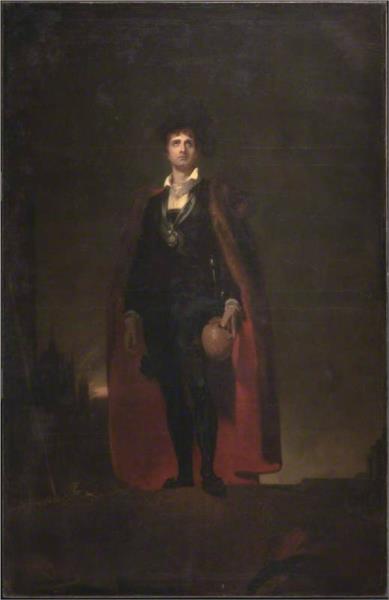
“John Philip Kemble as Hamlet“ (1801)
___________
if I’m to compare Beethoven’s 32nd
Piano Sonata, his opus 111, with
anything else you might be familiar
with, it would be Shakespeare’s
epochal contemplation, “To be, or
not to be“, both are, first, and
briefly, soliloquies, one performer
alone is on stage, both are
implicitly meditations, that will
augur, inspire, note, a new age
let me propound, for a moment, on
the Shakespeare, an introspective
piece set on resolving an existential
dilemma, To be, or not to be, that is
the question, it is pungent, forceful,
arresting, if only even rhythmically,
so much so that many still
pronounce the first line of that
trenchant aria with verily stentorian
conviction, without realizing that the
several concluding movements are
abysmally dire, indeed they
investigate, with improbably literate
fervour, a life and death situation
Whether ’tis nobler in the mind to suffer
The slings and arrows of outrageous fortune,
Or to take arms against a sea of troubles
And by opposing end them
should one, after contemplation,
bear the onslaught of life’s most
unacceptable tribulations, or,
most efficiently, cut all of it off
… To die – he says – to sleep,
No more; and by a sleep to say we end
The heart-ache and the thousand natural shocks
That flesh is heir to: ’tis a consummation
Devoutly to be wished
I’ve often been there
... To die, to sleep;
To sleep, perchance to dream – ay, there’s the rub:
the rub, which is to say, the problem,
what’s up once you’ve done yourself
in
For in that sleep of death what dreams may come
When we have shuffled off this mortal coil,
Must give us pause
indeed, there’s the respect, the angle,
the conundrum one must consider
that makes calamity of so long life
one ‘s stuck between the devil and the
deep blue sea
For who would bear the whips and scorns of time,
Th’ oppressor’s wrong, the proud man’s contumely
the demeaning disrespect a proud man ‘s
made to suffer
The pangs of dispriz’d love, the law’s delay,
The insolence of office, and the spurns
That patient merit of the unworthy takes
which is to say, life’s multifarious, and
beleaguering struggles
When he himself might his quietus make
With a bare bodkin?
quietus, silence, extermination
bodkin, a knife
… Who would fardels bear,
fardels, hardships
To grunt and sweat under a weary life,
But that the dread of something after death,
The undiscover’d country, from whose bourn
No traveller returns, puzzles the will,
And makes us rather bear those ills we have
Than fly to others we know not of?
we keep on grunting, in fear that
what comes after could be worse
a man considering his own demise,
his quietus, at the time of Shakespeare
would’ve been, only a generation earlier,
an heretic, one deserving of unforgiving,
and gruesome, censure, Hamlet was,
not incidentally, however, a prince, a
role model, though evidently controversial
but the Reformation had occurred,
a loosening of categorical strictures
in France, Descartes had, in his quest
for the true God, concluded, Cogito,
ergo sum, I think, therefore I am,
eclipsing the Catholic God as the
final arbiter, personal metaphysical
options were up for grabs, out in
the open, though yet not entirely
secular
which would happen, out loud, in
the Age of Reason, when God, as
we knew Him, lost His, by now
scattered, authority, among
Lutherans, for instance, Calvinists,
Anglicans, and a proliferation of
sprouting others, not to mention,
still, the stalwart, ever, Roman
Catholics
the Romantic Period needed a new
ethic, a personal evaluation of one’s
metaphysical position, Beethoven,
in a word, or in his 32nd Piano
Sonata rather, delivers, a piece no
less intense than Shakespeare’s
profound interrogation
briefly, there are two movements
here, merely, which demand your
attention, it isn’t music that one
listens to with just one ear, this
is Jesus on the Mount of Olives,
Gethsemane, not much different
from Shakespeare’s existential
soliloquy
war, peace, rebellion, resignation,
black, white, fast, slow, explosive,
extended, man, woman, yin,
indeed, yang, short, long,
irascible, submissive, all
paradoxical dichotomies, all
eventually, manifestly,
transcendent, all a subjugation,
a private prayer, eventually,
however fraught, however
nevertheless archetypal,
two movements that still
haven’t exhausted their
philosophical potential for
being assuaging, inspirational
R ! chard
 Richibi's Weblog