Richibi’s Weblog

Just another WordPress.com weblog

“Benefits Supervisor Sleeping” – Lucian Freud


                            “Benefits Supervisor Sleeping” (1995)

                                               Lucian Freud  
  
                                                 _________ 

 
nudes go back of course to Eden, female nudes to Eve,
but only after genitalia had long given way to fig leaves, 
during the somber and endless Middle Ages,
after the fall of the more licentious Rome, 
did they flourish unadorned again
 
men have had to wait much longer to be faithfully depicted,
we’re still under the sway, it would seem, of original sin 
 
paintings which have made historical inroads,
often accompanied by scandal, much indeed as was this one,
though here the shock was arguably less prurient than financial,  
The Toilet of Venus” for instance of Diego Velázquez
or Olympia” of Édouard Manet,
are obvious progenitors 
 
but see especially Egon Schiele in this case for matching townscapes
though most similarly subversive are their unexpurgated, indeed, males 
 
Lucian Freud‘s Benefits Supervisor Sleeping incidentally
sold at auction for $33.6 million, in May 2008  
 
what would Saint Augustine have had to say about that 
 
watch what Sue Tilly, the sitter, said
 
 
Richard  
  
psst: “In Farrell v. Burke … the following exchange from the testimony
          of a police officer who had charged a convicted sex offender for
          violating the terms of his probation by possessing obscene materials:
  
         ‘MR. NATHANSON: Are you saying, for example, that that condition of
          parole would prohibit Mr. Farrell from possessing, say, Playboy magazine?
          P.O. BURKE: Yes.
          MR. NATHANSON: Are you saying that that condition of parole would

          prohibit Mr. Farrell from possessing a photograph of Michelangelo[’s]
          David?
          P.O. BURKE: What is that?
          MR. NATHANSON: Are you familiar with that sculpture?
          P.O. BURKE: No. 
          MR. NATHANSON: If I tell you it’s a large sculpture of a nude youth with his 

          genitals exposed and visible, does that help to refresh your memory of what
          that is? 
          P.O. BURKE: If he possessed that, yes, he would be locked up for that.” 
                                                                               
                               from the New Yorker (“Number Nine” by Lauren Collins),

                                                                               January 11,2010 


“Two Cut Sunflowers” (1887) – Vincent van Gogh

Vincent van Gogh's Two Cut Sunflowers Painting

                             “Two Cut Sunflowers” (1887)


                                     Vincent van Gogh 

                                       ___________


two cut sunflowers 

the painter apportions mostly gold and blue   

to let their moment last forever       


                    Richard                                                                                                                                                                                    


“Winter Mood” – Leonid Afremov


                                                                                                                                                                                                                                      “Winter Mood
                                                                                                                                                                                                                             
Leonid Afremov 
 
     _____________
 

the thick application of paint in this painting, impasto,
and the disorder of acid colours in the foreground leaves, 
bring to mind Cézanne for me, 
and by inference, I guess, the more appealing, I think, Van Gogh
  
but the Belarusian Afremov, you might find interesting to know,
is from Vitebsk, the birthplace of Chagall,
studied at the school Chagall founded there,
as did incidentally in their times Malevich and Kandinsky also  
  
but the poetry of solitude by which this work touches me so
I find most reminiscent of Friedrich Caspar David‘s “The Wanderer“,
no less iconic a Romantic figure in art than Byron, Shelley, Keats became,
not to mention in Germany Goethe‘s tragic “Werther“, or in France, Victor Hugo 
  
in Spain the much earlier Don Quixote, inspired much later his compatriot Picasso,
whose own lonely horseman is to my mind recalled here, 
and in film more recent lonesome cowboys ride instead of on an open range
an empty street through a park in Paris maybe, Dresden, or Toronto
  
as on life’s journey they find, and we, each our road to follow 
  
                                                                                                                                                                                                                                      thought I’d pass it along  
 
Richard


“The Journey of the Magi” – Sassetta‏

                                                                                                                                                                          Sassetta (Stefano di Giovanni)

The Journey of the Magi (1435)                                                                 

              _____________      

                                                                                                                                                                              the sixth of January was the Feast of the Magi,
should you have forgotten, indeed should you have never known,
when the Three Wise Men travelled with gold, frankincense and myrrh
to Bethlehem, to where Jesus had just been born  
  
whatever became of all of it I’ve wondered,
and back when I  was learning about it at school,
and how incongruous to be visited by kings
in a life so otherwise cruel  
 
 
a star, it is said, led the way, low here on the horizon, 
shimmering incandescently beside the two birds,
not any less innocent all of these than cherubs
cavorting in celebration of the transcendental birth
 
Caspar, Melchior, Balthasar, on camels out of the East,
are represented on the more Italianate horses, 
along with the equally more Italianate gentry,
to of course reflect Sassetta‘s more Sienese sources 
 
  
but the pink castles, essentially indiscriminate, 
are there, I’m sure, 
specifically only to enchant you  
  
  
happy new year
  
Richard


sowing poems

since April, National Poetry Month, and a flurry of commemorative throughout poems, one at least a day sent out by a dutiful and diligent moderator, I’ve carried in my pocket at her inspired, I think, suggestion not one but two poems, one per side per page, to scatter indiscriminately as raindrops, it was recommended, anywhere

I cannot help but think that these inadvertent seeds will somehow somewhere flower

they needed to be accessible, I thought, not trite, distinct enough as well to be quickly unforgettable, by definition nearly therefore profound

one described a poet finding intimations of perfection in the song of a nearby thrush, thereby inspiration and an instant recuperative salve

the other takes you into the heart of any poem

both to my mind are brilliant

I’ve been leaving them in restaurants beside my less august of course tip 


Richard

                 __________________________

                                                                                                                                                                                                                                                   The Poet with His Face in His Hands

You want to cry aloud for your
mistakes. But to tell the truth the world
doesn’t need any more of that sound.

So if you’re going to do it and can’t
stop yourself, if your pretty mouth can’t
hold it in, at least go by yourself across

the forty fields and the forty dark inclines
of rocks and water to the place where
the falls are flinging out their white sheets

like crazy, and there is a cave behind all that
jubilation and water fun and you can
stand there, under it, and roar all you

want and nothing will be disturbed; you can
drip with despair all afternoon and still,
on a green branch, its wings just lightly touched

by the passing foil of the water, the thrush,
puffing out its spotted breast, will sing
of the perfect, stone-hard beauty of everything.
 

                                     Mary Oliver

          _______________________________


How to Read a Poem: Beginner’s Manual

First, forget everything you have learned,
that poetry is difficult,
that it cannot be appreciated by the likes of you,
with your high school equivalency diploma,
your steel-tipped boots,
or your white-collar misunderstandings.
Do not assume meanings hidden from you:
the best poems mean what they say and say it.

To read poetry requires only courage
enough to leap from the edge
and trust.

Treat a poem like dirt,
humus rich and heavy from the garden.
Later it will become the fat tomatoes
and golden squash piled high upon your kitchen table.

Poetry demands surrender,
language saying what is true,
doing holy things to the ordinary.

Read just one poem a day.
Someday a book of poems may open in your hands
like a daffodil offering its cup
to the sun.

When you can name five poets
without including Bob Dylan,
when you exceed your quota
      and don’t even notice,
      close this manual.
 

                      Pamela Spiro Wagner


       _____________________________

The Creation of the World

                                                                                                                                                                                                                                     though I’d been reading a not unaccomplished version of Ovid‘s “Metamorphoses“, thrilling already at much of it, for the sake of comparison I happened upon this other utter masterpiece
 
the pedigree is impeccable, an array of the most illustrious English poets of the eighteenth century in concert around a mighty translation of one of poetry’s crowning works, Sir Samuel Garth, John Dryden, Alexander Pope, Joseph Addison, William Congreve, “and other eminent hands”, according to the web page, do the work, and it is masterly
 
read on, from the very first book of fifteen, its beginning, its genesis
 
 
Richard
 
                   ____________________________   
 
 
The Creation of the World

Of bodies chang’d to various forms, I sing:
Ye Gods, from whom these miracles did spring,
Inspire my numbers with coelestial heat;
‘Till I my long laborious work compleat:
And add perpetual tenour to my rhimes,
Deduc’d from Nature’s birth, to Caesar’s times.
 
Before the seas, and this terrestrial ball,
And Heav’n’s high canopy, that covers all,
One was the face of Nature; if a face:
Rather a rude and indigested mass:
A lifeless lump, unfashion’d, and unfram’d,
Of jarring seeds; and justly Chaos nam’d.
No sun was lighted up, the world to view;
No moon did yet her blunted horns renew:
Nor yet was Earth suspended in the sky,
Nor pois’d, did on her own foundations lye:
Nor seas about the shores their arms had thrown;
But earth, and air, and water, were in one.
Thus air was void of light, and earth unstable,
And water’s dark abyss unnavigable.
No certain form on any was imprest;
All were confus’d, and each disturb’d the rest.
For hot and cold were in one body fixt;
And soft with hard, and light with heavy mixt.

But God, or Nature, while they thus contend,
To these intestine discords put an end:
Then earth from air, and seas from earth were driv’n,
And grosser air sunk from aetherial Heav’n.
Thus disembroil’d, they take their proper place;
The next of kin, contiguously embrace;
And foes are sunder’d, by a larger space.
The force of fire ascended first on high,
And took its dwelling in the vaulted sky:
Then air succeeds, in lightness next to fire;
Whose atoms from unactive earth retire.
Earth sinks beneath, and draws a num’rous throng
Of pondrous, thick, unwieldy seeds along.
About her coasts, unruly waters roar;
And rising, on a ridge, insult the shore.
Thus when the God, whatever God was he,
Had form’d the whole, and made the parts agree,
That no unequal portions might be found,
He moulded Earth into a spacious round:
Then with a breath, he gave the winds to blow;
And bad the congregated waters flow.
He adds the running springs, and standing lakes;
And bounding banks for winding rivers makes.
Some part, in Earth are swallow’d up, the most
In ample oceans, disembogu’d, are lost.
He shades the woods, the vallies he restrains
With rocky mountains, and extends the plains.

And as five zones th’ aetherial regions bind,
Five, correspondent, are to Earth assign’d:
The sun with rays, directly darting down,
Fires all beneath, and fries the middle zone:
The two beneath the distant poles, complain
Of endless winter, and perpetual rain.
Betwixt th’ extreams, two happier climates hold
The temper that partakes of hot, and cold.
The fields of liquid air, inclosing all,
Surround the compass of this earthly ball:
The lighter parts lye next the fires above;
The grosser near the watry surface move:
Thick clouds are spread, and storms engender there,
And thunder’s voice, which wretched mortals fear,
And winds that on their wings cold winter bear.
Nor were those blustring brethren left at large,
On seas, and shores, their fury to discharge:
Bound as they are, and circumscrib’d in place,
They rend the world, resistless, where they pass;
And mighty marks of mischief leave behind;
Such is the rage of their tempestuous kind.
First Eurus to the rising morn is sent
(The regions of the balmy continent);
And Eastern realms, where early Persians run,
To greet the blest appearance of the sun.
Westward, the wanton Zephyr wings his flight;
Pleas’d with the remnants of departing light:
Fierce Boreas, with his off-spring, issues forth
T’ invade the frozen waggon of the North.
While frowning Auster seeks the Southern sphere;
And rots, with endless rain, th’ unwholsom year.

High o’er the clouds, and empty realms of wind,
The God a clearer space for Heav’n design’d;
Where fields of light, and liquid aether flow;
Purg’d from the pondrous dregs of Earth below.

Scarce had the Pow’r distinguish’d these, when streight
The stars, no longer overlaid with weight,
Exert their heads, from underneath the mass;
And upward shoot, and kindle as they pass,
And with diffusive light adorn their heav’nly place.
Then, every void of Nature to supply,
With forms of Gods he fills the vacant sky:
New herds of beasts he sends, the plains to share:
New colonies of birds, to people air:
And to their oozy beds, the finny fish repair.

A creature of a more exalted kind
Was wanting yet, and then was Man design’d:
Conscious of thought, of more capacious breast,
For empire form’d, and fit to rule the rest:
Whether with particles of heav’nly fire
The God of Nature did his soul inspire,
Or Earth, but new divided from the sky,
And, pliant, still retain’d th’ aetherial energy:
Which wise Prometheus temper’d into paste,
And, mixt with living streams, the godlike image cast.

Thus, while the mute creation downward bend
Their sight, and to their earthly mother tend,
Man looks aloft; and with erected eyes
Beholds his own hereditary skies.
From such rude principles our form began;
And earth was metamorphos’d into Man.


            _______________________________

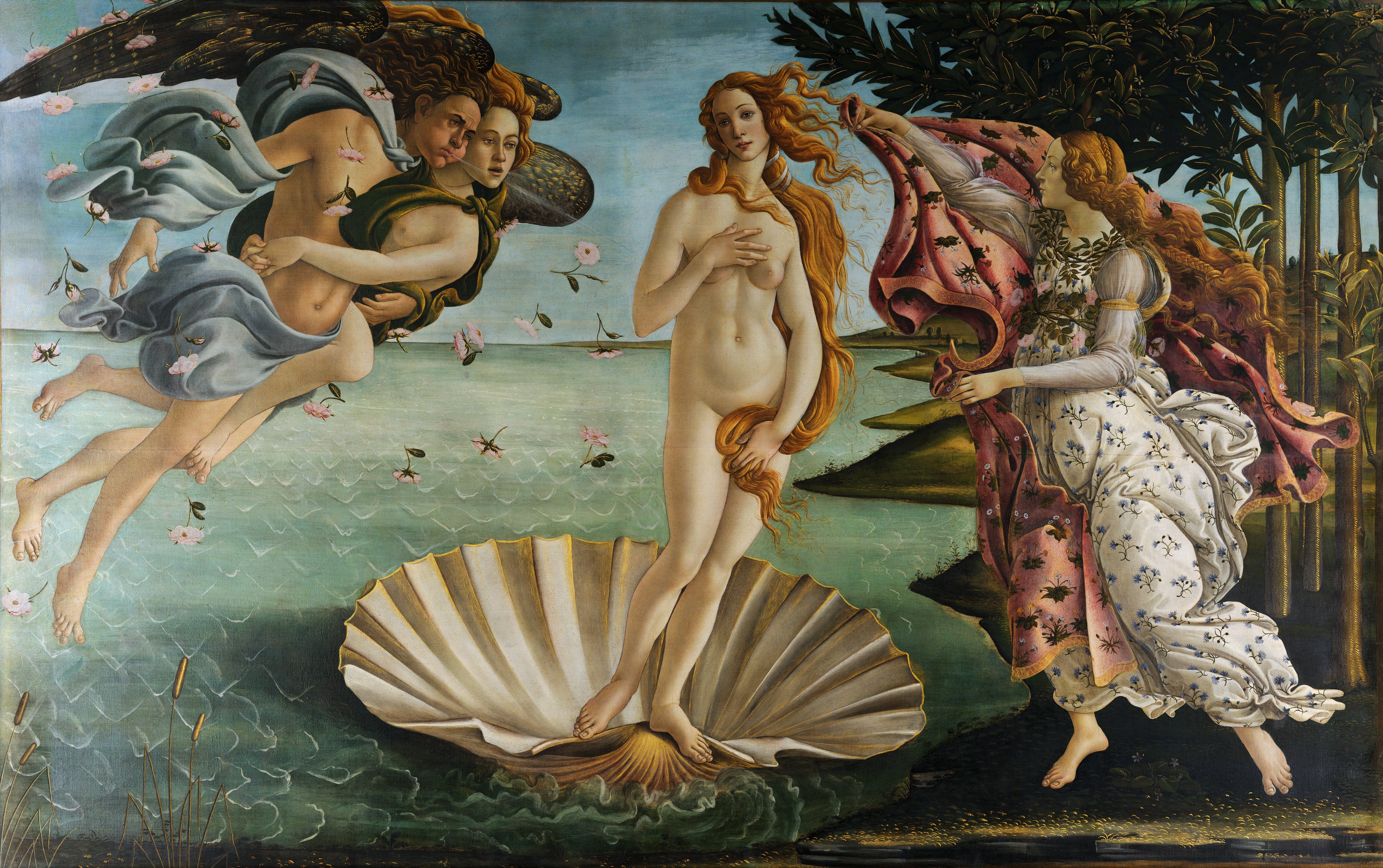
The Birth of Venus

  Botticelli Venus.jpg

                        “The Birth of Venus“, c.1482-6
 
                                    Sandro Botticelli 
 
                                       (1445 -1510)
 
                                         ________

this is me at New Year’s Eve, instead of a party after a day of some incidental work, not much but enough to hobble my spirit, I thought a hot bath would be good, maybe even an alternative, at midnight itself, I carried on, it sounded irresistible

I’d light a candle of course, play soft music, Lizst was already on, his “Années de Pèlerinage” – a meditation for piano on his Swiss, Italian pilgrimage – would go on tinkling away peripatetically prestidigitating still for hours, I wouldn’t have to even change a thing

I’d be reborn of course, that was the rationale for not going out, never mind the cold, the snow, for me the late hour, who’d pass after all even for a New Year’s party, I mused, on an outright reincarnation   

later I’d make my excuses

                                                                                                                                                                                                                                          meanwhile after a long, hot, indeed gestative soak, in the very womb of earth, in allegorical, I imagined, primal waters, wherein I’d redefine my inner being, redirect of course my errant soul, I could only rise transformed resplendent, I instinctively foresaw, as Venus, specifically Botticelli’s

I arose

a mane of golden hair, neck and profile by already Modigliani, fluted fingers a modest flutter above pert breasts, the others in their clutch a strand of protective locks to shield my innocent, inviolate pudenda

Venus, I thought, goddess of love

to be reflected not only for the moment in my mirror but like a resolution in my heart for the entire year, years in fact, to come

took a picture, hope you like it

                                                                                                                                                                                                                                             and all the very best                                                                                                                                                                                                                                     Richard

psst: only later did I realize there were zephyrs there, they’re there of course, I should’ve known, always

and one of also the Horae – Nymphe, I think, goddess of the morning hour of washing, ablutions – handing me a vernal cloak, a tribute to my season, of course, of spring


________________________________________________

Narcissus

Michelangelo Caravaggio 065.jpg

                           “Narcissus“,  (c.1597-1599)
 
                       Michelangelo Merisi da Caravaggio
 
                      (28 September 1571 – 18 July 1610)   
 
                            ________________________
 
in the myth of the beautiful Narcissus, he sees himself reflected for the first time in a pool, sees of course what others see, the surface    

but he’s confused, can’t see the forest for the trees, the id for the ego, the true for the superficial he knows quite well is there beyond what he’s been told again and again is beautiful, but that effortlessly and inextricably has always been just himself, just unsuspecting, unassuming Narcissus

to be beautiful, he inquires 

he will drown searching

                                                                                                                                                                                                                                           in truth and art       

Richard

psst: see also Salvador Dali’s “The Metamorphosis of Narcissus 


           ______________________________________

Stefan Lochner

    Stefan Lochner 007.jpg

                                   Stefan Lochner


                                      (1400-1452)


                       “Madonna in the Rose Bower”                            


                                                                    __________


                                    for Christmas


                           I wish you faith in angels    


                                          Richard    


                                     ________________________ 


falling for Abstraction

  
            Morning star  


                                “Morning star”, 1940                   

                                         Joan Miró

                                      _____________

                                                                                                                                      to prize Abstraction you need to feel its value, somehow make it relevant to your well-being, your soul, not an easy task for someone who hasn’t grown up with it, I see the same thing ‘s happened for instance for many with computers, the language is entirely foreign

I remember a sigh of relief, and unexpectedly delight, at the Queen Sofia after slogging through the history of art for a couple of weeks across the street at the Prado, before a roomful of Mirós

the Prado had been dripping in art

the Spaniards of course, Murillo, Goya, Zurbaran, were there, El Greco, the transplanted Doménicos Theotokópoulos, his great elongated figures depicting anguish, torment, ecstasies, edged unforgettably in charcoal black

the cheeky Velazquez – looking you straight in the face, where his subjects, the king and queen, also stand, reflected craftily albeit in a mirror at the back where you’d be too were this a real mirror – is a celebrated self-portrait, majesties no less have acquiesced to be merely backdrop here for the artist’s rendering of himself 

and indeed who remembers these once almighty monarchs beside their now immortal subject, their lasting fame assured ironically by virtue mostly of his grace

royal children meanwhile cavort up front, while on the far left taking up most of that side there’s the canvas he’s working on, a brush in one hand, in the other a palette of assorted colours, considering their applicability

a triumph

                                                                                                                                         the Dutch were there, the ubiquitous Rubens of course, the Rembrandts, the van Dycks, the Bruegels, but supreme for me among them was the unearthly rather “Garden of Earthly Delights“, I didn’t expect it there, it was awesome, Bosch representing pictorially the panoply of Christian mythological thought, from Eden to black and ignominious hell through, in the middle triptych, our earth, controversially carnal and cavorting, in pink and azure blue, for our sober edification and delight

and still there were the innumerable, the masterful, Italians

                                                                                                                                       we left the Prado saturated, my mom and I, the Queen Sofia was an afterthought with time left on our hands, we expected nothing other there than baubles, trinkets

but Miró greeted us at the door with a roomful of light, air, fantasy, planets, comets, asterisks swirled in orbits of infinite phantasmagorical invention, fish flew where stars fell, and eyes looked out of spiderwebs, perspective gave way to dimensions

my mom breathed a sigh of relief, simultaneously enchantment, we’d entered another world

just as had in its own time, for that matter, the history itself of art

from there it was just a hop, skip and jump of course to the more abstruse maybe even abstractions of for instance even a Jackson Pollock

imagine

                                                                                                                                      yours in the discovery of art                                                                                                                                         richibi

psst: in thinking of Miró I was reminded of Chagall, he could be he for whimsy, I recalled an ekphrastic poem about a painting of his I thought I might’ve lost, all I could remember was the poem’s own mimetic whimsy, and a blue, I’d thought, violin

here it is

by Lawrence Ferlinghetti

Don’t let that horse

Don’t let that horse
eat that violin
cried Chagall’s mother

But he kept right on painting

And became famous

And kept on painting
The Horse with Vilolin in Mouth
And when he finally finished it
he jumped up upon the horse
and rode away
waving the violin

And then with a low bow gave it
to the first naked nude he ran across

And there were no strings attached


____________________________________