Richibi’s Weblog

Just another WordPress.com weblog

Brahms Violin Concerto – Kyung-Wha Chung (1985)

having had a yen for Brahms lately, his grand, sweeping
concertos, I put on again Kyung-Wha Chung last night,
with André Previn, 1996doing the Violin Concerto, a
good fit at under fifty minutes, while I simultaneously 
washed the dishes – the gods never granted me a
dishwasher, probably to keep me humble, wary of
potentially crippling, I think, hubris 
 
afterwards for the sheer exhilaration of it I wanted to
watch the whole thing over again, but another version
intrigued and beckoned, from 1985, when Chung was of
course younger, less assured, I suspected, her take maybe
less profoundly felt, not yet quite as definitive 
 
but she proved to be again Olympian, on fire, more fierce
in her attack, more defiant, Aphrodite, goddess of love,
beauty, pleasure, this time, still radiant, utterly authoritative
and convincing, paying glorious court to her host of equally
divine peers
 
this performance is of another, of an utterly transcendental, 
order, of the Brahms Violin Concerto you are not likely, nor 
are they, ever to see than either so illustrious a rendition
again
 
 
Richard


Beethoven’s Symphony no 6 in F major, opus 68, “Pastoral”

here is the Beethoven that made me believe if not indeed
in God at least in something more transcendental than our
mere incarnate existence

it was specifically in the second movement that I found
myself dancing in an altogether other dimension with
my very own beloved, my angel, who’d flown for much
too short a season too close, it appeared, to the ground,
the ground had become much too insubstantial to sustain
so ethereal an organism

may my beloved angel rest in infinite peace

Beethoven’s Symphony no 6 in F major, opus 68, “Pastoral” (1808)

1. Erwachen heiterer Empfindungen bei der Ankunft auf dem Lande
(Awakening of Cheerful Feelings upon Arrival in the Country):
Allegro non troppo (sprighly but not overly so)
2. Szene am Bach (Scene by the Brook):
Andante molto mosso (at a brisk walking pace)
3. Lustiges Zusammensein der Landleute (Happy Gathering of Country Folk):
Allegro (sprightly)
4. Gewitter – Sturm (Thunderstorm – Storm):
Allegro (sprightly)
5. Hirtengesang. Frohe und dankbare Gefühle nach dem Sturm
(Shepherd’s Song. Cheerful and Thankful Feelings after the Storm):
Allegretto (not quite sprightly)

the instructions for the movements actually indicate a descriptive,
which is to say a literal, account, wherein musical notes are to
become words that evoke a setting, music assumes the properties
of language, you’ll hear the birds, you’ll hear the brooks, you’ll hear
the thunder, you’ll even imagine on your very own alone the rainbows

Herbert von Karajan (1908 – 1989) conducts from the hereafter –
this is 1967 – a version that is just about definitive, certainly
mystical, magical, wonderful

with abstract camera work to make watching worth your while,
the close-ups of the maestros thumbs alone are worth the price
of admission

Richard

Anton Bruckner’s Symphony no 7‏

this is what it’ll sound like, I believe, when you enter
the gates of heaven, should you actually watch this
video
you’ll be forthwith, I’m sure, even transported
there, I always am

Anton Bruckner‘s Symphony no 7 is the high mass of
all concertos, this is where Bruckner, patriarch and
prophet, gives us his, our, musical description of
grace

Celibidache makes the occasion august, and utterly
transcendental

no need to genuflect, of course, only to partake and
enjoy

Richard

psst: I believe it was Herbert Blomstedt among
conductors who said that Bruckner for him was
proof of God

though I wouldn’t completely agree I think he is a
very strong incentive, but I’d needed something
much more intimate and personalized, for me it
took Beethoven

Bach’s Toccata and Fugue in D minor, BWV 565‏

Bach’s Toccata and Fugue in D minor, BWV 565  
 
         for feet          

         for mostly fingers 

                                                                                                                                               Richard


Beethoven’s Sonata no 14 in C-sharp minor, “Quasi una Fantasia”, opus 27, no 2 (the “Moonlight Sonata”)

opus 27, no 2 – better known as the “Moonlight Sonata” after a
music critic several years after Beethoven had died likened its
famous first movement to impressions of moonlight, and the
name stuck – is probably along with his no 8, the “Sonate
Pathétique“, the most famous piano sonata in the history of
music, its name alone is hard to forget, and its murmuring
chords, like passing clouds before the quiet and uncluttered
simplicity of its central melody, like the longings of the very
moon, is etched in our Western cultural subconscious
 
“Quasi una Fantasia” means “in the manner of an improvisation”,
an idea already which would’ve been considered impudent earlier
at court, where decorum and form had held rigorous sway  
 
but Beethoven begins as well with a slow movement, an “adagio
sostenuto“, a sustained adagio, suggesting the inexorable passage
of time, interrupted only midst its unending undulations by the 
mournful cry of a melody, silken, yet solitary, as a moon    
 
so plaintive a display of pathos would not have played well
before an aristocracy which, ruled by codes of honour, would
have found common, base, such flagrant self-indulgence
 
but times had changed, discontent was having its say, and
Beethoven was fervently speaking it, for his era, and for very
history   
 
 
that a sonata would start with a slow movement also put into
question the very tradition, ineluctable until then, of having
to keep its place in the middle, by changing the order of play
the order of emotional commitment necessarily followed,
suggesting that these could be manipulated as in a play, a
novel, a poem, a narrative, wherein notes would speak like
words, Beethoven was devising to make music thus into a
veritable language 
 
just listen 
 
 
after a short middle movement, the allegretto, faster than
the first, the presto, the last and fastest movement of all,
usually the shortest movement of a sonata on account of
its technically difficult speed, is longer here than both other
movements put together, to concert pianists a very Everest,
a test of their mettle and skill, an irresistible challenge to
any ambitious virtuoso, another, more pragmatic, reason,
incidentally, for the success, and survival, of a piece, which
is championed, kept in view, by an artist for its ability to
make him or her technically impress, thereby creating the
canon, another word for the repertoire 
 
 
despite a few fluffed, here and there even discordant, notes,
Wilhelm Kempff (1895-1991), a titan among pianists, manages 
a completely convincing interpretation, not easily bested 
 
enjoy
 
 
Richard 


“Man at the Window” – Gustave Caillebotte‏

             Man at the Window - Gustave Caillebotte

                                  “Man at the Window”  (1875)
 
                                            Gustave Caillebotte  

                                                                  __________ 
 
 
it’s hard not to think of Caspar David Friedrich (1818) or
Norman Rockwell (1962) upon viewing now this painting,
which came up today in a lecture I was viewing on the
Impressionist Gustave Caillebotte1848-1894, halfway
between both 
 
they are, all three of course, all about contemplation,
but all explore a different aspect of that phenomenon
 
let me suggest that Friedrich‘s concerns are patently
metaphysical, he casts his eyes, which we do not see,
incidentally, upon a horizon that looks like destiny,
ours by extension, murky yet imbued with possibility,
even the improbable
  
or maybe this is just what I see
 
 
Rockwell‘s perspective is instead aesthetic, a view
of the world as expressed by others, the capacity to
understand and relate to other voices, opinions, within 
our social construct, allegorized here by the exhibition
room
 
it is a closed speculation, circumscribed by the limited
dimensions, physical or conceptual, of any other
counterpart, contained therefore metaphorically, and
concisely, within a frame  
 
that frame represents the physical limits imposed on
a painter, but also the conceptual limitations of the
viewer him- or herself, it works both ways, for some
this will be a man merely looking out a window, for
others an opening on an epoch
  
 
Caillebotte1848-1894, looks inward to his isolation,
alienation, from his luxurious interior, black as a cave,
upon a confined avenue where nothing but an impossible
communication, with the lone woman crossing the
street, surely a furtive eye, gives way necessarily to
resignation, and a kind of existential yield to ineluctable
fate, a sensibility beginning to burgeon at the time, see
Nietzsche, 1844-1900, and nihilism  
 
then again this is only my impression, this is what I got
 
and a picture is worth, we say, a thousand words
 
 
Richard  


Brahms piano concerto no 1 in D minor, opus 15‏

this morning as I washed the dishes – nary a butler had 
managed to show, nary a merciful maid – I thought I’d,
as often I do, put on some Classical music, Romantic,
Impressionist, something, to tide me through the tedium  
 
there was a Brahms Piano Concerto no 1 to look into I’d
set aside, his opus 15, in D minor, Emanuel Ax with
Bernard Haitink
 
Emanuel Ax – a man I’ve come to admire above all other
musical giants for his humble roots, Winnipeg trained, and
for the dizzying heights he’s reached in the musical 
firmament, humbly, not so austere, not so patrician as his
European counterparts, and obviously, maybe consequently,
finding joy in, not empire over, the music – does the pianistic
honours
 
Bernard Haitink conducts in perfect synchronicity, leading
the impeccable Chamber Orchestra of Europe, at London’s
Royal Albert Hall, August 18, 2011 
 
 
by the third movement my hands were out of the water,
dry, my undivided attention was riveted, ready to all out 
applaud a thrilling concert, which indeed I did, long, loud, 
and with all my heart
 
you too likely will 
 
 
Richard 


“The Connoiseur” – Norman Rockwell‏

The Connoiseur - Norman Rockwell

The Connoiseur (1962)

Norman Rockwell

____

serendipitously trolling Rockwells after sensing his spirit in a
poem I’d just been reading I happened upon this marvelous
piece, an homage of course to Jackson Pollock, perhaps the
most successful of the Abstract Expressionists

but lurking behind the obvious surface of this painting it was
easy to recognize also another glaring, though not as explicit
maybe, tribute, misted perhaps by the transformational
permutations of context and time, wherein a seed becomes
a tree, a caterpillar becomes a butterfly, to no less an iconic
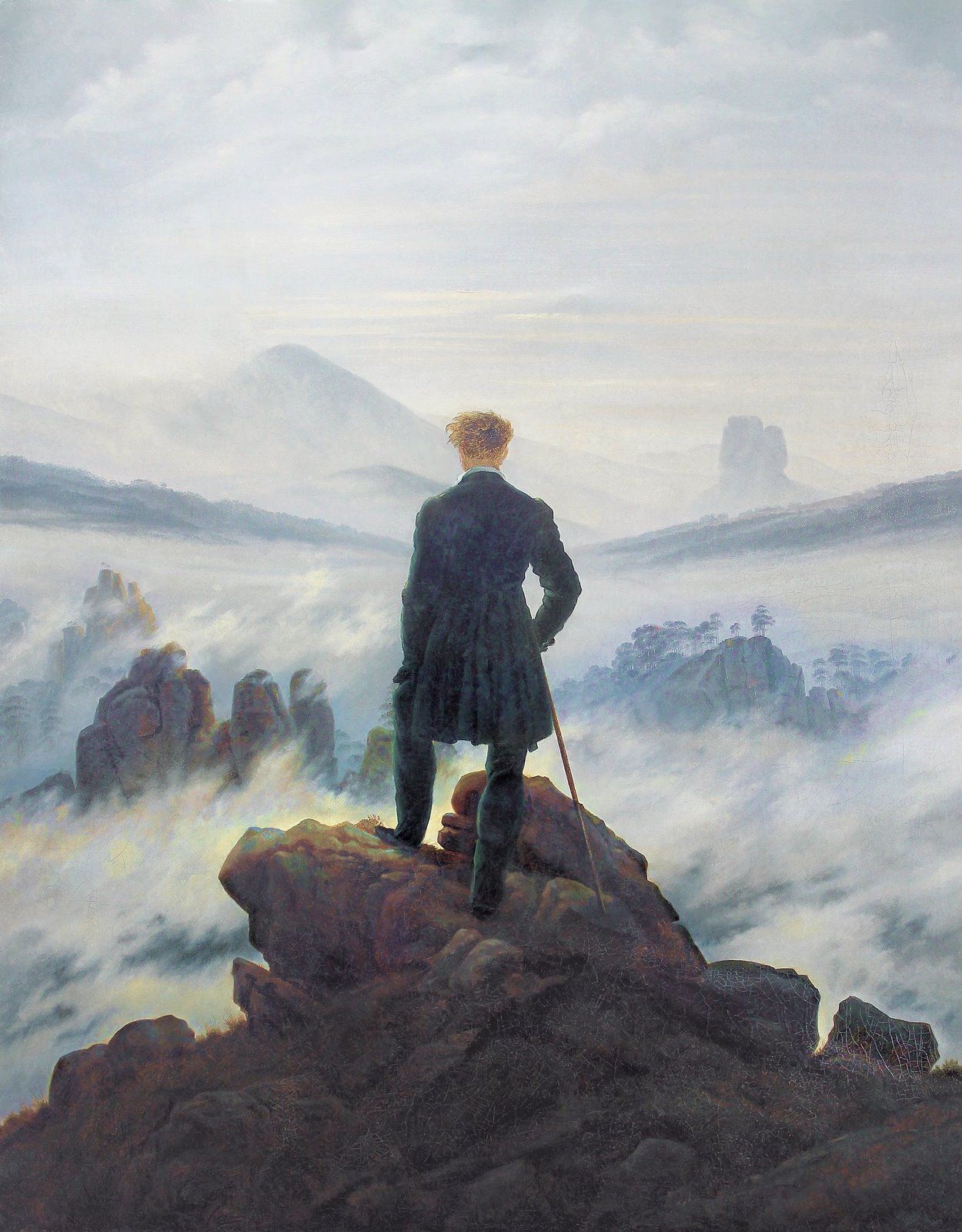
masterpiece than Caspar David Friedrich‘s Wanderer Above
a Sea of Fog
“,
the work we just, a blog or so ago, explored

both look upon their own idea of a new horizon

and a Pop Art stab at an Abstract Expressionist through a
High Romantic is a cute trick, witty, wonderful, wise

it’s an easy step to a literary counterpart from there, Keats’
On First Looking into Chapman’s Homer nearly automatically
comes to mind, another iconic Romantic new dawn

Much have I travell’d in the realms of gold,
And many goodly states and kingdoms seen;
Round many western islands have I been
Which bards in fealty to Apollo hold.
Oft of one wide expanse had I been told
That deep-brow’d Homer ruled as his demesne;
Yet did I never breathe its pure serene
Till I heard Chapman speak out loud and bold:
Then felt I like some watcher of the skies
When a new planet swims into his ken;
Or like stout Cortez when with eagle eyes
He star’d at the Pacific—and all his men
Look’d at each other with a wild surmise—
Silent, upon a peak in Darien.

Beethoven, were I to go to music, is always, especially in his
later works, contemplating new dimensions, new worlds, he
more than any other composer is a metaphysical explorer

maybe also Pink Floyd

who’ve taken me to their own also exalted musical galaxies,
awesome commanding perspectives, transcendental heights,
to my own “wild” indeed “surmise / Silent, upon a peak in”
my version of “Darien”

Richard

psst: Chapman’s “Homer”

“Wanderer Above a Sea of Fog” – Caspar David Friedrich


                                   “Wanderer Above a Sea of Fog”  (1818)  
 
                                              Caspar David Friedrich
 
 
                                                     __________ 


upon further reflection I realized that the painting above had also “the same power, the same clarity and precision” to describe the Romantic Era as the first chord of Beethoven’s “Pathétique” Sonata, it is an equally powerful representation of the spirit of that highly introspective time
 
the Romantic Epoch championed nature, patriotism on the political heels of the French Revolution – and explorations of the soul, following the latter’s calls to liberty, equality, fraternity, the natural groundwork for what followed, our own period of reverence for human rights
 
we look with Caspar David Friedrich here upon a nebulous perspective, onto daunting horizons, reflecting, with him, through the painter’s psychological ingenuity and art, upon our own daunting choices, our own murky landscapes, our own obscure and imposing destinies, both physical and philosophical, a profoundly Romantic conception 
 
it was a time when the heart and its irreverent passions took centre stage, stood, in all its permutations, under the light
 
 
please excuse my egregious oversight
 
and of also the inspired Caspar David Friedrich I’ve begged pardon, expressed my heartfelt, humble compunction, and regret, for a not insignificant slight  
 
 
cheers
 
Richard


“Somebody That I Used to Know”‏ – Walk off the Earth


this is surely a musical first, and quite probably a musical
last, not so much for the quality of the performance, which
is impressive, but for its daunting logistics
 
the five instrumentalists here, Walk off the Earth, are
apparently from Burlington, Ontario, they might be called
a quintet though this term usually applies to players playing
an equal number of instruments, they are performing what
I would call a guitar piece, a ballad maybe, for ten hands
 
can you dig it 
 
 
Richard