Richibi’s Weblog

Just another WordPress.com weblog

“Mrs Dalloway”‏

if you’re not afraid of Virginia Woolf
you might enjoy Mrs Dalloway“, the 
film version of one of her novels,
introspective, discreet ever, and 
only carefully and politely ever ardent,
existentially awash in civilities, with
feeble only attempts at philosophically
sounder, maybe, positions, all ultimately,
of course, inconclusive, an aristocratic
inversion of Van Gogh, but with statelier,
which is to say, more opulent, 
surroundings and, of course, corollary
attendant pretensions, all of it, incidentally, 
marvelously filmed  
 
the performances are all first rate, with
Vanessa Redgrave being, as usual,
resplendent
 
but Rupert Graves, as the shell-shocked
First-World-War veteran, turns in a
wrenching performance, one you’re not
likely to soon forget, one pointedly at
odds with the gentried airs of the rest of
the story, a terse, and damning, Woolfian
comment, who’s afraid of Virginia Woolf 
indeed, the institutionalization of
murderous insensitivities, and the
consequent blight of the blunting
of love  
 
nor did Virginia Woolf survive her own
condemnation, of course, famously
taking her own life in 1941   
 
 
all the other performances here are 
impeccable, up, admirably, each, to
the illustrious task  
 
I could’ve done without the two
time periods, however, Virginia Woolf,
the wordsmith, had it all going in her,
which is to say, Mrs Dalloway’s, 
sedentary head, leading up to her,
their, climactic party
 
 
may Septimus Warren Smith meanwhile,
and all others like him, rest ever in
ascendant, and proliferating, peace       
 
  
Richard


Beethoven piano sonata no 29, the “Hammerklavier”

take a few minutes, well, nearly an hour,
to watch, imbibe, incorporate, integrate,
this video, to smell this miraculous
flower, Beethoven’s piano sonata no 29,
the monumental Hammerklavier“, the
equivalent, to my mind, of the Eiffel
Tower, the Coliseum, the Parthenon,
Homer’s Iliad“, I promise it will
transform you

I’ll talk about it later, I also promise

Richard

psst: you might need some Kleenex

Beethoven piano sonata no 28 in A major, opus 101

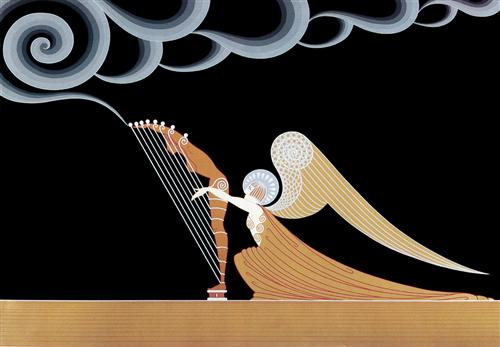
Erte - "The Angel"

The Angel

Erte

___

Beethoven’s piano sonata no 28, opus 101,
in A major
, is the first of what is considered
to be his late piano sonatas, as opposed to
early and middle, three entirely distinct
periods that are easily recognizable upon
closer listening, the early ones are bold,
even headstrong, with Beethoven’s ever
characteristic vigor and Promethean authority,
the length themselves of his early works are
a testament to his sense of his own great
personal validity, the first four, to my mind,
go on much longer than often enough they
should, a typically youthful presumption on
his part, and are musically at best trite, I find,
after their first expositions, the repeats come
as redundant, and tolerable merely, surprises,
even the famous 8th, the Pathétique“, opus 13,
is, I think, too brash and impudent, however in
this manner, nevertheless admittedly, entirely
effective, listen

the Pastorale“, of the middle period, opus 28,
no 15
, is where I deem the music to become
henceforward sublime, it has a settled
confidence that brims with not only technical
wizardry but with also positively enchanting
and entrancing musical ideas, bursting like
very flowers in springtime, with colour and
inspired, effervescent, imagination

the late period is where Beethoven becomes,
however, a sage, a prophet, and indeed a
hierarch in the new secular order of a
reconstituted Heaven, after all, someone
had to take the place of the now discredited
angels, Nietzsche called them Übermenschen,
Supermen

the 28th sonata starts out slowly, or rather,
more slowly than the earlier forthright ones,
already a sign of less physical, more
measured and considered reponses, my
impression here is of a grandfather visiting
his granchildren, jovial but not too disportive,
merely jaunty, always cheery but for a moment
of haunting melancholy, at the adagio, before
becoming congenial and avuncular again,
with then a big, boastful ending, snapping
staunchly his patriarchal suspenders,
getting the last, and traditional, word, with
a firm, which is to say, a foursquare-major-
chord, finish, the aural equivalent of turning
out the lights

musically, however, the progressions are
exploratory, incremental, more and more
layered with possible, and often apparently
rejected outcomes, in order to try out
something more fitting, maybe, more
accurate, a deconstruction, in other words,
of musical ideas, an investigation, in search
of a viable musically cohesive path

in the 28th sonata Beethoven, I think, is
doodling, however, coming up with the
methods of his great addresses, the
language here is not yet philosophically
precise, a smattering merely of pianistically
plausible ideas, musical sketches, the first
stirrings here, you’ll gather, of formal jazz

in the next sonata, the 29th, the still
unsurpassed “Hammerklavier”, he writes
the definitive book, speaking for music in
the forthcoming history of the world, and
determining its future path, we are still
moving along on his transcendent carpet,
no one ‘s come along still to give us a
more assured ride, kind of like Homer,
some would say Shakespeare, others
Albert Einstein, other, incidentally,
post-Christian, post Revolutionary
Supermen

who do you presently pray to, who are
your angels, who your Superwomen,
-men,
towards what do you aspire,
towards whom

Superwomen, -men, incidentally,
cultivate their own efflorescence,
manifest their own, I think, destinies,
or, if you like, their own Heaven

much as I believe angels also do

Mozart’s Fantasy in C minor on the
same program
shows him in a nearly
Beethovenian mode atavistically, much
more somber than he usually is, but he’s
nevertheless easily distinguished by
his much less intricate musical
accompaniment and his much more
rigorous melodic line, you’re more
likely to hum it

Mozart also composes from the nursery,
I find, the exhilaration of playful discovery,
you can see the toy soldiers, the golden
tresses on little milkmaids in dirndls with
red circles for cheeks

Mozart’s pieces are like nursery rhymes

Beethoven progresses to literature

before you judge me too harsh on Mozart,
by the way, consider that my favourite
piece of the two in this program is the
Mozart, it’s like comparing apples and
oranges, though, it depends on your
mood that day which you’ll favour

cheers

Richard

psst: just in case you missed it, this version
of the Pathétique is the best I’ve ever
heard, indeed, of all the pieces here
the most extraordinary, don’t miss it

Katharine Hepburn, among the prophets‏

 
to the icons of my art-infused philosophy,
Proust, primarily, and Beethoven, I am
adding this day, on the strength of this
very video, the indomitable Katharine
Hepburn, a veritable cultural treasure
and, here, a fierce and guiding light   
 
 
Richard


Rodin on Descartes

Rodin on Descartes

“The Thinker” – Auguste Rodin

just saying

Richard

Nemo – “Ennead I” by Plotinus (17 )‏


Date: Thu, 28 Mar 2013 00:08:23 +0000
To: richibi@hotmail.com
From: comment-reply@wordpress.com
Subject: [New comment] “Ennead I” by Plotinus
 

Richard,

You wrote, ” should there, in the instance, however, be a One, an Absolute, we would not, nor can anyway ever, from our intrinsically divergent perspectives, be able to, in any meaningful way, know It”

Our opinions are not “intrinsically”, but “accidentally” divergent. If they are intrinsic, they would not be affected by changes in our circumstances. But often times our opinions are affected by external circumstances. Therefore, they are not “intrinsic”. For instance, your story about the color of the wall reminds me of a similar story of how the English chemist John Dalton discovered color blindness. He himself was color blind but never realized it until his mother (or aunt) disagreed with him on the color. Without such a defect, there would be no disagreement.

Truth cannot be a sum of opinions or even an unanimous decision of all people. Why? Because the sum of contrary opinions amount to nothing, and the sum of contradictory opinions only lead to confusion, since people are never unanimous about anything.

To use a classic Platonic analogy: If you have a serious disease and want to be healed. Will you call everyone in from the street, hold a public assembly and have them vote for a treatment of your disease? Of course not. You’ll seek out the specialist in the field and have him examine you and give you the proper diagnosis and treatment. Because he possesses the knowledge, whereas the others don’t. Even a grain of truth is worth more than a boatload of false opinions.

Having said the above, however, I agree that the truth may be multifaceted, like the color of light shining through a prism. Because our senses have their limitations, we can only see part of the spectrum, similarly, our rational faculty may also be limited, and we only see the Truth in part. This is why dialogues such as we’re having are meaningful. That we may see the rainbow, while not losing sight of our own color.

“So please your majesty
That we may wake the king: he hath slept long.”
King Lear Act IV Scene VII


oof, Nemo, again where do I start, I’ll try to
tackle merely Truth here, deconstruct It, so
that we can know what we’re even talking
about
 
what do you mean by Truth
 
 
something corresponds to what it is that
we see, hear, feel, I would think, to be
locked in my head, my spirit, a fundamental
unity, without the support of an underlying
Reality, would be horrible, a profound, and
unbearable, solitude, I don’t want any more
to even try to imagine it, though, in my
youthful invincibilty, I once did, it would
nearly drive me, sometimes, I remember, 
crazy 
 
I would try to guess what people would
say in their next breath and found that
mostly I could do it, that mostly I could
get it right, which didn’t do much for an
outside Reality
 
but, again, babies must learn to separate,
not easily, their suddenly unfamiliar world
from their initially undifferentiated senses,
their identity from what we understand to
be Reality, I’d been merely atavistically
revisiting that fundamental experience 
 
I first fell in love, incidentally, when I met
someone I wasn’t able to preempt, to my
utter fascination, at which point I was
forced to acknowledge not only Reality
but also probably a Heaven, it has
become a condition, I fall in love with
only people from other planets, or, if
you like, dimensions
  
 
so, Nemo, I am also subservient to an
ideal, or even an Ideal
 
but it, or It, is my utter fabrication, though,
manifestly, not an uninformed one
 
my Truth is that ethereal, a bedrock, 
however, of my nevertheless basically 
nebulous view of life, made out of,
indeed, thin air
 
my opinions are therefore entirely
speculative, except for my
understanding of myself
 
I think, according to Descartes, therefore
I am, and of that, of myself, I am not at
all speculative, for I think, listen   
 
 
Truth, incidentally, is a function of our
species, assuming that it is a formal
Reality is akin to placing ourselves,
as we once did, at the centre of the
Universe, we were apparently
egregiously wrong about that, it
seems to be generally now agreed,
I suspect an Absolute, or Idealized,
potential Reality, is asking for hubris,
and too often, incidentally, we get it,
see wars, torture, man’s inhumanity
to not only man
   
 
about the world which has mathematical
dimensions we are mostly in agreement,
two plus two will always equal four in our
rational construct, and Science seems to
flow pretty smoothly from that
 
therefore Truth with respect to matter I
will not question, it is the grid we are all
at least comfortable with, like speaking
the same language, despite its even
basic insufficiencies, these fairly easy
mostly to patch up with persistence
and ingenuity   
 
but Plato’s Truth, Ideal, or Absolute, is
of a more noumenal, spiritual, which is
to say, abstract, order, and as such, like
Beauty, is in the eye of the beholder,
Truth is what we think it is
 
is John Dalton wrong to have seen a
divergent colour, and who could tell
him that his blue was green, his red,
orange, when these were categorically
his impressions, dissent is a matter
merely of concensus  
 
Truth, I believe, is our accommodation,
and is no more than the sum of its
collective parts, the truths that
scientists unearth are Science, not
Truth, Reality, not Wisdom     
 
other worlds would have entirely
different conceptions of the Universe
for being other than we, us
 
we are assuming we have the answer,
Nemo, to imponderables 
 
therefore, not Philosophy, I insist,
but Art, and metaphorical rather
than categorical imperatives
 
see Beethoven for that, and / or Proust   
 
 
Richard
 
psst: according to these two excellent
          programs,
 
                  Bernard Williams on Descartes      
 
                  Bernard Williams on Descartes (cont.)
 
           two parts of an interview with an
           authority on Descartes, I could’ve
           easily been a figment of his
           imagination for sounding nearly 
           word for word, to my surprise
           and delight, very much like him
 
           though he probably wouldn’t,    
           by my calculations, therefore,
           have loved me      


XXXV. If I leave all for thee, wilt thou exchange – Elizabeth Barrett Browning‏

from Sonnets from the Portuguese

XXXV. If I leave all for thee, wilt thou exchange

If I leave all for thee, wilt thou exchange
And be all to me? Shall I never miss
Home-talk and blessing and the common kiss
That comes to each in turn, nor count it strange,
When I look up, to drop on a new range
Of walls and floors, another home than this?
Nay, wilt thou fill that place by me which is
Filled by dead eyes too tender to know change?
That’s hardest. If to conquer love, has tried,
To conquer grief, tries more, as all things prove;
For grief indeed is love and grief beside.
Alas, I have grieved so I am hard to love.
Yet love me – wilt thou? Open thine heart wide,
And fold within the wet wings of thy dove.

Elizabeth Barrett Browning

_________________________

though I’d assumed throughout that Elizabeth
was already married to Robert Browning while
she was writing these poems, the first line of
this sonnet got me wondering, “If I leave all
for thee”,
what “all” could she be leaving if
she were already ensconced in his
metaphorical arms, even bedchamber

it turns out the poems, written from 1845
to 1846, were a prelude to their conjugal
knot, in 1846

well gee, so bold, even unbuttoned, I’ve
often thought, and yet evidently so
persuasive, or even conversely, maybe,
for him, irresistible, ultimately, who’d o’
thunk it

“If I leave all for thee”, “wilt thou”, she asks
“be all to me”, he must’ve asked her here,
just then, to be his bride

will I miss the place I’m leaving, will you
leave me more barren than in the “tender”
world I’m used to, than in the one I at least
know now, indeed an ever most adequate
haven

do not trip on the word “tried” in the first line
of the first triplet, which is to say, line nine,
which here means “has been a challenge”,
and not “has attempted”, Elizabeth is, of
course, a poet, poets do things like that,
supposing it to be good for your vocabulary

to conquer grief, she says, is even more trying
than conquering love, for grief is both together

tell me about it

her sadness, she feels, might have disqualified
her from ever being loved, would he chance it,
“wilt thou”, she questions him

about “the wet wings of [her] dove”, I’ll let you
figure it out

Richard

psst: he said yes

XXXlV. With the same heart, I said, I’ll answer thee – Elizabeth Barrett Browning‏

from “Sonnets from the Portuguese”

XXXlV. With the same heart, I said, I’ll answer thee

With the same heart, I said, I’ll answer thee
As those, when thou shalt call me by my name –
Lo, the vain promise! is the same, the same,
Perplexed and ruffled by life’s strategy?
When called before, I told how hastily
I dropped my flowers or brake off from a game,
To run and answer with the smile that came
At play last moment, and went on with me
Through my obedience. When I answer now,
I drop a grave thought, break from solitude;
Yet still my heart goes to thee – ponder how –
Not as to a single good, but all my good –
Lay thy hand on it, best one, and allow
That no child’s foot could run fast as this blood.

Elizabeth Barrett Browning

_______________________

despite the fact that this poem is evidently
a continuation of the last one, her XXXlllrd,
Yes, call me by my pet-name! let me hear“,
it is interesting to note that this XXXlVth
can stand entirely on its own, a separate
and independently cohesive entity, having
in this present iteration revisited all the
points that make the previously rendered
account wholly here a recapitulation, in all
even its intricate detail, superimposed upon
the other, or, more accurately here, after the
other, like skilled and artful embroidery, or
like Russian, maybe, nesting dolls

again it’s wise to watch the commas, and
read the lines as you would prose, if you’ll
pardon my, perhaps impertinent,
suggestion

but even then you’ll come up short, in the
second line at “those”, whose referents
are only inferred, though indeed still only
dimly, by the end of the poem

“those” are of course those she ran to, her
elders, and by extension their plural, note,
“eyes”, a wonderful, and shimmering, dare
I say, stitch, a reverberant metonymy, where
the “eyes” are not only those of one “some
face”,
but apparently various also others, a
veritable prism ultimately in which she had
been severally reflected

and we’re just at line two, the second verse,
Elizabeth is manifestly a poet

in the third verse, “the same, the same”
juxtaposes twin statements, the point is
that these identities are now timeworn,
[p]erplexed and ruffled by life’s strategy”,
by life’s disaffections and dislocations,
and become entirely opposite

but this remains

she says that her step is even more nimble,
now, fleeter, “no child’s step could run as
fast as this blood”,
“this blood” being her
ardent, of course, devotion, she asks that
he be her purpose, [n]ot as to a single
good, but all my good”

but isn’t that like saying God, in a world,
the Romantic Age, become then, if you’ll
remember, much more secular, this
position no longer a blasphemy, a heresy,
however unconsciously publically, even
scandalously, subversive

may he [l]ay [his] hand on it”, she invokes,
his metaphysical hand on her metaphorical
heart, and “allow”, confirm, indeed consecrate,
this fervent declaration, which she has signed
with, assigned her last word to, note, her very
“blood”

Richard

“To These Eyes” – W.S. Merwin‏

 
this poem, Nemo, my most recent
favourite, seems particularly
germane to our conversation
 
 
           To These Eyes
 
               You only ones
               I ever knew
               you that have shown me
               what I came to see
               from the beginning
               just as it was leaving
               you that showed me the faces
               in the realms of summer
               the rivers the moments of gardens
               all the roads that led here
               the smiles of recognition
               the silent rooms at nightfall
               and have looked through the glasses
               my mother was wearing when she died
               you that I have never seen
               except nowhere in a mirror
               please go on showing me
               faces you led me to
               daylight the bird moment
               the leaves of morning
               as long as I look
               hoping to catch sight
               of what has not yet been seen
 
 
                                     W.S. Merwin
 
 
cheers
 
Richard


Nemo – “Ennead I” by Plotinus (16)‏

 The School of Athens - Raphael

                                             The School of Athens

                                                         Raphael   

                                                     ____________


Date: Sat, 23 Mar 2013 22:47:05 +0000
To: Richibi’s Weblog
From: comment-reply@wordpress.com
Subject: [New comment] “Ennead I” by Plotinus
 
Richard,
 

As I said at the very beginning, you are “sensitive”, and I was right, because you rightly perceived that I was becoming impatient. My apologies. Patience is not my forte. 🙂 However, you have not “touched a nerve”, as this is by no means an emotional discussion from my pov. I have no intention to “vehemently reject” your position (after all it is yours not mine), but only to share my perspective, including what I perceive to be irrational arguments.

Here are the two statements you made;
” I, and the “demented” Nietzsche, incidentally, equally fervently mistrust, even deem fundamentally impossible”,
“I do not profess to “know what Nietzsche believes or “fervently mistrust[s]‘”.

Is that not a self-contradiction?

You say that you’re making an interpretation. But, what is knowledge but an interpretation? A translation from the concrete and the objective to the abstract and subjective, just as we translate a work of literature from one language to another? By interpreting Nietzsche to yourself, you gain a rational understanding of him, and by interpreting him to others, you share that understanding.

I think an important distinction should be made between a) the belief in the existence of Absolute Truth” and b) the belief of one’s monopoly of the Absolute Truth. You seem to be passionately rejecting b), which is quite understandable. But Platonism is not b) but a). It does not claim monopoly of the Absolute Truth, but instead, Plato and Socrates both exhort their listeners to pursue Beauty, Goodness and Truth, to pursue virtue, to be the lover of wisdom, which is the literal meaning of “philosophy”,

According to Einstein, this pursuit of the Absolute Truth is also the guiding principle of the scientists. Without this passionate pursuit of the truth, we would never discover that the earth is not flat. Now think about this: Can you still insist that it is uncertain whether or not the earth is flat, that it is impossible to have a rational understanding of the shape of the earth?

You argue that uncertainty makes people less likely to kill. But most people who kill are not driven by belief in the Absolute, but by their lust for pleasure, wealth and power. Some may kill in the name of Truth as a disguise for their ulterior motives, but it would be unfair and irrational to blame the Truth for their acts.

I’ll refrain from discussing the Catholic Church, partly because to me this discussion is about Platonism, and Christianity is not Platonism (though they share many similar aspects), and partly because I’m not associated with the Catholic Church and frankly don’t know enough about it to say anything useful


first of all let me raise a glass to our conversation,
a toast that it might live long
 
and thank you for your continued respectful and
penetrating participation, I will endeavour to as
assiduously hold up
  
 
that said, we get into, as I see it, the question
posed by Wittgenstein, an obstacle of the
most impenetrable sort, the egregious
unreliability of language, what do you mean
when you say something, and how does that
synch with the other guy’s interpretation of it,
or, indeed, girl’s 
 
your meat could be my poison, my Plato,
your Proust   
 
indeed which one of us is right about this,
is Plato a saint or a sinner, a boon or a
blight
 
though Proust, of course, would remain 
unquestionably and irreversibly here,
ever, surely, for both of us, benefactor
of positively Promethean, natch, 
proportions   
 
what has become here then of the
Absolute, gone up in a whiff of, just
as insubstantial, smoke, the exhalations,
note, of a fully material mens sana,
sound mind, which can be nothing
without the enveloping corpore sano,
sound body   
 
should there, in the instance, however, 
be a One, an Absolute, we would not, nor
can anyway ever, from our intrinsically
divergent perspectives, be able to, in
any meaningful way, know It
 
 
more practically and topically, when
my mother had her living room walls 
painted, my blue was her green, or vice
versa, in either case adamantly, trying
both of us to eke out from each other
concessions to a position, undyingly,
each, though ever politely, both, held, 
a model accommodation, which is to say,
without the often attendant bombs 
 
we remained puzzled, however, each,
ever, by insidious, and inescapable,
doubt, who saw the right colour 
  
 
there is a technical solution to my mother’s
wall, I know, but only after great psychological
adjustment, even torment, will the blue think
his or her visual impression another colour  
 
and who is mistaken 
 
or can some people be ever right, 
and ever wrong
 
this, incidentally, is the central problem
of philosophy, not just our own central
topic
 
and its resolution the central problem
of politics
 
 
in this instance when her cataracts were
removed, her blue became green, or vice
versa, I’d have to be in her apartment, I
can’t remember which colour, right now,
it was I saw, another philosophical
conundrum, but surely, you get the
picture, interpretation is highly
subjective, and porous 
 
which is why Science requires absolutely
unanimous approval, if you’ll forgive this
metaphorical only use of that prickly
adverb here, to determine Its still 
fundamentally ever tenuous theories
 
we’ve even only recently deconstructed
even time,
 
or Time
 
now there’s a God for you, Giver of context
 
however, even there, It would appear arbitrary,
there may be another Reality beyond our
particular three-dimensional Plato’s cave
 
but I digress
 
 
my misuse of the word “know” in citing
my apparently contradictory statements,
is at fault, I can never know, I can only
interpret, with custom we have come to
accept our suppositions as fact, and hope
that everyone else will do the same, which
we mostly do, except when we have wars
because of some intractable position,
where someone has set a price on his, her 
incontrovertible, but still fundamentally
arbitrary, opinion, even of ownership,
family structure, interpersonal affairs,
like this one 
 
but we are talking with only air, no
concrete certainty    
 
I believe Nietzsche, in other words, to
have thought my thoughts, or I, rather,  
to have incorporated his, but that is only
my understanding of it, which surely I
propound, though I might quite possibly
be wrong, but, Nemo, I can’t remember
the last time I was, I could check, I keep
a tally
 
 
scientists, I believe, are indeed seeking
always to know, perfecting their idea of
Reality, but Truth can only be the sum
of all things we think It is, nothing else,
nothing more, after all what other entity
that we know knows anything at all
about It, about Truth
 
we can only think there is a Real out
there, and make the best of It, the rest
is, Shakespeare again,  
 
           “…………………………………. such stuff
           As dreams are made on; and our little life
            Is rounded with a sleep.”
 
                                             The Tempest – act 4, scene 1
                                                                            lines 156 -158
 
 
cheers ever
 
Richard