Richibi’s Weblog

Just another WordPress.com weblog

Beethoven – piano sonata no 7, in D major, opus 10, no 3‏

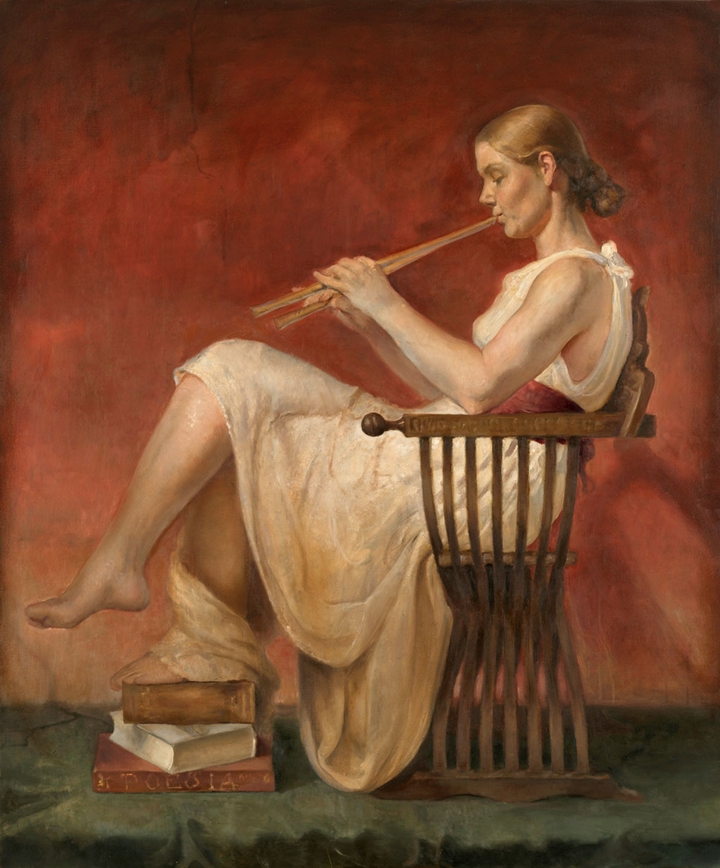
Euterpe - Apollo and the Muses - Helene Knoop 1979 - Norwegian Figurative painter - Tutt'Art@

EuterpeApollo and the Muses (2008 – 9)

Helene Knoop

________

if the piano sonata no 4 of Beethoven,
in E flat, opus 7, was academic, an
exercise, a display of technical
dexterity and some, admittedly,
even mighty, compositional verve,
it lacked, in my estimation, a centre,
a convincing motivating factor, a muse,
though ever ardent, ever entertaining,
it is ultimately arid, I think, trite, I’m
not, one is not, keen on returning to it

but in the piano sonata no 7, in D major,
opus 10, no 3
, Beethoven hits, I submit,
his stride, this sonata is enchanting

note the similarities of structure
between the two, the order of the
movements with identical, essentially,
tempo patterns, notably the middle
slow movement, in the first a largo,
con gran expressione,
slow with
great expression, in the latter, a
largo e mesta, slow with sadness,
where Beethoven plumbs, evidently,
the limits of pacing, the time lapse
between two notes, the capacity for
silence of this new instrument, the
pianoforte, of which he’ll look into
also, and even vigorously, its
capacity for volume, the crashing
introduction to his celebrated 8th,
for instance, to establish the
instrument’s new perimeters

you’ll note you can listen to the later
largo, the opus 10, no 3, forever, you
can get lost in its aural world, I can’t
think of anywhere else right now a
more profound largo

the other movements are dazzling
in their thrilling prestidigitation, all
organically sound, and, crucially,
motivationally centred, I think, this
is indeed music, magisterial music,
Beethoven’s not just kidding
anymore, he’s hitched onto his
proper inspirational deity, his own
private Euterpe, music’s muse, and
we’re in for something, from here
on, of a ride

note the cool riff closing off the last
movement, Beethoven in the guise
of Gene Kelly stepping in for a
breezy good-bye, prefiguring, of
course, XXth-Century music, and
the serendipitous extrapolations
of jazz

Richard

psst: incidentally, the headings, largo,
con gran expressione, largo e
mesta,
are entirely Romantic
musical notions, notations,
Classical composers would’ve
been too sedate, formal, courtly,
for such flagrant sentiment
Apollo Appleseed

a friend of mine, Apollo, having
appropriated that name already
to launch a, not unpromising,
career as an artist, had never
to date considered a surname
for what I called his nom de
pinceau
, his brush name

but in a farfelu moment, French
for having lost one’s head – my
head, not his, having surrendered
immediately to his fantasy – he’d
happened upon “Appleseed” as
maybe a fitting, and to be
considered, apposition, addition,
to his presently truncated name,
I jumped on it

he later called the phenomenon,
at a loss for provenance, an
inspiration, to which I forthwith
concurred, Apollo Appleseed,
can you dig it, I told him he now
had to live up to it

inspiration is always the source
of poetry, I said, poetry is what
we all live for, to make our lives
beautiful

it involves following our inspirations,
however fanciful, however out there,
people have built lives around art,
literature, dreams, madeleines, for
goodness’ sake, fording oceans,
climbing mountains, and have
become not to be forgotten, it’s the
magic that counts, ever the aim of
inspiration

when inspiration strikes it is ever
charged with possibility, perspicacity,
delight, it is not a negative function

when inspiration strikes it is time
to stand and deliver, it knows the
ineluctable way, the one that’s in
your heart

you too can plant apple trees across
the land, of your own potentialities, if
only you dare follow even one of your
dreams

Richard

psst: you’ll have to forgive my ardour,
it’s been my Johnny Appleseed
speaking

and don’t forget to click

Beethoven – piano sonata no 4, in E flat major, opus 7

though Beethoven’s piano sonata no 4,
in E flat major
, opus 7 has never been
one of my favourites, I’m finding this
particular renderin
g completely
enchanting

the opus 7 is, of course, early, when
you consider Beethoven reached into
the late 130s for his opuses, his opera,
not counting his, as bountiful, WoOs,
works without opus numbers

the sonata is steeped in Classical
conditions that are becoming ossified
at this point, about a decade after the
French Revolution, 1796 – 7, and that
have yet to be culturally overturned,
put to rest, you can hear it, you hear
the Classical form – formality, repetition,
congenial tonalities still – in the sonata,
brilliantly displayed by a composer
of ripe and rich imagination, but at
the service of structure rather than
the music itself, style over substance,
a student’s musical submission for a
composition exam

you’ll hear the repeat of the opening air
in the first movement more times than
you think is necessary, though the tune
be ever jaunty, never unpleasant, just
essentially trite, the second movement,
is a largo, a largo indeed, you’ll think,
about to fall asleep, even, at the wheel,
the later movements keep you
entertained in most interpretations,
not much, however, inspired, music to
pass the time, to check your watch by,
it needs what Beethoven will later
deliver in spades, miracles and
majesty, conviction

the opus 7 is long as well, nearly
interminable, I think, second only in
length to the sublime however
Hammerklavier, the 106, impudent
therefore, to my mind, if not outright
arrogant, in the mode of lesser artists,
Salieri, Clementi, for instance, who
never manage to transcend their,
however impressive, technical
expertise

but in this commanding account
maybe I’ve grown into the piece, or
maybe the performance itself is more
inspired – Joel Schoenhals finds
something that’s had me listen for
hours and hours, rapt, mesmerized

listen

Richard

psst: I needed this sonata for a course
I’m taking at Coursera, an Internet
learning site, on the Beethoven
piano sonatas
, the opus 7 is the
first one we’re looking at, this
performance
was the best one I
could find

join me

“Edward Hopper and the House by the Railroad” (1925) – Edward Hirsch‏

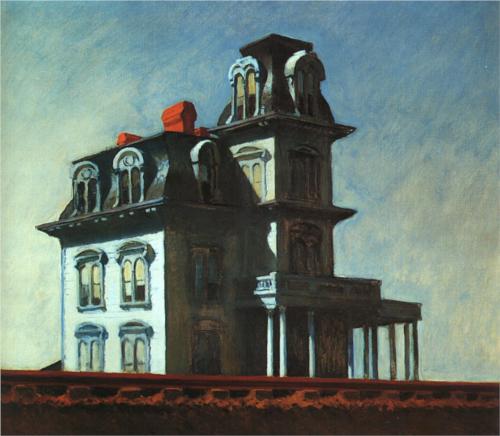
"House by the Railroad" (1925) - Edward Hopper

House by the Railroad (1925)

Edward Hopper

______

Edward Hopper and the House by the Railroad (1925)

Out here in the exact middle of the day,
This strange, gawky house has the expression
Of someone being stared at, someone holding
His breath underwater, hushed and expectant;

This house is ashamed of itself, ashamed
Of its fantastic mansard rooftop
And its pseudo-Gothic porch, ashamed
of its shoulders and large, awkward hands.

But the man behind the easel is relentless.
He is as brutal as sunlight, and believes
The house must have done something horrible
To the people who once lived here

Because now it is so desperately empty,
It must have done something to the sky
Because the sky, too, is utterly vacant
And devoid of meaning. There are no

Trees or shrubs anywhere–the house
Must have done something against the earth.
All that is present is a single pair of tracks
Straightening into the distance. No trains pass.

Now the stranger returns to this place daily
Until the house begins to suspect
That the man, too, is desolate, desolate
And even ashamed. Soon the house starts

To stare frankly at the man. And somehow
The empty white canvas slowly takes on
The expression of someone who is unnerved,
Someone holding his breath underwater.

And then one day the man simply disappears.
He is a last afternoon shadow moving
Across the tracks, making its way
Through the vast, darkening fields.

This man will paint other abandoned mansions,
And faded cafeteria windows, and poorly lettered
Storefronts on the edges of small towns.
Always they will have this same expression,

The utterly naked look of someone
Being stared at, someone American and gawky.
Someone who is about to be left alone
Again, and can no longer stand it.

Edward Hirsch

___________

Edward Hopper seems to have had
a profound influence on American
poets, this is the third poem around
one of his paintings I’ve encountered,
one by Joyce Carol Oates, a great lady
of not only poetry but of letters, having
been prolific in all literary forms, in each
nothing short of exemplary, another by
Brice Maiurro
, a budding poet of the
greatest, to my mind, merit, of whom
we will surely hear more if there is any
poetic justice

you can read about both of them right
here
in my blog, or just click their
individual names above

Edward Hirsch, by the way, stands
no less tall here, I submit, than the
other two in this coveted company

Richard

“Meditations”, Book 5 – Marcus Aurelius

“In the morning when thou risest unwillingly, let this thought be present – I am rising to the work of a human being. Why then am I dissatisfied if I am going to do the things for which I exist and for which I was brought into the world? Or have I been made for this, to lie in the bed-clothes and keep myself warm? – But this is more pleasant. – Dost thou exist then to take thy pleasure, and not at all for action or exertion? Dost thou not see the little plants, the little birds, the ants, the spiders, the bees working together to put in order their several parts of the universe? And art thou unwilling to do the work of a human being, and dost thou not make haste to do that which is according to thy nature? – But it is necessary to take rest also. – It is necessary: however nature has fixed bounds to this too: she has fixed bounds both to eating and drinking, and yet thou goest beyond these bounds, beyond what is sufficient; yet in thy acts it is not so, but thou stoppest short of what thou canst do. So thou lovest not thyself, for if thou didst, thou wouldst love thy nature and her will. But those who love their several arts exhaust themselves in working at them unwashed and without food; but thou valuest thy own own nature less than the turner values the turning art, or the dancer the dancing art, or the lover of money values his money, or the vainglorious man his little glory. And such men, when they have a violent affection to a thing, choose neither to eat nor to sleep rather than to perfect the things which they care for. But are the acts which concern society more vile in thy eyes and less worthy of thy labour?”

Meditations“, Book 5, 1

Marcus Aurelius

___________

though Marcus Aurelius produces
a seemingly logical argument in the
first paragraph of his fifth book of
meditations, his premises are not
air-tight

are we meant to “work”, a notion
already roundly infiltrating Christian
ideology, by the “sweat of its brow”,
as it were, at the time of Marcus
Aurelius, with those roots already in
early Stoicism, with Zeno of Citium,
a good 350 years before Christ

this notion is alive and well, indeed
thriving still, in the Protestant Ethic,
where very salvation is achieved
through labour, a consequence of
the Fall, which is to say, the expulsion
from the Garden of Eden

and Utilitarianism, where effort, which
is to say, work, is required to maximize
happiness, minimize suffering

these are profound pathways based
on faith, not necessarily ineluctable,
Epicureanism, an opposite philosophy,
of savouring the moment, though less
purported, less proclaimed, appears
ever flourishing nevertheless in our
voluptuous 21st Century

Marcus Aurelius brings up another
issue tangentially here, though he
expounds on it in later passages,
that of the primacy of either the
person or the community, a central
question of our times, socialism
versus democracy

he favours community, after Plato,
so, incidentally, does Jesus

these are not easy questions to
answer, what, essentially, are the
conditions required before one
starts to smell the flowers, is
smelling the flowers an abomination
when people are cruelly suffering,
dying

how can I help, should I, and when
do I say no to myself

therefore philosophy

your life, indeed your very next step,
depend on it

cheers

Richard

“Eugene Onegin”

years ago, when I first started paying
attention to opera, I listened to Joan
Sutherland and Luciano Pavarotti
singing “La Traviata” on my
headphones for six months solid,
Alfredo, Alfredo, I sang, di questa
core / Non puoi comprendere tutto
l’amore

now there’s “Eugene Onegin“,
Tchaikowsky’s homage to Pushkin,
the celebrated Russian poet who
wrote the national epic, turning it
into another prideful, musical this
time, monument

at first I’d been reluctant to take it on,
wary of other too ponderous Russian
productions, all heavy and lugubrious,
fraught with the trying tribulations of
too many harsh winters, I fathom

but after only a brief folkloric
interjection, too ecclesiastical a
reference for me, the story moved on
to less pompous things, an unfolding
love

Onegin is a rake, a rogue, a young
man not yet smitten, Tatyana, a
country lass but from a good manor,
hopelessly falls in love with him

he, of course, will break her heart

he will also break the heart of his
friend Lensky, when he dances an
écossaise, a grand waltz, and a
cotillion with Olga, Lensky’s
intended, and, parenthetically,
Tatyana’s sister

Olga had, injudiciously, allowed
Onegin to flirt

Lensky, offended, challenges
Onegin to a duel

in an aria that will haunt you forever,
Lensky commits himself to his fate,
be it Olga or the ineluctable hereafter,
knowing that she couldn’t either have
much loved him

you’ll cry

Kuda, kuda, you’ll also sing, kuda
vy udalilis,
like I will into surely at
least next month

I won’t tell you who wins, but it’s
tragic

and unforgettable

Richard

“Meditations“, Book 4 – Marcus Aurelius

“How much trouble he avoids who does not look to see what his
neighbour says or does or thinks, but only to what he does himself,
that it may be just and pure; or as Agathon says, look not round at
the depraved morals of others, but run straight along the line
without deviating from it.”

Meditations“, Book 4, 18

Marcus Aurelius

___________

having given the sciences their theoretical
foundations, philosophy, overtaken by facts,
theorems and numbers, impermeable verities
based on rigorous calculations and verifiable
experimentations, feared ceding its austere
position at the head of progressive thought
and ground its studies in more rationally
impregnable pursuits, empiricism overtook
speculation, morality became merely a
subtext instead of the existential quest
it had earlier informed

it has never recovered, though the
importance of the question of good
and evil has never subsided

towards what do we aspire, how do we
accord that with our environment, be it
social, political, natural

it is not a bad thing to consider our
priorities, otherwise we are merely
wisps, I would think, of undifferentiated
dust in the wind, dust having returned
inexorably to untransubstantiated
dust

therefore Marcus Aurelius

Richard

homespun philosophy‏

from the Westender, January 23 – 29, 2014

rant/rave (a weekly, and delightful, feature):

“Generally, by the time you are Real, most of your hair has been loved off,
and your eyes drop out and you get loose in the joints and very shabby.
But these things don’t matter at all, because once you are Real you can’t
be ugly, except to people who don’t understand.”
— The Velveteen Rabbit

Richard

“Meditations”, Book 3 – Marcus Aurelius‏

“If thou workest at that which is before thee, following right reason seriously, vigorously, calmly, without allowing anything else to distract thee, but keeping thy divine part pure, as if thou shouldst be bound to give it back immediately; if thou holdest to this, expecting nothing, fearing nothing, but satisfied with thy present activity according to nature, and with heroic truth in every word and sound which thou utterest, thou wilt live happy. And there is no man who is able to prevent this.”

Meditations“, Book 3, 12

Marcus Aurelius

_________

the idea of the virtuous man, or the
interpretation of Marcus Aurelius of
such a person, goes back of course to
Socrates by way of Plato, 427 – 347
B.C., who’s ideal was primarily
political, what to achieve within a
political order, rather than a private
meditation, an advice rather than
a contemplation as in Marcus
Aurelius, 121 – 180 A.D., 550,
not inconsequential, years later

other moral perspectives meanwhile
applied, Epicureanism, for instance,
notably, after which the stranglehold
of Christianity produced not philosophy
but dogma, for a subservient and,
biblically labeled, fallen people,
nearly fifteen hundred years spent
trying to figure out how many angels
fit through the eye of a needle,
essentially, how many irrationalities
could prove the existence, and
authority, of a mandated God

René Descartes inadvertently in this
very quest, but not before 1637, put
an end to that, introduced a new, and
revolutionary, perspective, I think,
therefore I am
“,
which put the individual
instead of the Church in the driver’s seat,
this, if it didn’t bring on the Renaissance,
at least gave it a significant push

but because of his famous scientific
method
, studies afterwards in what
we now know as the humanities
became more empirical than
specifically moral, how do we
perceive rather than how do we live
according to what is right or wrong,
Nietzsche‘s Beyond Good and Evil“,
1886, reoriented that investigation,
as it happened, ominously, in an age
where any kind of god had become
irrelevant, Beethoven would be
transformed into a Hitler, an
uncomfortably fateful Übermensch,
Superman

now philosophy is concerned with
language, what do we mean when
we say what do we mean, and can
anybody understand that

our closest moralist, our modern day
Marcus Aurelius, is at present Miss
Manners
, whom I wholeheartedly
recommend

as well as, of course, Marcus Aurelius

Richard

psst: Miss Manners‘ question and answer
format, incidentally, is not at all unlike
what Plato does in his Socratic dialogues
,
she just has a larger, more flip audience

Meditations, Book 2 – Marcus Aurelius‏

“Begin the morning by saying to thyself, I shall meet with the busy-body, the ungrateful, arrogant, deceitful, envious, unsocial. All these things happen to them by reason of their ignorance of what is good and evil. But I who have seen the nature of the good that it is beautiful, and of the bad that it is ugly, and the nature of him who does wrong, that it is akin to me, not only of the same blood or seed, but that it participates in the same intelligence and the same portion of the divinity, I can neither be injured by any of them, for no one can fix on me what is ugly, nor can I be angry with my kinsman, nor hate him, For we are made for co-operation, like feet, like hands, like eyelids, like the rows of the upper and lower teeth. To act against one another then is contrary to nature; and it is acting against one another to be vexed and to turn away.”

Meditations“, Book 2, 1

Marcus Aurelius

____________

Marcus Aurelius was an emperor, he ruled
Rome for just under 20 years, from 161 to
180 A.D., a highly unlikely fount of
philosophical inspiration, do potentates
think this way, for instance, nowadays

meanwhile the advice above is not a
bad way to start any day, I think, even
for impotentates

respectfully

Richard

psst: “Remember that all is opinion.”,
Book 2, paragraph 15, also one of my
favourite ruminations

for all I‘m apparently therefore worth