Richibi’s Weblog
Just another WordPress.com weblog
October 1, 2014
Jackson Pollock / Tristan Tzara

“Blue Poles (Number 11)“ (1952)
_____
To make a Dadaist poem:
Take a newspaper.
Take a pair of scissors.
Choose an article as long as you are planning to make your poem.
Cut out the article.
Then cut out each of the words that make up this article and put them in a bag.
Shake it gently.
Then take out the scraps one after the other in the order in which they left the bag.
Copy conscientiously.
The poem will be like you.
And here are you a writer, infinitely original and endowed with a sensibility that is charming though beyond the understanding of the vulgar.
_________________
though the idea at first seems fanciful,
outrageous, think of Jackson Pollock,
and his “action paintings”, great art
produced by the instinctual wisdom of
musculature, its preconscious impulses
Tristan Tzara, 1896 – 1963, was one of
the originators of Dada, an influential
art movement of the early Twentieth
Century that rejected all traditional
forms of art for having led to the
havoc of World War l
Richard
September 30, 2014
Pablo Picasso/Gertrude Stein
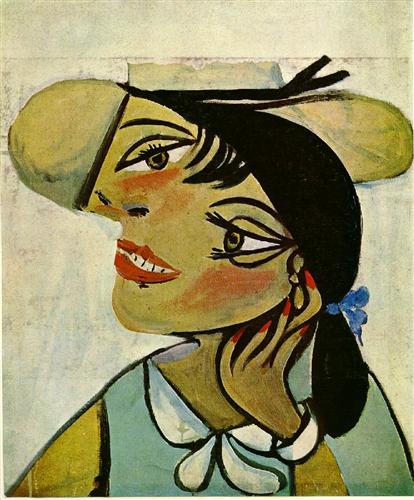
“Untitled“ (1923)
________
Gertrude Stein was a friend of Pablo Picasso,
you can see it in her prose, a disordering of
traditional practices, perspectives and
proportions
in “loving repeating“ she writes
“As I was saying loving repeating being is in a way earthly being. In some it is repeating that gives to them always a solid feeling of being. In some children there is more feeling and in repeating eating and playing, in some in story-telling and their feeling. More and more in living as growing young men and women and grown men and women and men and women in their middle living, more and more there comes to be in them differences in loving repeating in different kinds of men and women, there comes to be in some more and in some less loving repeating. Loving repeating in some is a going on always in them of earthly being, in some it is the way to completed understanding. Loving repeating then in some is their natural way of complete being. This is now some description of one.”
_________________
in my poetry course the Modernists keep on
coming, quite a few I’ve found impenetrable
and obtuse, I can see their points, but find
them pedantic and trivial
similar sentiments greeted the Impressionists
when they came out, so I’m watching myself
it’s easy to digest Picasso‘s painting now,
but even when I was a boy he was
controversial, now everyone admires him
Gertrude Stein not so much, writing is not
painting
they are both, I believe, returning to the
language of innocence, putting together
their world as children do, getting their
information in overlapping concepts,
trying to make their way through the
muddle
a five-year-old would talk like that, a
five-year-old would paint like that,
both are sorting out their new world,
the world that had been so profoundly
disturbed, disjointed
they were returning to the disarray,
and consequent irregular grammar,
of children, making their own kind
of common sense, trying to get their
bearings, after all, even God had
died, see Nietzsche on that
and, for better or worse, finally,
they’ll leave you behind, the children,
whose world, then, is it worth attending
Richard
psst: as a boy I asked my dad, while
interminably, I thought, fishing,
how long it would take the
minnow to grow into the
required fish, how’s that for
not illogical observation
September 28, 2014
Bill and Flossie Williams
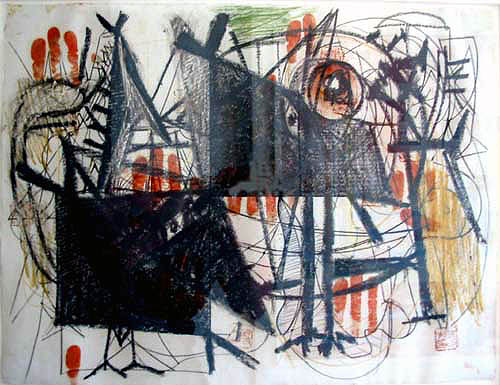
“Hitler Invades Poland“ (1939)
________
it must be understood that World War l
changed everything, the old order,
orders, had been discredited, new
states were formed, territories allotted,
-isms proliferated, the arts had to, of
course, reflect that, and did, as many
-isms were hatched in the art world
as in the political world, indeed,
many more
which is why much of it at first
seems questionable, practitioners
were learning anew how to talk, paint,
make music, they were creating a new
conceptual universe to replace the one
that had been roundly discredited, the
one that had been around in the West
for the last two thousand years
therefore Schoenberg, therefore
Picasso, and therefore “Finnegan’s
Wake“, for instance
we’ve been studying American
Modernists in the classes on the
Internet I’m taking, none of whom
I find interesting, and I’m, contrary
to all expectations, losing even my
early enthusiasm for the much too
thorny, I think, Emily Dickinson
but here’s another abstruse poet
that I like in this poem
though I much prefer his wife
Flossie’s sardonic reply, which
follows
________________
This Is Just To Say (1934)
I have eaten
the plums
that were in
the icebox
and which
you were probably
saving
for breakfast
Forgive me
they were delicious
so sweet
and so cold
________________
Flossie’s Reply (1934)
Dear Bill: I’ve made a
couple of sandwiches for you.
In the ice-box you’ll find
blue-berries–a cup of grapefruit
a glass of cold coffee.
On the stove is the tea-pot
with enough tea leaves
for you to make tea if you
prefer–Just light the gas–
boil the water and put it in the tea
Plenty of bread in the bread-box
and butter and eggs–
I didn’t know just what to
make for you. Several people
called up about office hours–
See you later. Love. Floss.
Please switch off the telephone.
Florence Williams
____________
go Florence, I say, but you can
see, of course, why I’d say that
Richard
September 26, 2014
the Argentinian tango

Jane and John
______
through the magic of the Internet, new
old friendships abound, with the click
of a connection I found the key to
erstwhile friends, who, it turns out,
are now ballroom dancers, pictured
above
can you dig it
she suggested an Argentinian tango I
might like
I am countering with another
meanwhile watch also what they’re
doing on Avenida Florida in Buenos
Aires, where miracles, trust me,
happen, just click
Richard
psst: do try all of this at home
September 24, 2014
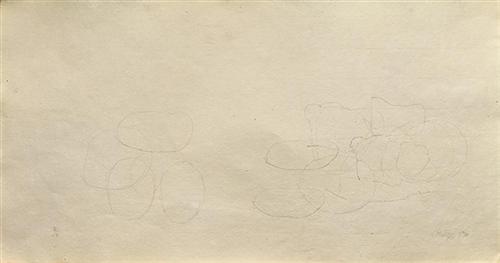
Ezra Pound “on the language of form and colour”

“304“ (1910)
______
in trying to explain the genesis of his poem,
“In a Station of the Metro“, Ezra Pound
says
“And so, when I came to read Kandinsky’s chapter on the language of form and colour, I found little that was new to me. I only felt that someone else understood what I understood, and had written it out very clearly. It seems quite natural to me that an artist should have just as much pleasure in an arrangement of planes or in a pattern of figures, as in painting portraits of fine ladies, or in portraying the Mother of God as the symbolists bid us.”
Pound is saying that playing at painting is
no different from playing an instrument or
playing a part in a play, art is about playing,
the artist has reached enough skill at his or
her craft, that he or she, however seriously,
is now playing
therefore Kandinsky, for instance
there remains, however, communication,
how much will one want to play, join in,
when the artist’s aim should be, I would
think, communication, have the
refinements become so inscrutable as to
become alienating, and contrary to art,
if not outright rubbish under an effete,
affected, gaze
what do you think
Richard
September 23, 2014
parsing art : “A Table of Desserts” – de Heem/Matisse
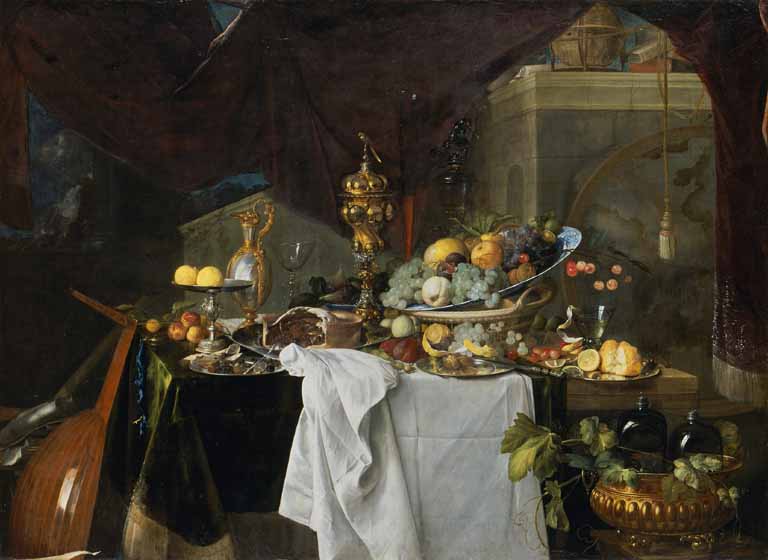
“A Table of Desserts“ (1640)
_________
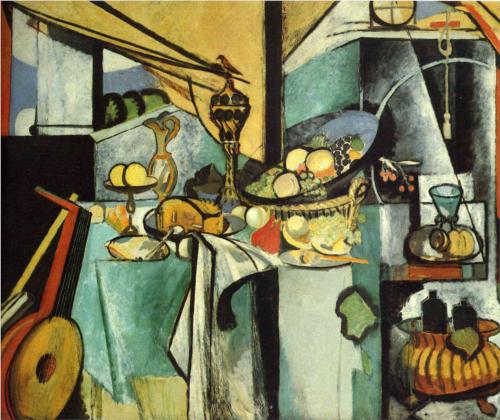
“Still Life after Jan Davidsz. de Heem’s ‘La desserte’” (1915)
________
if Siudmak was a little too much like
Rousseau for my taste, then what
Matisse does to de Heem is just
right, though the blueprint is
identical the outcome is starkly
different and individual, Matisse
is evidently his own man
directors will do the same with
Shakespeare, for instance, or
Verdi, when they alter, or update,
the work’s time frame, giving it
more immediacy, a new life
not always however effectively,
we saw a Figaro in Dresden come
in on a motorcycle, we walked out
after the first act, though not
before my mom had fallen asleep
during the torpid arias
whose table of desserts above
would you like
Richard
September 20, 2014
what is a philosopher
________
considering the response below too
forthright for a discussion we were
having on a university course website,
interactively dealing with the question
of free will, I nevertheless found worthy
my opinion of what a philosopher is,
which I deign to mount here on my,
less discreet, canvas
if you’ll allow
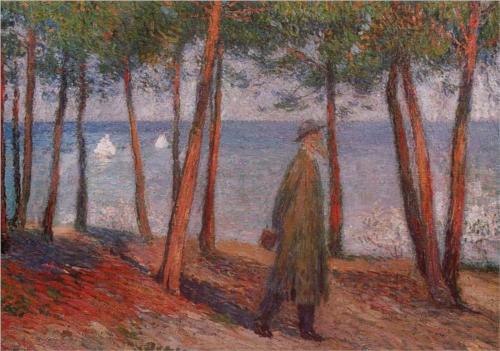
it is evidently a dramatic monologue
Richard
__________
what is a philosopher
you are not a philosopher, sir, to take
offence so quickly, a philosopher is
objective, and wouldn’t allow for
emotion to get in the way of even an
offensive argument
but with irrefutable logic simply
expose his, her sound position
indeterminacy would be encountered
with humility first, then grace, only
ever consummate deference
if you’ll allow
cheers
Richard
psst: see, for more on indeterminacy,
Socrates, ever catering to objections
September 19, 2014
ballin’ the Jack
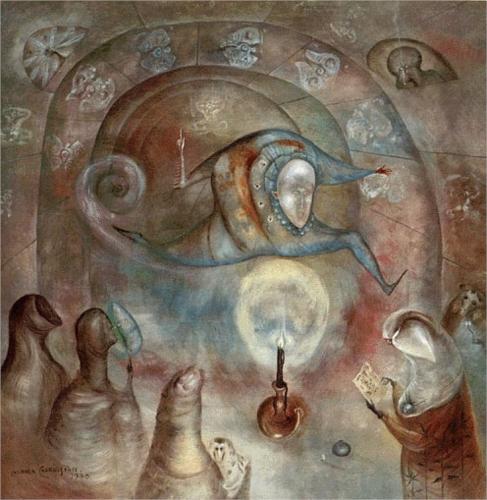
“Jack be Nnimble, Jack be Quick“ (1970)
_________
a friend writes about my most recent
parsing art – Rouseau/Siudmak entry
“You are so perceptive, Richard. How did you possibly remember these two very disparate paintings and realize (in your mind!!!) that they were so similar????
Encyclopedic visual memory?
Brilliant! Fun!
Thanks!
Theresa.”
I answered
it works every time, just click
enjoy
Richard
September 18, 2014
Visconti’s Death in Venice
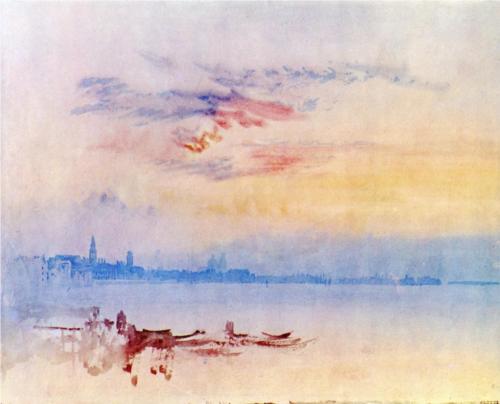
“Venice Looking East from the Guidecca, Sunrise“ (1819)
_______
“Death in Venice“ is perhaps the most
beautiful film I’ve ever seen, just click
Visconti suffuses his masterpiece with
all the colours and textures of Monet,
Renoir, Seurat, Toulouse-Lautrec, and
a host of other Impressionists, and
settles them all upon, nearly inevitably,
the splendours of a Canaletto Venice
Dirk Bogarde has never been better,
his von Aschenbach is definitive,
Silvana Mangano is every single inch
an aristocrat, the epitome of poise,
elegance and propriety, Tadzio is
throughout the very incarnation of a
Botticelli
all is given stately motion by the art
of film and made thereby into another
equal and haunting form of poetry
enjoy, marvel
Richard
psst: Visconti even makes Mahler sound
profound
as does Leonard Bernstein, incidentally,
in the accompanying clip, who is
manifestly transported throughout his
evidently otherworldly experience,
just as you might even be, just click
 Richibi's Weblog