Richibi’s Weblog

Just another WordPress.com weblog

me, in C# major – in the beginning
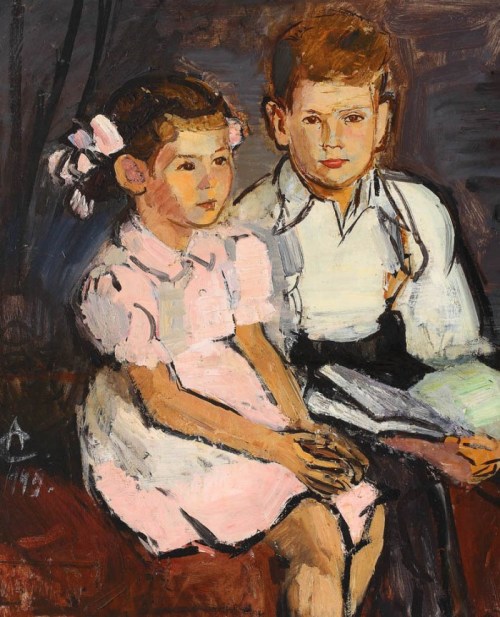
99_9

         “Prieteni

              Alexandru Ciucurencu

                      _______

                                              for my sister

my sister, who is presently recovering,
learning to walk again, up and down, 
apparently, the stairs, after a second, 
especially virulent, sarcoma, the first, 
a year ago, insignificant compared to 
this one, which has left her, this time,
with but two of seven muscles in her 
upper right hind leg, her thigh, was 
surely my first experience of someone 
who could understand my existence, 
she was born a year and a very few 
days later than I was 

two buds on a branch learning to 
weather the weather from the same 
degree, essentially, of inference

she had dark eyes, round, brown,
beautiful, would eventually win 
beauty pageants, her hair was also
brown, beautiful, though all this 
was to her ever irrelevant, until later 
perhaps when she learned to always, 
however humbly, as one should treat 
a gift from heaven, use it, to protect 
her child, to ensure her own ever 
noble existence, through which she 
never, however, stopped being 
beautiful, even radiant

however beautiful might she have 
been, I only ever saw her heart, 
something I’ve done since with 
beautiful people, beyond even 
their vaunted allure 

my sister was not only my sister, 
thus, she was also the other part
of my heart

still is


my parents worked, were gone all 
day, ensuring our physical comfort,
food, clothing, a roof over our 
heads, and they were little by little 
becoming eventually extravagantly
successful, for little people

but it was the ’50s, folks were 
coming out of a culture of log 
cabins and perseverance, aunts 
had survived fires that had burnt
the town down, and who’d saved 
their children, all cowering in the 
nearby river, cloaked in tarpaulins,
while the menfolk had been toiling 
in some other nearby township 
to keep their families going, 
nearly as heroically as the women

but my sister and I had just been 
born in this particular corner of  
infinity, where each child, in its  
own, needs to make its own way

we, blessed as we were, could 
confront this abashing new world
together

and we did

she had been a bud, she became
my anchor, as I, I think, ever for 
her since have also been

if you’ll pardon my inordinate, and
perhaps too gushing, ardour


R ! chard

me, in C# major – program notes

the-journey-of-the-stone-unicorn-2005

         “The Journey of the Stone Unicorn (2005) 

               Stefan Caltia

                     ______

                                     for my Uncle Al, who put 
                                     me up to this challenge


an uncle of mine recently, who’d only 
undertaken, just as recently, his own 

“memoir”, he called it, urged me to 
write my own autobiography on the 
strength of what he perceived to be 
my writing ability, I knew that would 
be a daunting venture, one that he’d 
shown me already in several internet 
correspondences how daunting it 
had been for his own eventually 
abandoned effort, it had been 
chronological, a death blow since at 
least Proust, Joyceand the advent 
of stream of consciousnesstime is 
no longer considered linear, watch 
any program on television

indeed I tried at one point, a few 
months back to start from the 
beginning, it was a disaster, where
I was born, when, in a manger, for
your information, for there was no 
room at the inn, but from there it 
was perfunctory, like watching the
hands on a clock turn

in the meantime, I thought I’d try 
something else, a recent inspiration,
just sit by the fire and tell your story,
my story, which is not at all, I think, 
as I would, of course, uninteresting,
but you’ll be the gauge of that, 
should you keep on reading  

and I think I can do that


R ! chard

Dmitri Shostakovich – “Symphony No 5” in D minor, opus 47

hi-xvii-congress-of-the-cpsu-b-1934

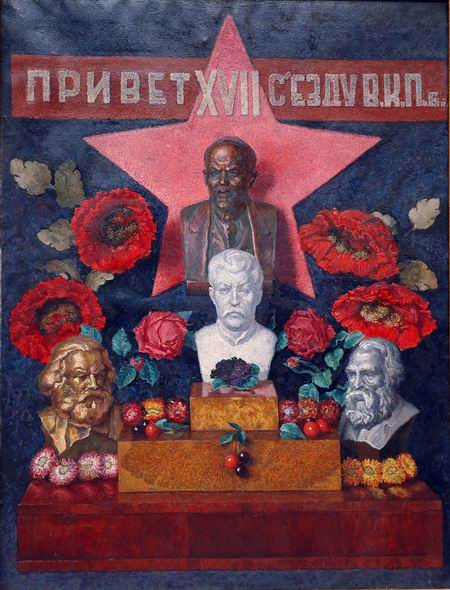
     “Hi, XVII Congress of the CPSU (B) (1934) 

              Ilya Mashkov

__________

if I thought the Fourth would knock 
your socks of, stockings, the Fifth 
ought to leave you with, dare I say, 
nothing on but your awe, it is 
extraordinary, so settle in, pour 
yourself a glass of wine, or vodka 
if you want to bethnic, for a 
mesmerizing three-quarter hour

days only before the first performance
of Shostakovich’s new symphony, an 
article showed up in a leading Moscow
paper suggesting that it would be
Soviet artist’s creative response to 
justified criticism” in reference, of 
course, to Stalin’s displeasure with 
Shostakovich’s Lady Macbeth of 
Mtsensk, which had led to the 
cancellation of his Fourth Symphony,
read all about it here

disregard for Stalin’s opinion would
have meant certain execution in an
environment where the leader could
not be contradicted, the ruler wanted
uplifting tunes, the rule was Socialist
Realism, art to celebrate the Party

a similar thing was happening at the
same time in Germany, incidentally, 
with Hitler objecting to entartete 
Kunst“, the degenerate art that 
moderns were producing, Kirchner
KleeDix, for example, who were 
only painting, as Shostakovich was 
only composing, what they heard, 
saw, for which they were all 
persecuted


a few necessary words about the 
Fifth Symphony itself, if 
Shostakovich had been moving

toward dissonance, you’ll find the
Fifth particularly notable for its 
tonal melodies, however sometimes
astringent, more larger intervals, 
sevenths, octaves, than strident 
atonal conjunctions

and since Shostakovich had been 
strictly adhering to the two other
Classical conditions, of tempo and
repetition, this symphony might as
well be a Romantic composition

listen to Beethoven’s Fifth and 
compare, they sound nearly 
identical but for a 130 years
distance, the peremptory opening, 
loud, brash, bracing, followed 
quickly by a lull in intensity, four 
movements eachhorns blare in 
either military salvos, propensity 
toward dance rhythms, short, sweet 
solo moments for several assorted 
instruments, usually contemplative, 
piercingly personal – after a 
comparison, you’ll never see 
Beethoven’s Fifth in the same light 
again

Beethoven, however, though 
forceful, indeed thunderous, is 
more centred on the actual music, 
which is jubilant, celebratory, an
exultation, while Shostakovich by 
contrast, however equally martial, 
sounds the implacability, the 
ruthlessness of the fanfare, the 
parade, you can feel the iron step 
of the guard, their advance 
inexorable, this is unquestionably 
political statement, then again 
Beethoven didn’t live in France


it’s to be noted that both works
are products of a recent revolution,
the French, the Russian, and the 
imminence of a Terror, as well of
the return of an autocratic leader,
the Emperor Napoleon in the first 
instance, in the second, of course 
Stalin

it’s helpful to view the bombastic 
portions in Shostakovich, as the 
unassailable positions of the Party, 
the more melting moments and 
single voices as those of the 
oppressed proletariat, people up 
against the stringent requirements 
of an unforgiving state growing up 
all around them 

a return to strict Classical 
conditions, by the way, which is 
to say tunes”, might’ve been 
Shostakovich’s way of placating, 
however risky still, a dictator’s 
fearful edicts regarding 
permissible taste, that’s what 
you can do when you can speak  
the language


incidentally, the symphonies are  
either composer’s Fifth, perhaps 
not incidentally


R ! chard

psst: the applause at the first 
          performance, November 21, 
          1937, lasted over half an hour,
          people were crying, they’d 
          found a prophet  


Dmitri Shostakovich – “Symphony No 4” in C minor, opus 43

portrait-of-joseph-stalin-iosif-vissarionovich-dzhugashvili-1936.jpg!Large

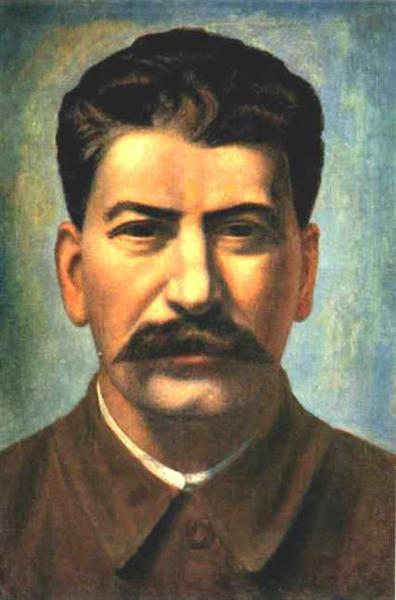
   “Portrait of Joseph Stalin (Iosif Vissarionovich Dzhugashvili) (1936)

                   Pavel Filonov

                           _________

if you’ve been waiting for a Shostakovich 
to write home about among his early 
symphonies, here’s the one, his 
Symphony no 4 in C minor, opus 43 will
knock your socks off from its very 
opening gambit, have a seat, settle in, 
and get ready for an explosive hour

the Fourth was written in 1936, some 
years after the death of Lenin, and the 
instalment of Stalin as the supreme, 
and ruthless, authority, after several 
years throughout the Twenties of
maneuvering himself, cold-bloodedly,
into that position 

from Stalin, Death is the solution to 
all problems. No man – no problem.

fearing retribution after Stalin had 
criticized his recent opera, Lady 
Macbeth of Mtsensk“, Shostakovich 
cancelled the first performance of 
this new work, due to take place in 
December, ’36, others had already 
suffered internal exile or execution 
who had displeased the tyrant, a 
prelude to the infamous Great Terror

the Symphony was eventually played
in 1961, 25 years later, conducted by
no less than Kirill Kondrashin, who’d
partnered Van Cliburn a few years 
earlier in Cliburn’s conquest of Russia
but along with this time however the 
long-lived Leningrad Philharmonic 
Orchestra 

to a friend, I said, this is the biggest
thing since verily Beethoven, no one 
has so blown me away symphonically 
since then

he looked forward, he replied, to 
hearing it 

the Fourth Symphony has three distinct 
movements, to fit thus appropriately the 
definition of symphony, though the first 
and third have more than one section, 
something Shostakovich would have 
learned from already Beethoven, it gives 
the opportunity of experiencing a variety 
of emotions within one uninterrupted 
context, add several movements and 
you have a poignant, peripatetic musical 
journey, more intricate, psychologically 
complex, than many other even eminent
composers, Schubert, Chopin, 
Mendelssohn, even Brahms, for instance 

it’s helpful to think of film scores, and 
their multiple narrative incidents,
brimming with impassioned moments,   
however disparate, Shostakovich had 
already written several of them

let me point out that Shostakovich’s 
rhythms are entirely Classical, even 
folkloric in their essential aspects, 
everywhere sounds like a march, 
proud and bombastic, if not a 
veritable dance, peasants carousing,
courtiers waltzing, and repetition is
sufficiently present to not not 
recognize the essential music 
according to our most elementary
preconceptions

but the dissonances clash, as though 
somewhere the tune, despite its rigid 
rhythms, falls apart in execution, as 
though the participants had, I think,  
broken limbs, despite the indomitable 
Russian spirit

this is what Shostakovich is all about, 
you’ll hear him as we move along 
objecting, however surreptitiously,
cautiously, to the Soviet system, like 
Pasternak, like Solzhenitsyn, without 
ever, like them, leaving his country 
despite its manifest oppression, and 
despite the lure of Western accolades,
Nobel prizes, for instance, it was their 
home

and there is so much more to tell, but
first of all, listen

R ! chard 


Symphony No 3 in Eb major, op. 20, “The First of May”

the-1st-may-demonstration-on-the-red-square-at-1929-1930.jpg!Large

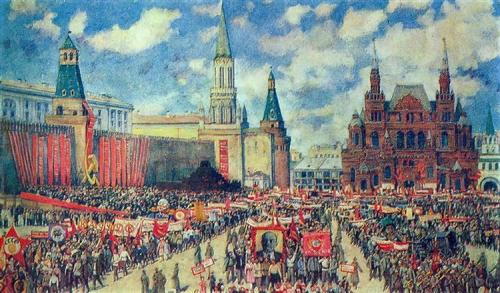
   “The 1st May Demonstration on The Red Square, 1929 (1930) 

            Konstantin Yuon

__________

let me correct something I wrote in my 
last comment, inadvertently, misleading
you somewhat with my inappropriate 
use of the word “movement”, that the
Symphony no 2 had only one, I stated, 
by which I meant that there were no 
pauses throughout, there are, however, 
indeed four movements in the Second
four distinct sections that have been 
joined together, such an uninterrupted 
piece would usually have been given 
an appropriate title, or an opus number, 
to identify it, but would not have been 
called a symphony, a symphony is by  
very definition a clearly segmented 
composition, like chapters in a book, 
they might follow a theme, though not
necessarily, see Mozart, but the breaks
are integral, where you get a chance to
cough, or to get up and replenish your 
glass of wine 

the Second could have been, should 
have been, called simply, October“, 
and, ergo, left at that 

but it wasn’t

the very same must be said about the
Third Symphony, “The First of May”,
you can already probably hear the 
jubilation and fanfare in just the title,
another milestone of the Revolution, 
the anniversary of Lenin’s death, the 
final chorus sings a lyric of a poet of
the Revolution, Semyon Kirsanov, a
sure nod to the symphony‘s political, 
however peripheral, intent 

what you’ll note, however, is the 
sensuality of the music, above
whatever weight of a, perhaps 
more fitting, dirge, or the bombast 
even of a commemorative, an exalting 
tribute – though these are determinedly 
there – going back to the orchestral 
triumphs of the Romantic Era, with 
its lush rallentandos and its voluptuous
ritardandos, the better to seduce
 
Shostakovich is getting ready for the 
real thing, a piece with any partisan 
message, he must sense, can never 
work


by the way, should you disagree 
with any of my evaluations, this 
would not at all be offensive, but
even wonderful, I have been 
wrong, I can prove it, I have the 
dates, they are listed somewhere 
in my papers, but it would mean 
you’re paying attention, listening, 
which is the entire purpose, more
than anything else, of this 
exploratory exercise, should you
wish to participate 

R ! chard

Dmitri Shostakovich – Symphony no. 2 in B major, opus 14 – “to October”

carpenter-1929.jpg!Large

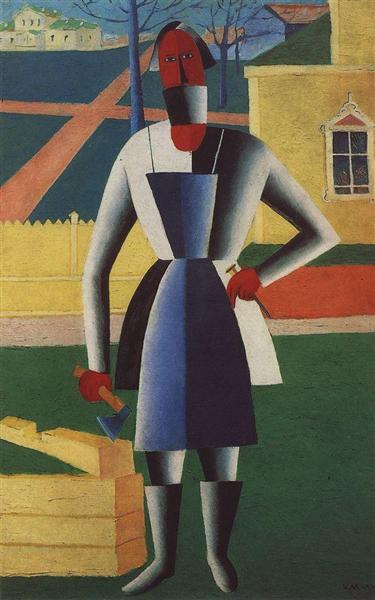
    “Carpenter (1929) – note the industrialization 
                                       of the subject, however 
                                       Cubist, for better or for 
                                       worse

      Kazimir Malevich

             _________

Shostakovich’s Symphony no. 2 doesn’t 
sound like a symphony – one movement
only, a chorus – but was never meant to, 
it had been conceived as a piece in 
commemoration of the October 
Revolution, a significant event in the 
Communist cosmology, and
commissioned by that very polity, 
hence the name, to October

but later, the symphonic poem was 
included chronologically, thus no 2,  
in the Shostakovichian oeuvre – if 
you’ll excuse that pedantry, “oeuvre” 
being too sweet a word for me not to 
resist its austere territoriality – the 
Symphony no 2 in B major being 
first performed in 1927 

it starts a shade above inaudibly, which 
I often find irritating – unless, of course, 
it’s Wagner, or Richard Strauss, who 
knew what they were doing – suggesting 
something significant is rumbling, 
brewing on the musical horizon, after 
which we enter in a lively fashion upon 
a dance, full of folkloric flavour

but the harmonies are atonal, discordant, 
a society, however traditional, is in disorder, 
tonality, one of the stalwarts of Classicism, 
along with tempo and repetition, has been 
upended, distorted, the commune, the 
community, can, no longer unburdened, 
with only discordant harmonies, dance, 
though you can feel them trying

Ravel does something similar in his 
La valse“, where, with a distortion  
of tempo, the world is spinning  

with only a change in volume, intensity,
in Shostakovichthe music becomes 
martial, autocratic, peremptory, nearly 
even frightening

I found at this point that the subtlety of 
the move from the conviviality of dance  
to the aggression delivered by a more 
forceful music, marches and so forth,
lay in a mere alteration of the musical 
pulse, from seduction to, indeed, rape, 
in a simple change of rhythm – thus is it 
written in our very sensibilities 

a violin obbligato then intervenes, 
strangely, but welcome, in a piece of
brash, by this point, agitprop, but 
soon becomes as vociferous as 
earlier the crowd who wanted to, 
however awkwardly, dance

the obbligato, incidentally, instead of
an out and out solo part, as also with 
the piano in Shostakovich’s First 
Symphony, suggests the work of a
a community, a Soviet ideal, rather 
than that of an individual asserting 
hir particular predominance, if you  
listen between the lines

a particularly impressive chorus 
eventually delivers a tribute, a  
hagiographic poem, to Lenin, which 
Shostakovich abjured, but delivered 
nevertheless for the money, and for 
the influence, reportedly, however 
ignominiously, for he was young, 
not fully formed, innocent yet  

it resembles, of course, a cantata, a
religious chant – see Bach, one of the 
evident muses of Shostakovich – but 
which addresses here a political 
system, a cute trick of contemporary 
secular regimes, the several –isms 
within our post-religious ideological
societies 

watch for it

note the spoken, or rather, prosaically 
proclaimed last verses of the oration,
hortatory, don’t you think, or what

R ! chard

psst: incidentally, few composers are as 
          political, though few have been 
          under such ideological pressure,
          as Shostakovich

Dmitri Shostakovich – Symphony no. 1, opus 10, continued

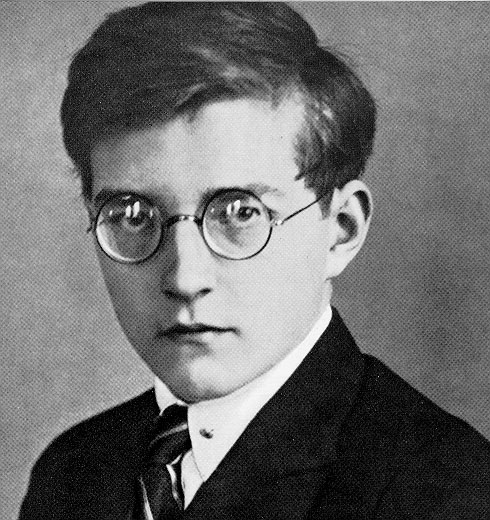
Dmitrij_Dmitrijevič_Šostakovič_(Дми́трий_Дми́триевич_Шостако́вич)

        Shostakovich in 1925

                   __________

                                        for Barbara, who died recently,
                                                 she would’ve loved this 

Shostakovich was just nineteen when
his Symphony No.1, opus 10 was 
first performed – it had been his 
graduation piece the previous year
from the Petrograd Conservatory –  
by, then, which is to say 1926, the 
Leningrad Philharmonicrenamed the 
Saint Petersburg after the fall of the 
U.S.S.R., the name it had held before 
the Bolshevik Revolution, the oldest 
philharmonic orchestra, therefore, 
incidentally, in our Russia, going  
back to 1882 

the work was a complete success, not 
surprisingly, if you’ll consider its scope, 
its power, and its novel musical 
interpolations, I mean a piano as an 
integral orchestral instrument rather 
than as a distinct, however interrelated, 
component, a pas de 40 instead of 
pas de deuxsomething I can’t remember 
anywhere else having seen for piano 

not to mention the drum roll between 
the last two movements, drums making 
splash in an orchestral setting, who’d 
‘a’ thunk it, though Richard Strauss had
done just that in his extraordinary 
Burleske” several decades earlier,  
another youthful work, Strauss only 21

but meanwhile back in Russia, before 
too seriously digress, Shostakovich  
was immediately compared to another 
earlier young prodigy there, Alexander 
Glazunovwho’d himself put out his 
own First Symphony, the Slavonic“,
at age 16, introducing, incidentally, his 
own instrumental novelty then, an oboe 
obbligato, which by very definition is 
lovely
  
Glazunov also mentored, by the way, 
Shostakovich at the Petrograd, proved
to be instrumental indeed in his 
progress

it’s interesting to put these last two 
together, to compare, the Glazunov, 1881,
follows the traditional Romantic 
imperatives, tempo, tonality and 
repetition, but with more bombast, to my
mind, than its European counterparts,
its fields are the Russian steppes with 
troikas, horse-drawn carriages, flying 
across vast unhampered vistas of the 
Russian snow-covered, therefore 
pristine, tundra, to whet the unbridled 
Russian spirit, the Europeans, Brahms,
MendelssohnMahler, conversely, 
are confined to the hunt, however ever
glorious, but with shrubs, copses,   
thickets, if not veritable forests, to blur
the sonic arena, inspire dreams, 
consequently, less far-reaching than  
those of Johnny Appleseed even, of 
the North American Prairies poets,    
their own far-flung, boundless  
imaginations, inspiration, you can 
hear it all, blatantly, in the resonance
of the horns

you’ll note the movements follow 
essentially the same rhythmic order 
in either symphony, the first two fast 
enough, then a third that’s somewhat 
slower, a variation from the strictly 
Classical order of fast, slow, fast, then
a last, eclectic, movement 

but Shostakovich is more atonal, 
melodically divergent, an eccentricity 
he’ll later polish to a degree of 
politically subversive brilliance

for not submitting, however, to the rule 
of repetition, which is manifest, though,  
in GlazunovShostakovichI find, leaves
us trying to find our bearings as his music 
rolls along, kind of like in biographical 
movies, when you start looking at your 
watch to determine how many life 
incidents remain in this particular, 
however significant, existential drama

as spectacle – and it must be noted that 
symphonic displays were at the time 
indeed spectacles – there was no 
phonographic, photographic 
equipment to transmit such 
experiences, the symphony itself was 
the show, it had, right there, itself, to 
wow the audience

in all of these cases, all of them did 

Shostakovich, however, of all of them 
remained eventually potently 
pertinent, powerfully paramount, 
watch

R ! chard

Dmitri Shostakovich – Symphony no. 1, opus 10

portrait-of-dmitri-shostakovich-1963.jpg!Large

     “Portrait of Dmitri Shostakovich (1963) 

             Martiros Sarian

                    ______

after being transfixed, rendered aquiver, by
this mesmerizing conductor in a performance
I can only remember for his magnetism, 
expressive fingers performing arabesques of 
such exquisite sensitivity, eyes that melt, 
light up, gleam, glitter, at every ebb and flow 
of the turbulent, towering, music, eyebrows 
that, blonde, cherubic, angelic, display with 
manifest intention, the spiritual implications 
of every musical turn, a youth only, in my 
senescent estimation, taking on the conquest 
of the 21st-Century world, lately installed as 
conductor, most illustriously, of both the 
Royal Liverpool, in 2005, and the Oslo, in 
2011, Philharmonics

Vasily Petrenko led me back to Shostakovich,
after his monumental Tchaikovsky 5th,
whereupon I’ve undertaken a chronological 
review of all Shostakovich’s symphonies, 
something I did long ago with Beethoven’s 
sonatas, to my great cultural advantage, it 
was a journey that informed me not only 
intellectually but, even more significantly, 
spiritually, taught me about patience, tumult, 
and the wisdom, even glory, one acquires in 
resignation, so long as you hold onto your 
principles, your core 

you look back, I told a man once, and you 
see what you’ve come through, and you 
are proud, you recognize the hero that 
you are, or weren’t

we have only our poise and grace to lend 
to the world, or our venom and invective

but I digress

here’s Shostakovich, his First, in a line 
of Shostakovichian explorations

if you’ll join me

R ! chard

the “wall”

study-for-a-sunday-on-la-grande-jatte-1885(1).jpg!Large

    “A Sunday on La Grande Jatte (1884)

           Georges Seurat

                 ________

should you know Vancouver, you’ll
recognize, nearly immediately, the 
Seawall on this video, before even 
a minute has elapsed you spot the 
Westin Bayshore coming at you, 
nearly perilously, before the speeding 
bullet that takes you on the journey 
turns the crucial corner on the paved 
path that wends its way afterwards
around the peninsula

on foot, this takes about three hours,
but here, inspired by the music of Pink 
Floyd, on a deft reinterpretation of the 
title and music from The Wall“, their 
oracular masterpiece, an inspired 
cyclist brings this local trajectory to 
psychedelic life, if you can stand the 
unsettling disjunction between his 
dizzying speed and the grandeur 
of the transcendent, immutable,  
coastlines

you’ll need, I suggest, seatbelt,
but the ride is wild

the journey ends abruptly, both 
geographically and musically, 
just down the street from my place, 
across the road from recently 
favourite restaurant, with a view, 
just as transcendent, however not
at all disappointingly mutable, of 
the Pacific sunset, whenever we, 
family and friends, eat there

R ! chard

the milonga

for-a-better-life-iii.jpg

   For a Better Life III 

          Fabian Perez

             ________

milonga, a song with a syncopated 
beat, is the musical form that gave 
birth to the tango, I wondered what 
one could be after my mom brought
my attention to one in a program for 
an upcoming event in our cityI had 
to look it up 

my only clue was that it was by 
Astor Piazzolla, the Argentinian who 
in the 20th Century reinvigorated the 
tango nearly all by himself, but in 
translation from Spanish to English,
milonga still came up milonga, what 
could milonga be, I asked 

here then, by Astor Piazzolla, is
what we’d be hearing

you’ll want to pay attention too to  
the paintings of Fabian Perez, also 
an Argentinian, which visually 
accompany the music, they are 
equally as seductive as the 
irresistible Piazzollan rhythms  

on the program as well, for a 
completely different musical 
experience, is Mozart’s Clarinet
Quintet, a piece I wrote about 
several years ago here, but must 
revisit, there is no more beautiful 
clarinet quintet, in my estimation,
and not many musical pieces are 
either as beautiful 

I won’t say a word about the other 
piece on this eclectic upcoming
programbut to say that I’d arrive 
after the intermission

R ! chard