Richibi’s Weblog

Just another WordPress.com weblog

Category: William Shakespeare

“Death and the Maiden” – Franz Schubert‏

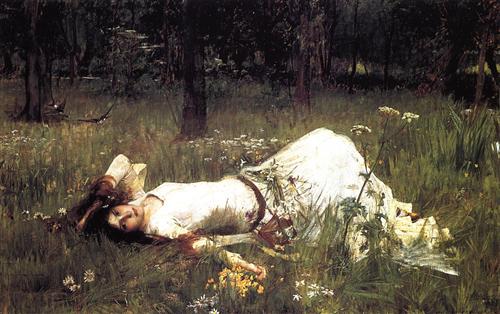
 "Ophelia" -  John William Waterhouse

Ophelia (1889)

John William Waterhouse

___________

though death is not an especially
appealing topic for many, it was
nevertheless of fundamental
consideration during the
Romantic Period

Goethe, the German poet, had
already created a sensation
with his The Sorrows of Young
Werther
, a young man,
disappointed in love, takes his
own life, a potent seed for the
new era, secularism was
overtaking theocracy, the
autocracy of the Christian
Church was giving way to the
prevalence of human rights,
a private opinion, well disputed,
was holding sway against the
rigidities of religious orthodoxies,
science and reason had been
chipping away at the very idea
of God

but with human rights there was
the question of personal
responsibility, if not an imposed
authority, then each man, woman
was in charge of his, her own

the fundamental question,
therefore, was Shakespeare’s
To be or not to be, or, for that
matter, Burt Bacharach’s and
Hal David’s What’s it all about

this is not me, this is Albert Camus
talking, who formalized the situation
in the 1940s

“There is but one truly serious
philosophical problem, and that
is suicide. Judging whether life
is or is not worth living amounts
to answering the fundamental
question of philosophy. All the
rest — whether or not the world
has three dimensions, whether
the mind has nine or twelve
categories — comes afterwards.”

after Werther, Madame Bovary followed,
Anna Karenina, suicide had become an
option, the penalty was no longer
opprobrium, castigation, as it had been
under unforgiving religious constraints

death itself, fatefully rather than
personally determined, was, of course,
no less considered when the era of
heartfelt declarations dominated,
Mendelssohn had written his
Quartet no 6 in F minor, opus 80
for his deceased sister, Beethoven
and Chopin, each his Funeral March,
either, incidentally, still iconic, and
perhaps the most poignant work
of all in this manner, Schubert’s
Death and the Maiden, a precursor
of his own much too premature
demise

this is music as if your life depended
on it

watch, listen

Richard

psst:

the Alban Berg Quartet, a group who
set the standard for several significant
string quartets in the ’80s, do no less
with this one

you’re not likely to see a better
performance of it ever, nor, for that
matter, of anything, pace even Glenn
Gould, a statement I think nearly
against my religion

you be the judge
“Julius Caesar”, a foretaste

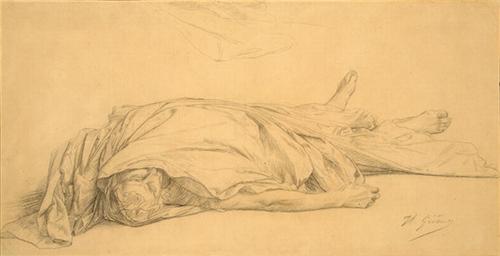
"The Dead Caesar" -  Jean-Léon Gérôme

The Dead Caesar (c.1859)

Jean-Léon Gérôme

__________

a friend and I are undertaking our
umpteenth reading of a Shakespeare
play, “Julius Caesar” this time, which
I hadn’t read in an age

in this version, still unparalleled,
Brutus, James Mason, presents his
argument for the assassination of
Caesar
, “Hear me for my cause, and
be silent that you may hear…not that
I loved Caesar less but that I loved
Rome more”,
he proclaims

Mark Antony, in the incarnation of
Marlon Brando, responds, for the
ages

and therein lies the glory, incidentally,
of Shakespeare

just saying

Richard

“Primavera” – Sandro Botticelli‏

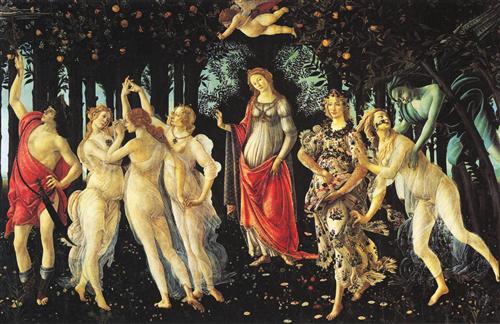
Sandro Botticelli - "Primavera"

Primavera (1478)

Sandro Botticelli

_________

on the right, Zephyrus, god of the west
wind, and messenger of spring, having
prised Chloris from his brother, Boreas,
the icy north wind, ravishes her, the
naked nymph, who is being transformed
into Flora, goddess of flowers, note
Chloris‘ hand dissolving into Flora‘s
arm

but listen to Ovid tell it

“‘I, called Flora now, was Chloris: the first letter in Greek
Of my name, became corrupted in the Latin language.
I was Chloris, a nymph of those happy fields,
Where, as you’ve heard, fortunate men once lived.
It would be difficult to speak of my form, with modesty,
But it brought my mother a god as a son-in-law.
It was spring, I wandered: Zephyrus saw me: I left.
He followed me: I fled: he was the stronger,
And Boreas had given his brother authority for rape
By daring to steal a prize from Erechteus‘ house.
Yet he made amends for his violence, by granting me
The name of bride, and I’ve nothing to complain in bed.
I enjoy perpetual spring: the season’s always bright,
The trees have leaves: the ground is always green.
I’ve a fruitful garden in the fields that were my dower,
Fanned by the breeze, and watered by a flowing spring.
My husband stocked it with flowers, richly,
And said: “Goddess, be mistress of the flowers.”
I often wished to tally the colours set there,
But I couldn’t, there were too many to count.””

Fasti, Book V, May 2 – Ovid

________________

I love “It would be difficult to speak of my
form, with modesty”

go, girl, indeed goddess

on the left of the painting the three Graces,
Aglaea, Euphrosyne, and Thalia dance

on the far left, Mars, whence, incidentally,
our name for the month of March, is god
not only of war, but of also agriculture

Venus, who needs no introduction,
presides at the centre, accompanied
by her prankish son, Cupid, fluttering
above

“Love looks not with the eyes, but
with the mind”, Shakespeare says,
“And therefore is winged Cupid
painted blind” *

as he is in the painting above

no painting has yet replaced Botticelli‘s
Primavera as a universal symbol of
spring

may yours be equally timeless,
enchanted

Richard

* A Midsummer Night’s Dream
Act 1, scene 1, lines 234 – 235

– William Shakespeare

“Macbeth” – Guiseppe Verdi‏

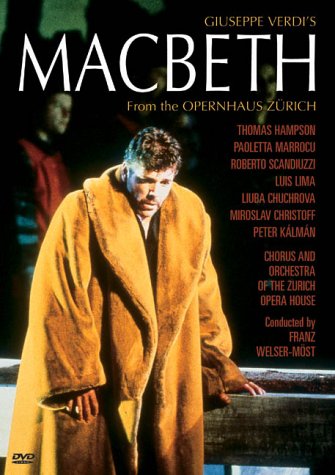
  "Macbeth" / Welser-Most, Zürich Opera

Macbeth / Welser-Most, Zürich Opera

______________

Giuseppe Verdi’s “Macbeth” has everything
you’d ever want out of even the very best of
Shakespeare’s, but with also music, rich,
passionate, searing

in this production, Thomas Hampson is
every inch Macbeth, warrior, murderer,
king, to date my very favourite incarnation

his wife, Paoletta Marrocu, unknown till
now to me, is a sinuous virago, seductive,
maleficent, deadly, “all the perfumes of
Arabia will not sweeten”
indeed “this
little hand”,
Lady Macbeth usually steals
the show if she’s able, here she does it,
incontrovertibly, again

the witches, dependably weird, malicious,
are mesmerizing, wait for the ghoulish
“Unknown Powers” telling of Birnam
Wood, and prophesying that “none of
woman born / Shall”
neither “harm
Macbeth”

chilling

brilliant

do not not watch

Richard

psst: “Tomorrow, and tomorrow, and tomorrow,
Creeps in this petty pace from day to day
To the last syllable of recorded time,
And all our yesterdays have lighted fools
The way to dusty death. Out, out, brief candle!
Life’s but a walking shadow, a poor player
That struts and frets his hour upon the stage
And then is heard no more. It is a tale
Told by an idiot, full of sound and fury,
Signifying nothing.”

“Macbeth”, act 5, scene 5

watching water boil‏

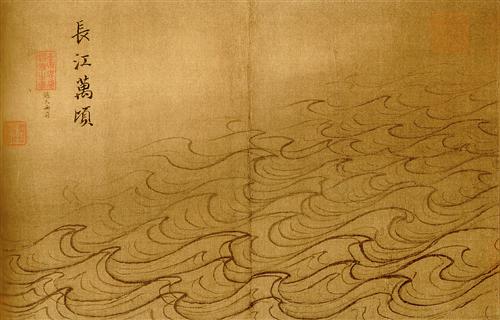
 "Water Album - Ten Thousand Riplets on the Yangzi" - Ma Yuan

Water Album – Ten Thousand Riplets on the Yangzi

Ma Yuan

____

I’ve got something for you, I said to
a friend when she fretted again about
a condition, one of several, dare I say,
eating away at her, though from the
inside, I believe, instead of the outside,
if you know what I mean

my tremor, she explained, something
I’d indeed earlier noted, and
commented on

my doctor said it wasn’t Parkinson’s
and I want a second opinion, she said,
he’s referred me to a neurologist

what did your doctor say it was, I
asked

just nerves, she answered

I’ve always thought it was just
nerves, I said, stress

but I don’t think I’m stressed, she
replied

you’re stressed right now, I retorted

have you been meditating, I asked,
like I suggested

no, she said, I just can’t get into it

I know, I know, I responded, listen,
this is why I called, I just figured
this out, I’ve been boiling water to
rinse my dishes for a while now,
ever since the water alert several
years ago when the water went
brown, I’ve got one or even several
pots behind me on the stove heating
while I’m washing the dishes, most
often I’m finished before the water
boils

I still have my plastic gloves on, I
don’t want to take them prematurely
off, so I either watch the water boil
or look at the mountains from my
window, both of which can get
tiresome

the mountains mostly win out but
then I have to turn back to check
on the water, and I’m back where
I started, watching the water boil

a watched pot never boils, this’d
be great for your condition

excuse me, she said

watch a pot of water boil, I said,
you probably won’t watch it from
start to finish, but

she started to laugh

you can start watching after several
minutes, you don’t even have to

she continued to laugh

watch it till it boils, every day you
can add minutes

she didn’t stop laughing

doesn’t that sound logical, I asked,
all she’d need was will, which’d get
rid of her tremor, I concluded

later I could’ve added that if you’re
diligent, which is to say patient, calm
you’ll start to more precisely define
the word “boil”, have 32 names for
it like Eskimos do for snow

from simmer, shimmer, steam and
hover, stir, roil, ripple and shudder,
to “Double, double, toil and trouble,
Fire burn, and cauldron bubble”,
for instance

a note to myself, do the same thing
with “mountain”

Richard

“Macbeth” – William Shakespeare‏

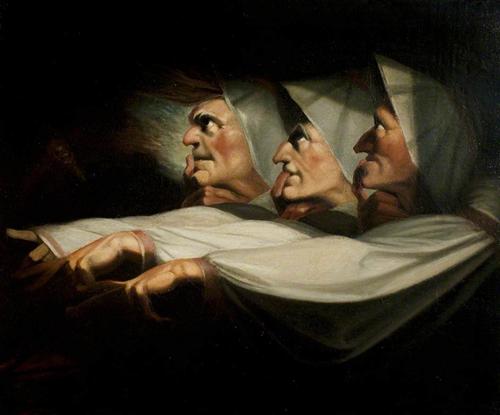
Henry Fuseli - "'Macbeth', Act I, Scene 3, the Weird Sisters"

‘Macbeth’, Act I, Scene 3, the Weird Sisters (1783)

Henry Fuseli

_______

Judy Dench is Lady Macbeth, Ian McKellen
her consort, in this superb production by
Trevor Nunn

also great witches

watch

Richard

“How I Didn’t Get Myself to a Nunnery” – Suzanne Lummis‏

"Ophelia" - Arthur Hughes

Ophelia (1852)

Arthur Hughes

_________

according to Suzanne Lummis Ophelia
“g[o]t outta town”

Suzanne Lummis is Ophelia here, this
is a dramatic monologue, I can’t tell you
how much I find that exciting

you’ll want to run to the source, of course,
to find pertinent references, so I’ve linked
a few for you from the text below to their
counterparts in Hamlet“, if it’s coloured,
just click, otherwise a couple of asterisks
explain two probably too obvious items,
in which case you’ll forgive me my
infelicitous impertinence, my unintended
and hapless presumption

thanks

How I Didn’t Get Myself to a Nunnery

That girl they found ensconced in mud and loam,
she wasn’t me. Small wonder, though, they jumped.
To a conclusion. Water puffs you up,
and we pale Slavic girls looked much alike—
back then. Deprivation smooths you out.
Yes, that was the season of self-drowned maids,
heart-to-hearts with skulls, great minds overthrown.
And minds that could be great if they could just
come up for air. Not in that town. Something stank. *

But me, I drifted on. I like rivers.
And I’m all right with flowers. I floated
on a bed of roses—well, O.K., rue
and columbine
. It bore me up not down.
That night I made a circle with my thumb
and finger, like a lens, and peered through it
at the moon—mine, all mine. My kissed-white moon.
“Moon River wider than a . . .” Mancini/
Mercer wrote that, sure, but I wrote it first.

You wonder where I’m going with all this?
Where water goes. It empties into sea.
Sold! I’d take it—the sea or a fresh life.
Some other life. A good man—good enough,
fair—fished me out. He’d come to quench his thirst.
No sun-god prince,* of course, like him I’d loved,
still loved. (Some loves don’t die; not even murder
kills them.) I married his thatched hut, hatched chicks—
kids running underfoot. Don’t cry for me,

Denmark. I’d learned the art of compromise
back there, in the black castle—then came blood,
ghosts. Something in me burst. If not lover,
father, king, ** then whom can you trust? Alone,
I took up some playing cards. I played them
into skinny air. A voice said, Swim or drown.
It said: Your house caught fire, flood, caught fear—
it’s coming down. No one loves you now, here.
By land or water, girl, get outta town.

Suzanne Lummis

* i.e. Hamlet, of course, prince of Denmark
** Hamlet, Polonius, Claudius

our debt to Shakespeare in literature
is enormous, after even 400 years –
“Hamlet” was written in 1602 – his
literary form, his countless neologisms,
his stories, his blueprints, transformed
into ballets, paintings as above, operas,
have become our myths, our moral and
philosophical standard, our modern
Olympus, the measure of our time,
our epoch, Shakespeare is our Iliad

only Beethoven in music has ever
matched this, in the visual arts, no
one

you’ll notice that the poem itself is a
monologue, in answer, in homage, to
Shakespeare, it’s in iambic pentameter,
also his wont

mine too, incidentally

Richard


parsing art : “A Table of Desserts” – de Heem/Matisse‏

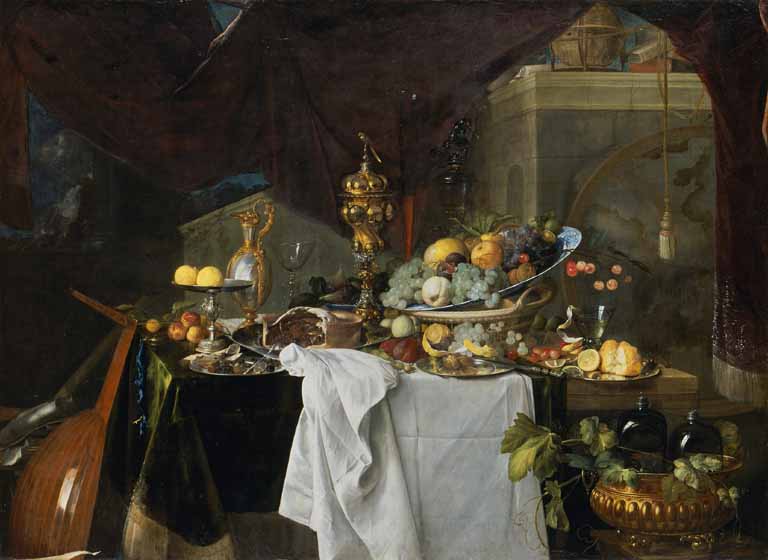
Jan Davidszoon de Heem - "A Table of Desserts" (1640)

A Table of Desserts (1640)

Jan Davidsz. de Heem

_________

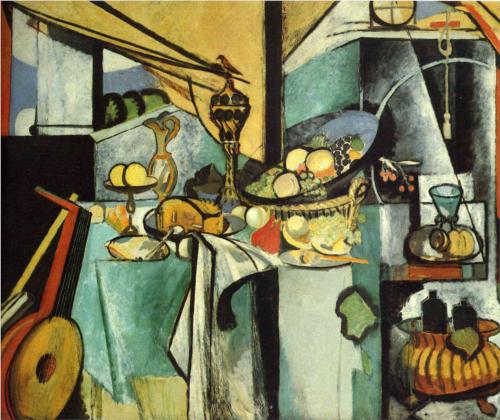
Henri Matisse - "Still Life after Jan- Davidsz de Heem's 'La desserte'"

Still Life after Jan Davidsz. de Heem’s ‘La desserte’(1915)

Henri Matisse

________

if Siudmak was a little too much like
Rousseau for my taste, then what
Matisse does to de Heem is just
right, though the blueprint is
identical the outcome is starkly
different and individual, Matisse
is evidently his own man

directors will do the same with
Shakespeare, for instance, or
Verdi, when they alter, or update,
the work’s time frame, giving it
more immediacy, a new life

not always however effectively,
we saw a Figaro in Dresden come
in on a motorcycle, we walked out
after the first act, though not
before my mom had fallen asleep
during the torpid arias

whose table of desserts above
would you like

Richard

“Bohemian Rhapsody” – Freddy Mercury‏


the poetic dramatic monologue, which finds
its popular source in Shakespeare, though
they are essentially introspective there,
philosophical rather than strictly narrative,
making them nevertheless, in a play, by
definition, dramatic, rightful claimants
still to that name, and which was
institutionalized as a poetic form by
Robert Browning later in the XlXth Century,
by upending the Shakespearean mode,
turning poems into plays instead of plays
into poems, makes its way into the XXth
Century, probably mostly unobtrusively,
no one really particularly notices, but
powerfully culturally nonetheless when
applied to, for instance, music, which is
to say poetry, of course, with notes

here’s “Bohemian Rhapsody”*, an abridged
version, as sung by Rose Osang Fostanes,
delivering a classic dramatic monologue

here’s Freddy Mercury’s complete version,
with a Greek chorus supplying oracular
even feedback

Richard

* Bohemian Rhapsody

Is this the real life?
Is this just fantasy?
Caught in a landslide,
No escape from reality.

Open your eyes,
Look up to the skies and see,
I’m just a poor boy, I need no sympathy,
Because I’m easy come, easy go,
Little high, little low,
Anyway the wind blows doesn’t really matter to me, to me.

Mama, just killed a man,
Put a gun against his head,
Pulled my trigger, now he’s dead.
Mama, life had just begun,
But now I’ve gone and thrown it all away.

Mama, ooh,
Didn’t mean to make you cry,
If I’m not back again this time tomorrow,
Carry on, carry on as if nothing really matters.

Too late, my time has come,
Sends shivers down my spine,
Body’s aching all the time.
Goodbye, everybody, I’ve got to go,
Gotta leave you all behind and face the truth.

Mama, ooh (anyway the wind blows),
I don’t wanna die,
I sometimes wish I’d never been born at all.

I see a little silhouetto of a man,
Scaramouche, Scaramouche, will you do the Fandango?
Thunderbolt and lightning,
Very, very frightening me.
(Galileo) Galileo.
(Galileo) Galileo,
Galileo Figaro
Magnifico.

I’m just a poor boy and nobody loves me.
He’s just a poor boy from a poor family,
Spare him his life from this monstrosity.

Easy come, easy go, will you let me go?
Bismillah! No, we will not let you go. (Let him go!)
Bismillah! We will not let you go. (Let him go!)
Bismillah! We will not let you go. (Let me go!)
Will not let you go. (Let me go!)
Never, never let you go
Never let me go, oh.
No, no, no, no, no, no, no.
Oh, mama mia, mama mia (Mama mia, let me go.)
Beelzebub has a devil put aside for me, for me, for me.

So you think you can stone me and spit in my eye?
So you think you can love me and leave me to die?
Oh, baby, can’t do this to me, baby,
Just gotta get out, just gotta get right outta here.

(Oh, yeah, oh yeah)

Nothing really matters,
Anyone can see,
Nothing really matters,
Nothing really matters to me.

Anyway the wind blows.

Freddy Mercury

Sonnet 128 – William Shakespeare‏

Sonnet 128

How oft when thou, my music, music play’st,
Upon that blessed wood whose motion sounds
With thy sweet fingers when thou gently sway’st
The wiry concord that mine ear confounds,
Do I envy those jacks that nimble leap,
To kiss the tender inward of thy hand,
Whilst my poor lips which should that harvest reap,
At the wood’s boldness by thee blushing stand!
To be so tickled, they would change their state
And situation with those dancing chips,
O’er whom thy fingers walk with gentle gait,
Making dead wood more bless’d than living lips.
Since saucy jacks so happy are in this,
Give them thy fingers, me thy lips to kiss.


                                William Shakespeare


it would not be incorrect to suppose that the
“wood” of which Shakespeare speaks here
is his own and not that of the instrument,
you’ll probably even enjoy the poem more
that way, which is to say for its saucy, not
to mention, unexpected and, ahem, 
protracted allegory 
 
you might also note the equally raffish
use of the word “jacks”
 
 
enjoy  
 
Richard