Richibi’s Weblog

Just another WordPress.com weblog

Category: walking in beauty

“Coming into New York” – John Updike‏

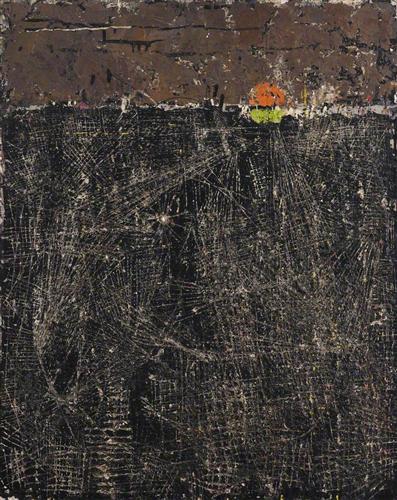
 "The Black City l (New York)" - William Congdon

The Black City l (New York) (1949)

William Congdon

________

at he other end of the continent from
Vancouver there’s New York, perhaps
not [t]he most liveable city on the
planet
but at one point the very
centre of the world, I know, I was
there, Liverpool, with even the
Beatles, had nothing on New York
City then

but that’s before Reaganomics and
Margaret Thatcher, since, Milan,
Tokyo, other cities have gotten into
the act, dulling some of New York’s
resplendence, glamour, magic

from the airport, rather than Updike‘s
Providence, the city buzzes with an
energy for me that’s electric, the
horizon sizzles already with a current
I feel in my skin, like watching bacon
fry, it commands your attention, all
grey, of course, with the washed out
colours of commercial advertisements
the size of buildings lining intermittently
the road in

New York seems a furnace, and it is,
whipping up Dante’s Inferno in all of
its myriad avenues and cells, but also
giving you flashes of Paradiso just
around any corner, the work of
inspiration, imagination, serendipity
and good will, the other side of the
infinitely variable human condition

here’s John Updike‘s equally idiosyncratic
picture of his coming home, however
more apocalyptic

Richard

_________________

Coming into New York

After Providence, Connecticut—
the green defiant landscape, unrelieved
except by ordered cities, smart and smug,
in spirit villages, too full of life
to be so called, too small to seem sincere.
And then like Death it comes upon us:
the plain of steaming trash, the tinge of brown
that colors now the trees and grass as though
exposed to rays sent from the core of heat—
these are the signs we see in retrospect.
But we look up amazed and wonder that
the green is gone out of our window, that
horizon on all sides is segmented
into so many tiny lines that we
mistake it for the profile of a wooded
hill against the sky, or that as far
as mind can go are buildings, paving, streets.
The tall ones rise into the mist like gods
serene and watchful, yet we fear, for we
have witnessed from this train the struggle to
complexity: the leaf has turned to stone.
John Updike


“Vancouver” – Philip Resnick

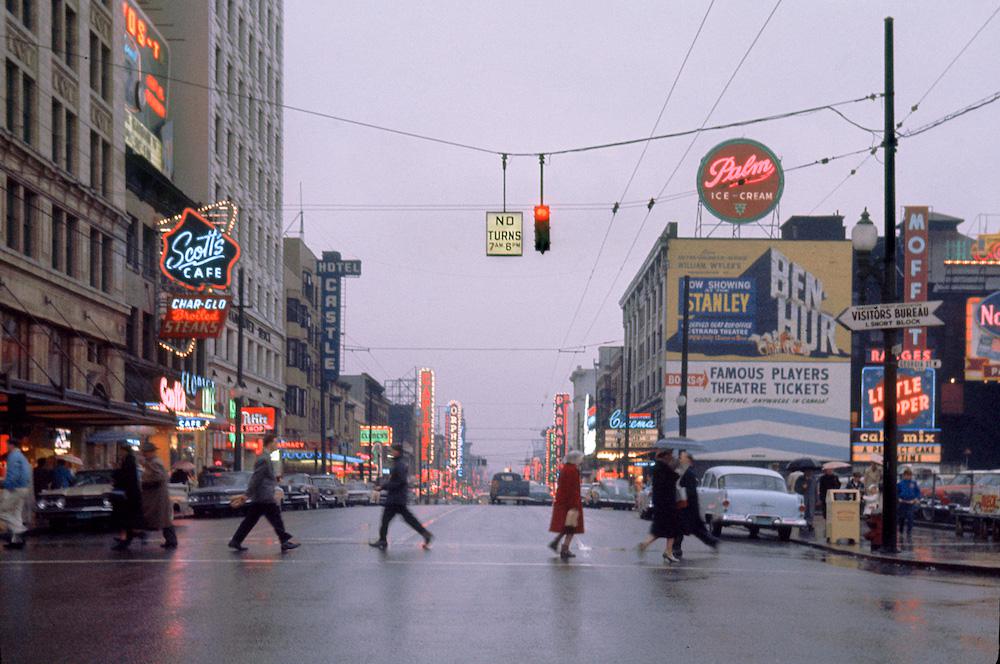
"Crosswalk" - Fred Herzog

Crosswalk (1960)

Fred Herzog

_______

not many poems exalt a city, the first
for me was Sandburg’s Chicago, a
far cry from Shelley, Byron, Keats,
and finally something that I could
sink my teeth into – though pretty,
the earlier, Romantic, poems had
been prissy, effete, skylarks,
Grecian urns, the irrelevant fall of
Babylon to the Assyrians
to me

– a lot of festooned air, I thought,
signifying nearly nothing, despite,
afterwards, its often very clever,
indeed truly inspiring, aphorisms

“Beauty is truth, truth beauty, — that is all
Ye know on earth, and all ye need to know.”

for instance

but I was young then, have gotten through
Romanticism’s idiosyncratic pretensions
to its noble universal heart, maybe ‘ve
even picked up a few of its literary
excesses since, what do you think

here’s one, right up there with Chicago“,
about Vancouver this time, my city

and it’s a dandy, I think

come visit

Richard

_______________

Vancouver

The most liveable city on the planet, they say,
which seems true enough on a mid-August afternoon,
sailboats dotting the bay,
picknickers at crowded beaches
competing for summer heat
and precious square centimetres of sand.
Sunlight casts its spell,
and hearing over and over again
how wonderful you are
has a hypnotic ring to it,
much like lovers gently rocking
to rhythms of the midnight hour
or first sight of running water to the parched.
We who grow old here
have like Cavafy‘s Alexandrians
learned to treat such messages with suspicion.
Those bereft of love
find little compassion betwixt concrete condo towers,
those with few means dwell in the same Inferno’s circles
as the bereft of other cities,
and those in hawk to the god of greed
are no less addicted for living in the suburbs of insatiability.

Philip Resnick

“King John” – Shakespeare‏

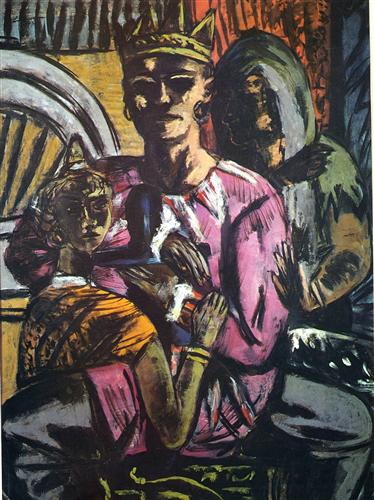
"The King" - Max Beckmann

The King ( 1934 – 1937)

Max Beckmann

_________

King John, 1166 to 1216, was the brother
of Richard the First, “the Lionheart”, and
of Geoffrey, both sons, as well as John,
of Eleanor of Aquitaine and Henry the
Second

you might remember them all from the
classic The Lion in Winter from the
Sixties

in Shakespeare’s story, John has become
king, both Geoffrey and Richard have
already perished, but Geoffrey has left an
heir, Arthur, Constance’s son, and since
Geoffrey had been the eldest, his own son,
it is contested, should be the rightful heir
to the English throne

John is not in agreement, nor is Eleanor,
his mom, but Constance is backed by the
Duke of Austria and the King of France,
who will go to war to unseat John

meanwhile Arthur is too young to be
anything but ineffectual, innocent

they all meet before Angiers, a town
now in France, but ruled then by
England, where a delightful
confrontation occurs at its gates,
the town representative will let in
the King of England but only when
he knows who, of either, He is

war is however averted when a
marriage is suggested between the
two courts, a niece of John, Blanche
of Castille, will marry the Dauphin,
Louis, son of Philip of France,
joining, however improbably, the
two sparring factions

but thereby Arthur’s claim is lost,
and Constance is fully aware of
the inevitable, and treacherous,
consequences

a legate from the Pope, Cardinal
Pandolf, also steps into the fray,
to stir the political pot, pompously,
predictably, punctiliously and
perniciously, not to mention,
perfidiously, in the end, of course

the language is Shakespeare’s, to
be sure, therefore unavoidably
wrought, but with garlands of
irrepressible poetry that is ever
utterly, and irresistibly, enchanting

“I am not mad:”, says Constance to
Pandolf, who’s accused her of being
in such a state

“Lady, you utter madness, and not sorrow.”

Constance replies

“I am not mad: this hair I pull is mine
My name is Constance; I was Geoffrey’s wife;
Young Arthur is my son, and he is lost:
I am not mad: I would to heaven I were!
For then, ’tis like I should forget myself:
O, if I could, what grief should I forget!
Preach some philosophy to make me mad,
And thou shalt be canonized, cardinal;
For being not mad but sensible of grief,
My reasonable part produces reason
How I may be deliver’d of these woes,
And teaches me to kill or hang myself:
If I were mad, I should forget my son,
Or madly think a babe of clouts were he:
I am not mad; too well, too well I feel
The different plague of each calamity.”

act lll, scene lV

has there ever been such a telling
evocation of agony

Stratford’s version is superb, extraordinary,
unforgettable, don’t miss it, just click

Richard

October, 2015‏

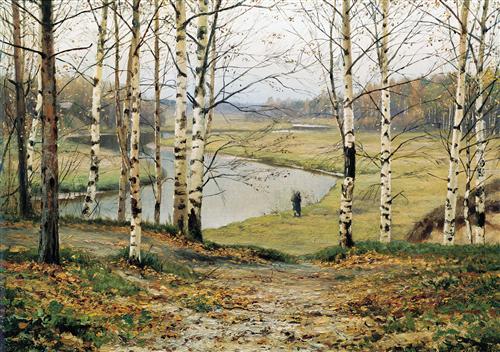
 "October" - Efim Volkov

October (1883)

Efim Volkov

_____

it’s the 3rd of October already, we’ve
slipped nearly imperceptibly, I’ve found,
into this new month, the days here are
crisp, if not cold, the leaves, not yet
fallen, are nevertheless bristling bright
orange, red, and gold, mustard, crimson,
and deep purple actually, in spotty
patches among the still prevalent greens
holding on determinedly to their extra
share of summer

nothing much more from me about this
otherwise unexceptional month, apart
from the introspection inherent in the
painting above
, offered for your
contemplation

and this wonderful piece from Tchaikovsky’s
The Seasons, its October: Autumn Song,
including this epigraph of Tolstoy from its
first Russian edition

“Autumn, our poor garden is falling down,
the yellowed leaves are flying on the wind.”

for your rapture

listen

Richard

psst:

today our building manager left a
chocolate on each of our doors


“King Lear” – William Shakespeare

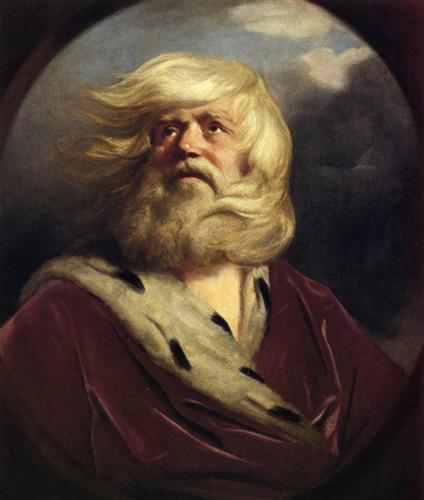
 "Study for King Lear" - Joshua Reynolds

Study for King Lear (1760)

Joshua Reynolds

________

though it has its weaknesses, I have
never seen a better version of “King
Lear”
than this one, also, to my mind,
Shakespeare’s best play

watch

Lear has always been a difficult
character to portray, a King becomes a
vagrant, a Jesus figure, “a man / more
sinned against than sinning”,
and the
most difficult part an actor must render,
I’ve found, is that of social status

and here we have both extremes, a not
easy transition, nor have I seen but once
a Lear I could believe in

James Earl Jones in New York’s Central
Park
is Lear from the word go, but the
rest of the cast betrays him, they all
mostly merely phone in their roles

in this alternate production, the reverse
is true, Lear, though in many moments
mighty, is never really a King, nor truly,
I think, a Jesus, though his final breaths
are nothing short of holy

Cordelia speaks her lines well, but
doesn’t breathe them

every other performer is magnificent,
with a special mention for the truly
human Fool, not merely a caricature
here, but a wise man

also Kent, the vitriolic sisters, Edgar
and his ignominious brother Edmund,
even the several messengers, all of
whom intently and forcefully to a one
live out their roles

the direction is thrillingly manifest in
the solid and detailed work of the cast,
note, for instance, Regan’s laugh, an
inspired directorial touch, when Lear
declares his intention to bequeath
his land according to which of the
daughter’s “doth love Us most”,
relaying in an instant, and at the very
start, her fundamental, and thereafter,
of course, unswerving, unfilial scorn

I’ve never seen that note played
elsewhere so incisively

mostly, however, it’s the poetry of
Shakespeare, which bristles throughout,
like buds in spring in a garden, which ‘ll
especially delight, and have you marvel

watch

Richard


‏‏String Quartet no 2 in D major – Alexander Borodin‏


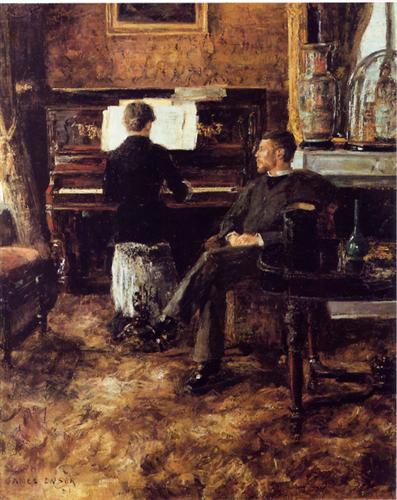
 "Russian Music" - James Ensor

Russian Music (1881)

James Ensor

_______

Alexander Borodin’s ravishing String
Quartet no 2 in D major
, from 1881,
was written only a few years after
Smetana’s 1876 From My Life“, and
sounds surprisingly similar, the same
number of movements all in the same
order, fast, a dance step, polka or
waltz, then slow, then fast

their second movements are notably
united by their common use of long
bowing of paired notes from the
violins, to establish, irresistibly,
the rhythm of their individual dances

their eccentric, even strident notes,
stretching towards atonality but
remaining this side of the divide,
thus surprisingly welcome, even
captivating

the change of tempo right in the
middle of every movement to
separate and sharpen contrast
between the exposition and the
development, then the whole
thing all over again, all quirks
of the evolution of the
nevertheless stalwart string
quartet structure, as unassailable,
it would appear, as that of the,
also inveterate, sonnet

I could go on

the difference is in the intention,
the appropriation of the Viennese
model to express more culturally
expanded varietals of the original
mode, in these two cases, Czech
and Russian, it’s all in each their
homegrown cadence

and that’s how music speaks if
you lend an ear

think of the European Pinot Noir,
for instance, taking root in other,
foreign soil not being necessarily
any longer inferior, sometimes
even superior, downright even
celebrated, you’ll get, essentially,
the big picture

Alexander Borodin’s ravishing
String Quartet no 2 in D major,
note, is such a prize, an utterly
intoxicating wine you wouldn’t
want to eschew, miss

Gesundheit

Richard


String Quartet no 1, “From My Life” – Bedřich Smetana‏

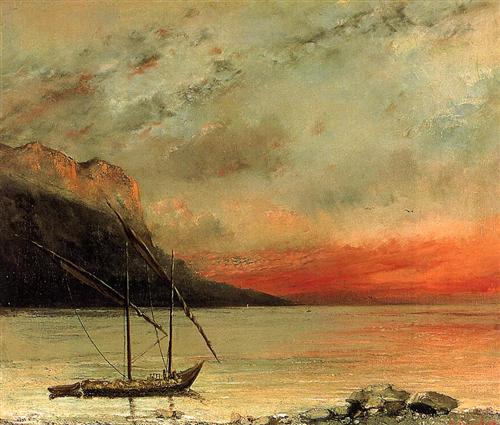
"Coucher de soleil sur le lac Léman" - Gustave Courbet

Coucher de soleil sur le lac Léman (1874)

Gustave Courbet

_________

paying attention to tenuti is not as
easy as all that, you’ll have found
probably that the music’s kept on
going and you’re not so sure if
what just went by indeed was a
tenuto, so brief, however stressed,
might’ve been the impression

rubati are easier, it’s hard to miss
them when they come round, for
being spread out through the
musical passage as a
consequence of being at the very
least three notes, usually
considerably more

tenuti happen on one note only,
one fleet fish in an ebullient river
rather than a more noticeable and
synchronous school

interestingly, not many of either,
rubati, tenuti, show up in music
history until the late Romantic
Era, the mid- to late 1800s, they’d
been only theoretically, and here
and there, part of the musical
vocabulary for having had no
purchase in music written for the
harpsichord, an instrument that
had allowed only minimal
resonance, though it laid the
foundations for composition,
and therefore dictated taste
into the very mid-nineteenth
century, a whole hundred years
after the invention of the piano,
by having entrenched the ideal
of strict tempo, the reflection,
note, of an ideal, and belief
then in a scientifically cogent
world

that was the Enlightenment

Romanticism came along to
express the ineffable reality of
the truths of the human heart,
in contrast to merely reason –
“Le coeur a ses raisons que la
raison ne connaît point”,
says
Pascal, “The heart has its own
logic which allows it to
understand what the rational
mind cannot”,
though he in a
somewhat other, much more
theological, context

but the shoe snugly fits, so I’ll
wear it, though with the same
consideration I’d render the
shoes, understand, of my
father

you can tell we’ve reached the
late 1800s when you start
hearing tenuti, ritardandi,
atonality, for that matter, and
also obscure and eccentric
repetitions

this pattern is probably more
evidenced in pictorial art,
where precision gives way to
individualized expression,
and the blurred lines of Early
Impressionism, see above

at the same time, the German
grip on the history of Western
music which it had held for a
hundred and fifty years, from
Bach to Brahms, began to loosen,
along with the idea, incidentally,
of a rationally, even irrationally,
conceived world, you can hear
it in the evolution of the tenuti,
the rubati, like canaries sense
altered conditions in a coal
mine

note however that music itself
is as indifferent to bald facts
as mathematics, it merely
describes, doesn’t comment

listen to Bedřich Smetana, a
Czech composer, his String
Quartet no 1, “From My Life”

follows in the footsteps of
the Germans, but with a
distinctively folkloric air,
there’s even a polka

tend the tenuti, relish the
rubati, if you can identify
them, they’re milestones
to the modern

but, more than anything,
enjoy

Richard


what’s happening in Poland

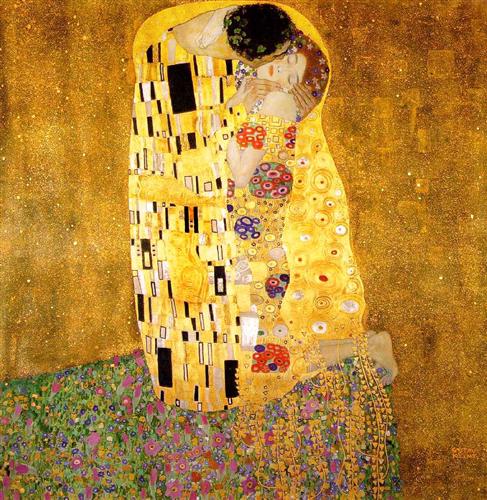
"The Kiss" - Gustav Klimt

The Kiss (1907-08)

Gustav Klimt

_______

last night, most unexpectedly,
someone I know sent me this, I
wondered if it was because of
the music, the message, or the
performance, consequently I
assumed everything

Mateusz Ziółko won the Voice
of Poland
contest in 2013, it’s
fun, despite the language
barrier – the adjudication being
all in Polish – to watch also,
during the evaluation, the judge
in blue fall apart, come entirely
undone, be unabashedly smitten,
from nearly the very first note of
this riveting audition, then spend
the rest of the show trying to get
herself back together again

much as I did, in fact, without
a camera

quiver too, enjoy

Richard


September, 2015‏

 "A September Day" - George Henry

A September Day (1935)

George Henry

_______

September is a melancholy month, it
suggests fall in all of its connotations,
the array of burning colours lighting
up the leaves, purple, amber, magenta,
the steady decline into winter, of the
year and, by metaphorical extension,
of the years we have to come

it’s a month for philosophy, I think,
and introspection, therefore,
incidentally, I am

listen

Richard

“Let’s Face the Music and Dance”‏

"Hot Jazz" - Frank Kline

Hot Jazz (1940)

Frank Kline

_______

having watched a superb interpretation
of this classic Nat King Cole number on
“So You Think You Can Dance” recently,
a show I havent missed since it started,
I went looking for a performance of the
song I could sink my teeth into, and
Fred and Ginger, however wonderful,
could not give me the immediacy I was
intent on discovering, I needed words,
not action, “Let’s Face the Music and
Dance”
from the heart

though I’d heard of Diana Krall, I hadn’t
anywhere yet identified her, if ever I’d
even heard her

she took my breath away, knocked my
socks off, I want to go to Rio, where
she sang this song, just click

once I’d heard this piece on free Internet
video, I ran, didn’t just walk, albeit on the
comfort of my own sofa, to iTunes and
bought the whole show for what turned
out to be essentially a song, $4.99
Canadian, wow

turned out I could’ve got it for free as
well right there by running instead to
Google, had I not been so impetuous,
smitten

Live in Rio is a revelation, and I don’t
even like jazz, but I liked this show
enough to make me want to fly to Rio,
make my own Bossa Nova, maybe even
meet my own Ipaneman

though Diana Krall, incidentally lives
right here in Vancouver, she says

note, in passing, the connections to
Classical music, you’ll want to count
tenuti, for instance, and rubati,
accelerandi
and rallentandi, while
you’re at it

note also the Classical imperatives,
tonality, tempo, and repetition, which,
you’ll find, haven’t much changed in
the 21st Century, though rhythm is a
lot more fluid, flexible, now, not so
rigid

the group is a variation on the string
quartet, now comprising double bass,
guitar, percussion, and piano, with
voice thrown in

an orchestral back up makes us ready
for a concerto, where here we have a
set of independent pieces held
together, however solidly, by mere
mood

and, of course, Diana Krall’s vocal
and interpretive magic

listen, be smitten

Richard