Richibi’s Weblog

Just another WordPress.com weblog

Category: up my idiosyncrasies

up my idiosyncrasies – Albertine‏

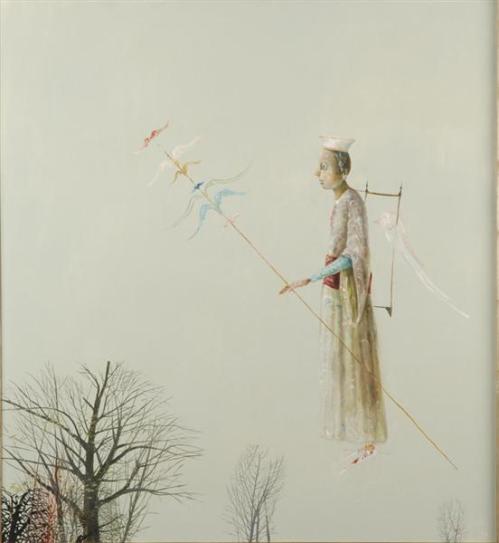
wing-seller-2006.jpg!Large

            Wing Seller (2006)

               Stefan Caltia


                        _______ 

 
what are you doing, a friend of mine
asked when he called 
 
I’m reading my Proust, I answered,
comfy enough with my textafter 
years waking up side by side, to 
use the possessive adjective 
 
what’s going on, he inquired
 
Albertine is lying on his bed, 
recounted, asleep, she’s been there 
for the past ten pages, and she’s 
just now turned onto her stomach
 
 
there is not so much story as 
paintings, in Proustdetailed 
descriptions applied like strokes of 
colour to a canvas, that of recovered 
time, colours that are specific to a 
place and a period, like photographs 
showing in their very fabric their 
ancestry, their lineage
 
but in the elucidation of what he 
sees, or, more accurately, of what
he remembers, Proust delivers 
a work of the very highest art, a 
mixture of poetry and philosophy,
Beethoven did as much, see his
 
 
Proust’s French is essentially 
immaculate, his tone, however 
intimate, always erudite, aristocratic, 
perspicacious, wise, penetrating,
embracing, which is to say, French,
though German can be also
incidentally, pretty cerebral, English 
is narrative, just the facts, please, 
though often, I think, hilarious
 
 
Albertine had been one of the “young
girls in bloom” he’d met at Balbec, a 
seaside resort, with whom he’d 
undertaken an illicit affair, but 
whose faithfulness he doubted
 
as she lay on his bed at his Paris
apartmenthe replays all the 
speculations his imagination could 
provide, an endless set of variations
on his anguish, which is to say, his
jealousy, worthy of a very Othello
 
for ten pages he paints a picture of 
infidelities completely of his making,
which, of course, becomes the world 
he will respond to
 
it is all in our little heads, I surmise, 
however informed, intelligent, that 
we create our little realities, they 
have never been nearly enough, 
though, indeed, our lives depend 
on themhowever dutifully
considered, however unconsciously,
and ever convincingly, contrived   
 
make them, I submit, good ones
  
I imagine myself a poet, for instance,
how’s that for a shot in the improbable 
dark
 
 
Richard
up my idiosyncrasies – Marcel Proust‏

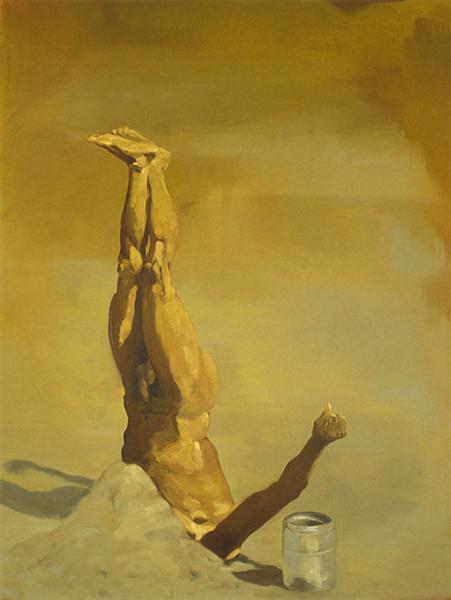
holy-man.jpg!Large

    “Holy Man (1989)
 
       Eric Fischl
 
          ______
 
 
Marcel Proust is not an easy read, 
of literature it is surely its Everest,
not an easy climb, but from its peak
the world takes on an entirely other
order
 
an English-speaking friend has 
suggested he might try to read it 
again, but not in French this time,
I countered that that way he’d miss
the many crevices and crags, the
slippery slopes and lethal ledges, 
that give shape to the mountain, 
which the French grammar would
apply in all its intricate 
manifestations
 
part of the pleasure in reading 
Proust is the poetry, where style 
and substance coexist to create 
magic, and inspiration  
 
the sentences are long, they wind 
on for often pages, you need to be 
able to tell the subject from the verb
despite sometimes extended
intervening distances
 
but the grammar is sound throughout, 
except for in a couple of isolated
instances, grammar that would test
even a Frenchman
 
indeed Proust is where, I profess, I 
truly learned to speak French
 
there’s another mountain
 
 
the conceit is that someone rings 
the bell at their Combray cottage,
and after 3300 pages someone 
rings at the same door again
 
in between the years have passed,
they are the fruit of Proust’s 
“recherche”, search, investigation,
quest, a term that can’t be fully 
expressed as such in English, 
which doesn’t express the 
confluence of cold science and 
candle-lit spirituality expressed 
in the French word
 
in dissecting the very entrails of a 
flower, a tea cup, a crumpet, an eye, 
a brow, a lip, a gesture, a frown, a 
smile, a gait, Proust describes his 
own world, concocts it, minutely, 
meticulously, until you realize this 
can be only his perception, that 
therefore all of our interpretations 
are but our individual perceptions, 
our myriad unique worlds
 
from which one can begin to 
shape one’s own
 
later with Wittgenstein, the 
philosopher, this became known 
as phenomenology, the idea that 
we are confined for knowledge to 
our private views of the world,
wherein language plays, manifestly, 
a crucial part
 
in the beginning, if you’ll remember, 
was the word
 
curiously, in French, it is the verb, in
the beginning, implicitly suggesting 
a word of action 
 
 
Proust had been prescient as Freud
uncovering an inner world we’d always 
believed was outside us
 
at the top of his priorities Proust
chose art, personal expression,
it’s all that we can return to the 
world
 
and what else could be our purpose
 
 
Richard
 
psst: bonne lecture, Kurt

up my idiosyncrasies – a bio

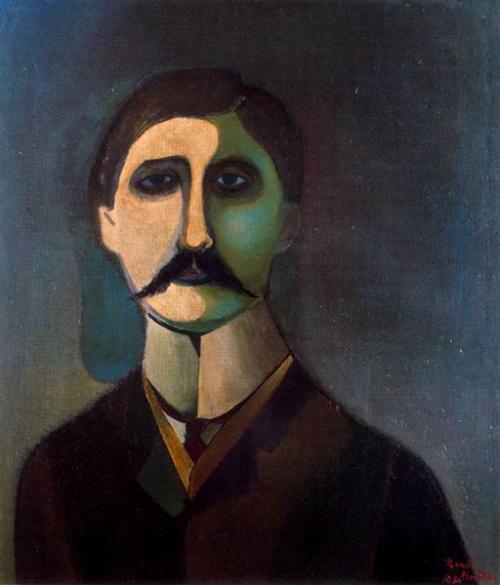
marcel-proust.jpg!Large

      “Marcel Proust” 
 
       Richard Lindner
 
          ___________
 
 
for a bio with which I’ve been asked 
to provide an online poetry magazine 
I’ve been encouraged to apply to, I’m 
submitting the following text
 
I thought you might enjoy it
 
 
Richard
 
           ______________
 
 
my name is Richard Bisson, from
which you’ll intuit my French 
Canadian background, though I 
write mostly in English, with no 
trouble however in French, my 
mother tongue is le français  
 
I am thus imbued, undoubtedly,
with that sensibility, my peers 
have been HugoFlaubert, and
most of all Marcel Proust, whom 
I imbibed for 33 years, in French,
page by page, reading each out 
loud as though it were my own, I 
cannot but be replicating now his 
rhythms, his aesthetic, his view 
of the world
 
it didn’t take me as long to read 
Homer, in the thunderous Robert  
Fitzgerald translation, – a mighty
roar resounding still from the 
ninth century before the Christian 
Era – from him I learned to speak 
from the heart, it’s not one’s style  
one has to master, but one’s 
humanity
 
Robert Browning gave me the 
dramatic monologue as a poetic
device, a gift he’d received from
 
Shakespeare himself, of course,
the unbridled freedom of his own 
literary imagination
 
Carl Sandburg‘s Chicago taught 
me to talk about every wo/man, 
about things even my own folks 
were doing
 
Collapsed showed me that even 
apparently inconsequential acts
can be poetry, poetry in the 
apparently humdrum 
 
Mary Oliver is a strong present 
influence
 
the cadence is entirely Beethoven,
with some help, I must admit, from 
the atonalists, SchoenbergBerg,
and Weberncommas are my bar 
lines
 
 
I call what I do prosetry, a word so 
new my computer won’t even let 
me write it, I’m a prosetrist, this 
word either
 
I want to link everyday experience 
with poetry, make poetry in the eye 
of the beholder, where truth and 
beauty lie
 
if people can see what I see, they 
can see that way themselves, it’s 
something one learns, and it’s all 
in the way one entrenches words 
and ideas
 
I eliminated the word “if” from my 
vocabulary once, for being then
too speculative, it changed my life, 
I’ve replaced it since with the word 
“miracle”, that has also changed 
my life
 
I am 67 years old
 
I live in Vancouver, Canada
 
I consider myself to be, at this 
point in my life, bibliosexual, I
sleep with my books, and we’re
all still getting along just fine 
 
may you be so blessed
 
 
Richard
 
psst: also Anaïs Nin, for the 
          intimacy of her diaries
 
          o, and Woody Allen, for
          giving up before his  
          nihilism and just 
          laughing

“Syrinx” – Claude Debussy‏

big

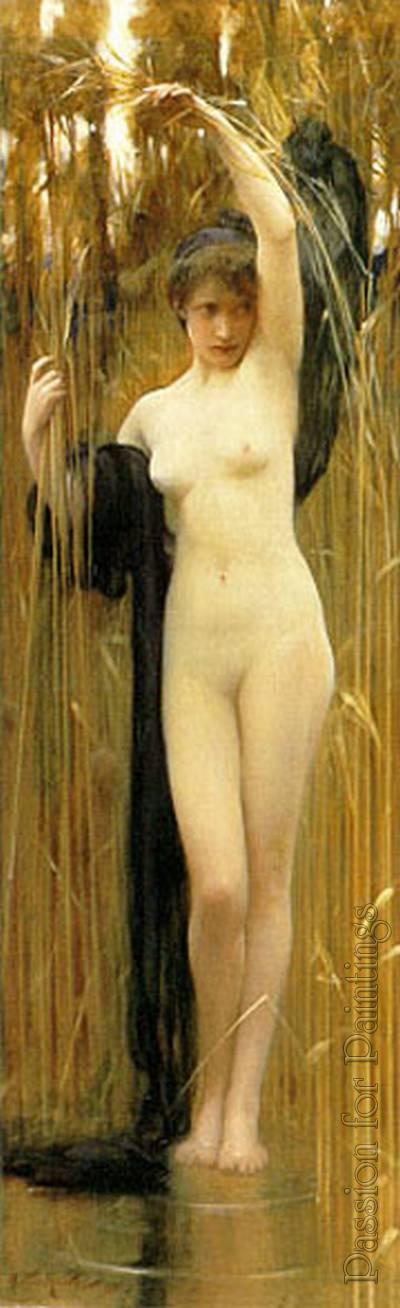
         Syrinx (1892)
 
          Arthur Hacker
 
            __________
 
 
though Debussy would’ve called his
Syrinx “Flûte de Pan”, “Pan Flute”,
alas, the name had already been 
taken, he therefore came up with the 
much more inspired Syrinx
 
Syrinx, with the help of other nymphs, 
who’d come at her cry for help as she 
fled the god Pan, a pursuer, had been 
turned into a bush of reeds, its canes 
producing a song so sweet as to 
confound and disarm him, impelling
him to create of them that sublime 
instrument  
 
Hermes had been telling Argus, Argus 
Panoptes, the giant with the hundred 
eyes, the story about the pipes he  
was playing, an implement received 
from Jove, apparently, god of all the 
gods, who wanted him to kill Argus, 
for confining Io, who’d been turned 
into a heifer by Juno, Jove’s wife, 
who’d caught him chasing her, Io’s 
plaintive lows had been getting to 
Juno as Io fretted unfettered through 
the fields too close to Olympus 
 
when Hermes’ music finally closed the
giant’s last two eyes, he beheaded him,
but Juno, in merciful recognition of his
service, however ultimately ineffectual, 
set them into the variegated tail of the 
peacock
 
are you kidding me, I always think when
I read Ovid’s “Metamorphoses”, and am
ever nevertheless entirely enchanted
 
a flute solo had not been composed in
over 150 years when Debussy composed
his Syrinx“, 1913, after C.P.E. Bach’s not  
at all unimpressive Sonata in A Minor 
of 1747, it duly set off a new life for the 
long overlooked flute, a reed which 
Mozart famously didn’t like
 
note the tonal, rhythmic, and repetition 
shifts from the rigid Classical model, 
where these are much more strict, 
Impressionism was not only breaking 
down pictures, the pictorial arts, but its
sound world as well, it was an utterly
new era, new sensibility, new zeitgeist, 
and you can feel it, though you might
not be quite able to immediately 
verbalize it, the arts were again, as
they ever ‘ve been, the canary in the 
gold mine
 
 
Richard
 
psst:
 
   The Transformation of Syrinx into Reeds 
 
Then Hermes thus: A nymph of late there was 
Whose heav’nly form her fellows did surpass. 
The pride and joy of fair Arcadia’s plains, 
Belov’d by deities, ador’d by swains: 
Syrinx her name, by Sylvans oft pursu’d, 
As oft she did the lustful Gods delude: 
The rural, and the woodland Pow’rs disdain’d; 
With Cynthia hunted, and her rites maintain’d: 
Like Phoebe clad, even Phoebe’s self she seems, 
So tall, so streight, such well-proportion’d limbs: 
The nicest eye did no distinction know, 
But that the goddess bore a golden bow: 
Distinguish’d thus, the sight she cheated too. 
Descending from Lycaeus, Pan admires 
The matchless nymph, and burns with new desires. 
A crown of pine upon his head he wore; 
And thus began her pity to implore. 
 
Now while the lustful God, with speedy pace, 
Just thought to strain her in a strict embrace, 
He fill’d his arms with reeds, new rising on the place. 
And while he sighs, his ill success to find, 
The tender canes were shaken by the wind; 
And breath’d a mournful air, unheard before; 
That much surprizing Pan, yet pleas’d him more. 
Admiring this new musick, Thou, he said, 
Who canst not be the partner of my bed, 
At least shall be the confort of my mind: 
And often, often to my lips be joyn’d. 
He form’d the reeds, proportion’d as they are, 
Unequal in their length, and wax’d with care, 
They still retain the name of his ungrateful fair.
 
                                                  Ovid