Richibi’s Weblog

Just another WordPress.com weblog

Category: up my idiosyncrasies

the judgment of richibi
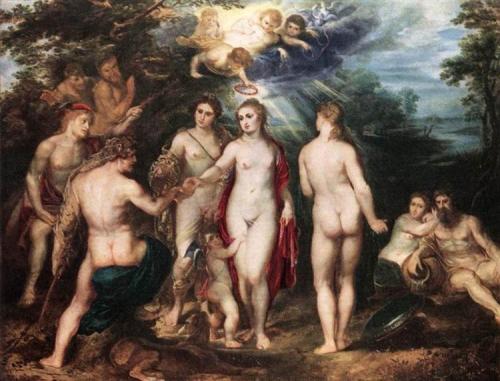
the-judgment-of-paris-1.jpg!Large.jpg

        “The Judgment Of Paris (1625) 

                         Peter Paul Rubens

                                       ___________

at the end of a long overdue visit to 
friend’s home the other night, she 
asked me, did you notice their facial
skin, which of us do you think had 
the best complexion, you can be 
honest, she insisted

we had intended to watch the finals
of a voice competition we’d both 
been following, over a glass of 
wine, or two, each, when a friend 
called, from, essentially, the door,
with a second friend in tow on their
way to a concert in the city

the friend of the friend, a lovely,
effervescent woman, from Poland
originally, with a story to tell of
growing up behind the Iron 
Curtain, was also a beautician in 
spa she runs in a nearby resort
city

the first friend, equally effervescent, 
had been telling my own friend of the 
intervening events since last they’d  
met, while I lapped up, more or less  
by default, this other alternate Soviet 
reality, perfumed as it was irresistibly 
throughout with the friend’s  
friend’s mellifluous Polish accent

I hadn’t paid any attention whatsoever
to skin quality apart from accepting  
a spa courtesy card for my mother, who 
would, naturally, be interested 

my dearest dear, I answered, I am  
not going anywhere near that one
look what happened to Paris when
he fell into that trap

what happened, she asked

the Trojan War, I answered  

the Trojan War, she asked

Paris was the son of Priam and Hecuba
king and queen of Troy, explained, he, 
one of its princes, he’d been awarded 
Helenwife of Menelausking of Sparta, 
by Aphroditegoddess of lovehe’d 
chosen Aphrodite to be the most 
beautiful among the goddesses, that 
was her prize

but let me step back a little, I  
interrupted, you need more context

Eris, goddess of discord, had not been 
invited to the marriage of Peleus and 
Thetis, I recounted, he a Greek hero, 
she a sea nymph, parents both later to 
Achilleshero at Troy, slain, incidentally, 
by that very Paris, you can read all about 
it in the Iliad“, I highly recommended

during the festivities, Eris tosses a 
golden apple among the assembled 
divinities, which reads

            “to the fairest” 
 
you can hear the stirrings of the much 
later Sleeping Beautyincidentally, in 
this earliest of tellings, reconfigured 
from the original myth

AthenaAphrodite and Hera, all assume
they are meant to receive the apple, and 
ask Zeus, father and husband, to decide

you’ll have to get someone else to touch 
that one, he replies, much as I did

and delegates the task, with the help 
of Hermes, the messenger god, to the
the guileless Paris, son of Priam and 
Hecuba, Trojan king and queen, as I 
said, he, Parisprince

Paris was tending sheep on Mount Ida
when, fatefully, by a spring, the nubile 
goddesses appeared vaunting their 
unadorned splendours, stark, flagrant, 
manifest, to the musical accompaniment 
of the Graces, Faith, Hope and Charity, 
also the Horae, the Hoursgoddesses 
of the seasons, maidens all in complicit  
attendance

Paris, mere mortal, would never have 
stood a chance 

but to sweeten, nevertheless, the 
deal, were it not yet sufficiently sweet, 
Hera promises Paris Europe and Asia 
should he choose her, Athena
conquest in war, Aphroditegoddess 
of love, was set to give him the most
beautiful woman in the world

Paris opts for Aphrodite, and is 
awarded Helenthe face that
launched the thousand proverbial 
ships, the wife, not incidentally,  
and completely inconveniently, of 
the King of Sparta, Menelauswho 
attacks thereupon Troy with his 
brother, Agamemnon, and their 
allied legions, to reclaim 
Menelaus’, whether abducted, or 
indeed unfaithful, wife, no one 
has ever conclusively determined
Paris having been Paris

no one won 

no one survived but Odysseus
but that’s another story

I walked home shortly afterwards, 
crossed my own Aegean, ten or
eleven blocks back, red lights, 
nighttime traffic, watched the voice 
competition I’d taped in any case at 
homewhooped it up along with my
favourite contestants, drank to my
narrow miss, had gotten away, I
considered, with the equivalent of 
Europe and Asia, if only in my 
mind

beauty might be in the eye of the 
beholder, I surmised, but it can 
have its thorny indeed 
consequences

Richard
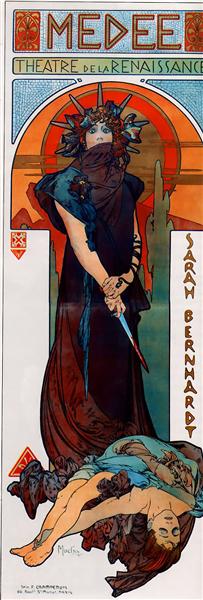
“Medea” – Euripides

medea-1898-jpglarge

       Medea (1898) 

       Alphonse Mucha

          ____________

catching up on my Greek tragedies 
for a course I’m following online, I
happened upon this marvel

Medea, by Euripides, was written 
in 431 BCE, the next significant 
playwright in world history was
Shakespeare, the Dark Ages had
been “Dark” indeed, it took a 
Renaissance, in fact a new 
flowering of Greek and Roman
arts and institutions to get us 
moving forward again, you’ll 
notice how much of Euripides 
there is in Shakespearenot to 
mention in the French Classicists, 
Racine and Corneille

none of these, incidentally, have 
yet been equalled, never mind 
surpassed, except by maybe 
Anton Checkov, the superb 
Russian playwright

Zoe Caldwell won the 1982 Tony 
Award for best actress for her
incarnation of Medea, she was 
up against Katharine Hepburn 
and Geraldine Pageno less, 
among other distinguished 
luminaries, this is, in other 
words, no ordinary performance, 
watch her turn a mere script, 
however incandescent, into 
set of spoken arias worthy of 
the most celebrated divas

everyone else in the play is also
strong, excellent, impeccable

note the application of the three 
unities, of time, place, and action,
there is no set change, everything 
takes place within 24 hours,
according to the dictates of the 
very plot, the action surrounds 
the expulsion from Corinth of 
Medea and her two, and Jason’s, 
sons, the restrictions of the form 
put the tension, the drama, utterly 
in the hands of the poet, the 
success of the work depends not
on stunts, special effects, but on
words, poetry

Aristotle says in his Poetics“, 
section I, part VI, “The Spectacle has, indeed, an
emotional attraction of its own, but, of all the parts,
it is the least artistic, and connected least with the
art of poetry. … Besides, the production of
spectacular effects depends more on the art
of the stage machinist than on that of the poet.”  

the three unities have no room,
therefore, for Spectacle“, their 
product must be reflections of 
the poet’s humanity, heart, 
straight through, if s/he can, 
to ours

Richard

what is poetry

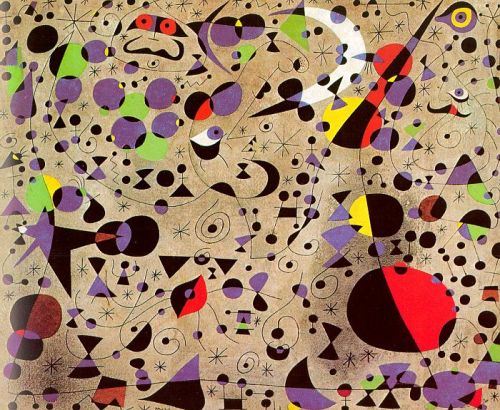
the-poetess

     “The Poetess (1940)

           Joan Miró

                 _____

when Aristotle proceeds to declare the 
parameters of “Poetry” for the ages“, his
definitions of the various poetic 
manner[s] or mode[s] of imitation” 
have already been established, his 
categorizations are not unlike Darwin’s 
categorizations of the species during
a much later age, Aristotle was a natural 
scientist much more than he was our 
notion of an abstract philosopher, he 
traded in facts rather than in the 
esoteric musings that Platofor 
instance, pursued, Virtue, Justice, 
the Good, his conclusions were more 
verifiable

Kant, incidentally, is also famous for 
following a similar form of investigation
as he attempted, nearly, for most, 
inscrutably, to categorize the elements 
of our faculty of understanding

a side story

Kant had stated that at birth we already 
have within our perceptual framework 
implicit understanding of space and 
time, these are not learned through 
experience but are already 
incorporated within us, he said

many years ago, coming out of a 
week-long coma, not knowing where
I was but alone, at that point even
just my consciousness, cause my 
body, were it there, would’ve been 
under the immaculate white sheets 
I could see that would’ve been 
shielding my legs

I looked around, could gather motes 
upon rays of light that were entering 
from what appeared to be a window 
on the right, behind sheer white 
curtains stirred by a soft breeze,  
whirling the shimmering particles 
alive in the light before me like 
miniature spinning galaxies moving 
at the pace of their own infinity

there was no sound

white walls around me stood utterly
still in the purview of my perception,
a door, also white, stood opposite 
me on the opposite wall

where am I, I wondered, could this 
be heaven, an afterlife, I might’ve 
died, I thought, marvelling, no fear, 
regret, nothing other than curiosity, 
absorption, fascination

I tried to answer my question, where 
am I, two dimensions, I figured
after having watched Terence Stamp 
exiled by Marlon Brando to a flat 
intergalactic window pane in 
Superman“, I hadn’t excluded this 
eventualityhowever ingloriously 
transcendental, as a possible 
outcome, I might be in a world with 
only two dimensions, height and 
width, no depth yet without more 
investigation, experience 

ergo, Kant, I concluded, was wrong, 
our knowledge of space is not inborn 
but a product of time and thought like 
everything else 

later, the white door on the far wall
opened, and a nurse walked in, also, 
incidentally, in incandescent white,  
and understood I was alive

Aristotle suggested that our original 
double instincts towards poetry were 
our propensity to imitate, children 
imitating their parents’ even 
idiosyncratic mannerisms, for
instance

and rhythm, repetition, preludes to 
order, coherence

those two

poetry, I read, is expression
reflecting the heartbeat, essentially,
in all its myriad representations

Richard  

“To One Who Loved Not Poetry” – Sappho

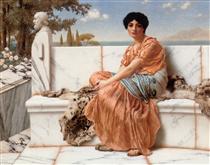
in-the-days-of-sappho-1904-jpgpinterestsmall

  “In The Days Of Sappho (1904) 

        John William Godward

                    _________

if I digressed towards “Tragedy” in my
most recent chat about poetry, I perhaps
blurred the fact that there were several 
kinds of poetry Aristotle was speaking   
about, but that all had the essential 
elements of both rhythm and 
representation, the idea that a poem 
was a reproduction of something 
that was not itself, a retelling

some of these rhythmic utterances 
were tragedies“, others were mere,  
indeed, verses without much of an 
agenda other than being the replication 
of something with rhythm the poet
wanted to promote

o, what a beautiful morning, two dactyls
and a trochee, for instance, the poetic 
meters that describe – ta da da, ta da da, 
dah dah – the natural music of that 
exclamation

and that can be a poem

here’s one of Sappho‘s, who lived 
sometime between 630 and 612 BCE
to around 570 of the same, of course,
era, famous for being from the island  
of Lesbos, yes, Lesbos 

it is To One Who Loved Not Poetry

    Thou liest dead, and there will be no memory left behind
     Of thee or thine in all the earth, for never didst thou bind
     The roses of Pierian streams upon thy brow; thy doom
     Is now to flit with unknown ghosts in cold and nameless gloom.”

so there, she says, I think, and all in iambic 
octameter, eight times ta dah

I preferred not to use one of her more
flirtatious, therefore controversial,
utterances, for fear of skewing to  
another, however compelling,
discussion

maybe next time

Richard

psst: the Pierian Spring was a spring in 
          Macedonia sacred to the Muses,
          the source of inspiration for 
          science, then, as well as the arts

what is a poet

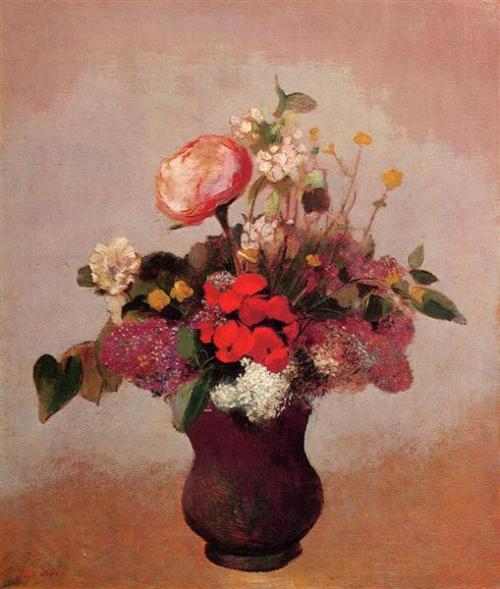
flowers-in-aa-brown-vase.jpg!Large.jpg

                            Flowers In a Brown Vase (1904)

                                            Odilon Redon

                                                 _______

if I imagine myself to be a poetwhat 
is a poet, I have to ask, or, more 
accurately, what do I imagine a poet 
to be

cause this is a two-way street, I am
defined by the word I inhabit, but I 
define the word as well, redefining 
it, essentially, to fit my etymological 
purpose   

my moral purpose I leave to myself,
in a completely other ideological
dimension

if I can

a poet then is one who writes, paints,
composes, manifests, in a word, 
creates, poems

what is a poem

a poem is where beauty and truth 
combine to create harmony, 
coalescence, to the point of one’s
admiration, enchantment, wonder, 
enlightenment, in incremental steps 
leading to very transcendence, the 
feeling that something has moved 
in your heart

just a bouquet of flowers will do it,
for instance

that’s what I think

Richard

on truth

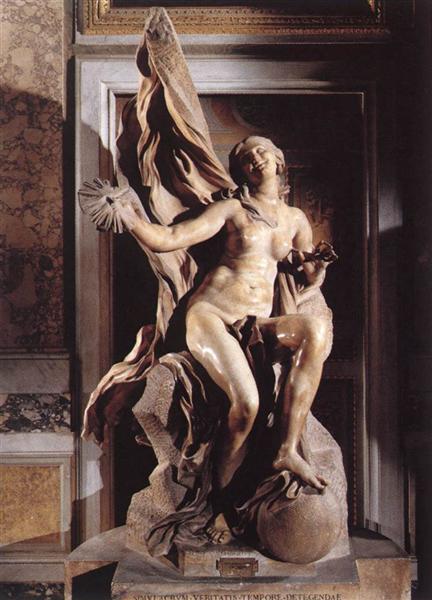
truth-unveiled-by-time3-jpglarge

               “Truth Unveiled By Time (1645-1652)

                               Gian Lorenzo Bernini

                                           _______

a cousin once said to me about 
his father, that he was as honest 
as the day is long

though I didn’t say a word, this 
was emphatically not my opinion

but I concluded nevertheless that, 
once again, truth is in the eye of 
the beholder, not, of course, truth 
truth, the one we all would like to 
believe must exist, but the one 
which is the only one that we can 
work with, our own 

but what is true

no one knows but for personal 
intimations, truth must be, in other 
words, our individual constructions, 
a kind of existential prosetry,  
consistent story we tell ourselves, 
a walking shadowa tale / told by 
an idiotaccording to Macbethfull 
of sound and fury, / signifying 
nothing 

I imagine I am a poet

imagine 

Richard

psst: prosetry is poetry written in prose,
          see “up my idiosyncracies – a bio

“The Man I Love” – George and Ira Gershwin

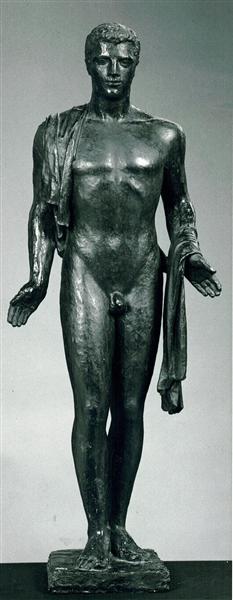
apollon-1937-jpglarge

             Apollon” (1937) 

             Charles Despiau

                    _______

when my heart is broken, I learn the 
words to torch songs, and wallow in 
my misery until the poignancy of the
poetry seduces me and I revel in its 
caress

for a while now I’ve been yodelling 
along with Hank Williams, who, 
incidentally, sings in my key, though 
the accurate reach of his far-flung 
notes can be tricky

but today, I inadvertently slipped into 
this Sophie Tucker classic enough to 
change my tune

watch this wonderful rendition of 
The Man I Love in a version you’ll 
never forget for both its originality
and its great humanity

Richard

” Shakespeare and Politics”- Professor Paul Cantor

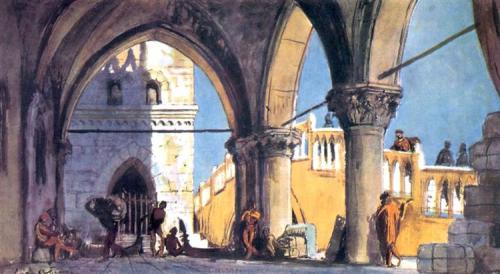
on-the-waterfront-set-design-for-shakespeare-s-drama-the-merchant-of-venice(1).jpg!Large.jpg

 On The Waterfront. Set Design For Shakespeare’s Drama

   “The Merchant Of Venice” (1920)


      Alexandre Benois


                 ________


though this recommendation might seem 

erudite, esoteric, indeed eccentric, if not

even improbable, I vaunt this invaluable 

series to the stars, Professor Paul Cantor

of the University of Virginia, speaking from 

Harvard, however, here, shines such 

glorious light on the already extraordinary 

Shakespeare so as to make him the equal 

of very  Beethoven, poets of nearly 

supernatural ability 


Professor Paul Cantor views Shakespeare 

through Shakespeare’s understanding of  

politics, comparing his political settings – 

commercial Venice, imperial Rome, 

medieval and Renaissance England, 

Denmark under a Christian king – to not 

only shed light on those individual 

political systems alive at a time when 

democracy was being born, but as well 

on Shakespeare’s own unexpectedly 

probing philosophical insights in the 

matter of governance, right up there 

with John Locke and Machiavelli


who’d ‘o thunk it 


the professor is engaging throughout, his  

information entirely absorbing, you’ll come 

out a new wo/man


the lectures are not short at an hour, twenty
minutes, I break to powder my nose, get a
a glass of wine, even answer the phone to,
of course, preferred only parties, but have 
been returning addictively daily 

 it’s a heady indeed addiction


Richard   

to Socrates – on monotheism‏

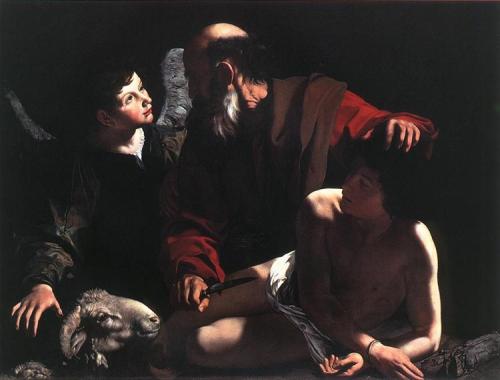
sacrifice-of-isaac(1).jpg!Large

      “The Sacrifice of Isaac (1598)

                        Caravaggio

                               ________

by very definition, the inevitable
result of monotheism, Socrates,  
is war, if there is one authority it  
will eventually be opposed by a 
contrary, however picayune, 
however trivial, opinion, see the 
Protestant Reformationsee Islam, 
for instance, now
 
after which there is disintegration
 
before Christianity, there were gods, 
a pantheon of them symbolically
alive among the rivers, the trees, 
the mountains, read Ovid for an
exhilarating description, wars were 
waged for territory, not conscience  
 
Judaism, the religion of the Jews,
evolved for their own existence a
deity, Yahweh, who was their one 
god, disdainful of foreign others,
an uncharacteristic attitude among 
other religions then, becoming one 
of the very first monotheistic, and
consequently existentially 
compromised faiths, if not the 
first
 
the intent was to rally ideological 
support among its adherents so 
that they could protect the lands 
of Israel and Judahtheir ancestral 
homesas they would have it, a 
sanctification of the territorial 
principle
 
their Bible, the Torah, a vengeful 
work, and the basis for the 
Christian Old Testament, 
demanded of its followers 
unblinking and cruel allegiance,
the sacrifice of Isaacfor instance,
a father required to sacrifice his 
own son, however might it ‘ve
been at the last minute averted by 
the intercession of an angel sent 
by that very Lord
 
Christ came along to turn the other
cheek
 
which didn’t last long 
 
indeed Montesquieu, an early 
philosopher of the French
Enlightenment, tells of the 
King’s librarian of Chinese 
texts, who had been converted 
to Catholicism in China, but 
who was nonplussed upon his 
arrival in Christian France to find 
that the French did not do onto 
others as they would have them 
do unto themselves, nor did they, 
more catastrophically, turn the  
other cheek
 
for that matter see what Christian 
Europe did to the Americans
 
Christ’s own followers, once they’d 
achieved political prominence, after, 
admittedly, 300 years of persecution 
by the prevailing Roman authorities, 
set their own deity, God, on high, 
indeed beyond the rivers, the 
mountains, the trees into the very 
ineffable, the inscrutable abstract, 
and squelched any opposition for  
the next thousand and some years,
the philosophical underpinnings of 
which was the work of your 
contemporary, Plato, Socrates, his 
ideal of the Ideal
 
Augustine signed those recalibrated 
papers with his City of God“, it took 
the Renaissance to make a dent in its 
armour, and another several centuries 
to declare the Christian God dead, 
Time magazine in the ’60s, on the 
heels of Nietzsche‘s nihilistic  
pronouncement some 70 years earlier, 
that God had exited history
 
what we are left with, Socrates, is every 
wo/man for hirself, therefore the Age of 
Human Rights, for better or for worse
otherwise many of us would’ve been 
guillotined, burnt at the stake, stoned 
to death, by now
 
what do you think
 
I’ll bet I can tell, you think that every 
wo/man owes allegiance to what s/he 
believes in, even to inexorable death, 
however impractical, unfortunate, or 
fateful, if your exemplary life has  
anything to say about it 
 
 
cheers
 
Richard

up my idiosyncrasies – Plato‏

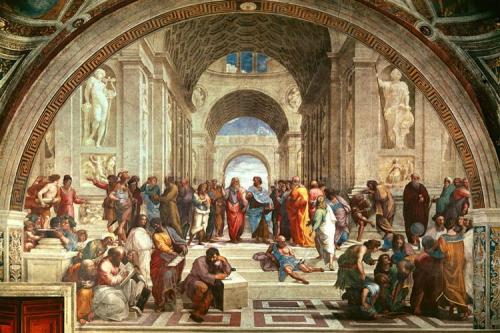
school-of-athens-detail-from-right-hand-side-showing-diogenes-on-the-steps-and-euclid-1511.jpg!Large

      “The School Of Athens (1510-1511)
 
                   Raphael
 
                       _____
 
 
he sounds just like you, my friend said,
who’d bought me the works of Plato
for C***mas maybe, or my birthday, or 
maybe just because he knew I’d very
much appreciate them
 
we were reading him together, as is 
always my inclination, his Meno 
according to my calculations, 
Socrates was doing most of the 
talking, with Meno, a Sophist 
acolyte, a school of philosophy then, 
the Sophists, which claimed it could 
prove anything by using the right 
arguments 
 
lawyers, of course, ensued, politicians
 
and rhetoric, the art of proving anything 
by using the right arguments 
 
philosophy had reached a structural,
indeed an existential, impasse, why, 
they therefore wondered, philosophy
 
wherein it entered a phase of moral 
speculation, StoicismEpicureanism,
ScepticismCynicism, and can you 
blame them, theories about the 
stars, the moon, the world, even 
matter itself, had become so 
questionable, was it fire, air, water, 
atoms, at its source, who knew
 
 
I thought so too, I said, and told 
him that Plato’s were the first   
texts studied in philosophy when 
entered university, that’s where I 
learned to talk like that, philosophy 
from the scratch, as my German 
teacher would’ve said, which is to 
say, from its very beginnings, 
whence I could view, I figured, the 
evolution of received wisdom in 
Western culture
 
I was young then, the young have 
such dreams 
 
 
my father had been agnostic, ever
asking questions, though we were 
being raised Catholic, my sister 
and I, on account of our mother 
tongue, our entire community, 
having been historically linked 
with that religion, and cause my 
parents wanted us to be educated 
in French
 
an existentialist crisis would
eventually follow, I intuited, as
indeed it did, so I majored in 
philosophy
 
 
Socrates taught me to ask 
questions, that no one had  
all the answers
 
Plato, usurping his master’s voice, 
created the paradigm for our present 
version of a Divinity, and Its Paradise
 
there is an ideal version of any 
item we might consider, he spouted,
an ideal table, for instance, exists
of which every material table is an
imperfect example
 
to virtue, love, beauty, truth, he 
applied the same principle, which
early erudite Catholics, Augustine
Thomas Aquinas, for instance, and
others, despite rejecting all of the 
other Greek cultural achievements
appropriated in order to bolster their 
impression of God, the ideal of the 
Ideal
 
this lasted uncontested for just
over a thousand years
 
for a thousand years our salvation
had been extraterrestrial, 
supranatural, this, our very, 
perhaps only, existence, an 
imperfect reflection of somewhere
else an ideal, a mere simulacrum,  
we were, a metaphor
 
Socrates had only asked questions,
what is virtue, what is justice, what
is beauty, truth
 
Plato presumed to have known the 
answers
 
 
Aristotle is making a comeback,
whose method, in opposition to 
his contemporaneous forebear,  
was much more like Charles 
Darwin‘s, working from the facts, 
which proved then, and are 
proving still now, to be multifarious, 
diverse, astonishing, and nearly 
enough to make you believe in 
God/dess again, this time, however, 
through the back door 
 
or in a multiplicity, a panoply, a 
very pavilion, even, of natural 
deities, otherwise known as 
angels, for better or for worse
 
God/dess bless, or angels
 
 
Richard