septet / schleptet – Beethoven / Schikele
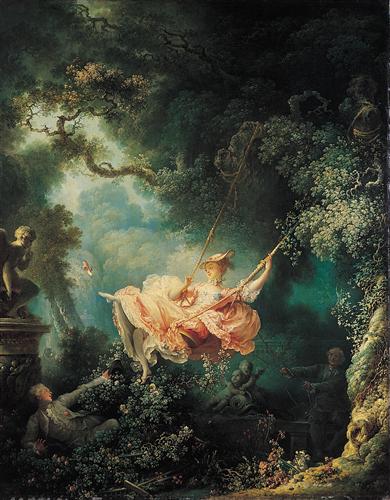
“The Swing“ (“Les hasards heureux de l’escarpolette“) 1767
_____
though I’ve spent the last forty years
exploring Beethoven, I still haven’t
heard, much less seen performed
all of his music, unexpected gems
pop up still to prick up even my
weathered ears
but a septet this time, who’d ‘a’
thunk it
the opus 20, not unexpectedly, sounds
like Mozart, formal, musically inventive,
but not prompted by Beethoven’s later
transcendental passions, it was 1800,
he was still showing off his Classical
shoes, spinning andante cantabiles
out of minuets, for no less than Maria
Theresa in this instance, the Empress,
its august dedicatee, not yet having
profoundly outgrown them, the tiara,
the shoes, though you’ll find
expressions of his surpassing majesty
already throughout this masterpiece
six movements, for instance, uppity,
impudent, bold, an impertinence
towards imperial time and its
exigencies, unless it’s worth it, of
course, even in the case of my own
more relaxed schedule
but a precursor to his seven-part
C# minor String Quartet, opus 131,
for its breadth, for its ambition, for
the prefiguring of a monument, a
cultural institution, for its
proclamation of the advent of a
veritable sonic Parthenon
you’ll note a peculiarity, he uses
in the Septet‘s third movement
the same air that served him well
in his 20th piano sonata, opus 49,
no 2, second movement – why not,
it’s his – an earlier composition
despite the later opus number
don’t ask
opus 49, no 2 has only two
movements, incidentally, like his
earlier opus 5, no 1, or his later
incandescent no 111, to shed light
on the chronology of his musical
evolution, his eventual historical
apotheosis
find the movement with variations
in the Septet, your body will tell
you, much like it does slow tempi
from fast ones, you merely listen
with your senses, not just your
ears, your unconsciousness, while,
distractedly, you’re, say, washing
dishes, you’ll say, hey, I’ve just
heard this before, but different,
only this minute
hence the term variation
compare this Schleptet in Eb major,
from Peter Schikele for fun, from
the year 2000, a spoof on Beethoven’s
Septet in the identical key the
better to roast him, but in five
movements this one, in the Classical
style, but where the mood is neither
Classical, nor even Romantic, it’s
ironic, satirical, wry, even cynical,
note the slapstick tempo markings
I. Molto Larghissimo – Allegro Boffo
II. Menuetto con brio ma senza Trio
III. Adagio Saccharino
IV. Yehudi Menuetto
V. Presto Hey Nonny Nonnio
the voice, for better or worse, of our
time
Richard
 Richibi's Weblog