Richibi’s Weblog

Just another WordPress.com weblog

Category: recitals to ponder

the late sonatas of Beethoven‏

"Music" - Gustav Klimt

Music (1895)

Gustav Klimt

______

the last three sonatas of Beethoven have
always seemed to me a progression, the
first two being sketches for the third,
however accomplished these earlier ones
might’ve individually nevertheless been

they are not often heard chronologically,
pianists will usually play the full 32 in a
more representative order, some early,
some middle, some late Beethoven, as
they do, not unreasonably, in even less
comprehensive performances

but it’s instructive to hear them played
in a row

let me point out that the Hammerklavier“,
the piano sonata right before them, opus
106
, had already pronounced, with the
authority of the very Ten Commandments,
the purview of the piano, and by extension
the possibilities inherent in Western music,
or any music, for that matter, yet there was
more to come from this prophet, this
Nietzschean superman

the last sonata, the 32nd, the opus 111, is
his testament, a work of the utmost majesty,
humanity, and reflection, not only a
masterpiece but a prayer, a transcendence,
a musical rendition of the resurrection

this is what I heard one recent Sunday
night at a recital in the city

here are the three by, however, another
pianist, for the performer I saw wasn’t
available on the Internet, but these are
equally, if not even more, effective,
though the player, a youth still, is a boy
putting on a man’s shoes, audibly, they
are not, however, save for that karmic
insufficiency, a bad at all fit, bad is
never so inspiring

note the short, fast, explosive second
movements in both the 109 and 110,
prefiguring the first movement of 111

note how the last movement of the last
sonata
, instead of merely rendering
what had been considered beautiful
music, as in 109 and 110, breaks
through into a quite other dimension,
an irresistible level spirituality, a
transcendental elevation, an ascension,
a sublime trajectory for the secular age
which ‘d follow

there still hasn’t been heard anything
quite as profound

Richard
Beethoven Cello Sonata no 1, opus 5, no 1‏

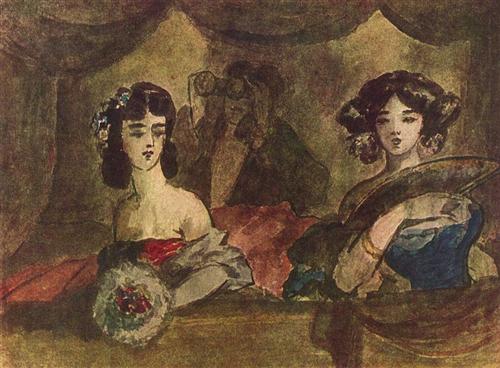
"La loge de l'opéra"-  Constantin Guys

La loge de l’opéra

Constantin Guys

__________

through the good graces of a friend
of mine, a musicologist, who writes
the programmes for the chamber
music presentations put on by our
city’s recital society, pithy, pungent
pieces to prepare the patrons for
their palpitating performances, I had
the not only unfettered privilege but
also the undiluted glee, yes, glee, of
seeing, hearing, two internationally
acclaimed artists deliver works for
piano and cello of Beethoven, one
of them one of my very favourite
compositions, the opus 5, no 1

unable to find anything by these two
of anything of Beethoven’s, I struck
upon, instead, these two others,
titans in their field, the very two who
defined for me this exuberant sonata
in the eighties, wherein Beethoven
was finding, to my mind, his chops,
nothing before this, of his nevertheless
extraordinary output, had inspired me,
the early piano sonatas still sound to
my ear didactic, like someone putting
together academic theory, where here
Beethoven lets his spirit fly, let’s the
music running through him deliver,
carry unimpeded the fire, the charge
is electric

eccentricities abound, there are only
two movements, the first sports two
tempi, an introductory, hesitant,
segment giving way to the second
unfettered one, the contrast a move
in the direction of drama, I think,
highlighting context, narrative, an
aesthetic inspired, I’m sure, by
opera, and its combative
peregrinations

Beethoven wrote one opera, not at all
the equal of his other productions,
words were to get in the way of his
instrumental, it appears, music, his
more direct, ultimately,
communication

though you’ll not want to miss, from
Fidelio“, his Mir ist so wunderbar,
a vocal quartet of the very highest
order

mir ist, you’ll say, so wunderbar,
indeed

Richard

psst: click everything, there are wonders
beneath the above links

Beethoven Cello Sonata no 3, opus 69 – Gould/Rose‏

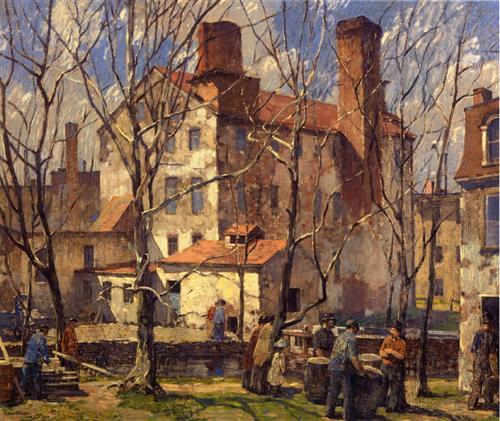
 "A Day in March" - Robert Spencer

A Day in March(1918)

Robert Spencer

_________

hot upon having seen a tremendous recital
by two internationally renowned interpreters
of the cello sonatas of Beethoven, neither
could I find their own renditions on the
Internet but their individual performances
only of works by other composers, some
astounding, others not, nor performances
by other artists of the same works I could
wholeheartedly recommend, even the big
ones, sometimes they have an off night

but with Beethoven, Glenn Gould never
lets you down, he is, quite simply, ever
transcendent, watch his Cello Sonata
no 3 of Beethoven, opus 69
, with cellist
Leonard Rose, up as well to so august
a challenge, be unequivocally
transported, don’t not watch, just click,
wow

Richard

“La voix”‏

Quebec, Canada’s distinctly French
province, produces disproportionately
for its size extraordinary talents

La voix“, it’s version of “The Voice”,
vaunts proudly and confidently
performances of the very highest
calibre

worth noting, as showings that could
make your day, listen to Karine and
Mathieu
rival Willie Nelson‘s original
version of the wonderful “You Were
Always on My Mind”

or watch what Annabelle and Lili-Ann
do to the indomitable Tina Turner‘s
“River Deep, Mountain High”

you tell me who’s hot

Sundays on TVA

Richard

walking in beauty – January 9, 2015‏

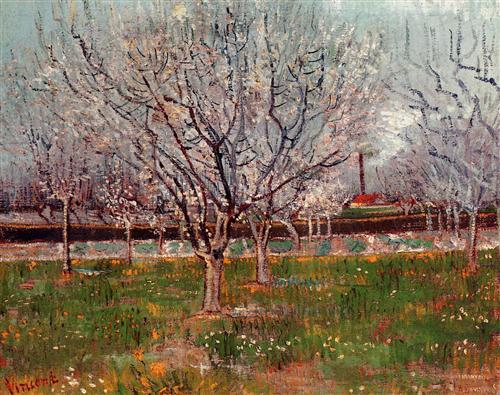
Vincent van Gogh - "Orchard in Blossom (Plum Trees)"

Orchard in Blossom (Plum Trees) (1888)

Vincent van Gogh

__________

walking in beauty must be a conscious
thing, you don’t wake up doing it in the
morning unless you train yourself to

for the past few days I’ve incorporated
the prayer, am intending to learn it
through, not just its kernel, however
itself highly inspirational

In beauty I walk.
With beauty before me I walk.
With beauty behind me I walk.
With beauty around me I walk
With beauty above me I walk.
With beauty below me I walk
In beauty all is made whole.
In beauty all is restored.
In my youth I am aware of it, and
In old age I shall walk quietly the beautiful trail.
In beauty it is begun.
In beauty it is ended.

during the past several days the weather
has been grey, bleak, uninviting, there
was beauty only in the candles I lit, the
pyjamas I never took off, and, truth be
told, the chicken I broiled with soya
sauce, lemon juice and honey, with
baby carrots to dip, and carrot cake to
top it all off, with lots of icing

nor do I ever run out of wine

what’s not beautiful about that, I needed
to conclude after all those days moping,
feeling sorry for myself

I said the same to a friend today over
lunch, at presently the best restaurant
in Vancouver
, there she sat poised,
dripping in grace, a tailored olive
jacket, an ochre pendant with a light
brown scarf wrapped loosely around
her neck, stretched towards me with
just the right amount of both discretion
and attention, presenting her Mona Lisa
smile
, as she’d herself called it

she had crossed her defunct great love
inadvertently somewhere, his jaw had
dropped, she had smiled that mysterious
smile, she told me, and slipped beyond
his ken

should I go to Australia, she asked,
where her nephew’s daughter is
getting married, it’s hot, it’s humid,
it’s a long trip, I could die on the
way

every time I go downtown, I think I
might not make it, I retorted, but I do,
and I don’t

when was the last time you saw your
nephew, I asked

four or five years ago, she replied

you love him, he loves you, he would
be so honoured, I said, and if you die
on the way he’ll still be honoured,
they all will

this is how you walk in beauty, I said,
you latch onto the poem as it passes,
they’re fleeting, be they ever so many,
we let them go by, they would’ve been
our memories, instead of our default
position, where you could die anyway

today I left home, I said, saw my first
cherry blossoms of the season, midst
the gnarled van Gogh branches of the
other trees lining both sides of the
street, emerald moss growing already
along their trunks

a woman selling wares mouthing the
words to Billy Holiday’s “God Bless
the Child”
so that I thought she’d
been the one singing

beside her someone selling wooden
marionettes he was dangling, grinning,
trying to look enchanting in his Charlie
Chaplin clothes, looking more like
Ebenezer Scrooge, a wolf in sheep’s
clothing

but a cover of You, You’re Driving
Me Crazy
I sent Apollo, my Sun God,
for ukulele, megaphone, and of course
voice, inspired me more than anything
else today, I continued, turned my
frustration into poetry, how not to
mope, he’s been gone since before
C***mas, much too long

beauty is in the eye of the beholder, in
beauty all is made whole

to walking in beauty, we toasted

Richard

“Vingt regards sur l’enfant Jésus” – Olivier Messiaen‏

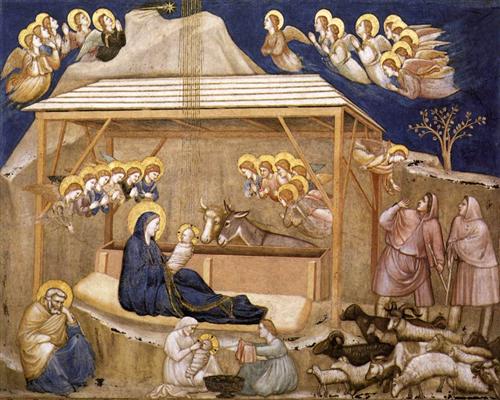
Giotto - "Nativity" (1311-1320)

Nativity (c. 1311)

Giotto

____

just in time for C***mas, a sublime
piece on the Nativity of Christ as
profound, dare I say, as any High,
or even Midnight, Mass

Olivier Messiaen, one of, to my mind,
the greatest composers of the XXth
Century, was also a devout Catholic,
the organist at the Église de la Sainte
-Trinité
in Paris, his music is imbued
with Catholic sentiment, the idea of
holiness

he seems to me a reincarnation, nearly,
of the great organist at the Augustinian
monastery of Sankt Florian
in Upper
Austria, Anton Bruckner, no other
composers, after Bach, have been so
inspired specifically by their religious
faith

Bruckner builds cathedrals with his
music, notably out of his eleven
symphonies

Messiaen, a century later, performs,
instead, sacraments, attends to the
intricacies of their consecrations

Vingt regards sur l’Enfant Jésus is
a succession of twenty perspectives
upon the child Jesus, linked by their
intention rather than by a common
musical theme, as would be the case
in a set of variations, the only other
form that would contain so many
movements

it is atonal, arhythmic, and does not
present the evident repetitions that
Classically would have given the
music a sense of structure, it seems
to me to be trying rather to describe
the iridescence of starlight, the
majesty of the enveloping night,
the gathering, and worshipful
confederation, of the host angels

Richard

psst:

the 20 movements –

1. Regard du Père (“Contemplation of the Father”)
2. Regard de l’étoile (“Contemplation of the star”)
3. L’échange (“The exchange”)
4. Regard de la Vierge (“Contemplation of the Virgin”)
5. Regard du Fils sur le Fils (“Contemplation of the Son upon the Son”)
6. Par Lui tout a été fait (“Through Him everything was made”)
7. Regard de la Croix (“Contemplation of the Cross”)
8. Regard des hauteurs (“Contemplation of the heights”)
9. Regard du temps (“Contemplation of time”)
10. Regard de l’Esprit de joie (“Contemplation of the joyful Spirit”)
11. Première communion de la Vierge (“The Virgin’s first communion”)
12. La parole toute-puissante (“The all-powerful word”)
13. Noël (“Christmas”)
14. Regard des Anges (“Contemplation of the Angels”)
15. Le baiser de l’Enfant-Jésus (“The kiss of the Infant Jesus”)
16. Regard des prophètes, des bergers et des Mages (“Contemplation of the prophets, the shepherds and the Magi”)
17. Regard du silence (“Contemplation of silence”)
18. Regard de l’Onction terrible (“Contemplation of the awesome Anointing”)
19. Je dors, mais mon cœur veille (“I sleep, but my heart keeps watch”)
20. Regard de l’Église d’amour (“Contemplation of the Church of love”)

“Le Jazz Hot” – Henry Mancini‏

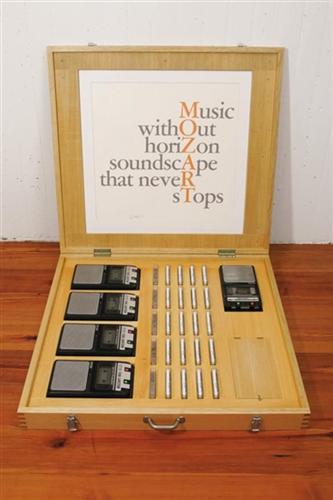
  John Cage - "Mozart Mix" (1991)

Mozart Mix (1991)

John Cage

_______

in a movie,“Victor Victoria”, that should’ve
gotten more Oscars than it finally did,
Le Jazz Hot sizzles, Henry Mancini
received one for the music, Lesley Anne
Warren should’ve too for her incandescent
moll

lock the door, she says to Julie Andrews,
in an otherwise compromising moment,
a line one should never forget

in Julie Andrews’ category, who could’ve
taken it away from Meryl Streep for
“Sophie’s Choice”

but jazz here is a misnomer, jazz merely
dolls up in this number an otherwise
entirely Classical structure, the melody
is right out of Mozart, rigid rhythm,
unflinching tonality, and repetition after
repetition, you can sing along just as you
can for Mozart, try doing that with anyone
after him, try to hum along with real jazz

but I’ll entirely agree that this
whatever-it-is is hot, steaming

catch the astounding vocal glissando
at the very end, just before the final
whispered recitative, riveting

Richard

Vox Balaenae (Voice of the Whale) – George Crumb‏

whales

whales

____

we say that birds sing, despite the
fact that it is their ordinary language,
whales, upon our hearing them, seem
also to be singing

when we sing we alter our voices to
fit pitches and volume and rhythms
intentionally, otherwise we’re talking

what, then, is music, is bird song
music, whale song, is Vox Balaenae“,
a composition by George Crumb, from
1971

if so, what do we mean by music, which
used to be, a long time ago it appears
now, melodic, recurrent and rhythmic

in Vox Balaenae“, where is the music
we used to think of as music, though
harmonious it has the elements rather
of language, communication, instead
of the ordered outlay of composition

it is, however, indeed Classically laid,
with movements and everything, even
a set of variations, though interestingly
attended on either side, these, by, as it
were, book ends, a prologue and an
epilogue, literary terms, to reinforce
the idea of narration, there are three
movements

Prologue: Vocalise (…for the beginning of time)

Variations on Sea-Time [Sea Theme]
Archeozoic
Proterozoic
Paleozoic
Mesozoic
Cenozoic

Epilogue: Sea-Nocturne (…for the end of time)

a blue light in the performance suggests
a marine environment, masks dehumanize,
render everything “[a]rcheozoic”, extended
technique, unusual use of the instruments,
are instructions stated in the score

for a while I’ve been saying that prose is
just bad poetry, for a while I’ve been trying
to make poetry out of prose

how are we doing

Richard

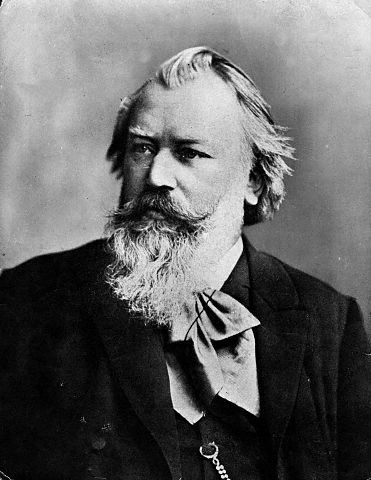
Horn Trio in E-flat Major, opus 40 – Johannes Brahms

Johannes Brahms

Johannes Brahms

__________

if I’ve been away from my perhaps too
abundant, Cornucopian indeed sometimes,
post of late, not as ubiquitous in your
hotmail, it’s because I’ve been following
not six but six and half courses at
Coursera, which have taken up a
considerable amount of my time, all of
them fruitful except for that half, which
apart from some smoke still from its
lingering ashes in the form of belated
comments on what were personally
pertinent fora, forums, I’ve committed to
the cellar of wasted money, despite its
being free, time itself being, according
to my father, hard currency

The Fiction of Relationship
Introduction to Philosophy
Revolutionary Ideas: An Introduction to Legal and Political Philosophy
Søren Kierkegaard – Subjectivity, Irony and the Crisis of Modernity
From the Repertoire: Western Music History through Performance
Philosophy and the Sciences

the half will remain unnamed for its
being, to my mind, inferior, not worth
not only recommending but even
mentioning, or, worth not only not
recommending but neither mentioning,
take your pick

but from “From the Repertoire” we were
offered this week to investigate Brahms’
Horn Trio in E-flat Major, opus 40
, entirely
worth looking into, I thought I’d pass it
along

it was composed in commemoration of
Brahms’ mother who’d died not much
earlier, a cello could replace the horn,
stipulated Brahms, even a viola for
fear of later horns being too brassy,
incommensurate with the intent of the
dedication however passionate some
of its musical argumentation, much
more abstract than that of Beethoven,
you’ll note, though still nevertheless
ever melodic

he has as well a more heraldic tone,
consequently, by extension
earthbound, rather than Beethoven’s
more transcendental ruminations
,
both remaining equal, however, ever,
in, in each his realm, their grandeur

Richard