Richibi’s Weblog

Just another WordPress.com weblog

Category: recitals to ponder

Symphony no 14, opus 135 – Dmitri Shostakovich
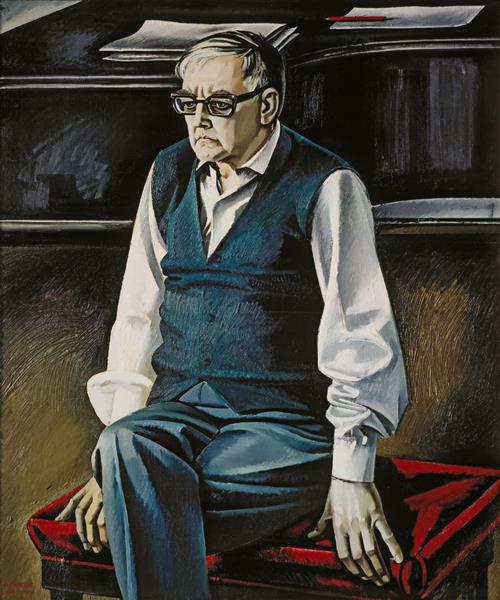
portrait-of-shostakovich-1976-2.jpg!Large

      “Portrait of Shostakovich (1976)

            Tahir Salahov

                   _______

though I’d feared undertaking Shostakovich’s
14th Symphony – it would be a set of eleven
movements, each setting its own poem to
music, poems by Federico García Lorca,
Guillaume Apollinaire, Rainer Maria Rilke,
and one Wilhelm Küchelbecher, translated 
from their respective languages into Russian,
compounded by once again the fact that this
wasn’t either a symphony, but strictly speaking
a song cycle – I found the 14th Symphony to be,
counterintuitively, a triumph, all the issues I’d
earlier listed as compositional misadventures 
– the play of voice and instruments, the dangers 
of using a single singer, one pitch, to anchor an 
orchestral work – had been dealt with expertly, 
all the obbligatos, even, were back, I couldn’t 
wait to hear it again

Schubert had done several song cycles, 
Die Schöne Müllerin“, “Schwanengesang“,
Winterreise“, for instance, sad stories, 
steeped in Romantic torment, not unlike, 
still in 1969, Shostakovich the 14th  

Schubert, though, accompanies with just a 
piano


but a music cycle, without voice this one, 
no poems, just musical ones, of Liszt, his 
Années de pèlerinage“, his Years as a 
Pilgrim, three years, one, two, three,  
1835 through to 1838, travelling through 
Switzerland and Italy, is consummate, 
ethereal, exquisite, and goes on for a  
few utterly enchanting hours 

one New Year’s Eve, I sat before a cozy fire,  
comfortable on my fluffy sofa, cuddled up 
in the several picturesque melodies along 
the musical way, like station stops on a 
train

did the entire trip with him, nearly three 
hours, the music like a sonic looking glass
a hearing glass, a hearing film, not only 
transparent, but transcendental, into  
very wonderland, beyond even its mere 
incidental geography

that’s what art does, and music, when 
you look, listen

enjoy


R ! chard
Shostakovich – intermission

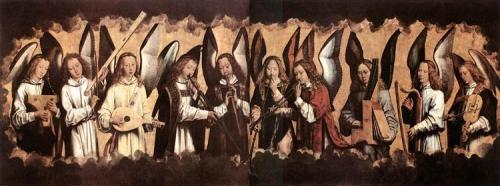
five-angels-playing-musical-instruments-left-hand-panel-from-a-triptych-from-the-church-of-1490.jpg!Large

  Five Angels Playing Musical Instruments (c.1487 – 1490) 

         Hans Memling

            __________

the Quartet for the End of Time by 
Messiaen, which I lauded in my last
transmission, is perhaps a wonderful 
place to take a break, an intermission,
from the central Shostakovich, mighty
and imperial as he is, perhaps even 
overbearing, compared to the more 
introspective meanderings of Messiaen, 
bird calls, philosophical, if more organic 
explorations, a radically different musical 
reaction to the tyrannical tribulations of 
Shostakovich, but not in the least less 
viable, convincing, you can decide 

Beethoven’s 14th String Quartet in
C# minor, here, seems an apposite
musical counterpart also, a model 
for the tortured movements, implicit 
in either other incendiary work

note how the several movements in
either quartet hold together neatly, like
a bespoke suit, made to order, you can 
follow the line of the cut in all of its 
detail, and the suit fits everywhere like, 
well, a glove

there are too many extra, unnecessary 
ruffles, flounces, frills, excess material
to distract from the essential garment 
up until now, to my mind, in Shostakovich, 
one gets lost in the kerfuffle, one drifts
away, all except for his Fifth Symphony

neither do the ebb and flow of the 
movements, from largo to prestissimo 
and throughout the tempo ledger, lead
to distinct, personal, statements from 
the individual parts in Shostakovich
as they do in MessiaenBeethoven
when they slip from one chapter to
the next

Shostakovich seems to return to, rely
on, the same, however magisterial  
technique – the guy ‘s an obvious 
symphonist, an orchestrator of 
instruments of the very highest order
– but with the same melodic matter
variations on a single complaint, too 
often reiterated to maintain rapt 
attention from start to finish, one
wanders 

it might be noted that comparing 
string quartets and symphonies is
like comparing apples and oranges 

but listen to any Beethoven symphony
for an array of unforgettable musical 
airs, dances, dirges, marches, lyrical 
romps through Elysian fields, you’re 
transfixed through to the very end,
always, everywhere


nevertheless there is indeed the 
splendid, and thoroughly 
successful Shostakovich Fifth  

and alone, the first movement of his 
Seventh, which I’m still singing in 
the streets 

to eternally validate Shostakovich as
the greatest composer of the Twentieth
Century, along with Messiaen


R ! chard

Symphony no 7 in C major, opus 60, the “Leningrad”- Dmitri Shostakovich

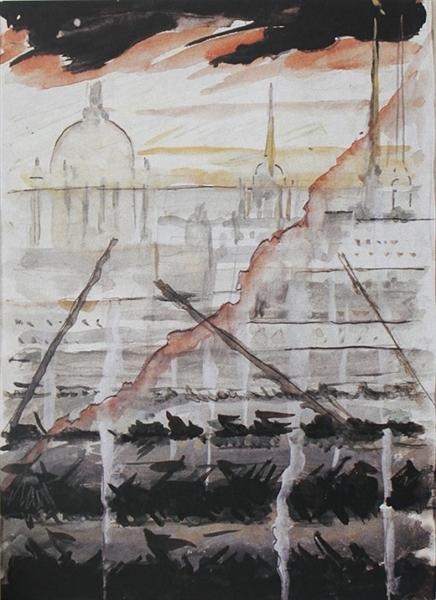
leningrad-in-blockade-sketch-on-the-theme-of-leningrad-symphony-of-d-d-shostakovich-1943.jpg!Large.jpg

Leningrad in blockade. Sketch on the theme of 
         “Leningrad Symphony” of D. D. Shostakovich. 
                                                                (c.1943) 

     Mstislav Dobuzhinsky

             __________

though I’ve been through the Seventh 
three times already, consecutively, it
doesn’t reach, for me, the heights the 
Fifth did, its first movement is
manifestly imperious, nearly even 
overwhelming, certainly unforgettable, 
I’ve been humming the ostinato in my 
sleep

but the following movements seem to 
me – not being Russian, nor having as
intimately incorporated their culture, 
where rhythms and history are 
inextricably intertwined – muddled 
about the reconstruction of its 
shattered world, melodies might be
lovely but are lost in a blur of musical
directions, there isn’t enough repetition 
of musical motifs to find solid ground, 
angry statements follow lyrical adagios
too often to get our bearings on what 
might be going on 

the first movement, however, remains a 
triumph, note the debt owed to Ravel’s 
Bolero in the rousing ostinato, the 
part where the same musical phrase 
obstinately repeats its peremptory and 
ever more vociferous mantra, its 
headlong incantation, an interesting 
blend in either symphonic work of the 
sinuous, the seductive, the beguiling,
turning into the overtly martial, all to 
do with pulse 

the Symphony no 7, the “Leningrad”,
was first presented in that very city 
during its siege by the Germans
which lasted from 1941 to 1944, 
however unbelievably, Shostakovich, 
already giant, was expected to deliver 
masterpiece by both the people and 
by the regime, imagine Bono doing a
concert for Syria 

Shostakovich doesn’t disappoint

players were culled from what remained 
of instrumentalists among the survivors
of both Stalin’s criminal purges and of 
the German siege itself left in the city, 
those who hadn’t survived the famine
there, Valery Gergiev, an exalted 
Russian conductor, describes them as
walking skeletonsmeagre from 
starvation, we’ve seen these before at 
Auschwitz

the world heard, and was moved, 
imperialism in any form was being 
vociferously condemned, going back 
to Napoleon even and his own failed 
invasion, if not also to Hannibal 
crossing the Alps, Caesar, his 
Rubicon

much of this symphony is about cultural 
resistance, the survival of a proud and 
resilient seed, any proud and resilient 
seed, hence its international standing

see Beethoven’s 9th Symphony for 
comparable fanfare, flourish, and 
circumstance, the only other work of
any such historical political importance
and, appreciably, still unsurpassed,

except for, maybe, Roger Waters
channeling Pink Floyd at the Berlin 
Wall, along with, not incidentally
thereagain Beethoven 


R ! chard

psst: the other great composer of the 
          20th Century, Messiaen, also 
          composed a commemoration of
          an awful moment in our history,
          the Holocaust, his Quartet for 
          the End of Time“, played originally
          in his very concentration camp by 
          similarly “walking skeletons”, does   
          for me everything Shostakovich’s 
          Seventh didn’t 


on “Elegy for the Victims of the Tsunami of March 11, 2011 in Japan” – Nobuyuki Tsujii

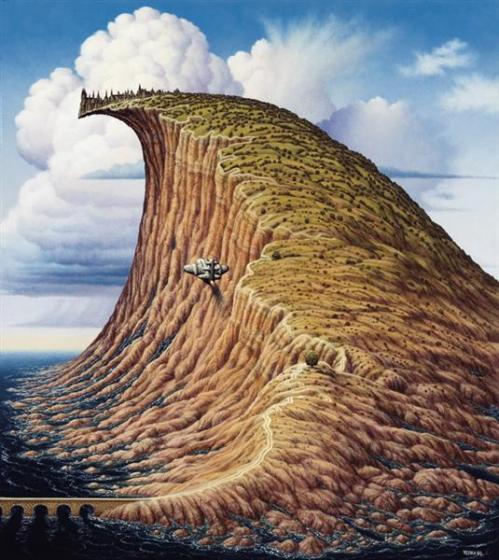
tsunami-1998.jpg!Large

    Tsunami (1998) 

         Jacek Yerka

          __________

while watching Nobuyuki Tsujii play the
extraordinarily demanding Tchaikovsky 
First Piano Concerto on television the 
other night, with no less than Valery
Gergiev, conducting the resident 
orchestra at the Mariinsky Theatre in 
Moscow, for its White NightsI was 
wonderstruck by the challenges a 
visually handicapable pianist would 
have to conquer in order to reach 
such an apogee 

everything must be learned by ear, all
items must be discovered tactually, 
from the piano itself to the very 
individual keys, not to mention 
the player’s very own fingers

there can be no visual contact with a 
conductor, either, for cues, for 
instance, nor for any other 
accompaniment, for neither even an 
audience, it would all take place in 
the dark recesses of the head, the 
amorphous and, I suppose, 
confounding, cerebellum

later he played for an encore his own 
composition, Elegy for the Victims of
the Tsunami of March 11, 2011 in Japan“,
a fine addition to my budding collection 
of threnodies

and a very, very moving piece

an elegy, incidentally, is usually written,
while a threnody is composed, but these 
terms are often used interchangeably, as, 
indeed, they are here

you’ll note the utterly Classical mode of
composition of the Elegy“, it adheres to  
a uniform tonality, a consistent tempo, 
and the grounding and comfort of 
repetition, returning always to the main, 
endearing air, rather than more modern 
tripwires and stridencies, traditionalism 
being not an inappropriate, nor ineffective,
mode of address for honoured forebears 

long live Classicism


R ! chard

on “Song to the Moon” – Antonin Dvořák

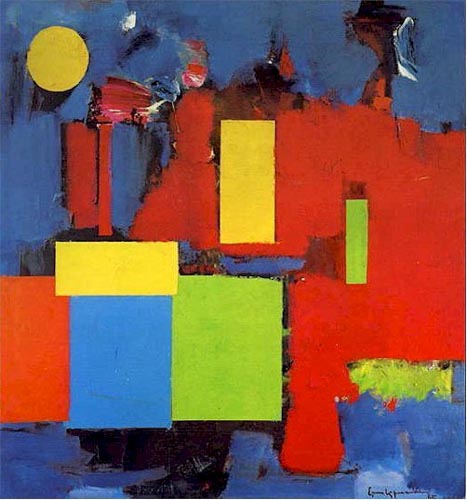
rising-moon-1964

   “Rising Moon (1964)

          Hans Hofmann

              __________

the moon was out last night, grand
upon the starlit evening, either 
waxing or waning, I’m not sure, but
not full, a gibbous moon, above the 
buildings that scrape, in my big city 
neighbourhood, in the very Cubist 
manner, the night sky, see above

I’d been listening to Renée Fleming
singing Dvořák‘s Song to the Moon
in my head since I’d seen her do it, 
on television, in a summer evening 
concert at Schönbrunn, Vienna, some
few days ago, sheit, had been utterly, 
sublimely, enchanting, I’m a Cancer, a
moon child, I speak to the moon

to the moon, I said, moon in the dark
heavens, who steal into every home
and hearth at night, find my beloved
and tell him what is in my heart, rapt 
as I was in the spell of my special
planet, my personal orb, and the 
enveloping Dvořákian magic, though 
there’s been no beloved lately, just 
trailings of the latest one who broke, 
of course, my heart, which gives more 
pathos, however, incidentally, to my 
singing, I’ve giddily gathered

at home, I found Renée Fleming doing 
the piece on the Internet, entirely as 
splendidly, earlier, at London’s Royal
Albert Hall, September, 2010

listen

R ! chard

threnodies: to the victims of Hiroshima, of the Holocaust, and to the Canadian North

The Scream, 1893 - Edvard Munch

       The Scream (1893) 

             Edvard Munch

                    ____________

before we leave too far behind the 
anniversary of the annihilation of
Hiroshima, August 6, 1945, let me 
introduce you to a piece that 
purports to pay it homage

if I didn’t bring it up before, it’s 
because the date was wrong, but
especially because the work 
offends me, the only thing I like
about it is the title, a thing of 
beauty, poetry – Threnody to the
Victims of Hiroshima – a threnody
is a song of lamentation for the 
dead, which worked for me, this 
one, no further than its title

there is nothing remotely 
reminiscent of the tragedy
throughout the piece, it is a 
collection of academic exercises,
pretensions, I think, without a 
heartbeat 

let me compare Steve Reich’s 
threnody to the victims of the 
Holocaust, the other signature 
Twentieth Century atrocity, his 
Different Trains“, a work in three 
movements, America – Before the 
War”, “Europe – During the War”, 
and After the War”, for string 
quartet and tape, upon which 
Reich has recorded interviews 
with people relating impressions 
from before the warduring, and 
after, according to the movements

the quartet, you’ll note, must keep 
time with the tape, and in this 
production visuals have been 
effectively added 

Glenn Gould had done something 
like this several years earlier,
incidentally, in his The Idea of 
North“, a threnody itself to that 
very idea, a masterpiece, a
groundbreaking transcendental
work of the imagination, with 
overlapping voices, which is to 
say human counterpointthough 
without string quartet

you’ll note that distressing tonalities
affect throughout this other, much 
more successful however, tribute
but the different rhythms of the 
recurrent, which is to say minimalist, 
rails keep you emotionally, as it were, 
on track

Different Trains is appropriately,
and profoundly, commemorative, 
not to mention unforgettable 

Richard

“My Romance” – Carly Simon

hot-jazz-1940.jpg!Large

       Hot Jazz (1940) 

               Franz Kline

                        _____

in this video of one of her concerts, 
Carly Simon tells the story of how
when she told her special guest on
the program, Harry Connick Jr., that
he was born the same year as 
Sgt. Pepper, he answered, Sgt. Who

   “Harry, you were born the same year that 
                     Sgt. Pepper came out”, she said
   “Sgt. Who”, he answered

the same had happened to me when  
I’d told someone, a sprite, ten years 
younger, don’t ask, about my 
admiration for Susan Hayward
Richard, he asked, who’s Susan 
Hayward, to my utter consternation

I mean, Susan Hayward

you might not know who Carly Simon
is, nor even Sgt. Pepper, but the story 
is that those who once had been our 
very idols fade and become question 
marks in the eyes of the following 
generations

you might not either know who Harry 
Connick Jr. is, but listen to both of 
them here, Carly and Harry, put 
together an entertainment enough 
to turn an otherwise lazy hour into 
an unmitigated enchantment

Richard

“First Piano Concerto” – Pyotr Ilyich Tchaikovsky

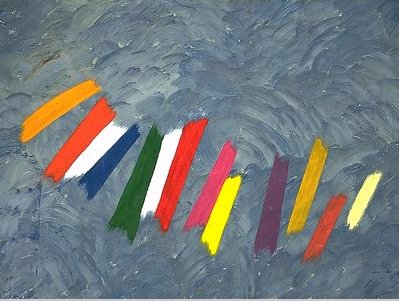
concerto-1975

      “Concerto (1975) 

               Jack Bush

                         _____

if there’s a piece that defines Classical music
for most people, encapsulates it, even for 
those who aren’t especially interested in 
Classical music, that piece would be, I think,
Tchaikovsky‘s First Piano Concerto

strictly speaking Tchaikovsky isn’t a Classical
composer, but a Romantic one, the Classical 
period in music having been transformed 
some years earlier into the Romantic period
by none other than Beethoven1770 – 1827, 
perhaps the most transformative composer 
of all time – Tchaikovsky‘s First Piano Concerto
was written in the winter of 1874 – 1875, pretty
well at the end of the Romantic Period, which 
then ceded to the Impressionists, just to get 
our periods right

what the Romantic Period added to the 
Classical Era was emotion, sentiment – note 
the use of tenuto, for instance, beats being 
drawn out, languidly, longingly, for pathos – 
what it maintained was the structure, the 
trinity of Classical conditions, rhythm, tonality, 
and repetition, which is why even the most 
uninformed listener will usually be able to 
sing along throughout the entire performance
the blueprint is in our collective blood, in the 
DNA of our culture

to remain present a piece must remain 
relevant to the promoter, an interpreter must
have reason to play it, substance surely plays 
a big part, but technical considerations play 
perhaps an even greater role towards a great
work’s longevityChopsticks“, for instance, 
is good but it won’t fill a concert hall  

unless, of course, it’s with Liberace

the “First Piano Concerto” of Tchaikovsky is 
the Everest of compositions, emotionally
complex and technically forbidding, nearly 
impossible, it would seem, were it not for 
those few who’ve mastered its treacherous 
challenges, conquered its nearly indomitable  
spirit

Van Cliburn put it on the map for my 
generation, with a ticker tape parade in 
New York to confirm it

Martha Argerich later on kept the ball rolling

and now Behzod Abduraimov, a mere youth, 
born in 1990 in UzbekistanTashkent, delivers 
by far the best performance I’ve seen since,
giving it new life for the new millenium
 
behold, be moved, be dazzled, be bewitched  

Behzod Abduraimov, watch

Richard

“Octet in F major”, D803 – Franz Schubert

schubert-at-the-piano-ii-jpglarge

     “Schubert At The Piano II (1899) 

              Gustav Klimt

                  _______

there are reasons why an octet, a 
piece for eight performers, would 
be a rare occurrence in our modern
world, the most flagrant being the 
sheer number of players to 
assemble, all with international 
commitments, and all, more 
specifically, working individually, 
or in smaller composites

duos can play any choice of 
instruments, trios as well, but
quartets are usually, which is to 
say traditionally, comprised of 
only strings, first and second 
violins, a viola and a cello, 
these three groupings, duos, 
trios, quartets, are often already 
formed, play or meet together 
regularly

also musical compositions for such 
groupings abound, the canon is 
replete with music written for two, 
three or four instruments

but at five participants, a quintet, 
the combinations are less stable, 
there isn’t enough in the 
repertoire for four strings and 
clarinet, say, to play, so that a
clarinettist must be invited in
for such an occasion, any 
other alternative accompanying 
instrument would be fit in as
incidentally 

with six, of course, and upwards, 
you get egg rolls, anything can 
happen

but at eight, an octet, you need 
friends, people who’ll gather from 
their individual busy schedules to 
perform specifically together out 
of sympathy, much as friends 
would’ve back in the Nineteenth 
Century, before television, when 
the form took shape, to socially 
cut up the rug
 
if indeed it did take shape, cause I 
can think of no other octet, off hand
after Schubert’s glorious one 

Schubert’s Octet, the composition, 
with this particular octet, the group, 
is probably the best you’ll ever hear 
of either ever, Schubert’s D803 in F
major is everything you want 
Schubert to be, and in a generous 
indeed six movements, while
Janine Jansen and her friends, the 
octet performing here, with the 
requisite four strings, plus a horn,  
a bassoon and a clarinet, are 
magisterial, dare I say definitive, 
the standard now to exceed 

octets, incidentally, don’t do 
encores, for obvious reasons

enjoy

Richard

psst: for a comparable congregation 
         of friends, see Roy Orbison’s 
         Black & White Night“, equally
         as improbable, epic

up my idiosyncrasies – Albertine‏

wing-seller-2006.jpg!Large

            Wing Seller (2006)

               Stefan Caltia


                        _______ 

 
what are you doing, a friend of mine
asked when he called 
 
I’m reading my Proust, I answered,
comfy enough with my textafter 
years waking up side by side, to 
use the possessive adjective 
 
what’s going on, he inquired
 
Albertine is lying on his bed, 
recounted, asleep, she’s been there 
for the past ten pages, and she’s 
just now turned onto her stomach
 
 
there is not so much story as 
paintings, in Proustdetailed 
descriptions applied like strokes of 
colour to a canvas, that of recovered 
time, colours that are specific to a 
place and a period, like photographs 
showing in their very fabric their 
ancestry, their lineage
 
but in the elucidation of what he 
sees, or, more accurately, of what
he remembers, Proust delivers 
a work of the very highest art, a 
mixture of poetry and philosophy,
Beethoven did as much, see his
 
 
Proust’s French is essentially 
immaculate, his tone, however 
intimate, always erudite, aristocratic, 
perspicacious, wise, penetrating,
embracing, which is to say, French,
though German can be also
incidentally, pretty cerebral, English 
is narrative, just the facts, please, 
though often, I think, hilarious
 
 
Albertine had been one of the “young
girls in bloom” he’d met at Balbec, a 
seaside resort, with whom he’d 
undertaken an illicit affair, but 
whose faithfulness he doubted
 
as she lay on his bed at his Paris
apartmenthe replays all the 
speculations his imagination could 
provide, an endless set of variations
on his anguish, which is to say, his
jealousy, worthy of a very Othello
 
for ten pages he paints a picture of 
infidelities completely of his making,
which, of course, becomes the world 
he will respond to
 
it is all in our little heads, I surmise, 
however informed, intelligent, that 
we create our little realities, they 
have never been nearly enough, 
though, indeed, our lives depend 
on themhowever dutifully
considered, however unconsciously,
and ever convincingly, contrived   
 
make them, I submit, good ones
  
I imagine myself a poet, for instance,
how’s that for a shot in the improbable 
dark
 
 
Richard