Richibi’s Weblog

Just another WordPress.com weblog

Category: positions to ponder

Études, opus 10 and 25 – Frédéric Chopin
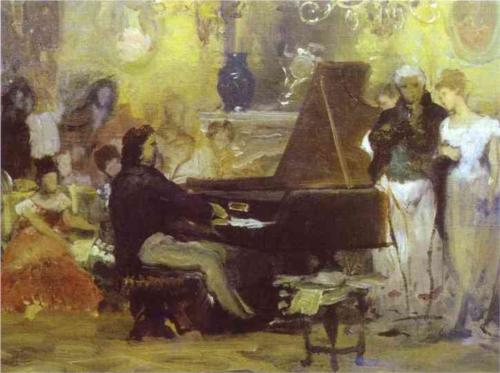
 Henryk Siemiradzki - "Chopin Performing in the Guest Hall- of Anton Radziville in Berlin In 1829" (1887)

Chopin Performing in the Guest Hall- of Anton Radziville in Berlin In 1829” (1887)

Henryk Siemiradzki

__________

no sooner does one inveigh against an
attitude than that attitude turns around
and slaps you in the face, my, however
brief, enrolments at art school, musical
conservatories, and creative writing
classes, were not, I think, without some
merit, some would even say much merit,
despite my short disparagement of them
in my last blog, there are tools for every
art, schools have the machinery to
channel inspiration

Hans Hofman must’ve believed he was
painting a Poème d’amour when he
painted it, why otherwise would he
have painted it, despite myriad
objections, and general
incomprehension, could he have
known that no one would get it, did
he care, who called it art

did Chopin know when he wrote his
first set of “Études”, opus 10, a
theoretical set if there ever was one,
a set of fiendishly challenging
technical exercises, that they would
define the Romantic Period, an era
given over to the very heart, he was
23, having fun

what is art, art is what works, art is a
consensus, sometimes you’ll get it,
sometimes you won’t, sometimes I
get it, sometimes I don’t, art is in the
eye of the beholder, just like beauty
and love

Chopin, the theoretician, produces a
resounding argument for the technical
side of composition, the cerebral, this
is perhaps why they are my favourites
of his compositions

but he hasn’t left out the very centre
of music, how it connects, how it can
carry you along, even to enchantment,
he hasn’t left out the enchantment,
these to me are poems of love

he calls them études, opus 10 and 25

who’d ‘a’ thunk it

enjoy

Richard
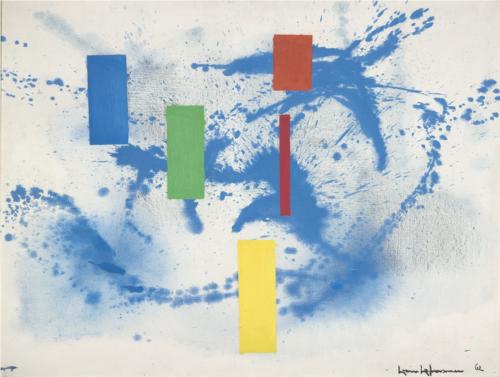
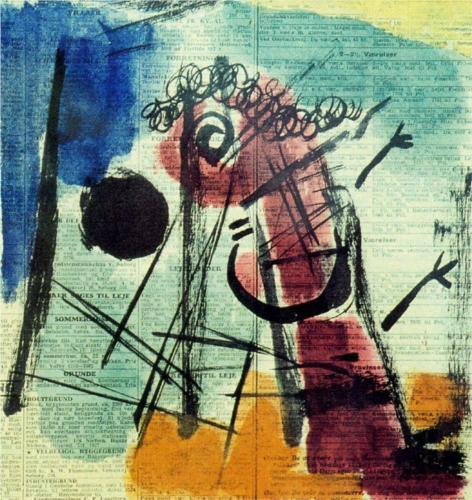
“Poème d’amour” – Hans Hofman‏

Hans Hofman - "Love Poem" (1962)

Poème d’amour (1962)

Hans Hofman

______

this “Love Poem“, Poème d’amour“,
challenges our preconceptions

is this painting a poem, what does it
say about love

you tell me

Richard

“Poem for Piano in C# minor” – Arno Babajanian‏

Corneille - "Music" (1949)

Music (1949)

Corneille

______

in the spirit of unusual juxtapositions,
the very stuff, let me suggest, of art,
here’s a Poem for Piano, in C# minor“,
by Arno Babajanian, an Armenian
composer, 1921 to 1983, played by a
countryman of his, Armen Babakhanian

a Poem for Piano begs the question,
what is a poem, can a poem be devoid
of stanzas and words, can music be a
poem

you tell me

Richard

psst: can music, incidentally, be a painting,
see here, or above

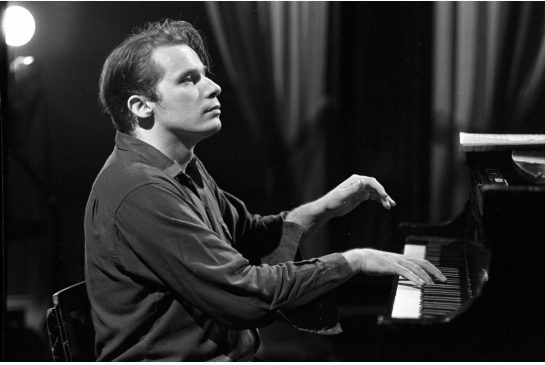
Glenn Gould‏

Glenn Gould

Glenn Gould

_______


if you think I can talk, listen to Glenn
Gould
tell in spades what I’ve only
ever been able to tell in clubs, or,
as we say in French, trèfles, clover,
a piece of music can say more than
just hello, great ones are oracular,
even transcendent

if ever they made a movie of my life
I want Glenn Gould to play me, even
the wonderful Colm Feore, I think,
couldn’t as effectively manage it

Richard

psst: here’s more, incandescent, Bach,
Glenn Gould playing his signature
piece
, just click

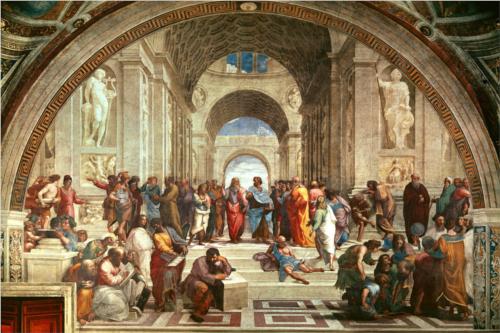
philosophers at play


Raphael - "The School of Athens"

The School of Athens (1510-11)

Raphael

_________

the Philosophers’ World Cup – Germany vs. Greece,
enjoy the live action

the Philosophers’ World Cup – Germany vs. France,
read the debate

existentially yours

Richard

“Chiquitita”, revisited‏

Dear Richard:

The lyrics don’t make sense to me from a Mexican perspective. They do from a Spanish Republican perspective, particularly as they were written by a European from a country which decidedly was on the Republican side in the Spanish Civil War, at a time in recent history when Spanish Republican veterans could finally come out into the open (i.e. after Franco died and a constitutional democracy was established in Spain).

It would be interesting to find out for sure.

_________________

do you think this might help, Jim, just click

Richard

psst: a great read on the consequences
of the Spanish Civil War, by Javier
Cercas
, The Anatomy of a Moment

on rhyme‏


commenting on his choice of idiom
in Paradise Lost, John Milton writes
the following

“The measure is English heroic verse without rime, as that of Homer in
Greek, and of Virgil in Latin—rime being no necessary adjunct or true
ornament of poem or good verse, in longer works especially, but the
invention of a barbarous age, to set off wretched matter and lame metre;
graced indeed since by the use of some famous modern poets, carried away
by custom, but much to their own vexation, hindrance, and constraint to
express many things otherwise, and for the most part worse, than else they
would have expressed them. Not without cause therefore some both Italian
and Spanish poets of prime note have rejected rime both in longer and
shorter works, as have also long since our best English tragedies, as a thing
of itself, to all judicious ears, trivial and of no true musical delight; which
consists only in apt numbers, fit quantity of syllables, and the sense variously
drawn out from one verse into another, not in the jingling sound of like
endings—a fault avoided by the learned ancients both in poetry and all good
oratory. This neglect then of rime so little is to be taken for a defect, though
it may seem so perhaps to vulgar readers, that it rather is to be esteemed an
example set, the first in English, of ancient liberty recovered to heroic poem
from the troublesome and modern bondage of riming.”

“Paradise Lost”: The Verse

John Milton

_______________

that’s of course his opinion, what do
you think

and what, thus, do you think poetry is,
not an especially easy question

Richard

Apollo Appleseed

a friend of mine, Apollo, having
appropriated that name already
to launch a, not unpromising,
career as an artist, had never
to date considered a surname
for what I called his nom de
pinceau
, his brush name

but in a farfelu moment, French
for having lost one’s head – my
head, not his, having surrendered
immediately to his fantasy – he’d
happened upon “Appleseed” as
maybe a fitting, and to be
considered, apposition, addition,
to his presently truncated name,
I jumped on it

he later called the phenomenon,
at a loss for provenance, an
inspiration, to which I forthwith
concurred, Apollo Appleseed,
can you dig it, I told him he now
had to live up to it

inspiration is always the source
of poetry, I said, poetry is what
we all live for, to make our lives
beautiful

it involves following our inspirations,
however fanciful, however out there,
people have built lives around art,
literature, dreams, madeleines, for
goodness’ sake, fording oceans,
climbing mountains, and have
become not to be forgotten, it’s the
magic that counts, ever the aim of
inspiration

when inspiration strikes it is ever
charged with possibility, perspicacity,
delight, it is not a negative function

when inspiration strikes it is time
to stand and deliver, it knows the
ineluctable way, the one that’s in
your heart

you too can plant apple trees across
the land, of your own potentialities, if
only you dare follow even one of your
dreams

Richard

psst: you’ll have to forgive my ardour,
it’s been my Johnny Appleseed
speaking

and don’t forget to click

“Meditations”, Book 5 – Marcus Aurelius

“In the morning when thou risest unwillingly, let this thought be present – I am rising to the work of a human being. Why then am I dissatisfied if I am going to do the things for which I exist and for which I was brought into the world? Or have I been made for this, to lie in the bed-clothes and keep myself warm? – But this is more pleasant. – Dost thou exist then to take thy pleasure, and not at all for action or exertion? Dost thou not see the little plants, the little birds, the ants, the spiders, the bees working together to put in order their several parts of the universe? And art thou unwilling to do the work of a human being, and dost thou not make haste to do that which is according to thy nature? – But it is necessary to take rest also. – It is necessary: however nature has fixed bounds to this too: she has fixed bounds both to eating and drinking, and yet thou goest beyond these bounds, beyond what is sufficient; yet in thy acts it is not so, but thou stoppest short of what thou canst do. So thou lovest not thyself, for if thou didst, thou wouldst love thy nature and her will. But those who love their several arts exhaust themselves in working at them unwashed and without food; but thou valuest thy own own nature less than the turner values the turning art, or the dancer the dancing art, or the lover of money values his money, or the vainglorious man his little glory. And such men, when they have a violent affection to a thing, choose neither to eat nor to sleep rather than to perfect the things which they care for. But are the acts which concern society more vile in thy eyes and less worthy of thy labour?”

Meditations“, Book 5, 1

Marcus Aurelius

___________

though Marcus Aurelius produces
a seemingly logical argument in the
first paragraph of his fifth book of
meditations, his premises are not
air-tight

are we meant to “work”, a notion
already roundly infiltrating Christian
ideology, by the “sweat of its brow”,
as it were, at the time of Marcus
Aurelius, with those roots already in
early Stoicism, with Zeno of Citium,
a good 350 years before Christ

this notion is alive and well, indeed
thriving still, in the Protestant Ethic,
where very salvation is achieved
through labour, a consequence of
the Fall, which is to say, the expulsion
from the Garden of Eden

and Utilitarianism, where effort, which
is to say, work, is required to maximize
happiness, minimize suffering

these are profound pathways based
on faith, not necessarily ineluctable,
Epicureanism, an opposite philosophy,
of savouring the moment, though less
purported, less proclaimed, appears
ever flourishing nevertheless in our
voluptuous 21st Century

Marcus Aurelius brings up another
issue tangentially here, though he
expounds on it in later passages,
that of the primacy of either the
person or the community, a central
question of our times, socialism
versus democracy

he favours community, after Plato,
so, incidentally, does Jesus

these are not easy questions to
answer, what, essentially, are the
conditions required before one
starts to smell the flowers, is
smelling the flowers an abomination
when people are cruelly suffering,
dying

how can I help, should I, and when
do I say no to myself

therefore philosophy

your life, indeed your very next step,
depend on it

cheers

Richard

“Meditations“, Book 4 – Marcus Aurelius

“How much trouble he avoids who does not look to see what his
neighbour says or does or thinks, but only to what he does himself,
that it may be just and pure; or as Agathon says, look not round at
the depraved morals of others, but run straight along the line
without deviating from it.”

Meditations“, Book 4, 18

Marcus Aurelius

___________

having given the sciences their theoretical
foundations, philosophy, overtaken by facts,
theorems and numbers, impermeable verities
based on rigorous calculations and verifiable
experimentations, feared ceding its austere
position at the head of progressive thought
and ground its studies in more rationally
impregnable pursuits, empiricism overtook
speculation, morality became merely a
subtext instead of the existential quest
it had earlier informed

it has never recovered, though the
importance of the question of good
and evil has never subsided

towards what do we aspire, how do we
accord that with our environment, be it
social, political, natural

it is not a bad thing to consider our
priorities, otherwise we are merely
wisps, I would think, of undifferentiated
dust in the wind, dust having returned
inexorably to untransubstantiated
dust

therefore Marcus Aurelius

Richard