Richibi’s Weblog

Just another WordPress.com weblog

Category: poetry

“A Repentance” – richibi‏

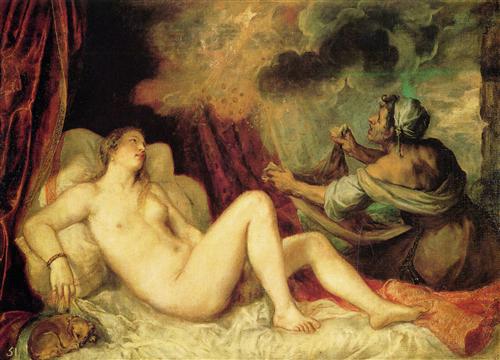
Titian "Danaë" (1554)

Danaë (1554)

Titian

________

nor can I not report a poem that I offered
as an apology for an affront I’d caused,
utterly unwittingly, to one of my course’s
gracious participants

she had objected to slights against the
very perception of sex crimes, which I’d
egregiously equated, she said, with
soul-destroying profanities

_________

A Repentance

(wherein I “bite my thumb”
at the Petrarchan sonnet, I think)

Stand certain, Anonymous, that
I am completely in your corner,
No even passing account of sexual
Crimes against women should

Ever overlook their horror,
Regardless of the context,
Erudite or otherwise, therefore
Let me here sincerely apologize

Your reprimand is not lightly
Stamped upon my conscience,
Only understand that for me a

Rape of the soul is also a
Repulsive matter, greatly also deplorable
Yours truly, Richard

____________

you’ll note the acrostic interpolation,
“SINCERELY SORRY”, at the head of
each verse of my text, meant to
counter the mode of the offending
matter, John Peale Bishop’s vicious
A Recollection

Richard

psst: the painting above is the subject
of Bishop’s, completely
objectionable, stunt

Visconti’s Death in Venice‏

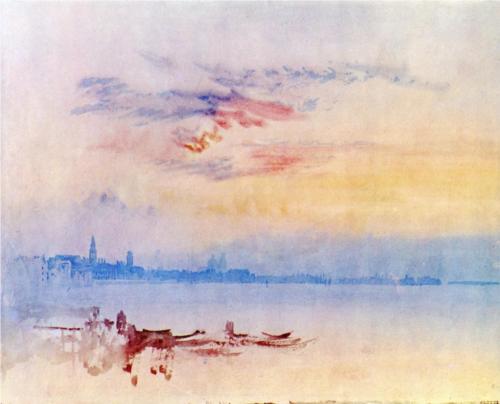
  William Turner -  "Venice Looking East from the Guidecca, Sunrise" (1819)

Venice Looking East from the Guidecca, Sunrise (1819)

William Turner

_______

Death in Venice is perhaps the most
beautiful film I’ve ever seen, just click

Visconti suffuses his masterpiece with
all the colours and textures of Monet,
Renoir, Seurat, Toulouse-Lautrec, and
a host of other Impressionists, and
settles them all upon, nearly inevitably,
the splendours of a Canaletto Venice

Dirk Bogarde has never been better,
his von Aschenbach is definitive,
Silvana Mangano is every single inch
an aristocrat, the epitome of poise,
elegance and propriety, Tadzio is
throughout the very incarnation of a
Botticelli

all is given stately motion by the art
of film and made thereby into another
equal and haunting form of poetry

enjoy, marvel

Richard

psst: Visconti even makes Mahler sound
profound

as does Leonard Bernstein, incidentally,
in the accompanying clip, who is
manifestly transported throughout his
evidently otherworldly experience,
just as you might even be, just click

parsing art – David Hockney‏

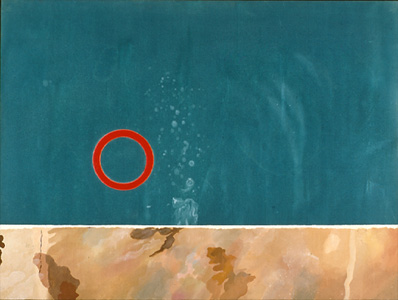
David Hockney - "Rubber Ring Floating in a Swimming Pool"

Rubber Ring Floating in a Swimming Pool (1971)

David Hockney

_________

in responding to the powerful dictates
of Abstract Expressionism, dominant
in mid-Twentieth-Century art, its return
to essentials, the technical elements
of the medium – as indeed was taking
place in music and literature as well
during that period, see John Cage,
or Samuel Beckett, for instance, if
you dare – David Hockney, as well
as other related artists at the time,
were, it would seem, looking to
reconnect with a more general public,
their, after all, burgeoning market in
the post-war rise of the Middle Class,
not only with objects it would find
familiar, even iconic, Campbell Soup
can
s, Marilyn, but with outright fun,
a not inconsequential attribute

out with ontological musings, they
were saying, dry taxonomy, and in
with, as it were, the bomp sh’ bomp
sh’ bomp

or Pop Art

noteworthy for its sense of
outrageousness, levity

and fashion, incidentally

not either inappropriately, fashion
was what the popes had been doing,
after all, adorning the Sistine Chapel

David Hockney here takes colour field
– flat, undifferentiated areas of a single
colour, a founding element of Abstract
Expressionism – and applies it to a
recognizable surface, which,
incidentally, he insists in his very title,
is not “Abstract”

we delight in the ingenuity of this
conjunction, form has become
function, or the reverse

and note furthermore the aptness
of other painterly preoccupations,
texture, a consideration that goes
back to Vermeer, and further

dimensionality, there is no horizon
to force representation of a third
dimension, which nevertheless
ingeniously doesn’t obliterate
clear three-dimensional
perspective

geometry, a hats-off to Mondrian
perhaps, and Cubism, though
we’ve come a long way from the
more diaphanous and shimmering
Cubism, just click

in fine, I’m impressed by the manner
in which this painting, despite its
naked and overt representation of
its subject, devoid of any context,
urges a more theoretical
consideration than substantial,
indeed “Abstract” rather than
grounded, rock, materially
speaking, solid

does Rubber Ring Floating in a
Swimming Pool
inform the form,
in other words

or does the form inform the
Rubber Ring Floating in a
Swimming Pool

is this grammar or a poem

you tell me

Richard

“Morning Poem” – Wojciech Siudmak‏

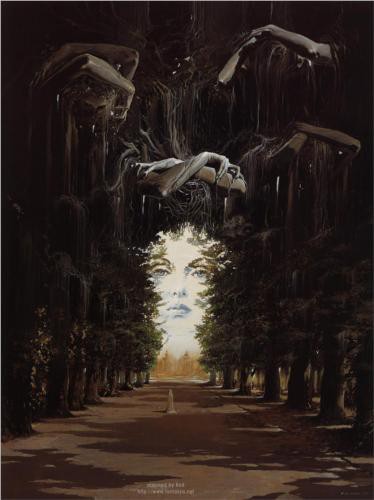
Wojciech Siudmak  - "Morning Poem"

Poème matinal (“Morning Poem“)

Wojciech Siudmak

__________

looking for a poem this morning among an
array of poem paintings, I came across this
morning one
to start my day, evidently also
to share

this could be any street in Vancouver right
now, where the trees overwhelm the streets,
where branches like arms bless even the
very pavement, where magic lurks in every
indentation of the leaves

you look for poems, you find poems, I say,
even in paintings, even in innocent trees

Richard

“Tonight You Belong to Me”

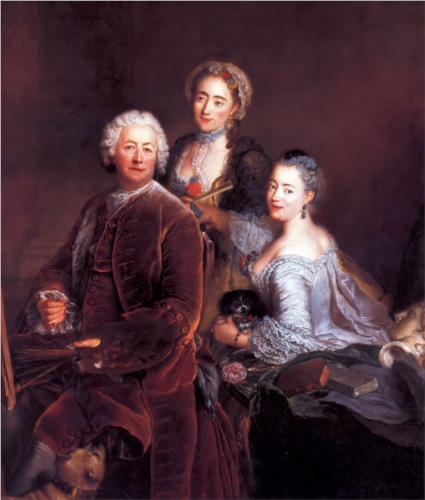
Antoine Pesne - "Self-portrait with Daughters" (1754

Self-portrait with Daughters (1754)

Antoine Pesne

______

for fathers, especially, and daughters

and all those who love them

just click

Richard

psst: in the spirit of Brain,
worthy contenders from

before my time

after

“Poem for Piano in C# minor” – Arno Babajanian‏

Corneille - "Music" (1949)

Music (1949)

Corneille

______

in the spirit of unusual juxtapositions,
the very stuff, let me suggest, of art,
here’s a Poem for Piano, in C# minor“,
by Arno Babajanian, an Armenian
composer, 1921 to 1983, played by a
countryman of his, Armen Babakhanian

a Poem for Piano begs the question,
what is a poem, can a poem be devoid
of stanzas and words, can music be a
poem

you tell me

Richard

psst: can music, incidentally, be a painting,
see here, or above

“Monet Refuses the Operation” – Lisel Mueller‏

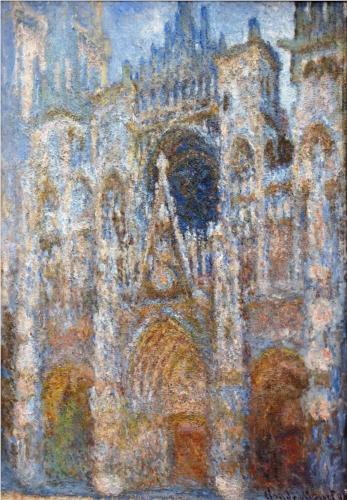
Claude Monet - "Rouen Cathedral, Magic in Blue"

Rouen Cathedral, Magic in Blue (1894)

Claude Monet

______

up until now I’ve presented dramatic
monologues
, but only to music, on my
blog
, referring to Robert Browning as
their originator, but not ever producing
any representative spoken work, never
mind any of, themselves, the poet’s
seminal masterpieces, My Last
Duchess
“, “Fra Lippo Lippi“, “How
They Brought the Good News from
Ghent to Aix
“,
for instance, which,
granted, can be daunting now in their
breadth and erudition, the Romantics
didn’t have television, they had to
entertain themselves

here’s a poem for our time, written
in 1996, only two decades ago, gasp,
Lisel Mueller imagines herself Claude
Monet
, an easier concept, after all,
who’s been to Ghent or Aix, why
would anyone want to run there,
whereas Monet‘s another story, who
doesn’t today know Monet

Monet was blind at the end of his life,
one learns from the website where I
got this
, a blog with plenty of breadth
and already considerable erudition, he
received corrective surgery to be able
to continue with his work

there was, however, a limit

Monet Refuses the Operation

Doctor, you say there are no haloes
around the streetlights in Paris
and what I see is an aberration
caused by old age, an affliction.
I tell you it has taken me all my life
to arrive at the vision of gas lamps as angels,
to soften and blur and finally banish
the edges you regret I don’t see,
to learn that the line I called the horizon
does not exist and sky and water,
so long apart, are the same state of being.
Fifty-four years before I could see
Rouen cathedral is built
of parallel shafts of sun,
and now you want to restore
my youthful errors: fixed
notions of top and bottom,
the illusion of three-dimensional space,
wisteria separate
from the bridge it covers.
What can I say to convince you
the Houses of Parliament dissolve
night after night to become
the fluid dream of the Thames?
I will not return to a universe
of objects that don’t know each other,
as if islands were not the lost children
of one great continent. The world
is flux, and light becomes what it touches,
becomes water, lilies on water,
above and below water,
becomes lilac and mauve and yellow
and white and cerulean lamps,
small fists passing sunlight
so quickly to one another
that it would take long, streaming hair
inside my brush to catch it.
To paint the speed of light!
Our weighted shapes, these verticals,
burn to mix with air
and change our bones, skin, clothes
to gases. Doctor,
if only you could see
how heaven pulls earth into its arms
and how infinitely the heart expands
to claim this world, blue vapor without end.

Lisel Mueller

Richard

psst: thanks Brain for this beautiful poem

“Bohemian Rhapsody” – Freddy Mercury‏


the poetic dramatic monologue, which finds
its popular source in Shakespeare, though
they are essentially introspective there,
philosophical rather than strictly narrative,
making them nevertheless, in a play, by
definition, dramatic, rightful claimants
still to that name, and which was
institutionalized as a poetic form by
Robert Browning later in the XlXth Century,
by upending the Shakespearean mode,
turning poems into plays instead of plays
into poems, makes its way into the XXth
Century, probably mostly unobtrusively,
no one really particularly notices, but
powerfully culturally nonetheless when
applied to, for instance, music, which is
to say poetry, of course, with notes

here’s “Bohemian Rhapsody”*, an abridged
version, as sung by Rose Osang Fostanes,
delivering a classic dramatic monologue

here’s Freddy Mercury’s complete version,
with a Greek chorus supplying oracular
even feedback

Richard

* Bohemian Rhapsody

Is this the real life?
Is this just fantasy?
Caught in a landslide,
No escape from reality.

Open your eyes,
Look up to the skies and see,
I’m just a poor boy, I need no sympathy,
Because I’m easy come, easy go,
Little high, little low,
Anyway the wind blows doesn’t really matter to me, to me.

Mama, just killed a man,
Put a gun against his head,
Pulled my trigger, now he’s dead.
Mama, life had just begun,
But now I’ve gone and thrown it all away.

Mama, ooh,
Didn’t mean to make you cry,
If I’m not back again this time tomorrow,
Carry on, carry on as if nothing really matters.

Too late, my time has come,
Sends shivers down my spine,
Body’s aching all the time.
Goodbye, everybody, I’ve got to go,
Gotta leave you all behind and face the truth.

Mama, ooh (anyway the wind blows),
I don’t wanna die,
I sometimes wish I’d never been born at all.

I see a little silhouetto of a man,
Scaramouche, Scaramouche, will you do the Fandango?
Thunderbolt and lightning,
Very, very frightening me.
(Galileo) Galileo.
(Galileo) Galileo,
Galileo Figaro
Magnifico.

I’m just a poor boy and nobody loves me.
He’s just a poor boy from a poor family,
Spare him his life from this monstrosity.

Easy come, easy go, will you let me go?
Bismillah! No, we will not let you go. (Let him go!)
Bismillah! We will not let you go. (Let him go!)
Bismillah! We will not let you go. (Let me go!)
Will not let you go. (Let me go!)
Never, never let you go
Never let me go, oh.
No, no, no, no, no, no, no.
Oh, mama mia, mama mia (Mama mia, let me go.)
Beelzebub has a devil put aside for me, for me, for me.

So you think you can stone me and spit in my eye?
So you think you can love me and leave me to die?
Oh, baby, can’t do this to me, baby,
Just gotta get out, just gotta get right outta here.

(Oh, yeah, oh yeah)

Nothing really matters,
Anyone can see,
Nothing really matters,
Nothing really matters to me.

Anyway the wind blows.

Freddy Mercury
“Ambush at Five O’clock” – Stephen Dunn‏


from the New Yorker, February 3, 2014

Ambush at Five O’clock

We were by the hedge that separates our properties
when I asked our neighbors about their souls.
I said it with a smile, the way one asks such a thing.
They were somewhat like us, I thought, more
than middle-aged, less dull than most.
Yet they seemed to have no interest
in disputation, our favorite game,
or any of the great national pastimes
like gossip and stories of misfortunes
about people they disliked.

In spite of these differences, kindred
was a word we often felt and used.
The man was shy, though came to life
when he spotted an uncommon bird,
and the woman lively, sometimes even funny
about barometer readings and sudden dips
in pressure, the general state of things.
We liked their affection for each other
and for dogs. We went to their house;
they came to ours.

After I asked about their souls
they laughed and stumbled towards an answer,
then gave up, turned the question back
to me. And because I felt mine always was
in jeopardy I said it went to the movies
and hasn’t been seen since. I said gobbledy
and I said gook. I found myself needing
to fool around, avoid, stay away from myself.

But my wife said her soul suffered from neglect,
that she herself was often neglectful
of important things, but so was I.
Then she started to cry. What’s the matter? I asked.
What brought this on? She didn’t answer.
I felt ambushed, publicly insensitive
about something, whatever it was.

It was a dusky five o’clock, that time
in between one thing and another.
Our neighbors retreated to their home,
but the women returned
and without a word put her arms
around my wife as if a woman weeping
indicated something already understood
among women, that needn’t be voiced.
They held each other, rocked back and forth,

and I thought Jesus Christ, am I guilty again
of one of those small errors
I’ve repeated until it became large?
what about me? I thought. What about
the sadness of being stupid?
Why doesn’t her husband return
with maybe a beer and a knowing nod?

Stephen Dunn

____________

poetry is a conversation, of course, a poet
has with all the other poets who’ve come
before him, her, here Dunn is evidently
channelling Robert Browning, “This is
my last Duchess”,
Browning writes,
“painted on the wall / Looking as though
she were alive.”,
from his My Last
Duchess
“,
a poem I’ve never forgotten,
wherein the speaker discusses the
portrait of his earlier wife, one he’d
summarily purportedly got rid of

Robert Browning had learned his craft,
the dramatic monologue, from, of course,
Shakespeare, down to even its dramatic
content

Elizabeth meanwhile had been inspired
rather by Shakespeare’s sonnets, by his
thee, thy, thine, and thou’s

in Dunn the Browningian drama is
significantly less dour, nobody out and
out dies, though the dilemma is never
not existential, however less morally
compromised, less psychologically
and tragically fraught

neither does Dunn rhyme

but that just sends us back to Homer
of course, less epic, more, maybe,
middle class, very, and distinctively,
XXlst Century

but that’s how you read between the
lines, the verses, in this case, and
thus across the centuries

poetry is a conversation

Richard

on rhyme‏


commenting on his choice of idiom
in Paradise Lost, John Milton writes
the following

“The measure is English heroic verse without rime, as that of Homer in
Greek, and of Virgil in Latin—rime being no necessary adjunct or true
ornament of poem or good verse, in longer works especially, but the
invention of a barbarous age, to set off wretched matter and lame metre;
graced indeed since by the use of some famous modern poets, carried away
by custom, but much to their own vexation, hindrance, and constraint to
express many things otherwise, and for the most part worse, than else they
would have expressed them. Not without cause therefore some both Italian
and Spanish poets of prime note have rejected rime both in longer and
shorter works, as have also long since our best English tragedies, as a thing
of itself, to all judicious ears, trivial and of no true musical delight; which
consists only in apt numbers, fit quantity of syllables, and the sense variously
drawn out from one verse into another, not in the jingling sound of like
endings—a fault avoided by the learned ancients both in poetry and all good
oratory. This neglect then of rime so little is to be taken for a defect, though
it may seem so perhaps to vulgar readers, that it rather is to be esteemed an
example set, the first in English, of ancient liberty recovered to heroic poem
from the troublesome and modern bondage of riming.”

“Paradise Lost”: The Verse

John Milton

_______________

that’s of course his opinion, what do
you think

and what, thus, do you think poetry is,
not an especially easy question

Richard