Richibi’s Weblog

Just another WordPress.com weblog

Category: poetry

Aristotle on poetry

aristotle-jpglarge

      Aristotle” (1653)

        Luca Giordano

          ___________

so what’s a poem

in an attempt to get a clearer picture 
of what a poem should be, rather 
than trust only my own, however 
informed perhaps, opinion – though 
it must be added that we all bring 
something to that word’s definition, 
mine no less worthy than yours, 
yours no less worthy than mine – 
thought I’d go back to authoritative 
sources to see what they might 
have said

and it doesn’t get any earlier and 
authoritative than Aristotlewriting 
in 350 B.C.E., at the height of 
Ancient Greek preeminence, 
dissecting the term in his 
penetrating and perspicacious, 
ahem, Poetics” 

I propose to treat of Poetry in itself and of its various kinds,
noting the essential quality of each, to inquire into the
structure of the plot as requisite to a good poem; into the
number and nature of the parts of which a poem is
composed; and similarly into whatever else falls within
the same inquiry.“, he says in Part 1 of his 
magisterial treatise

and proceeds to declare the parameters 
of “Poetry” for the ages  

Poetry in general seems to have sprung from two causes“, 
he proceeds, imitation and rhythm 

by imitation I think it best to think of 
representation, which is another way, 
anyway, of saying imitation, but 
much more evocative in this instance,
more attuned to our sense of his word 

a poem is a representation then, a 
reproduction of something other than 
itself 

while its rhythm is what George
Gershwin‘s got, and by extension, as  
you can see from this videoGene Kelly

and yes, that means that “Epic poetry and Tragedy, Comedy also
and Dithyrambic poetry, and the music of the flute and of the lyre in
most of their forms, are all in their general conception modes of
imitation.” 

so, according to Aristotle, is dance 

all, therefore, poems

an interesting elaboration about “Tragedy” 
states that it should have the three unities 
that I grew up with during my French 
Canadian upbringing, the unity of time, of
space, and of action the famous French 
Classical dramatists, Racine and Corneille,
applied under the aegis of Louis XlV

not to mention Tragedy’s use of iambic 
pentameter, Shakespeare’s ubiquitous 
beat, a beat that persevered into the very 
Nineteenth Century, in France with 
Rostand‘s Cyrano de Bergerac“, for 
instance, and into the Twentieth Century 
with Eliot‘s Murder in the Cathedral“, 
about the assassination of Archbishop
Thomas Becket at Canterbury in 1170 
under Henry the Second‘s own aegis,
all written as poetry 

the most famous play to follow the 
three unities in the modern era is 
Who’s Afraid of Virginia Woolf?“,
the play which I think defines the 
Twentieth Century, which takes 
place overnight somewhere in 
New England college town, mid-
century, at George and Martha’s 

though followed closely by O’Neill‘s 
Long Day’s Journey int Night“, 
which transpires from morning, one 
day in August, 1912, till midnight, at 
the home ofunity of space, note, 
the dysfunctional Tyrones

so it appears not much has changed
about poetry, Aristotle got a lot of 
mileage out of his early definition, 
nearly 2500 years 

makes you wonder  why so much 
attention was paid instead to 
Platohis contemporary, the 
mystic, who would’ve banned
poetry, he thought it was 
subversive
 
Richard

psst: for a modern day application
          of the three unities, watch 
          In Treatment“, a television
          series, which takes place 
          in a psychotherapist’s office,
          each episode a session,  
   

what is a poet

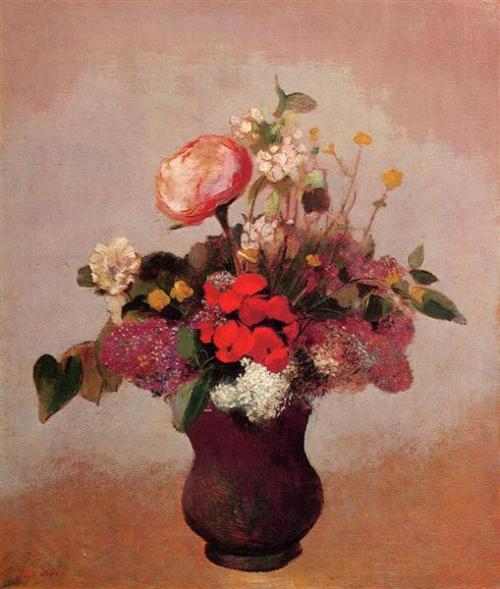
flowers-in-aa-brown-vase.jpg!Large.jpg

                            Flowers In a Brown Vase (1904)

                                            Odilon Redon

                                                 _______

if I imagine myself to be a poetwhat 
is a poet, I have to ask, or, more 
accurately, what do I imagine a poet 
to be

cause this is a two-way street, I am
defined by the word I inhabit, but I 
define the word as well, redefining 
it, essentially, to fit my etymological 
purpose   

my moral purpose I leave to myself,
in a completely other ideological
dimension

if I can

a poet then is one who writes, paints,
composes, manifests, in a word, 
creates, poems

what is a poem

a poem is where beauty and truth 
combine to create harmony, 
coalescence, to the point of one’s
admiration, enchantment, wonder, 
enlightenment, in incremental steps 
leading to very transcendence, the 
feeling that something has moved 
in your heart

just a bouquet of flowers will do it,
for instance

that’s what I think

Richard

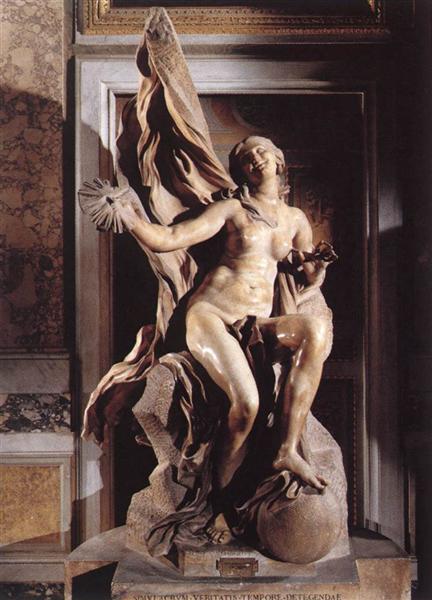
on truth

truth-unveiled-by-time3-jpglarge

               “Truth Unveiled By Time (1645-1652)

                               Gian Lorenzo Bernini

                                           _______

a cousin once said to me about 
his father, that he was as honest 
as the day is long

though I didn’t say a word, this 
was emphatically not my opinion

but I concluded nevertheless that, 
once again, truth is in the eye of 
the beholder, not, of course, truth 
truth, the one we all would like to 
believe must exist, but the one 
which is the only one that we can 
work with, our own 

but what is true

no one knows but for personal 
intimations, truth must be, in other 
words, our individual constructions, 
a kind of existential prosetry,  
consistent story we tell ourselves, 
a walking shadowa tale / told by 
an idiotaccording to Macbethfull 
of sound and fury, / signifying 
nothing 

I imagine I am a poet

imagine 

Richard

psst: prosetry is poetry written in prose,
          see “up my idiosyncracies – a bio

up my idiosyncrasies – Albertine‏

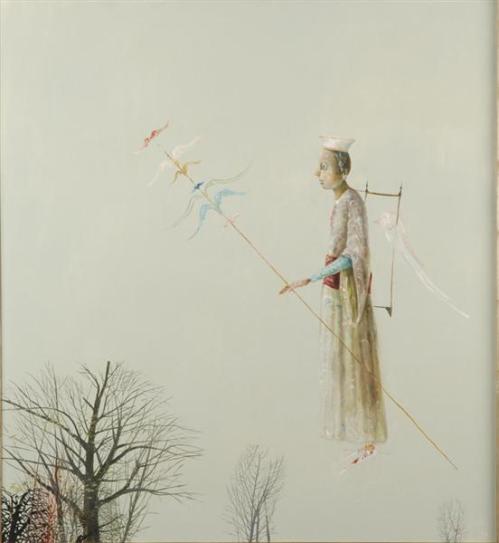
wing-seller-2006.jpg!Large

            Wing Seller (2006)

               Stefan Caltia


                        _______ 

 
what are you doing, a friend of mine
asked when he called 
 
I’m reading my Proust, I answered,
comfy enough with my textafter 
years waking up side by side, to 
use the possessive adjective 
 
what’s going on, he inquired
 
Albertine is lying on his bed, 
recounted, asleep, she’s been there 
for the past ten pages, and she’s 
just now turned onto her stomach
 
 
there is not so much story as 
paintings, in Proustdetailed 
descriptions applied like strokes of 
colour to a canvas, that of recovered 
time, colours that are specific to a 
place and a period, like photographs 
showing in their very fabric their 
ancestry, their lineage
 
but in the elucidation of what he 
sees, or, more accurately, of what
he remembers, Proust delivers 
a work of the very highest art, a 
mixture of poetry and philosophy,
Beethoven did as much, see his
 
 
Proust’s French is essentially 
immaculate, his tone, however 
intimate, always erudite, aristocratic, 
perspicacious, wise, penetrating,
embracing, which is to say, French,
though German can be also
incidentally, pretty cerebral, English 
is narrative, just the facts, please, 
though often, I think, hilarious
 
 
Albertine had been one of the “young
girls in bloom” he’d met at Balbec, a 
seaside resort, with whom he’d 
undertaken an illicit affair, but 
whose faithfulness he doubted
 
as she lay on his bed at his Paris
apartmenthe replays all the 
speculations his imagination could 
provide, an endless set of variations
on his anguish, which is to say, his
jealousy, worthy of a very Othello
 
for ten pages he paints a picture of 
infidelities completely of his making,
which, of course, becomes the world 
he will respond to
 
it is all in our little heads, I surmise, 
however informed, intelligent, that 
we create our little realities, they 
have never been nearly enough, 
though, indeed, our lives depend 
on themhowever dutifully
considered, however unconsciously,
and ever convincingly, contrived   
 
make them, I submit, good ones
  
I imagine myself a poet, for instance,
how’s that for a shot in the improbable 
dark
 
 
Richard

up my idiosyncrasies – Marcel Proust‏

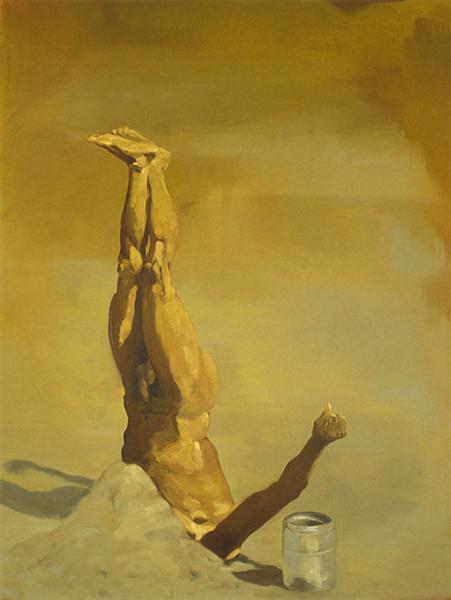
holy-man.jpg!Large

    “Holy Man (1989)
 
       Eric Fischl
 
          ______
 
 
Marcel Proust is not an easy read, 
of literature it is surely its Everest,
not an easy climb, but from its peak
the world takes on an entirely other
order
 
an English-speaking friend has 
suggested he might try to read it 
again, but not in French this time,
I countered that that way he’d miss
the many crevices and crags, the
slippery slopes and lethal ledges, 
that give shape to the mountain, 
which the French grammar would
apply in all its intricate 
manifestations
 
part of the pleasure in reading 
Proust is the poetry, where style 
and substance coexist to create 
magic, and inspiration  
 
the sentences are long, they wind 
on for often pages, you need to be 
able to tell the subject from the verb
despite sometimes extended
intervening distances
 
but the grammar is sound throughout, 
except for in a couple of isolated
instances, grammar that would test
even a Frenchman
 
indeed Proust is where, I profess, I 
truly learned to speak French
 
there’s another mountain
 
 
the conceit is that someone rings 
the bell at their Combray cottage,
and after 3300 pages someone 
rings at the same door again
 
in between the years have passed,
they are the fruit of Proust’s 
“recherche”, search, investigation,
quest, a term that can’t be fully 
expressed as such in English, 
which doesn’t express the 
confluence of cold science and 
candle-lit spirituality expressed 
in the French word
 
in dissecting the very entrails of a 
flower, a tea cup, a crumpet, an eye, 
a brow, a lip, a gesture, a frown, a 
smile, a gait, Proust describes his 
own world, concocts it, minutely, 
meticulously, until you realize this 
can be only his perception, that 
therefore all of our interpretations 
are but our individual perceptions, 
our myriad unique worlds
 
from which one can begin to 
shape one’s own
 
later with Wittgenstein, the 
philosopher, this became known 
as phenomenology, the idea that 
we are confined for knowledge to 
our private views of the world,
wherein language plays, manifestly, 
a crucial part
 
in the beginning, if you’ll remember, 
was the word
 
curiously, in French, it is the verb, in
the beginning, implicitly suggesting 
a word of action 
 
 
Proust had been prescient as Freud
uncovering an inner world we’d always 
believed was outside us
 
at the top of his priorities Proust
chose art, personal expression,
it’s all that we can return to the 
world
 
and what else could be our purpose
 
 
Richard
 
psst: bonne lecture, Kurt

“Syrinx” – Claude Debussy‏

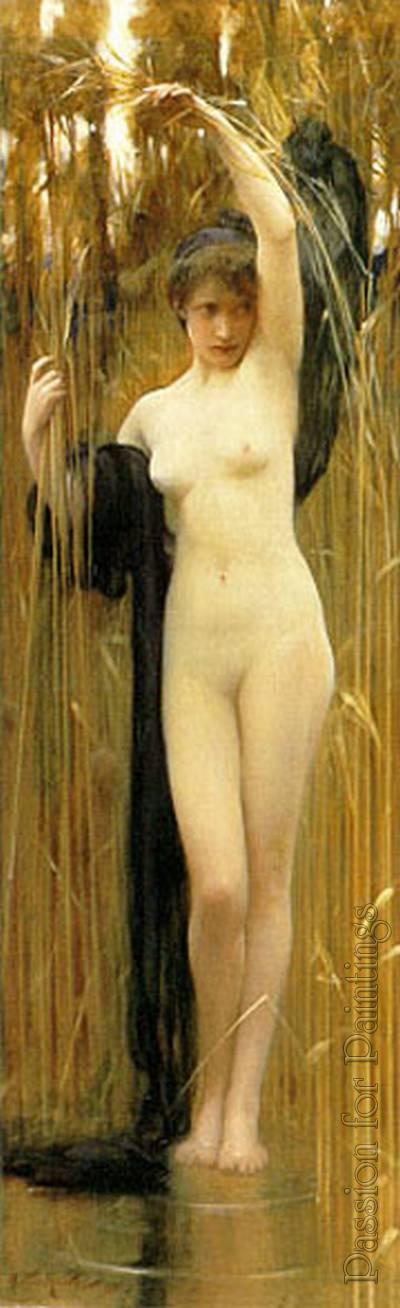
big

         Syrinx (1892)
 
          Arthur Hacker
 
            __________
 
 
though Debussy would’ve called his
Syrinx “Flûte de Pan”, “Pan Flute”,
alas, the name had already been 
taken, he therefore came up with the 
much more inspired Syrinx
 
Syrinx, with the help of other nymphs, 
who’d come at her cry for help as she 
fled the god Pan, a pursuer, had been 
turned into a bush of reeds, its canes 
producing a song so sweet as to 
confound and disarm him, impelling
him to create of them that sublime 
instrument  
 
Hermes had been telling Argus, Argus 
Panoptes, the giant with the hundred 
eyes, the story about the pipes he  
was playing, an implement received 
from Jove, apparently, god of all the 
gods, who wanted him to kill Argus, 
for confining Io, who’d been turned 
into a heifer by Juno, Jove’s wife, 
who’d caught him chasing her, Io’s 
plaintive lows had been getting to 
Juno as Io fretted unfettered through 
the fields too close to Olympus 
 
when Hermes’ music finally closed the
giant’s last two eyes, he beheaded him,
but Juno, in merciful recognition of his
service, however ultimately ineffectual, 
set them into the variegated tail of the 
peacock
 
are you kidding me, I always think when
I read Ovid’s “Metamorphoses”, and am
ever nevertheless entirely enchanted
 
a flute solo had not been composed in
over 150 years when Debussy composed
his Syrinx“, 1913, after C.P.E. Bach’s not  
at all unimpressive Sonata in A Minor 
of 1747, it duly set off a new life for the 
long overlooked flute, a reed which 
Mozart famously didn’t like
 
note the tonal, rhythmic, and repetition 
shifts from the rigid Classical model, 
where these are much more strict, 
Impressionism was not only breaking 
down pictures, the pictorial arts, but its
sound world as well, it was an utterly
new era, new sensibility, new zeitgeist, 
and you can feel it, though you might
not be quite able to immediately 
verbalize it, the arts were again, as
they ever ‘ve been, the canary in the 
gold mine
 
 
Richard
 
psst:
 
   The Transformation of Syrinx into Reeds 
 
Then Hermes thus: A nymph of late there was 
Whose heav’nly form her fellows did surpass. 
The pride and joy of fair Arcadia’s plains, 
Belov’d by deities, ador’d by swains: 
Syrinx her name, by Sylvans oft pursu’d, 
As oft she did the lustful Gods delude: 
The rural, and the woodland Pow’rs disdain’d; 
With Cynthia hunted, and her rites maintain’d: 
Like Phoebe clad, even Phoebe’s self she seems, 
So tall, so streight, such well-proportion’d limbs: 
The nicest eye did no distinction know, 
But that the goddess bore a golden bow: 
Distinguish’d thus, the sight she cheated too. 
Descending from Lycaeus, Pan admires 
The matchless nymph, and burns with new desires. 
A crown of pine upon his head he wore; 
And thus began her pity to implore. 
 
Now while the lustful God, with speedy pace, 
Just thought to strain her in a strict embrace, 
He fill’d his arms with reeds, new rising on the place. 
And while he sighs, his ill success to find, 
The tender canes were shaken by the wind; 
And breath’d a mournful air, unheard before; 
That much surprizing Pan, yet pleas’d him more. 
Admiring this new musick, Thou, he said, 
Who canst not be the partner of my bed, 
At least shall be the confort of my mind: 
And often, often to my lips be joyn’d. 
He form’d the reeds, proportion’d as they are, 
Unequal in their length, and wax’d with care, 
They still retain the name of his ungrateful fair.
 
                                                  Ovid

a reader writes‏

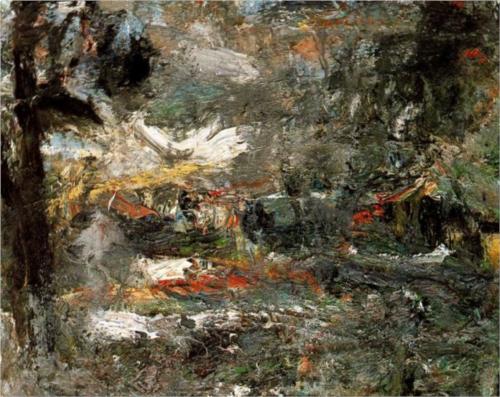
"November" - Eugène Leroy

November (1988)

Eugène Leroy

_________

a reader writes about Coming to
New York – John Updike
“,
my last
weblog entry

kurtnemes
October 30, 2015 at 12:00 pm

Nice post. Yours is a[s] poetic as Updike’s. Do you live there now? My wife and I spend June of 2013 in the Village and June of 2015 in Beacon, NY. When in NYC I always feel more alive, and it’s because of the frying bacon cheek-by-jowl with the Flat Iron Bldg, the Whitney, Union Square, Grand Central Station.

when my reply to him became too long,
and a paean to Vancouver, I thought I’d
make my tribute more formal, include it
in my main text, I hope you enjoy it

while I lived in Toronto, Kurt, ’68 – ’82, New York was my playground, Toronto, the Good, was still coming out of its WASP insularity, fun was a dirty word – when I moved to Vancouver, the only thing I missed, I used to always say, was civilization, or, interchangeably, New York

Vancouver has grown, of course, since then, but it still isn’t New York, we have no theatre to speak of, no competing orchestras, a modest art scene, thanks to, especially, significant art exhibitions on occasion, and here and there an errant, inspired, flower – the recital society, however, has been impressive, with a catalogue of international names visiting often

for Vancouver is indeed beautiful, breathtakingly so, right now the autumn colours are bold, bright, infinitely remarkable, enough to make you believe in God/dess

also the mountains make a splendid backdrop

thanks for the likeness to John Updike, a shot in the arm for someone who thinks he might be a poet

Richard

psst: Kurt has a blog with noteworthy
information about, esoteric even,
Classical music – check him out

thanks Kurt

“Julius Caesar”, a foretaste

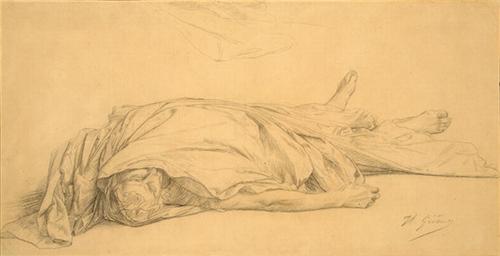
"The Dead Caesar" -  Jean-Léon Gérôme

The Dead Caesar (c.1859)

Jean-Léon Gérôme

__________

a friend and I are undertaking our
umpteenth reading of a Shakespeare
play, “Julius Caesar” this time, which
I hadn’t read in an age

in this version, still unparalleled,
Brutus, James Mason, presents his
argument for the assassination of
Caesar
, “Hear me for my cause, and
be silent that you may hear…not that
I loved Caesar less but that I loved
Rome more”,
he proclaims

Mark Antony, in the incarnation of
Marlon Brando, responds, for the
ages

and therein lies the glory, incidentally,
of Shakespeare

just saying

Richard

“No Ideas But In Things” – Jessica Greenbaum‏

   "Lady with a Squirrel and a Starling" (c.1527) - Hans Holbein the Younger

Lady with a Squirrel and a Starling (c.1527)

Hans Holbein the Younger

__________

it’s been a while since I’ve offered
up a poem, it’s been a while since
I’ve read one, and I miss them

but this one inadvertently this
morning struck a conversational
tone I found particularly engaging,
easy to read, though with cadences

no paragraphs

Jessica Greenbaum uses longer
iambic pentameters than I do, you
might note, decidedly more
punctuation

but she sings her lines, her daily
prose, as if they were poems

that’s what I especially like

Richard

_____________

No Ideas But In Things

We checked the vents and hidden apertures of the house,
then ran out of ideas of where it might be open to the world.
So we couldn’t figure out how the squirrel was getting in.
We each had methods that succeeded in shooing him,
or her, out the door—but none of them lasted. Whether
it was the same squirrel—terrified when in the house, and
persistently so—or various we couldn’t tell because,
tipped off by a glance, he zigzagged from froze-to-vapor,
vanishing, Zorro-like, until signs would tell us he had
revisited the sideboard to dig in the begonia. (Escaping
Newcastle in a search for coal.) We plotted his counter-
escape, laying a path of pecans to a window opening
on the yard. A few days would pass, and, believing him
gone, we felt inexplicably better than when we began.
Then, from another room, the amplified skritch of nutmeg
being grated—and, crash. Bracelets off dresser tops, bud
vases, candy dishes, things houses have that the back yard
doesn’t. You don’t think of squirrels knocking things over,
but inside it was like living with the Ghost and Mrs. Muir.
When we couldn’t trust the quiet or prove his absence,
we cast him as that hapless shade: worry. Our own gray
area, scat-trailing proof of feral anxiety. But after a few
cycles of release-and-catch I grew bored with the idea,
with its untamed projections. Since he dashes up walls,
(yanked, like a pulley), or seeks treasure in a five-inch pot,
daily, why not adopt him as optimism’s travelling rep?
I tried. But the sun comes up, we step toward the stove,
and he shoots out like a cue ball, banks off the kitchen door
—what mayhem is caused by going to make coffee!—
and the day, again, begins with a shriek. We are now in
week three and I accept that, inside, the squirrel is going
to stand for something else. And so is the May rain
and so is the day you took off your coat and the tulips
joined in with the cherry blossoms and the people came out
and the pear-tree petals floated down in polka dots
around the tulips, and even around the cars. We name life
in relation to whatever we step out from when we
open the door, and whatever comes back in on its own.

Jessica Greenbaum

songs of some birds‏


untitled-1939-1.jpg!BlogPablo Picasso - "Untitled" (1939)

Untitled (1939)

Pablo Picasso

_________

having wondered only recently about
bird song, whale song
, can these be
considered singing when they are
essentially language, we think, and
not codified, technically constricted,
I see pertinently appear a study
suggesting birds follow a pentatonic
scale, our own musical basis,
harmonics between birds and
humans are apparently identical

this suggests that harmonics in
nature are as fundamental as
mathematics, we have somehow,
humans, diverged from what we
think of as singing, left rhythm
and tonality from our conversation
to produce uninflected prose and
monotony, language at the level
of atonal, arhythmic expression,
for better or for worse, corruption,
or refinement, evolution

I wonder, again, if prose is not
bad poetry, or has poetry evolved
into prose

should we feel shame or ingenuity,
do birds have their own divergent
degrees of poetry, do some, most
maybe, veer also towards the less
exacting prose

do some birds not sing, in other
words, or only sometimes maybe,
when mating, for instance,
something like how we croon
when we’re dating, put on our
very best airs

Richard