Richibi’s Weblog

Just another WordPress.com weblog

Category: poetry

Apollo Appleseed

a friend of mine, Apollo, having
appropriated that name already
to launch a, not unpromising,
career as an artist, had never
to date considered a surname
for what I called his nom de
pinceau
, his brush name

but in a farfelu moment, French
for having lost one’s head – my
head, not his, having surrendered
immediately to his fantasy – he’d
happened upon “Appleseed” as
maybe a fitting, and to be
considered, apposition, addition,
to his presently truncated name,
I jumped on it

he later called the phenomenon,
at a loss for provenance, an
inspiration, to which I forthwith
concurred, Apollo Appleseed,
can you dig it, I told him he now
had to live up to it

inspiration is always the source
of poetry, I said, poetry is what
we all live for, to make our lives
beautiful

it involves following our inspirations,
however fanciful, however out there,
people have built lives around art,
literature, dreams, madeleines, for
goodness’ sake, fording oceans,
climbing mountains, and have
become not to be forgotten, it’s the
magic that counts, ever the aim of
inspiration

when inspiration strikes it is ever
charged with possibility, perspicacity,
delight, it is not a negative function

when inspiration strikes it is time
to stand and deliver, it knows the
ineluctable way, the one that’s in
your heart

you too can plant apple trees across
the land, of your own potentialities, if
only you dare follow even one of your
dreams

Richard

psst: you’ll have to forgive my ardour,
it’s been my Johnny Appleseed
speaking

and don’t forget to click
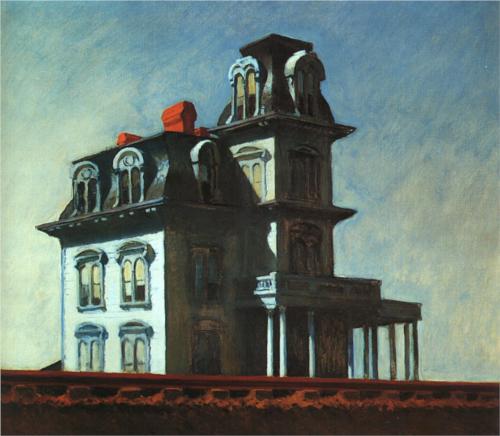
“Edward Hopper and the House by the Railroad” (1925) – Edward Hirsch‏

"House by the Railroad" (1925) - Edward Hopper

House by the Railroad (1925)

Edward Hopper

______

Edward Hopper and the House by the Railroad (1925)

Out here in the exact middle of the day,
This strange, gawky house has the expression
Of someone being stared at, someone holding
His breath underwater, hushed and expectant;

This house is ashamed of itself, ashamed
Of its fantastic mansard rooftop
And its pseudo-Gothic porch, ashamed
of its shoulders and large, awkward hands.

But the man behind the easel is relentless.
He is as brutal as sunlight, and believes
The house must have done something horrible
To the people who once lived here

Because now it is so desperately empty,
It must have done something to the sky
Because the sky, too, is utterly vacant
And devoid of meaning. There are no

Trees or shrubs anywhere–the house
Must have done something against the earth.
All that is present is a single pair of tracks
Straightening into the distance. No trains pass.

Now the stranger returns to this place daily
Until the house begins to suspect
That the man, too, is desolate, desolate
And even ashamed. Soon the house starts

To stare frankly at the man. And somehow
The empty white canvas slowly takes on
The expression of someone who is unnerved,
Someone holding his breath underwater.

And then one day the man simply disappears.
He is a last afternoon shadow moving
Across the tracks, making its way
Through the vast, darkening fields.

This man will paint other abandoned mansions,
And faded cafeteria windows, and poorly lettered
Storefronts on the edges of small towns.
Always they will have this same expression,

The utterly naked look of someone
Being stared at, someone American and gawky.
Someone who is about to be left alone
Again, and can no longer stand it.

Edward Hirsch

___________

Edward Hopper seems to have had
a profound influence on American
poets, this is the third poem around
one of his paintings I’ve encountered,
one by Joyce Carol Oates, a great lady
of not only poetry but of letters, having
been prolific in all literary forms, in each
nothing short of exemplary, another by
Brice Maiurro
, a budding poet of the
greatest, to my mind, merit, of whom
we will surely hear more if there is any
poetic justice

you can read about both of them right
here
in my blog, or just click their
individual names above

Edward Hirsch, by the way, stands
no less tall here, I submit, than the
other two in this coveted company

Richard

“Eugene Onegin”

years ago, when I first started paying
attention to opera, I listened to Joan
Sutherland and Luciano Pavarotti
singing “La Traviata” on my
headphones for six months solid,
Alfredo, Alfredo, I sang, di questa
core / Non puoi comprendere tutto
l’amore

now there’s “Eugene Onegin“,
Tchaikowsky’s homage to Pushkin,
the celebrated Russian poet who
wrote the national epic, turning it
into another prideful, musical this
time, monument

at first I’d been reluctant to take it on,
wary of other too ponderous Russian
productions, all heavy and lugubrious,
fraught with the trying tribulations of
too many harsh winters, I fathom

but after only a brief folkloric
interjection, too ecclesiastical a
reference for me, the story moved on
to less pompous things, an unfolding
love

Onegin is a rake, a rogue, a young
man not yet smitten, Tatyana, a
country lass but from a good manor,
hopelessly falls in love with him

he, of course, will break her heart

he will also break the heart of his
friend Lensky, when he dances an
écossaise, a grand waltz, and a
cotillion with Olga, Lensky’s
intended, and, parenthetically,
Tatyana’s sister

Olga had, injudiciously, allowed
Onegin to flirt

Lensky, offended, challenges
Onegin to a duel

in an aria that will haunt you forever,
Lensky commits himself to his fate,
be it Olga or the ineluctable hereafter,
knowing that she couldn’t either have
much loved him

you’ll cry

Kuda, kuda, you’ll also sing, kuda
vy udalilis,
like I will into surely at
least next month

I won’t tell you who wins, but it’s
tragic

and unforgettable

Richard

my Bruges, December 1, 2013‏

though we were some distance away
from Bruges the journey back and forth
proved to be no inconvenience given
both that Staf and Annemie, our hosts,
were so accommodating, ensuring that
those treks would be seamless, and that
our stay with them would be warm
 
in fact, every one of our wishes became
their inviolable command, and that at no
less than our indiscriminate pleasure
  
 
at the door of their glorious country 
home at first, behind the wrought
iron gate, there were only the chickens
to greet us, pecking away at the front
yard – whose fresh eggs we had for
breakfast every morning, along with
fresh orange and apple juices from
the nearby orchards, bottomless pots
of hot coffee, tea, ham, cheese and
warm bread – but soon around the
corner from the back Annemie showed
up having returned from harvesting
apples, welcoming us like old friends,
then Staf, doing his avuncular same  
 
the rooms, named after Flemish
artists, were unique, spotless,
and heartfelt 
 
we stayed a week, and it remains
equal to very Bruges, a Gothic
wonderland, in our estimation 
 
5 unequivocal st * rs
 
 
Richard  
 
psst: there’s even a five-star restaurant
        across the street, inexplicably, which
        doesn’t however, be warned, take
        credit cards, as do neither Staf and
        Annemie, who, none of them, ever
        questioned our honour in that
        improbable, we thought, 
        circumstance, an Old World, we
        guessed, thing  


blog alert: “Wild & Precious Life”

wherein Wild & Precious Lifedescribes herself 

 
     “My love for poetry is simple but at the same time, hard to
      explain. I was drawn to it from an early age however, with
      questionable motives. In my young eyes, the appreciation
      of poetry personified sophistication, poise and intelligence.
      And so I became that nine year old reciting lines from Dylan
      Thomas poems even though I had yet to live enough life to
      truly understand the deeper themes. But I continued my
      poetry admiration, convinced that I looked wise beyond
      my years. Believe me,  the irony of it is not lost on me now……
 
      And then those life experiences that one needs to truly
      understand poetry came knocking, and at times pounding
      on my door. Some were welcomed but many were not, but
      with them came my true love of poetry.
 
      I now read poetry for a simple and unequivocal reason – it
      makes me feel connected to something tangible but at the
      same time larger than myself. When I am sad, overwhelmed,
      lost, lovelorn, confused, I turn to it. I’ll read a beautiful
      composition of words and suddenly realize that I am not
      the first or last person to feel such things and that calms me,
      gives me hope and makes me feel gratitude.
 
      That having been said, this website is a simple collection of
      beautiful words. They are poems, quotes, lyrics and excerpts
      that have resonated with me. They are words that have made
      me smile, laugh, cry and sometimes simply take pause. I hope
      you enjoy the website, lovingly titled [Wild & Precious Life] –
      the closing lines of [Mary Oliver’s The Summer Day]: 
 
 
                  Doesn’t everything die at last, and too soon?
                            Tell me, what is it you plan to do
                  with your one wild and precious life?
 
                                 ___________________


what I needed to reply
 
 
      coming from a small town in the middle of
      nowhere, I aspired even then to discover
      what the rest of the world was thinking,
      admired, why had literary giants become
      legends, even archetypes, what were the
      parameters 
 
      poetry ever however seemed especially
      sterile, odes, for goodness’ sake, on 
      Grecian urns, I ask you, I, a budding
      person before the unfolding world
 
      abstract art too was pretty questionable, 
      though I persisted, diligently probing 
      afield for convincing, manifest, arguments,
      the world couldn’t be so wrong
 
      until here and there a bud would blossom,
 
      I now read poetry just to find out what
      other hearts are thinking    
 
      some say quite wonderful things   
   
 
      ever the best 
 
      Richard 
 
      psst:  I’ve subscribed, by the way, to your 
              Wild and Precious adventure
 
               many thanks


Richard


“A Little Touch of Schmilsson in the Night” – Harry Nilsson‏

 
when I was much younger, and still beset
by the unruly vagaries of love, finding my
way through its thorny thickets, this is
what I’d listen to as I’d fall asleep   


Richard
 
psst: all adagios, you’ll note, each and
        every one a lullaby
 
        Harry Nilsson (1941 – 1994)


on the evolution of poetry‏


in “T. E. Hulme: The First Modern Poet?“,

Interesting Literature“, a great literary

blog I’m now following, says an awful

lot about the pivot to Modernism in the

early 20th Century, from the earlier

more allusive style of the Romantics,

essentially, the style we now find too 

often affected, and even consequently

irrelevant, the play of a metaphorical

imagination having given way in our

more impatient generations to a 

requirement, for better or for worse,

for “just the facts, ma’am, you’ll have

to put off the roses till there’s time to

properly smell them”, “allusive” has

bitten, it appears, the proverbial dust  


ever respectfully


Richard


“Making Love” – Shawn L. Bird‏

                                                                                                                                                                                                                                        Making Love
 
I make you.
Word by word
I write you.
Stroke by stroke
I paint you.
View by view
I see you.
What I say
is what you are
So
I make you kind
I make you good
I make you loving
and so
you are. 

             Shawn L. Bird


and soon, I’ve found, your love begins

to believe you, aspires to be that exalted

person you speak of, fills in the personal

details, colours 


though the road might be long


thanks Shawn


Richard 


psst: this also works very well with

          children, rear them to be giants


“Gate C22” – Ellen Bass‏

Gate C22

At Gate C22 in the Portland airport
a man in a broad-band leather hat kissed
a woman arriving from Orange County.
They kissed and kissed and kissed. Long after
the other passengers clicked the handles of their carry-ons
and wheeled briskly toward short-term parking,
the couple stood there, arms wrapped around each other
like he’d just staggered off the boat at Ellis Island,
like she’d been released at last from ICU, snapped
out of a coma, survived bone cancer, made it down
from Annapurna in only the clothes she was wearing.

Neither of them was young. His beard was gray.
She carried a few extra pounds you could imagine
her saying she had to lose. But they kissed lavish
kisses like the ocean in the early morning,
the way it gathers and swells, sucking
each rock under, swallowing it
again and again. We were all watching —
passengers waiting for the delayed flight
to san jose, the stewardesses, the pilots,
the aproned woman icing cinnabons, the man selling
sunglasses. We couldn’t look away. We could
taste the kisses crushed in our mouths.

But the best part was his face. When he drew back
and looked at her, his smile soft with wonder, almost
as though he were a mother still open from giving birth,
as your mother must have looked at you, no matter
what happened after — if she beat you or left you or
you’re lonely now — you once lay there, the vernix
not yet wiped off, and someone gazed at you
as if you were the first sunrise seen from the earth.
The whole wing of the airport hushed,
all of us trying to slip into that woman’s middle-aged body,
her plaid bermuda shorts, sleeveless blouse, glasses,
little gold hoop earrings, tilting our heads up.

Ellen Bass – from “The Human Line” (2007)

_____________________

the line, as it were, is blurred here between
prose and poetry, what is the one and what
is the other, the answer, of course, is in the
eye of the beholder, what do you think

I cannot profess to be able to give you an
answer, to be able to tell you your difference,
I can only know what I know, and how that
accords with what I think poetry is, or
prose, for that matter, what for me are
their definitions

these have been tested, much as my
definitions of love, for instance, or
friendship as well, throughout my ages,
and for the very same reasons, to get to
know myself, to somehow learn there life’s
lessons, for art and affections have been
the most profitable sources of my
metaphysical scrutiny, who am I, where
am I, and why, these and ill health, and
the looming inexorability of its
consequence, of course, death

a simple answer to the question, is
Gate C22 a poem, would be that it is
written in iambic pentameter, like
Shakespeare, like Elizabeth Barrett
Browning
, and a host, of course, of
others, if that is for you sufficient
grounds to validate, not to mention
its metaphors, even allegories,
alliterations, onomatopeiae

the more difficult answer is in its
articulation, its condensation and
distillation, of a very magical and
immutable, perhaps even oracular,
moment

which, for me, already, is, in and of
itself, very poetry

but I’m a poet, I look for stuff like
that, you’ll have to forgive me
that idiosyncrasy, it has provided
me ever, however, with wonders

Richard

psst: loved “vernix“, who knew

XXXVlll. First time he kissed me, he but only kissed – Elizabeth Barrett Browning‏

from Sonnets from the Portuguese

XXXVlll. First time he kissed me, he but only kissed

First time he kissed me, he but only kissed
The fingers of this hand wherewith I write;
And ever since, it grew more clean and white,
Slow to world-greetings, quick with its “Oh, list,”
When the angels speak. A ring of amethyst
I could not wear here, plainer to my sight,
Than that first kiss. The second passed in height
The first, and sought the forehead, and half missed,
Half falling on the hair. O beyond meed!
That was the chrism of love, which love’s own crown,
With sanctifying sweetness, did precede.
The third upon my lips was folded down
In perfect, purple state; since when, indeed,
I have been proud and said, “My love, my own.”

Elizabeth Barrett Browning

________________________

had the sonnet allowed for more lines,
instead of its strict fourteen, this poem
could not ‘ve not become indecent,
“purple”, she says, indeed

nor, for that matter, more clear, Elizabeth
has succumbed to his one, two, three
kisses, enough to now call him [m]y love,
my own”

meed is a reward, and archaic

chrism is holy anointing oil, nearly also
now, but sacramentally, lost

so intimate a declaration as this would’ve
been unprecedented in 1845-46, when
these poems were written, though we’re
used to much more flagrant stuff nowadays

that this had been written by a woman
must’ve been nearly scandalous, though
such was allowing the Romantic Age, and
this “most flagrant” expression would
become eventually its very symbol, the
exploration of the human heart, the highly
intimate revelations of an individual soul

Elizabeth Barrett Browning holds the top
spot here, nobody does it better

in intrinsically less overtly graphic music,
Chopin

Richard Strauss does a similar thing in his
opera “Salome” several years later, several,
indeed, decades later, 1905, but in reverse,
Salome wants to first of all touch John the
Baptist’s skin, he won’t allow it, undaunted
she asks to touch his black hair, nor will
he allow that, she insists further on a kiss,
which doesn’t either come, the scene is
lurid and shocking

“nothing in the world is as red as your
mouth”,
she begs, “let me kiss it, your
mouth”

my dear, I cautioned

later she will dance the Dance of the Seven
Veils
“,
lately performed even, after the veils
are, one by one, off, naked

for which she gets John the Baptist’s head,
and finally gets her kiss

honest

the version I saw was unforgettable,
though it had taken a free ticket to
get me there

Richard

psst: you’ll note, incidentally, that this poem
is not an avowal, but a confidence,
spoken to us, not to him, a not
insignificant factor