Richibi’s Weblog

Just another WordPress.com weblog

Category: poetry to ponder

“The Condolence Call” – Marsha Barber‏

the-princess-in-the-tower.jpg!Large

                The Princes in the Tower
 
                       John Everett Millais
 

                          _______________

when you’ve known this, or know 
someone who’s known this, this
poem will be profoundly affecting
 
 
Richard
 
             ______________
 
 
The Condolence Call
 
       I cradle the phone gently.
       You are so far away.
 
       Your grief surrounds you now
       like a moat full of dark water.
 
       I cannot reach
       far enough to comfort you.
 
       My words flit around useless
                                          as flies.
       What, after all, can be said?
 
       It’s a parent’s worst nightmare, you say.
 
       I imagine I would have howled.
       I imagine I would have rolled on the floor.
       But in the end, I cannot begin to imagine.
 
       I’ll be okay, you say,
 
       but your voice is so remote,
       as if you’ve left us all
       behind,
       for a bleaker planet
 
       where the air is charred,
       and you cannot find the path
       that leads
       back home.*
 
                                   Marsha Barber
 
 
* once there was a way to get back 
   homewards …
   
   and in the end, the love you take 
   is equal to the love you make
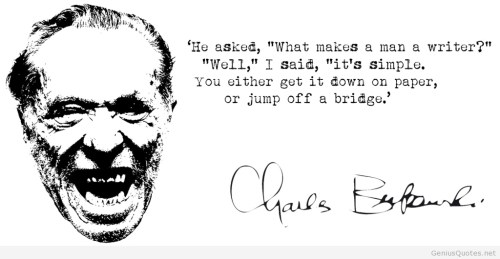
“So You Want To Be A Writer” – Charles Bukowski‏

Charles-Bukowski-quotes

                                                                      ___________
 
 
reading this poem for me was like 
looking into a mirror


if it doesn’t come bursting out of you

in spite of everything,
don’t do it.
unless it comes unasked out of your
heart and your mind and your mouth
and your gut,
don’t do it.
if you have to sit for hours
staring at your computer screen
or hunched over your
typewriter
searching for words,
don’t do it.
if you’re doing it for money or
fame,
don’t do it.
if you’re doing it because you want
women in your bed,
don’t do it.
if you have to sit there and
rewrite it again and again,
don’t do it.
if it’s hard work just thinking about doing it,
don’t do it.
if you’re trying to write like somebody
else,
forget about it.
if you have to wait for it to roar out of
you,
then wait patiently.
if it never does roar out of you,
do something else.

if you first have to read it to your wife
or your girlfriend or your boyfriend
or your parents or to anybody at all,
you’re not ready.

don’t be like so many writers,
don’t be like so many thousands of
people who call themselves writers,
don’t be dull and boring and
pretentious, don’t be consumed with self-
love.
the libraries of the world have
yawned themselves to
sleep
over your kind.
don’t add to that.
don’t do it.
unless it comes out of
your soul like a rocket,
unless being still would
drive you to madness or
suicide or murder,
don’t do it.
unless the sun inside you is
burning your gut,
don’t do it.

when it is truly time,
and if you have been chosen,
it will do it by
itself and it will keep on doing it
until you die or it dies in you.

there is no other way.

and there never was.

                   Charles Bukowski

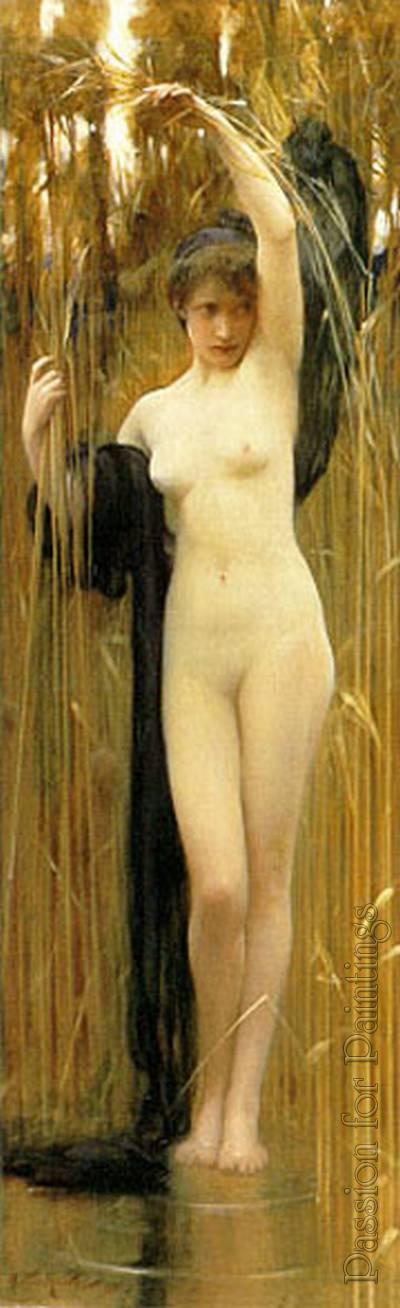
“Syrinx” – Claude Debussy‏

big

         Syrinx (1892)
 
          Arthur Hacker
 
            __________
 
 
though Debussy would’ve called his
Syrinx “Flûte de Pan”, “Pan Flute”,
alas, the name had already been 
taken, he therefore came up with the 
much more inspired Syrinx
 
Syrinx, with the help of other nymphs, 
who’d come at her cry for help as she 
fled the god Pan, a pursuer, had been 
turned into a bush of reeds, its canes 
producing a song so sweet as to 
confound and disarm him, impelling
him to create of them that sublime 
instrument  
 
Hermes had been telling Argus, Argus 
Panoptes, the giant with the hundred 
eyes, the story about the pipes he  
was playing, an implement received 
from Jove, apparently, god of all the 
gods, who wanted him to kill Argus, 
for confining Io, who’d been turned 
into a heifer by Juno, Jove’s wife, 
who’d caught him chasing her, Io’s 
plaintive lows had been getting to 
Juno as Io fretted unfettered through 
the fields too close to Olympus 
 
when Hermes’ music finally closed the
giant’s last two eyes, he beheaded him,
but Juno, in merciful recognition of his
service, however ultimately ineffectual, 
set them into the variegated tail of the 
peacock
 
are you kidding me, I always think when
I read Ovid’s “Metamorphoses”, and am
ever nevertheless entirely enchanted
 
a flute solo had not been composed in
over 150 years when Debussy composed
his Syrinx“, 1913, after C.P.E. Bach’s not  
at all unimpressive Sonata in A Minor 
of 1747, it duly set off a new life for the 
long overlooked flute, a reed which 
Mozart famously didn’t like
 
note the tonal, rhythmic, and repetition 
shifts from the rigid Classical model, 
where these are much more strict, 
Impressionism was not only breaking 
down pictures, the pictorial arts, but its
sound world as well, it was an utterly
new era, new sensibility, new zeitgeist, 
and you can feel it, though you might
not be quite able to immediately 
verbalize it, the arts were again, as
they ever ‘ve been, the canary in the 
gold mine
 
 
Richard
 
psst:
 
   The Transformation of Syrinx into Reeds 
 
Then Hermes thus: A nymph of late there was 
Whose heav’nly form her fellows did surpass. 
The pride and joy of fair Arcadia’s plains, 
Belov’d by deities, ador’d by swains: 
Syrinx her name, by Sylvans oft pursu’d, 
As oft she did the lustful Gods delude: 
The rural, and the woodland Pow’rs disdain’d; 
With Cynthia hunted, and her rites maintain’d: 
Like Phoebe clad, even Phoebe’s self she seems, 
So tall, so streight, such well-proportion’d limbs: 
The nicest eye did no distinction know, 
But that the goddess bore a golden bow: 
Distinguish’d thus, the sight she cheated too. 
Descending from Lycaeus, Pan admires 
The matchless nymph, and burns with new desires. 
A crown of pine upon his head he wore; 
And thus began her pity to implore. 
 
Now while the lustful God, with speedy pace, 
Just thought to strain her in a strict embrace, 
He fill’d his arms with reeds, new rising on the place. 
And while he sighs, his ill success to find, 
The tender canes were shaken by the wind; 
And breath’d a mournful air, unheard before; 
That much surprizing Pan, yet pleas’d him more. 
Admiring this new musick, Thou, he said, 
Who canst not be the partner of my bed, 
At least shall be the confort of my mind: 
And often, often to my lips be joyn’d. 
He form’d the reeds, proportion’d as they are, 
Unequal in their length, and wax’d with care, 
They still retain the name of his ungrateful fair.
 
                                                  Ovid

“Coming into New York” – John Updike‏

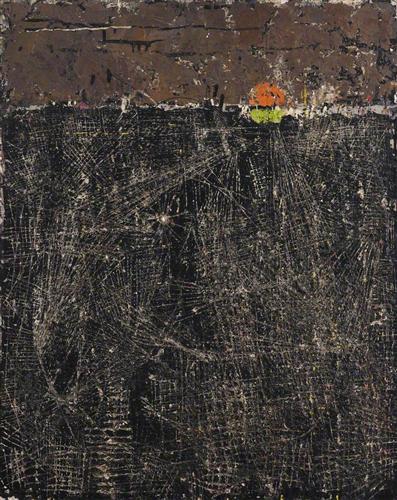
 "The Black City l (New York)" - William Congdon

The Black City l (New York) (1949)

William Congdon

________

at he other end of the continent from
Vancouver there’s New York, perhaps
not [t]he most liveable city on the
planet
but at one point the very
centre of the world, I know, I was
there, Liverpool, with even the
Beatles, had nothing on New York
City then

but that’s before Reaganomics and
Margaret Thatcher, since, Milan,
Tokyo, other cities have gotten into
the act, dulling some of New York’s
resplendence, glamour, magic

from the airport, rather than Updike‘s
Providence, the city buzzes with an
energy for me that’s electric, the
horizon sizzles already with a current
I feel in my skin, like watching bacon
fry, it commands your attention, all
grey, of course, with the washed out
colours of commercial advertisements
the size of buildings lining intermittently
the road in

New York seems a furnace, and it is,
whipping up Dante’s Inferno in all of
its myriad avenues and cells, but also
giving you flashes of Paradiso just
around any corner, the work of
inspiration, imagination, serendipity
and good will, the other side of the
infinitely variable human condition

here’s John Updike‘s equally idiosyncratic
picture of his coming home, however
more apocalyptic

Richard

_________________

Coming into New York

After Providence, Connecticut—
the green defiant landscape, unrelieved
except by ordered cities, smart and smug,
in spirit villages, too full of life
to be so called, too small to seem sincere.
And then like Death it comes upon us:
the plain of steaming trash, the tinge of brown
that colors now the trees and grass as though
exposed to rays sent from the core of heat—
these are the signs we see in retrospect.
But we look up amazed and wonder that
the green is gone out of our window, that
horizon on all sides is segmented
into so many tiny lines that we
mistake it for the profile of a wooded
hill against the sky, or that as far
as mind can go are buildings, paving, streets.
The tall ones rise into the mist like gods
serene and watchful, yet we fear, for we
have witnessed from this train the struggle to
complexity: the leaf has turned to stone.

John Updike


“Vancouver” – Philip Resnick

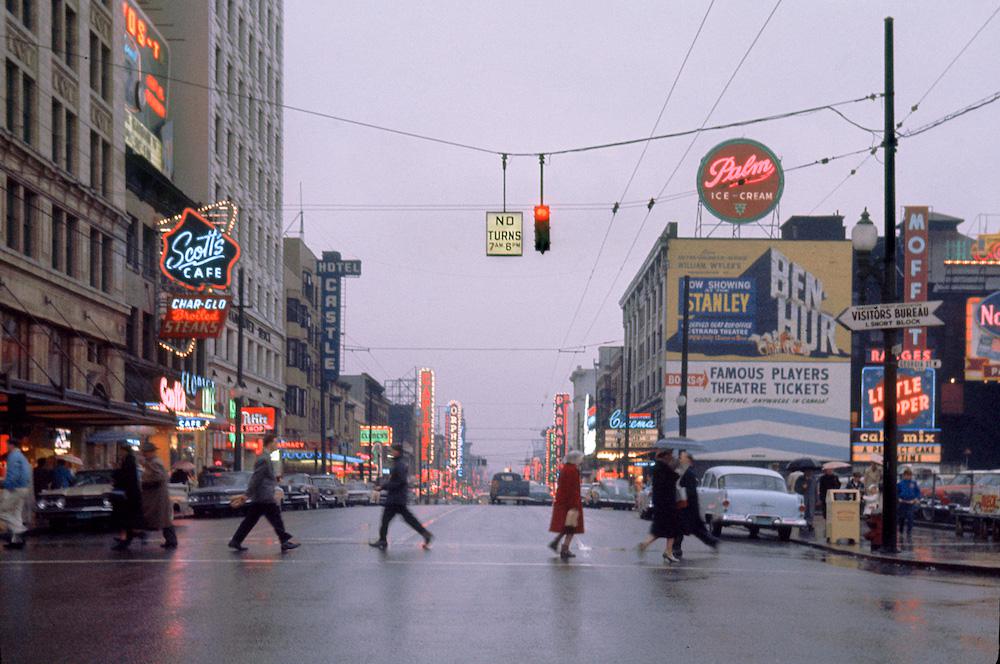
"Crosswalk" - Fred Herzog

Crosswalk (1960)

Fred Herzog

_______

not many poems exalt a city, the first
for me was Sandburg’s Chicago, a
far cry from Shelley, Byron, Keats,
and finally something that I could
sink my teeth into – though pretty,
the earlier, Romantic, poems had
been prissy, effete, skylarks,
Grecian urns, the irrelevant fall of
Babylon to the Assyrians
to me

– a lot of festooned air, I thought,
signifying nearly nothing, despite,
afterwards, its often very clever,
indeed truly inspiring, aphorisms

“Beauty is truth, truth beauty, — that is all
Ye know on earth, and all ye need to know.”

for instance

but I was young then, have gotten through
Romanticism’s idiosyncratic pretensions
to its noble universal heart, maybe ‘ve
even picked up a few of its literary
excesses since, what do you think

here’s one, right up there with Chicago“,
about Vancouver this time, my city

and it’s a dandy, I think

come visit

Richard

_______________

Vancouver

The most liveable city on the planet, they say,
which seems true enough on a mid-August afternoon,
sailboats dotting the bay,
picknickers at crowded beaches
competing for summer heat
and precious square centimetres of sand.
Sunlight casts its spell,
and hearing over and over again
how wonderful you are
has a hypnotic ring to it,
much like lovers gently rocking
to rhythms of the midnight hour
or first sight of running water to the parched.
We who grow old here
have like Cavafy‘s Alexandrians
learned to treat such messages with suspicion.
Those bereft of love
find little compassion betwixt concrete condo towers,
those with few means dwell in the same Inferno’s circles
as the bereft of other cities,
and those in hawk to the god of greed
are no less addicted for living in the suburbs of insatiability.

Philip Resnick

“King John” – Shakespeare‏

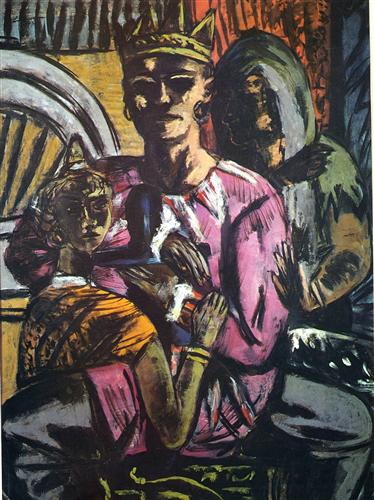
"The King" - Max Beckmann

The King ( 1934 – 1937)

Max Beckmann

_________

King John, 1166 to 1216, was the brother
of Richard the First, “the Lionheart”, and
of Geoffrey, both sons, as well as John,
of Eleanor of Aquitaine and Henry the
Second

you might remember them all from the
classic The Lion in Winter from the
Sixties

in Shakespeare’s story, John has become
king, both Geoffrey and Richard have
already perished, but Geoffrey has left an
heir, Arthur, Constance’s son, and since
Geoffrey had been the eldest, his own son,
it is contested, should be the rightful heir
to the English throne

John is not in agreement, nor is Eleanor,
his mom, but Constance is backed by the
Duke of Austria and the King of France,
who will go to war to unseat John

meanwhile Arthur is too young to be
anything but ineffectual, innocent

they all meet before Angiers, a town
now in France, but ruled then by
England, where a delightful
confrontation occurs at its gates,
the town representative will let in
the King of England but only when
he knows who, of either, He is

war is however averted when a
marriage is suggested between the
two courts, a niece of John, Blanche
of Castille, will marry the Dauphin,
Louis, son of Philip of France,
joining, however improbably, the
two sparring factions

but thereby Arthur’s claim is lost,
and Constance is fully aware of
the inevitable, and treacherous,
consequences

a legate from the Pope, Cardinal
Pandolf, also steps into the fray,
to stir the political pot, pompously,
predictably, punctiliously and
perniciously, not to mention,
perfidiously, in the end, of course

the language is Shakespeare’s, to
be sure, therefore unavoidably
wrought, but with garlands of
irrepressible poetry that is ever
utterly, and irresistibly, enchanting

“I am not mad:”, says Constance to
Pandolf, who’s accused her of being
in such a state

“Lady, you utter madness, and not sorrow.”

Constance replies

“I am not mad: this hair I pull is mine
My name is Constance; I was Geoffrey’s wife;
Young Arthur is my son, and he is lost:
I am not mad: I would to heaven I were!
For then, ’tis like I should forget myself:
O, if I could, what grief should I forget!
Preach some philosophy to make me mad,
And thou shalt be canonized, cardinal;
For being not mad but sensible of grief,
My reasonable part produces reason
How I may be deliver’d of these woes,
And teaches me to kill or hang myself:
If I were mad, I should forget my son,
Or madly think a babe of clouts were he:
I am not mad; too well, too well I feel
The different plague of each calamity.”

act lll, scene lV

has there ever been such a telling
evocation of agony

Stratford’s version is superb, extraordinary,
unforgettable, don’t miss it, just click

Richard

“King Lear” – William Shakespeare

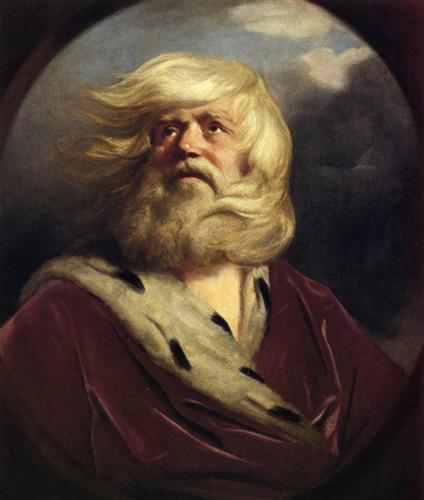
 "Study for King Lear" - Joshua Reynolds

Study for King Lear (1760)

Joshua Reynolds

________

though it has its weaknesses, I have
never seen a better version of “King
Lear”
than this one, also, to my mind,
Shakespeare’s best play

watch

Lear has always been a difficult
character to portray, a King becomes a
vagrant, a Jesus figure, “a man / more
sinned against than sinning”,
and the
most difficult part an actor must render,
I’ve found, is that of social status

and here we have both extremes, a not
easy transition, nor have I seen but once
a Lear I could believe in

James Earl Jones in New York’s Central
Park
is Lear from the word go, but the
rest of the cast betrays him, they all
mostly merely phone in their roles

in this alternate production, the reverse
is true, Lear, though in many moments
mighty, is never really a King, nor truly,
I think, a Jesus, though his final breaths
are nothing short of holy

Cordelia speaks her lines well, but
doesn’t breathe them

every other performer is magnificent,
with a special mention for the truly
human Fool, not merely a caricature
here, but a wise man

also Kent, the vitriolic sisters, Edgar
and his ignominious brother Edmund,
even the several messengers, all of
whom intently and forcefully to a one
live out their roles

the direction is thrillingly manifest in
the solid and detailed work of the cast,
note, for instance, Regan’s laugh, an
inspired directorial touch, when Lear
declares his intention to bequeath
his land according to which of the
daughter’s “doth love Us most”,
relaying in an instant, and at the very
start, her fundamental, and thereafter,
of course, unswerving, unfilial scorn

I’ve never seen that note played
elsewhere so incisively

mostly, however, it’s the poetry of
Shakespeare, which bristles throughout,
like buds in spring in a garden, which ‘ll
especially delight, and have you marvel

watch

Richard


at the XVth International Tchaikovsky Competition – Maria Mazo, ll‏

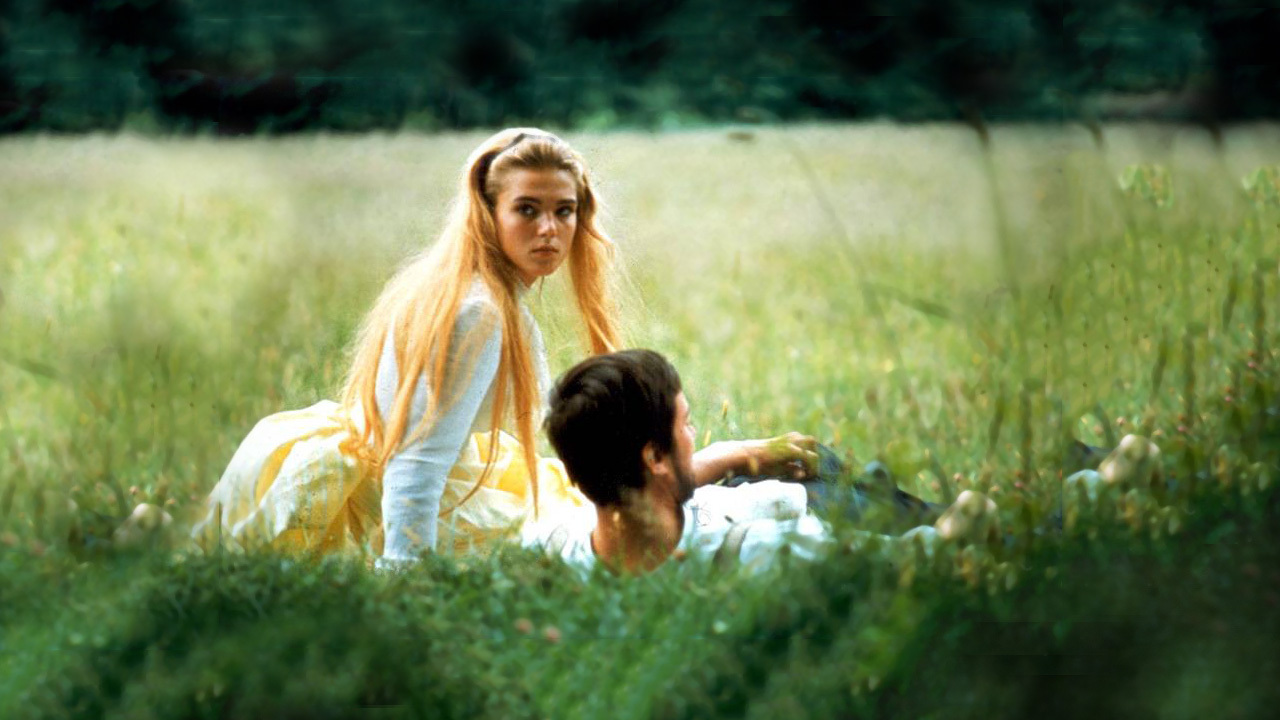
"Elvira Madigan"

a still from the movie “Elvira Madigan

________________

there’s been a second round of
recitals, enough to make you
weary of sonatas, unless you’re
stalwart, devoted, primed

the prizes have been awarded,
the results posted at the site,
so that any mystery, excitement,
has been chilled, had you been
in any way excited about your
choices

they certainly rained on my
parade

by now most of my favourites
have gone down, others have
been perfunctory, to my mind,
but three, which surely I’ll
cover, but presently let me
start with Maria Mazo, a
wonder, who’d wowed me
earlier with her
transcendental Beethoven

here, with an orchestra, she
takes on a monument of the
20th Century, Mozart’s 21st
Piano Concerto, better known
since the mid-20th Century as
the theme to the movie,
Elvira Madigan, a forgotten
film now, however enchanting,
but this is where a generation
learned about Mozart

Maria Mazo sets the new
standard here, this is how
you’ll hear this concerto from
now on, it is magical, it is
mystical, it is extraordinary,
it’s right up there with the
greatest, who are presently
handing over to her our
musical reins

thank you, Mitsuko Uchida,
with the greatest admiration

strangely Maria Mazo didn’t
even place

who could ‘a’ ever thunk it

Richard

“Primavera” – Sandro Botticelli‏

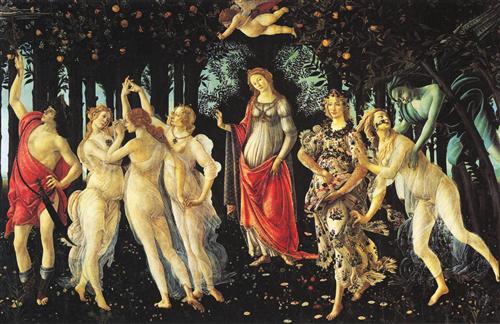
Sandro Botticelli - "Primavera"

Primavera (1478)

Sandro Botticelli

_________

on the right, Zephyrus, god of the west
wind, and messenger of spring, having
prised Chloris from his brother, Boreas,
the icy north wind, ravishes her, the
naked nymph, who is being transformed
into Flora, goddess of flowers, note
Chloris‘ hand dissolving into Flora‘s
arm

but listen to Ovid tell it

“‘I, called Flora now, was Chloris: the first letter in Greek
Of my name, became corrupted in the Latin language.
I was Chloris, a nymph of those happy fields,
Where, as you’ve heard, fortunate men once lived.
It would be difficult to speak of my form, with modesty,
But it brought my mother a god as a son-in-law.
It was spring, I wandered: Zephyrus saw me: I left.
He followed me: I fled: he was the stronger,
And Boreas had given his brother authority for rape
By daring to steal a prize from Erechteus‘ house.
Yet he made amends for his violence, by granting me
The name of bride, and I’ve nothing to complain in bed.
I enjoy perpetual spring: the season’s always bright,
The trees have leaves: the ground is always green.
I’ve a fruitful garden in the fields that were my dower,
Fanned by the breeze, and watered by a flowing spring.
My husband stocked it with flowers, richly,
And said: “Goddess, be mistress of the flowers.”
I often wished to tally the colours set there,
But I couldn’t, there were too many to count.””

Fasti, Book V, May 2 – Ovid

________________

I love “It would be difficult to speak of my
form, with modesty”

go, girl, indeed goddess

on the left of the painting the three Graces,
Aglaea, Euphrosyne, and Thalia dance

on the far left, Mars, whence, incidentally,
our name for the month of March, is god
not only of war, but of also agriculture

Venus, who needs no introduction,
presides at the centre, accompanied
by her prankish son, Cupid, fluttering
above

“Love looks not with the eyes, but
with the mind”, Shakespeare says,
“And therefore is winged Cupid
painted blind” *

as he is in the painting above

no painting has yet replaced Botticelli‘s
Primavera as a universal symbol of
spring

may yours be equally timeless,
enchanted

Richard

* A Midsummer Night’s Dream
Act 1, scene 1, lines 234 – 235

– William Shakespeare

“Riposte to Ode” – Michael Homolka‏

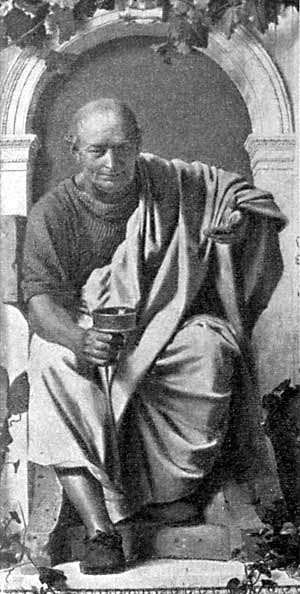
Anton von Werner - "Horace"

Horace

Anton von Werner

______

Riposte to Ode

It isn’t like that Horace Life stresses us out
However many hundreds of decades later we’re told
to welcome anxiety is beneficial
and to quote honor our imperfections

You’ve got the Adriatic Sea We’ve got what
the Finger Lakes? Not quite as conducive
to worrying the infinite question so we worry
about other things equities statistics

I’m not really a wine man either
not in the unmixed sense where Alcibiades
might barge in any moment and out-naked us all
I’m an American so I prefer pig iron

Wildflowers abound somewhere I’m sure
I don’t know anything about flowers though
Few of us in the cities follow them
the way you seem to as if tracking currencies

But to speak to your point about an actual
battlefront approaching Main Street who knows?
Maybe we would resort to hookers and crack
per your suggestion I can’t say Horace I wish I could

Michael Homolka

______________

which “Ode” remains a mystery, so
one should suppose Michael Homolka
is “ripost[ing]” to Horace’s entire body
of odes, he wrote four books of them,
23 – 11 B.C.E., during the time of
Augustus

I found the Odes too steeped in
Roman and mythological arcana to
follow their uneasy referents, too
esoteric, I thought, to even look
them up, seems Michael Homolka
thought the same

but his Ars Poetica“, if you’ll pardon
the expression, spoke directly to my
heart, On style“, “On metre“, on
How to be a good poet“, for
instance, topics I find irresistible

you’ll note that whereas I’ve used
commas ever to indicate pauses
in what I write, Homolka uses
spaces, if you’ll allow me that,
perhaps immodest, conjunction,
you’ll find these in his original
copy
, WordPress won’t allow me
that, click here for that original
copy

he also allows himself question
marks, something I never do

go figure

you’ll also note his dramatic
monologue, my favourite, if
you haven’t already done so

Richard

psst: “None knows the reason why this curse
Was sent on him, this love of making verse.” – Ars Poetica“, line 470