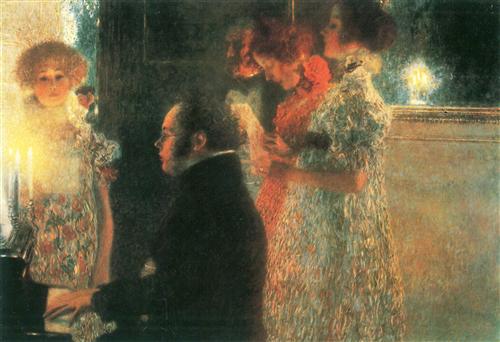
“Schubert at the Piano” (1899)
________
the Filarmonica Quartet, which I’d earlier described
as “not at all unimpressive”, show themselves here,
performing Schubert‘s otherworldly String Quintet
in C major, D 956, to be the very sound of those
angels Schubert calls upon to perform his
miraculous music
their hometown Novosibirsk audience will continue
however to stubbornly, shamelessly, cough, in
scattered places, though the angels themselves,
the players, seem not especially distraught, they
play with great conviction, patience and tolerance
throughout superbly, caught up surely in their own
Schubertian Nirvana, a not uninstructive response
the Filarmonica Quartet of course will need a fifth
to play with them a quintet, who is, I think, the
extra cello at the front on the right, uncredited,
the piece calls for two violins, a viola and two
cellos, instead of the standard, at the time, extra
viola, surely for their greater and more resonant
chthonic character, which is to say, triggered by
the very earth
Franz Schubert, 1797-1828, died much too young,
only 31, this piece was completed not two months
before he passed away
it is also therefore a very haunting last testament
Richard
psst: D is for Otto Erich Deutsch
on a day of commemoration, or at a moment even of
merely contemplation, perhaps it’s not a bad idea to
revisit Shostakovich’s String Quartet no 15, in E flat
minor, opus 144, his flurry of mournful adagios, his
string of stately dirges, his penetrating meditation
on mortality
complete this time around, on one only site, though
just a short while ago indeed I said it wasn’t to be
found, March 28, 2012, again I was wrong
today it stood, perhaps not coincidentally, directly
before me as I clicked onto my list of music,
unadulterated, intact, complete, apart from an
irrtating audience member coughing at one point,
unforgivably, for marring so sincere an expression
of fervent string sounds, though only momentarily
by the “Filarmonica” Quartet, of Novosibirsk, Russia,
a city just north of Mongolia and Kazakhstan, the
players are not at all unimpressive
accompanying images are apparently of Russian
inspirational countryside nearby, and of
neighbouring Mongolia
Richard
“Russisches Ballett (I)“ (1912)
several years ago when an angel I knew passed away
I read at his commemoration something I had written
for him, adagios, I said, always remind me of John
only a few days later, after I’d spoken, an adagio in
the distance was weaving its magic spell as I
abstractedly washed perennial dishes, a pivotal
spot, it would appear, for me, in my mystic
wanderings, my spiritual peregrinations
gradually I recognized the presence I’d apparently
inadvertently evoked with my unsuspecting but
thoughtful and caring script, opening a key, like
Ali Baba, it would transpire, to the very undiluted
infinite, something I’d wished for from my dad,
who’d died just a few months earlier, promising
me he’d speak to me if he could, though by then
I hadn’t yet heard from him
later when I was browsing for music to get into
to while away my pensive hours I happened upon
some Shostakovich in a nearby record store, I’d
recently been exploring his stuff, having reached
forward from the Romantics and even the
Impressionists, and looked to a relatively more
recent touch, the early Twentieth Century
which is to say the atonalists, Schoenberg, Berg,
Stravinsky and so forth, of which Shostakovich,
I would argue, has proven to be the most
significant voice, his music being that of a
desperate, nearly broken people enduring
the atrocities under Stalin
he is the most important composer of the
Twentieth Century, I think, along with Olivier
Messiaen, who survived a German prisoner of
war camp, two tough, even heroic, spirits
and here were not one, not two, not even three,
but six adagios in his 15th String Quartet, when
anything faster was too much for me to bear,
otherwise it would have to have been silence,
I was elated
I was not let down, Shostakovich’s 15th String
Quartet, opus 144, is a masterpiece, and helped
me through my rigorous Calvary with compassion,
grace, and ultimately golden hope, to health and
resignation
it is not an easy piece, you might find it
overwhelming, but it is the last word in adagios,
and for me it means the world, I couldn’t leave
it out
I found the distribution awkward however, I
haven’t found the quartet complete anywhere
on the Internet, you’ll have to access the movements
separately, pee breaks are therefore allowed, there
are six movements, not usual but we’ve seen
Beethoven do five already for his Sixth Symphony,
so not entirely unexpected
the first movement, Elegy (Adagio), is played by the
Rubio Quartet, but with only an image of war torn
Leningrad to inspire visually
the second, Serenade (Adagio), by the Borodin String
Quartet, perhaps Shostakovich’s best interpreters, are
also presented visuals inert
the third, fourth, and fifth – Intermezzo (Adagio),
Nocturne (Adagio), and Funeral March (Adagio molto) –
in that order, are played live by the Shostakovich
Quartet, named of course in the composer’s honour
and the sixth, Epilogue (Adagio), again by the Borodin
may you be granted the poise and profound grace
of the adagio
Richard