Richibi’s Weblog

Just another WordPress.com weblog

Category: poems to ponder

“One Last Poem for Richard” – Sandra Cisneros

One Last Poem for Richard

December 24th and we’re through again.
This time for good I know because I didn’t
throw you out — and anyway we waved.
No shoes. No angry doors.
We folded clothes and went
our separate ways.
You left behind that flannel shirt
of yours I liked but remembered to take
your toothbrush. Where are you tonight?

Richard, it’s Christmas Eve again
and old ghosts come back home.
I’m sitting by the Christmas tree
wondering where did we go wrong.

Okay, we didn’t work, and all
memories to tell you the truth aren’t good.
But sometimes there were good times.
Love was good. I loved your crooked sleep
beside me and never dreamed afraid.

There should be stars for great wars
like ours. There ought to be awards
and plenty of champagne for the survivors.

After all the years of degradations,
the several holidays of failure,
there should be something
to commemorate the pain.

Someday we’ll forget that great Brazil disaster.
Till then, Richard, I wish you well.
I wish you love affairs and plenty of hot water,
and women kinder than I treated you.
I forget the reason, but I loved you once,
remember?

Maybe in this season, drunk
and sentimental, I’m willing to admit
a part of me, crazed and kamikaze,
ripe for anarchy, loves still.

Sandra Cisneros

_____________

Sandra Cisneros is in a direct line from
Elizabeth Barrett Browning, you’ll note,
from the Romantic Age through to the
XXlst-Century emancipation and
independence of women, Elizabeth could
never ‘ve so cavalierly abandoned a lover
in fiction, much less fact, in the Romantic
Age, not to mention two, or three, maybe
even, gallants, any more being, of course,
unthinkable, without dire consequences,
often suicide, see Anna Karenina, Madame
Bovary, the lot, for details, Violetta Valéry
in “La Traviata”

what remains however is the stark,
emotionally driven truth of their
declarations before either of
their consorts

the Romantic ideal still burns bright, in
other words, in our cultural imagination,
see even my own derivations

Richard
Brice Maiurro/John Donne on bugs‏

who says poetry isn’t supposed to be delightful,
poetry is delightful, exhilarating, inspirational,
the good stuff is 
 
I couldn’t resist sending again some utterly
ingenious Brice Maiurro, an absolute wunderkind
in my estimation, consistently artful and unfailingly
entertaining, topical, terse and dependably
insightful ever 
 
John Donne seemed an obvious comparison to me
here 
 
Brice Maiurro sees no reason not to swat the fly
apart from their equally existential, and essentially
blameless each, journey
 
John Donne is after the girl, the fly is the conjunction
of their blood, “suck’d” from each, and therefore
sacred, a “marriage temple”, he calls it, though she
remains apparently unimpressed
 
literary history however was, and is, and I, for at least
one, had never forgotten it, him  
 
nor probably them
 
thanks Brice, thanks John   
 
 
Richard  
 
                       ____________________


1.

as i watched
this fly
land on the beer
on my dresser
he clasped his hands
together

this fly
prays more than
i do

2.

he swarms
around my head
and near my ears
as my blood boils
and i think about
murder

he just wants
attention

he just wants
to be seen
and heard
and loved

3.

how come
i never
encounter a fly
when other people
are around?

4.

this fly moves
in a severely unorthodox way
zig-zagging
and writing through the
stale air

either he governs
his own motion
or something else does

he lands
just to take off again
he goes
to the same place
twice

there is a method
to his madness
i don’t know what

what keeps him
doing the
same quaint thing
over
and again?

5.

if i swat at him
recklessly
i will never kill him
i have to watch him

i have to understand him
at least a little
if i want to absolve him
of his horrid fly life

(is it horrid?
i can’t fly.)

he grows to trust me
it feels like:

he lands on my bed
then the fabric
of my pajamas
then my knee
then my bare chest

6.

after i killed him
i lifted my pillow
where i found him dead

i picked up his lifeless corpse
and his legs moved
pain
i euthanized him
from the suffering i began
and set him outside
of my window

i’m not cut out for this

life is so big
and i’m flying desperately
in chaotic patterns
landing in the same spot
over and again

 
              Brice Maiurro  
 
            ______________________


Mark but this flea, and mark in this,
How little that which thou deniest me is ;
It suck’d me first, and now sucks thee,
And in this flea our two bloods mingled be.
Thou know’st that this cannot be said
A sin, nor shame, nor loss of maidenhead ;
     Yet this enjoys before it woo,
     And pamper’d swells with one blood made of two ;
     And this, alas ! is more than we would do.

O stay, three lives in one flea spare,
Where we almost, yea, more than married are.
This flea is you and I, and this
Our marriage bed, and marriage temple is.
Though parents grudge, and you, we’re met,
And cloister’d in these living walls of jet.
    Though use make you apt to kill me,
     Let not to that self-murder added be,
     And sacrilege, three sins in killing three.

Cruel and sudden, hast thou since
Purpled thy nail in blood of innocence?
Wherein could this flea guilty be,
Except in that drop which it suck’d from thee?
Yet thou triumph’st, and say’st that thou
Find’st not thyself nor me the weaker now.
    ‘Tis true ; then learn how false fears be ;
    Just so much honour, when thou yield’st to me,
    Will waste, as this flea’s death took life from thee 


                                                John Donne  (1572-1631) 


“EDWARD HOPPER*” – Brice Maiurro‏

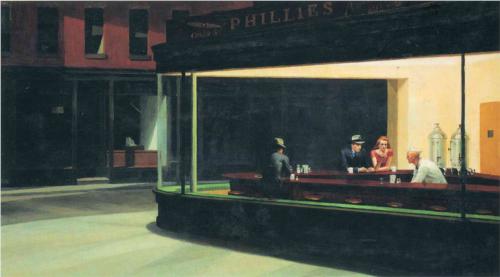
nighthawks.jpg!Blog

Nighthawks (1942)

Edward Hopper

___________

here‘s another gem from Brice Maiurro, of which
there are many, too many to daily share, I’d
sound like too much of an addled fan, or worse,
an unbridled sycophant, though soon that might
be already too late

I’ll commend you rather to his rich and growing
website, FLASHLIGHT CITY BLUES, ardently

the following poem ‘s to do with Edward Hopper,
remember Edward Hopper, for the sake of, nudge,
nudge, always revelatory comparison

EDWARD HOPPER*” is an ekphrastic poem

ekphrasis is poetry about art,
that’s where I got my formal start,
my poetry is still trying to sprout
wings under my perhaps too literal prose

Richard

______________

EDWARD HOPPER*

*based on the notes of American artist Edward Hopper and his wife Jo

Night
+ brilliant interior of
cheap restaurant.

Bright items:

cherry wood counter
+ tops of surrounding
stools; light on metal tanks
at rear right;

brilliant streak
of jade green tiles
3/4 across canvas-
at base of glass
window
curving around the
corner.

Light walls,

dull
yellow
ocre
door
into kitchen right.

Very good looking
blond boy
in white (coat, cap)
inside counter.

Girl in red blouse,

brown hair

eating sandwich.

Man night hawk
(beak)
in dark suit,
steel grey hat,
black band,
blue shirt (clean)
holding cigarette.

Other figure
dark
sinister
back-
at left.

Light side walk
outside
pale greenish.

Darkish red brick
house opposite.

Sign across
top of restaurant,
dark-
Phillies 5c cigar.

Picture of cigar.

Outside of shop dark,
green.

Note:
bit of bright
ceiling
inside shop

against dark of
outside street

-at edge
of stretch
of top
of window.

Brice Maiurro

“A Girl Named America” – Brice Maiurro‏

Brice Maiurro‘s A Girl Named America
does for America what Carl Sandburg‘s “
Chicago” did for Chicago

it becomes your picture, condensed and easy
to fit into your pocket, of then, Chicago, here,
America now

only a great poet can do that

wow

Richard

_______________________

A Girl Named America

we adopted this girl
from an orphanage in the middle of nowhere
and we named her america
and we made her america
and we made her pretty
we put her hair in curlers
and we dyed it blonde
we put her in a pink dress
and red rouge
we taught her how to walk in heels
and how to smile with vaseline on her teeth
we made her eyes blue
and we threw her out on stage

and she was our little princess
with her sparkling tiara
queen of this old beauty pageant
she juggled and she sang
and she twirled her baton
like the american flag

we taught her how to barely eat anything
we showed her how to fold her napkin
and to excuse herself from the table
we taught her to cross her legs like a lady
we never stopped teaching her how to win

and on the world stage, she smiled
and she danced and she sang and she smiled
and when she spoke, she spoke of charity
and freedom and she opened her arms
for the world to hug her

then she got older
and the world is cruel
and everyone got sick of her
saying the same scripted things
again and again
and she grew desperate for attention
she got naked on the silver screen
burnt herself into an edie sedgewick coma
made a million off her tragedy

she danced for dollars
thrown by old, rich, white, american men
she still smiled like marilyn
but she was dying where everyone could watch
she talked about the past like a drug she loved
she shot quick fixes into her fragile arms

meanwhile
her lovely bones turned to dust
her structure began to break
her knees cracked
and her backbone crumbled
while we yelled at her
to get out on stage
and dance like she used to

Brice Maiurro

__________________________

Chicago

Hog Butcher for the World,
Tool Maker, Stacker of Wheat,
Player with Railroads and the Nation’s Freight Handler;
Stormy, husky, brawling,
City of the Big Shoulders:

They tell me you are wicked and I believe them, for I have seen your painted women under the gas lamps luring the farm boys.
And they tell me you are crooked and I answer: Yes, it is true I have seen the gunman kill and go free to kill again.
And they tell me you are brutal and my reply is: On the faces of women and children I have seen the marks of wanton hunger.
And having answered so I turn once more to those who sneer at this my city, and I give them back the sneer and say to them:
Come and show me another city with lifted head singing so proud to be alive and coarse and strong and cunning.
Flinging magnetic curses amid the toil of piling job on job, here is a tall bold slugger set vivid against the little soft cities;
Fierce as a dog with tongue lapping for action, cunning as a savage pitted against the wilderness,
Bareheaded,
Shoveling,
Wrecking,
Planning,
Building, breaking, rebuilding,
Under the smoke, dust all over his mouth, laughing with white teeth,
Under the terrible burden of destiny laughing as a young man laughs,
Laughing even as an ignorant fighter laughs who has never lost a battle,
Bragging and laughing that under his wrist is the pulse, and under his ribs the heart of the people,
Laughing!
Laughing the stormy, husky, brawling laughter of Youth, half-naked, sweating, proud to be Hog Butcher, Tool Maker, Stacker of Wheat, Player with Railroads and Freight Handler to the Nation.

Carl Sandburg

how to read poems – Maiurro, Spiro Wagner

How to Read a Poem: Beginner’s Manual
by Pamela Spiro Wagner has been a model
of effective, which is to say inspiring, poetry
for me for a long while, calling out as it does
pretentiousness around verse, and having
verse mean something, something you can
understand and relate to, in a way that is
potent and beautiful, resonant, ever tolling,
extolling, stirring profoundly, like a
conscience, or an echo

but here is another voice that will not let you
pass it by, Brice Maiurro, and in more than
just one poem, How to Read My Poems
is a good place, however, to start

check out also his significant others

this man is incontrovertibly a poet, the very
voice of a generation, I believe, Brice Maiurro
is what presently, I think, is happening

a cardinal rule for me of aeshtetic consideration
is ever to juxtapose, be it art, music, poems –
these are all essentially conversations among
acolytes – in order to be able to consider
differences, it is in the interstices that the artist
flourishes, the personal, and telling, touches,
their foundational stories most often remain
the same

How to Read My Poems and How to Read
a Poem: Beginner’s Manual
are both equally
powerful exhortations, each resounding mightily
above the generally less compelling fray, read
them and listen to what they’re saying, they
are messengers, oracles, of nothing less than
harmony and compassion, better known
together as grace

Richard

________________________

How to Read My Poems

slink up
behind them
in the stale of
night
with a baseball bat
with nails
sticking out of the end
and bash them in the
head
like a zombie
terrorizing your childhood
home.

do not listen
to their
bullshit.

bitch back.

stomp
on their
toes.

poison
their drinking
water.

let the fucking
curse words shout
at their
stupid
fucking
faces like
unintentional spitwads

but don’t
talk
behind their backs.

my poems
keep their friends close,
but their enemies
even
closer

Brice Maiurro

____________________________

How to Read a Poem: Beginner’s Manual

First, forget everything you have learned,
that poetry is difficult,
that it cannot be appreciated by the likes of you,
with your high school equivalency diploma,
your steel-tipped boots,
or your white-collar misunderstandings.

Do not assume meanings hidden from you:
the best poems mean what they say and say it.

To read poetry requires only courage
enough to leap from the edge
and trust.

Treat a poem like dirt,
humus rich and heavy from the garden.
Later it will become the fat tomatoes
and golden squash piled high upon your kitchen table.

Poetry demands surrender,
language saying what is true,
doing holy things to the ordinary.

Read just one poem a day.
Someday a book of poems may open in your hands
like a daffodil offering its cup
to the sun.

When you can name five poets
without including Bob Dylan,
when you exceed your quota
and don’t even notice,
close this manual.

Congratulations.
You can now read poetry

Pamela Spiro Wagner

Evgeny Kissin – a bouquet of composers‏

midway in my considerations about music I
came to myself in a dark wood for the straight
way was lost, if I may paraphrase Dante for my
own purposes, I’d digressed to Elizabeth Barrett
Browning, Audrey Hepburnand others, and
forgot what I had been talking about with
respect to the development of music, but have
been wonderfully, and perhaps even karmically, 
put back on track by this correspondingly 
 
Evgeny Kissin had provided a resplendent
haven’t yet finished enjoying often, but
found among his other Internet offerings
 
 
at first I wondered about the Schubert/Liszt
connection in the written introduction to the
program, they’d been united by a forward
slash, implying that there’d been some kind
of cooperation, but I hadn’t ever heard of
those two ever meeting  
 
upon very little investigation however I found
out that Liszt had merely transcribed of course
some of the Schubert lieder, something which 
Liszt was wont to do, Liszt transcribed
everybody and everything, most famously all
of Beethoven’s symphonies, writing them
up for piano only, so that more remote areas
could also enjoy them, in often even there 
aristocratic salon settings
 
lieder are songs in German, a lied, a song,
works Schubert produced in astonishingly
great number
 
 
Liszt was paraphrasing Schubert for his own 
Lisztian purposes of course, artists do that, 
which is to say he was giving them much
more Lisztian fanfare and, not unwelcome,
I might add, extravagance, Schubert could
be pretty dry, I think, in his lieder,
uncharacteristically, even his fun ones, 
despite their being ever so eminently
 
 
und der Bach  from Die schöne Müllerin“, one
of his song cycles,Ständchen” from
Schwanengesang“, another cycle, Gretchen
 am Spinnrade“, and Erlkönigare all poems
of celebrated German poets Schubert set for
accompanied voice, and that Lizst, and Kissin,  
transform into something pretty special   
 
 
next on the program Schubert takes independent
flight with his wondrous “Wanderer” Fantasy,
opus 15, D760
 
 
a fantasy is not a sonata for having only one
movement, but note this fantasy goes through
all the motions of a sonata, fast, slow, fast, each
with its own structural contrasts, but without
any of the intervening pauses
 
so is a fantasy just a sonata without breaks, or is
a sonata just a fantasy with hiatuses, had the
sonata become a fantasy, had the fantasy
become a sonata, definitions were being
upended, then again that’s what revolutions
are about
 
before Beethoven this had been unheard of
when music hadn’t yet learned to actually talk,
mean something, Schubert, like Beethoven,
not only talks, not only narrates, as in for
 “Pastoral“,  nor either describes, as in
but actually speculates, ponders, moves 
metaphysically forward, in thrall to his
vagabond spirit much more than to his
wayward heart 
 
hence, incidentally, the more abstract, less
geographical, “Wanderer”, to compare with
for instance Liszt’s more panoramic
see also Caspar David Friedrich here for 
a close contemporary counterpart of his
in art
 
 
music has become no longer merely narration 
then but philosophy, it is finding its way like
the rest of us, and for the rest of us, to the
stars 
 
 
Bach then intervenes here with a Siciliana, a
Baroque composer in Kissin’s Romantic
clothing, but the shoe entirely fits, and
hauntingly, you’ll remember Bach was
composing for the harpsichord, which
had none of the piano’s resonance 
 
 
Brahms then returns us to a more abstruse
Romanticism, “7 Fantasies”, his opus 17,
pushes the limits of melodic continuity, you
can’t sing Brahms, you’re not even drawn to     
 
seven fantasies in one opus, incidentally,
suggests a sonata with seven movements,
with all of the permutations that have been  
suggested already for the fantasy I talked
about, it’s open season on sonatas, in
other words, and by extension their less
segmented fantasies  
 
it is the history of art 
 
 
the final piece is totally transcendent, some
incidental music from Glück, from his sublime
Orfeo ed Euridice“, one of my very favourite
operas, Orpheus approaches the Underworld
in order to retrieve his beloved bride, we are
about to enter the Elysian Fields, the actual,
original Champs Élysées, or Elysium, with
him, the moment is unforgettable
 
others have led us into the Underworld, most
notably Homer in the “Odyssey“, Virgil in the
Aeneid“, and of couse, somewhat more
recently but just, Dante in his Divine Comedy“,
even Bosch in his Garden of Earthly Delights”  
 
Glück is the one whose hereafter you won’t
not  remember  
 
 
Richard


un-still lifes‏

 
  Fairy tale. Garden of Eden. - Martiros Saryan
 
                                           Fairy tale. Garden of Eden (1904)

                                                           Martiros Saryan    
   
                                                               __________
                                                                                                                                                                                                                                         
 
animals are also poems, just by even standing
there
 
 
well, mammals, I meant, and, of course, birds 
 
 
Richard
 
psst: sometimes I think that the Fall from the Garden
           of Eden is not behind us but before us, we are
           the cancer, we are the terror, we have eaten
           irresponsibly from the Tree of Knowledge, not
           for better but for, too often it would appear,
           unfortunately, worse


“Song of the South”‏ – Walt Disney

it’s been over fifty years since I’ve seen this movie,
never thought I’d see it again but now for the magic
of the Internet, the boundless trove of irreducible
treasures, like those in Ali-Baba’s caves, or the
attics of our ancestors, stowed away, open again
to our poetic or otherwise imaginations, at our
very fingertips
 
I remembered this movie to be wonderful, moving,
but not much else, except for the Zip-A-Dee-Doo-
Dah” theme, which is unforgettable, and a single
plot twist it would be unchivalrous to divulge 
 
it has apparently been controversial, and is
presently banned, it would appear, in cinemas,
but it would be to my mind as racially insensitive
as “Huckleberry Finn”, “Tom Sawyer’, or even
“Gone with the Wind” have been, when they
were patently giving voice rather to a shocking
human cultural, and political, abomination, 
however awkwardly, that is still powerfully,
shamefully, even manifestly, resonant
 
this is not a universal, note, condition, every
season for any culture has its bugbears, its
demons and monsters, and woe to the
unfortunate and inadvertent victim 
 
 
in perhaps his most wonderful movie, and there
were quite a few, Song of the South“, Walt Disney 
lets us know that we’re all in this together, and
that kindness meets kindness in everyone, when
you open your heart 
 
and that the reverse is horrible 
 
 
Walt Disney is of course one of the great cultural
influences of the 20th Century, dismissed among
the titans as merely for kids
 
Walt Disney will be for an entire generation the
place where we learned our moral ABCs, much
more than in the dire Bible
 
as such he’s no less significant an artist, not at
all less significant, than Monet, Picasso, for
instance, Beethoven, Shakespeare, in shaping
our present moral and aesthetic world 
 
 
you’ll need some Kleenex 
 
 
you can also sing along 
 
 
Richard 
 
psst: filmed, I’m sure, right here in beautiful Stanley
         Park behind my place in Vancouver, even the
         animated portions    


“Années de pèlerinage” – Franz Liszt

                                                                                                                                                      Franz Liszt (1811 – 1886)

    Années de pèlerinage 

         Première année: Suisse (published in 1855)

                1 Chapelle de Guillaume Tell
                2 Au lac de Wallenstadt
                3 Pastorale
                4 Au bord d’une source
                5 Orage
                6 Vallée d’Obermann
                7 Églogue
                8 Le mal du pays
                9 Les cloches de Genève

 
                                    Alfred Brendel, pianoforte
 
 
          Deuxième année – Italie (published in 1858)
 
                   1 Sposalizio
                   2 Il Pensieroso
                   3 Canzonetta del Salvator Rosa 
                   4 Sonetto 47 del Petrarca
                   5 Sonetto 104 del Petrarca
                   6 Sonetto 123 del Petrarca
                   7 Après une lecture du Dante. Fantasia quasi una Sonata
 
 
                                           Lazar Berman, piano


         Troisième année  (published in 1883)
 
                1 Angélus! Prière aux anges gardiens
                2 Aux cyprès de la Villa d’Este I 
                3 Aux cyprès de la Villa d’Este II
                4 Les jeux d’eaux à la Villa d’Este
                5 Sunt lacrymae rerum
                6 Marche funèbre
                7 Sursum corda

 
                                            Lazar Berman, piano
 

                                      ___________________________


music as literature


Richard


XXlV. Let the world’s sharpness, like a clasping knife – Elizabeth Barrett Browning

notice: the following, I suspect, is for poetry lovers
only, others will likely want to roll their eyes
at my idiosyncratic choices and preoccupations
and delete what I perceive nevertheless and
mean always to be priceless gifts

such is my eccentricity

Richard

psst: one person’s gift however could be another’s
burden, admittedly, meat be their even poison

_________________

from Sonnets from the Portuguese

XXlV. Let the world’s sharpness, like a clasping knife

Let the world’s sharpness like a clasping knife
Shut in upon itself and do no harm
In this close hand of Love, now soft and warm,
And let us hear no sound of human strife
After the click of the shutting. Life to life –
I lean upon thee, Dear, without alarm,
And feel as safe as guarded by a charm
Against the stab of worldlings, who if rife
Are weak to injure. Very whitely still
The lilies of our lives may reassure
Their blossoms from their roots, accessible
Alone to heavenly dews that drop not fewer;
Growing straight, out of man’s reach, on the hill.
God only, who made us rich, can make us poor.

Elizabeth Barrett Browning

_____________________

it had been pointed out in my poetry class at
university, where our supposed greater maturity
would allow us now to peruse somewhat more
prurient texts, that the compass in John Donne‘s
Valediction was, well, prurient, however, to my
mind, at the very least then, eccentric

much like Elizabeth Barrett Browning‘s “clasping
knife”
in her XXlVth sonnet here

all that to our much more jaded XXlst-Century
amusement, we are never ever now so circuitous,
coy, nor were any of us even back in my
mid-XXth-Century teens, D.H. Lawrence had
already irreversibly made courtship graphic,
for better, as in any contract, or for worse

and the beat goes on

Richard

psst:

A Valediction Forbidding Mourning

As virtuous men pass mildly away,
And whisper to their souls to go,
Whilst some of their sad friends do say,
“Now his breath goes,” and some say, “No.”

So let us melt, and make no noise,
No tear-floods, nor sigh-tempests move ;
‘Twere profanation of our joys
To tell the laity our love.

Moving of th’ earth brings harms and fears ;
Men reckon what it did, and meant ;
But trepidation of the spheres,
Though greater far, is innocent.

Dull sublunary lovers’ love
—Whose soul is sense—cannot admit
Of absence, ’cause it doth remove
The thing which elemented it.

But we by a love so much refined,
That ourselves know not what it is,
Inter-assurèd of the mind,
Care less, eyes, lips and hands to miss.

Our two souls therefore, which are one,
Though I must go, endure not yet
A breach, but an expansion,
Like gold to aery thinness beat.

If they be two, they are two so
As stiff twin compasses are two ;
Thy soul, the fix’d foot, makes no show
To move, but doth, if th’ other do.

And though it in the centre sit,
Yet, when the other far doth roam,
It leans, and hearkens after it,
And grows erect, as that comes home.

Such wilt thou be to me, who must,
Like th’ other foot, obliquely run ;
Thy firmness makes my circle just,
And makes me end where I begun.

John Donne