Richibi’s Weblog

Just another WordPress.com weblog

Category: poems to ponder

“The Poet’s Calendar” (February) – Henry Wadsworth Longfellow‏

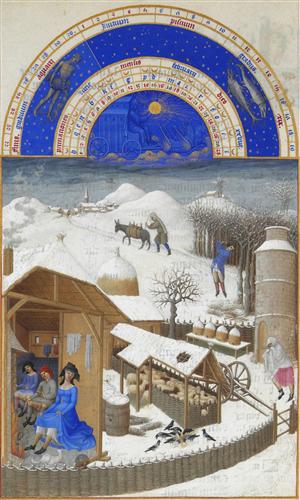
 "Facsimile of February: Farmyard Scene with Peasants" -  Limbourg brothers

Facsimile of February:
Farmyard Scene with Peasants

the Limbourg brothers

___________

if there are paintings about February,
there must be poems about February,
I thought, hence the following entry,
though preceded by a belated January,
or Janus, as it turns out, held back by
nothing other, surely, than the “fields
with snow”, the “frosts”, and the
fowl-filled “frozen fen”

both are from a very calendar of
poems by Henry Wadsworth
Longfellow
, whom I’ve always
imagined tall, however
inappropriate, kind of like thinking
that because my name is Richard
I’m rich

it’s called, appropriately enough,
The Poet’s Calendar, just click

January

Janus am I; oldest of potentates;
Forward I look, and backward, and below
I count, as god of avenues and gates,
The years that through my portals come and go.
I block the roads, and drift the fields with snow;
I chase the wild-fowl from the frozen fen;
My frosts congeal the rivers in their flow,
My fires light up the hearths and hearts of men.

February

I am lustration, and the sea is mine!
I wash the sands and headlands with my tide;
My brow is crowned with branches of the pine;
Before my chariot-wheels the fishes glide.
By me all things unclean are purified,
By me the souls of men washed white again;
E’en the unlovely tombs of those who died
Without a dirge, I cleanse from every stain.

Henry Wadsworth Longfellow

March will have to wait

Richard

psst: lustration is a purification, Janus, the
god with two faces, who can see
backwards and forwards, fen,
marshland
Bill and Flossie Williams

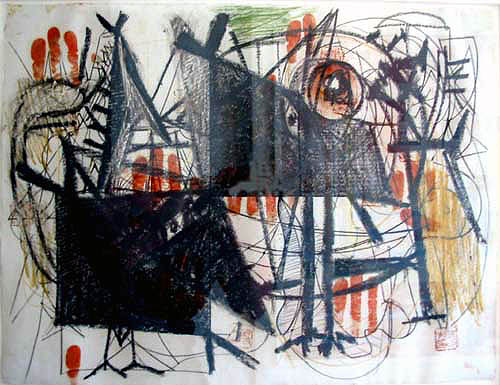
Arshile Gorky - "Hitler invades Poland" (1939)

Hitler Invades Poland (1939)

Arshile Gorky

________

it must be understood that World War l
changed everything, the old order,
orders, had been discredited, new
states were formed, territories allotted,
-isms proliferated, the arts had to, of
course, reflect that, and did, as many
-isms were hatched in the art world
as in the political world, indeed,
many more

which is why much of it at first
seems questionable, practitioners
were learning anew how to talk, paint,
make music, they were creating a new
conceptual universe to replace the one
that had been roundly discredited, the
one that had been around in the West
for the last two thousand years

therefore Schoenberg, therefore
Picasso, and therefore Finnegan’s
Wake
“,
for instance

we’ve been studying American
Modernists in the classes on the
Internet I’m taking
, none of whom
I find interesting, and I’m, contrary
to all expectations, losing even my
early enthusiasm for the much too
thorny, I think, Emily Dickinson

but here’s another abstruse poet
that I like in this poem

though I much prefer his wife
Flossie’s sardonic reply
, which
follows

________________

This Is Just To Say (1934)

I have eaten
the plums
that were in
the icebox

and which
you were probably
saving
for breakfast

Forgive me
they were delicious
so sweet
and so cold

William Carlos Williams

________________

Flossie’s Reply (1934)

Dear Bill: I’ve made a
couple of sandwiches for you.
In the ice-box you’ll find
blue-berries–a cup of grapefruit
a glass of cold coffee.

On the stove is the tea-pot
with enough tea leaves
for you to make tea if you
prefer–Just light the gas–
boil the water and put it in the tea

Plenty of bread in the bread-box
and butter and eggs–
I didn’t know just what to
make for you. Several people
called up about office hours–

See you later. Love. Floss.

Please switch off the telephone.

Florence Williams

____________

go Florence, I say, but you can
see, of course, why I’d say that

Richard

what is a philosopher‏

Henri Martin - "Philosopher"

Philosopher

Henri Martin

________

considering the response below too
forthright for a discussion we were
having on a university course website,
interactively dealing with the question
of free will, I nevertheless found worthy
my opinion of what a philosopher is,
which I deign to mount here on my,
less discreet, canvas

if you’ll allow

it is evidently a dramatic monologue

Richard

__________

what is a philosopher

you are not a philosopher, sir, to take
offence so quickly, a philosopher is
objective, and wouldn’t allow for
emotion to get in the way of even an
offensive argument

but with irrefutable logic simply
expose his, her sound position

indeterminacy would be encountered
with humility first, then grace, only
ever consummate deference

if you’ll allow

cheers

Richard

psst: see, for more on indeterminacy,
Socrates, ever catering to objections

a merely theoretical dilemma, a poem


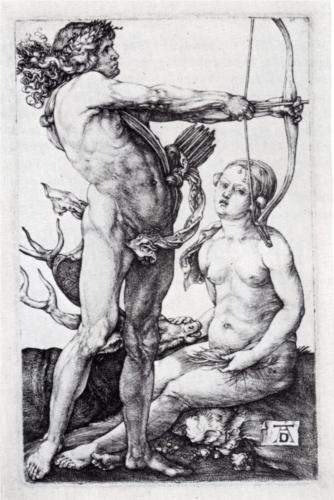
Albrecht Dûrer - "Apollo and Diana(" (1502)

Apollo and Diana (1502)

Albrecht Dürer

________

in the tradition of Elizabeth Barrett Browning,
a forthright, personal poem

a merely theoretical dilemma

yesterday, I had lunch with Vickie,
she said she admired our relationship,
despite the fact, which I’d interjected,
that there was no sex

she didn’t find that unacceptable

I found her concern more personal,
revealing, than strictly theoretical

then gave up the improbable
thought

I dream, however, ever, Apollo, and
irrepressibly, of your genitals,
knowing that your spawn would
transform me, ineradicably, into
a constellation, its crystallization
our progeny, into immortal stars

but that would mean leaving you,
Apollo, behind

could I, would I, do that

love

me

“I’ve Got a New Attitude”‏


as the Beatles once sang, Roll Over Beethoven

I’d been touching up my blog, specifically my
Elizabeth Barrett Brownings
, which WordPress
had to my dismay defaced, when one of my
submissions, the XXXlst, gave me the choice
of his Appassionata or Patti LaBelle, to
accompany me on the dishes, my ritual
homage to Sisyphean labour before the
limitless

both are electrifying

but I opted for a change, the effect of, maybe,
springtime, chose Patti, who’d awakened by
her very name a world of magical memories
for me, even inspiring me to find finally a
long lost friend, an ardent fan, then, of Patti

I looked for an appropriate, concert, length,
enough to finish my dishes, this is what I
found

I’ve been hooked on divas ever since

I hope you’re also enjoying them

Richard

psst: more Patti

“Miss Otis Regrets” (1934) – Cole Porter‏

while we’re on the subject of dramatic
monologue
s, here’s one, performed by
Fred Astaire, which splendidly illustrates
the intention

here’s Bette Midler doing it

and here’s more Bette, irrepressible, and
utterly irresistible, if you can stand it

or, as she would have it, the Divine,
and indeed, Miss M

just click

enjoy

Richard

psst: “Miss Otis Regrets”

Miss Otis regrets, she’s unable to lunch today, madam,
Miss Otis regrets, she’s unable to lunch today.
She is sorry to be delayed,
but last evening down in Lover’s Lane she strayed, madam,
Miss Otis regrets, she’s unable to lunch today.
When she woke up and found that her dream of love was gone, madam,
She ran to the man who had led her so far astray,
And from under her velvet gown,
She drew a gun and shot her love down, madam,
Miss Otis regrets, she’s unable to lunch today.
When the mob came and got her and dragged her from the jail, madam,
They strung her upon the old willow across the way,
And the moment before she died,
She lifted up her lovely head and cried, madam
Miss Otis regrets, she’s unable to lunch today

“Ambush at Five O’clock” – Stephen Dunn‏


from the New Yorker, February 3, 2014

Ambush at Five O’clock

We were by the hedge that separates our properties
when I asked our neighbors about their souls.
I said it with a smile, the way one asks such a thing.
They were somewhat like us, I thought, more
than middle-aged, less dull than most.
Yet they seemed to have no interest
in disputation, our favorite game,
or any of the great national pastimes
like gossip and stories of misfortunes
about people they disliked.

In spite of these differences, kindred
was a word we often felt and used.
The man was shy, though came to life
when he spotted an uncommon bird,
and the woman lively, sometimes even funny
about barometer readings and sudden dips
in pressure, the general state of things.
We liked their affection for each other
and for dogs. We went to their house;
they came to ours.

After I asked about their souls
they laughed and stumbled towards an answer,
then gave up, turned the question back
to me. And because I felt mine always was
in jeopardy I said it went to the movies
and hasn’t been seen since. I said gobbledy
and I said gook. I found myself needing
to fool around, avoid, stay away from myself.

But my wife said her soul suffered from neglect,
that she herself was often neglectful
of important things, but so was I.
Then she started to cry. What’s the matter? I asked.
What brought this on? She didn’t answer.
I felt ambushed, publicly insensitive
about something, whatever it was.

It was a dusky five o’clock, that time
in between one thing and another.
Our neighbors retreated to their home,
but the women returned
and without a word put her arms
around my wife as if a woman weeping
indicated something already understood
among women, that needn’t be voiced.
They held each other, rocked back and forth,

and I thought Jesus Christ, am I guilty again
of one of those small errors
I’ve repeated until it became large?
what about me? I thought. What about
the sadness of being stupid?
Why doesn’t her husband return
with maybe a beer and a knowing nod?

Stephen Dunn

____________

poetry is a conversation, of course, a poet
has with all the other poets who’ve come
before him, her, here Dunn is evidently
channelling Robert Browning, “This is
my last Duchess”,
Browning writes,
“painted on the wall / Looking as though
she were alive.”,
from his My Last
Duchess
“,
a poem I’ve never forgotten,
wherein the speaker discusses the
portrait of his earlier wife, one he’d
summarily purportedly got rid of

Robert Browning had learned his craft,
the dramatic monologue, from, of course,
Shakespeare, down to even its dramatic
content

Elizabeth meanwhile had been inspired
rather by Shakespeare’s sonnets, by his
thee, thy, thine, and thou’s

in Dunn the Browningian drama is
significantly less dour, nobody out and
out dies, though the dilemma is never
not existential, however less morally
compromised, less psychologically
and tragically fraught

neither does Dunn rhyme

but that just sends us back to Homer
of course, less epic, more, maybe,
middle class, very, and distinctively,
XXlst Century

but that’s how you read between the
lines, the verses, in this case, and
thus across the centuries

poetry is a conversation

Richard

on rhyme‏


commenting on his choice of idiom
in Paradise Lost, John Milton writes
the following

“The measure is English heroic verse without rime, as that of Homer in
Greek, and of Virgil in Latin—rime being no necessary adjunct or true
ornament of poem or good verse, in longer works especially, but the
invention of a barbarous age, to set off wretched matter and lame metre;
graced indeed since by the use of some famous modern poets, carried away
by custom, but much to their own vexation, hindrance, and constraint to
express many things otherwise, and for the most part worse, than else they
would have expressed them. Not without cause therefore some both Italian
and Spanish poets of prime note have rejected rime both in longer and
shorter works, as have also long since our best English tragedies, as a thing
of itself, to all judicious ears, trivial and of no true musical delight; which
consists only in apt numbers, fit quantity of syllables, and the sense variously
drawn out from one verse into another, not in the jingling sound of like
endings—a fault avoided by the learned ancients both in poetry and all good
oratory. This neglect then of rime so little is to be taken for a defect, though
it may seem so perhaps to vulgar readers, that it rather is to be esteemed an
example set, the first in English, of ancient liberty recovered to heroic poem
from the troublesome and modern bondage of riming.”

“Paradise Lost”: The Verse

John Milton

_______________

that’s of course his opinion, what do
you think

and what, thus, do you think poetry is,
not an especially easy question

Richard

“Edward Hopper and the House by the Railroad” (1925) – Edward Hirsch‏

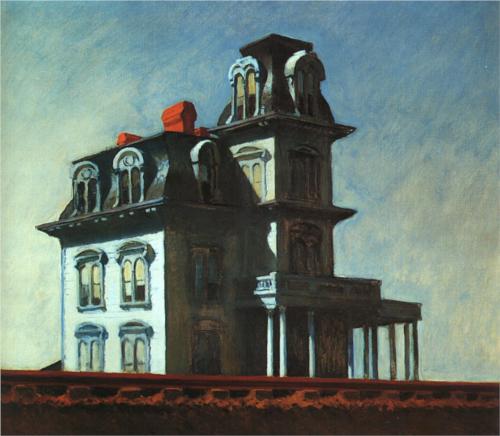
"House by the Railroad" (1925) - Edward Hopper

House by the Railroad (1925)

Edward Hopper

______

Edward Hopper and the House by the Railroad (1925)

Out here in the exact middle of the day,
This strange, gawky house has the expression
Of someone being stared at, someone holding
His breath underwater, hushed and expectant;

This house is ashamed of itself, ashamed
Of its fantastic mansard rooftop
And its pseudo-Gothic porch, ashamed
of its shoulders and large, awkward hands.

But the man behind the easel is relentless.
He is as brutal as sunlight, and believes
The house must have done something horrible
To the people who once lived here

Because now it is so desperately empty,
It must have done something to the sky
Because the sky, too, is utterly vacant
And devoid of meaning. There are no

Trees or shrubs anywhere–the house
Must have done something against the earth.
All that is present is a single pair of tracks
Straightening into the distance. No trains pass.

Now the stranger returns to this place daily
Until the house begins to suspect
That the man, too, is desolate, desolate
And even ashamed. Soon the house starts

To stare frankly at the man. And somehow
The empty white canvas slowly takes on
The expression of someone who is unnerved,
Someone holding his breath underwater.

And then one day the man simply disappears.
He is a last afternoon shadow moving
Across the tracks, making its way
Through the vast, darkening fields.

This man will paint other abandoned mansions,
And faded cafeteria windows, and poorly lettered
Storefronts on the edges of small towns.
Always they will have this same expression,

The utterly naked look of someone
Being stared at, someone American and gawky.
Someone who is about to be left alone
Again, and can no longer stand it.

Edward Hirsch

___________

Edward Hopper seems to have had
a profound influence on American
poets, this is the third poem around
one of his paintings I’ve encountered,
one by Joyce Carol Oates, a great lady
of not only poetry but of letters, having
been prolific in all literary forms, in each
nothing short of exemplary, another by
Brice Maiurro
, a budding poet of the
greatest, to my mind, merit, of whom
we will surely hear more if there is any
poetic justice

you can read about both of them right
here
in my blog, or just click their
individual names above

Edward Hirsch, by the way, stands
no less tall here, I submit, than the
other two in this coveted company

Richard

“good news from Ghent”‏

the only thing that rang in my ears ever
about Ghent until contemplating the van
Eyck Altarpiece was Robert Browning‘s
poem about it, “How They Brought the
Good News from Ghent to Aix
“, the
idea, like in his “Pheidippides“, of
dying valiantly for a cause had mightily
impressed me

that cause is incidental, of course,
dependent on the beliefs and situation
of that particular stalwart person

it might make you unforgettable, that
unfettered and irevocable devotion, as
it did for me, for instance, the heroes
of these two poems, such an exalted
mission is an ambition for lots of folks,
very much for a young boy, especially,
such as I was when I read these

Rose Valland rose indeed to the occasion
when it came to saving priceless art before
the onslaught of ruthless Naziism, wherein
the very van Eyck Altarpiece, and also even
Raphael‘s incandescent “Sistine Madonna“,
to my utter horror, from another, and opposite,
corner of Europe, Dresden, could’ve been
forever lost

but the “good news” was in kind returned
to Ghent, eventually, in this fascinating
documentary, “Hitler’s Museum: The Secret
History of Art Theft During World War II”,
part 1, part 2, just click, from its hiding place
in Altaussee, a mountain fortress in Austria

The Adoration of the Lamb” now resides in
its rightful Ghent, even more, after so fraught
a trek, a wonder

also returned to Dresden, incidentally, the
Sistine Madonna“, that city’s own defining
artwork

it is to be noted that a task force had been
set up by no less than the Americans to
save the purloined art of Europe in that
however fraught time

this hasn’t been at all the case in their
recent military forays, what do you gain,
I ask, if you lose your ideals, what exactly
do you conquer

Richard

psst: Browning‘s “news”, if you’re wondering,
was of the “Pacification of Ghent“, 1576